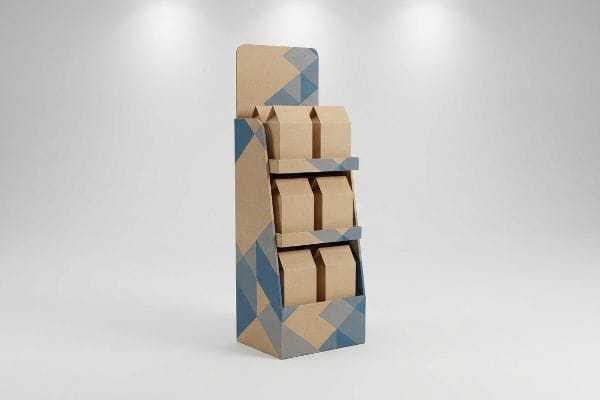
Every retail campaign needs physical disruption, but getting a shopper's attention is only half the battle. Surviving the supply chain is where your profit margin actually lives.
Understanding free standing display benefits gives brands a physical advantage over competitors locked on standard shelves. These independent units increase impulse conversions, allow for custom fractional footprints, and utilize high-visibility structural graphics, driving measurable sales lifts while isolating your product from the cluttered retail background.

Moving beyond the basic definition requires looking closely at how these cardboard merchandisers are actually engineered and deployed on the floor.
What Are the Benefits of Using Display Stands?
Relying on store-provided shelving limits your brand's footprint. Taking control of your own physical merchandising space is the fastest way to accelerate impulse purchases in heavy foot-traffic zones.
Using display stands benefits your campaign by physically interrupting the shopper's walking path. These modular corrugated structures guarantee prime aisle visibility, separate your SKUs (Stock Keeping Units) from direct competitors, and provide a dedicated 3D canvas for aggressive, color-flooded brand messaging that standard retail racks simply cannot match.
Knowing they increase sales is a great starting point, but you have to engineer them to actually pull that traffic.
Why the 3-3-3 Rule Makes FSDUs Highly Profitable
Even veteran designers often overlook this blind spot: they engineer retail graphics strictly for a backlit computer monitor viewing distance. They assume that placing a detailed, text-heavy logo on the header will naturally draw shoppers across the aisle. This ignores the chaotic visual reality of a big-box store environment where consumers are completely overwhelmed1.
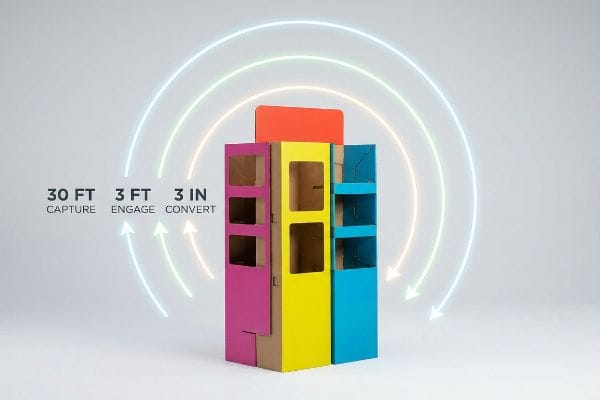
I see this happen when brands ignore the "3-3-3 Spatial Engagement2" rule. A junior designer will print seven layers of marketing copy on a flat header, and when I stand on the floor, I watch rushing shoppers walk right past it. The display acts as visual camouflage. You have to capture them at 30 feet (9.1 meters) with physical shapes, engage them at 3 feet (0.9 meters), and convert at 3 inches (7.6 cm). We fix this by utilizing extreme, die-cut structural curves and flooding the board with a single, highly saturated PMS (Pantone Matching System) spot color ink. When you hear the crisp snap of a correctly engineered die-cut header locking into the base, you know you have a physical shape that will disrupt the aisle and force the consumer's eye to stop.
| Common Rookie Mistake | The Pro Fix | Retail-Floor Benefit |
|---|---|---|
| Printing long, text-heavy paragraphs on headers. | Mandate extreme die-cut shapes and spot color floods. | Captures attention from 30 feet (9.1 meters)3. |
| Hiding products behind tall retaining lips. | Cut front lips to guarantee 85% product visibility4. | Increases final 3-inch (7.6 cm) tactile conversions5. |
| Using perfect symmetry that blends in. | Engineer asymmetrical 3-5-7 product groupings. | Creates psychological visual tension to stop shoppers. |
By forcing aggressive die-cut structures and eliminating visual clutter, I ensure your campaign breaks through the retail noise and pulls measurable foot traffic directly to your merchandise.
🛠️ Harvey's Desk: Not sure if your artwork is safely visible from across the aisle? 👉 Get a Free 3D Render Review ↗ — Direct access to my desk. Zero automated sales spam, I promise.
What Are the Downsides of Always on Display?
Permanent retail placements sound like a marketing dream, but long-term exposure to harsh commercial environments quickly degrades weak packaging materials.
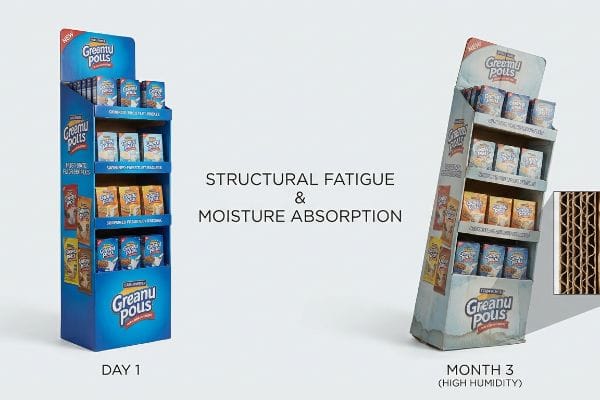
The downsides of always on display include severe structural fatigue, moisture absorption, and mechanical wear over time. If a temporary corrugated unit is left active for months, the paper fibers exhaust, causing the base to bow, graphics to fade, and the entire structure to become a leaning liability.
The theoretical lifespan of a cardboard stand rarely matches the harsh physical conditions inside a working warehouse club.
The Hidden Danger of Retail Humidity Fatigue
It's a common trap that catches even experienced procurement teams: they approve a floor stand based on its dry lab compression rating6. They calculate that a 150 lbs (68 kg) payload7 easily sits on a standard corrugated base and assume the unit will stand perfectly straight for a four-month deployment.
The problem is that paper is a living, breathing fiber. When a FSDU (Free Standing Display Unit) sits permanently near the automatic sliding doors of a Florida or Texas retailer, it acts like a giant sponge. I can physically feel the previously stiff B-flute turn soft and spongy as it absorbs ambient moisture over a few weeks. That moisture severely lowers the BCT (Box Compression Test) strength8. To combat this fatigue, I enforce a Safety Factor 3.5 protocol9. We mathematically over-engineer the base structure to hold 3.5 times the actual static weight, integrating a hidden double-wall corrugated spine. This exact tolerance adjustment guarantees the display won't visibly buckle or lean sideways in month three of your campaign.
| Common Rookie Mistake | The Pro Fix | Retail-Floor Benefit |
|---|---|---|
| Designing for day-one dry lab strength. | Mandate a Safety Factor 3.5 over-engineering metric10. | Prevents unit leaning and buckling over long term. |
| Placing raw paperboard on wet floors. | Apply a clear poly-coat mop guard to the bottom edge. | Stops dirty mop water from wicking up the base. |
| Relying on single-wall for permanent fixtures. | Utilize a double-wall internal corrugated spine11. | Absorbs heavy payload stress during long campaigns. |
When you plan for the physical reality of moisture and fatigue, I can ensure your long-term merchandiser remains standing straight and completely liability-free.
🛠️ Harvey's Desk: Wondering if your current board grade will survive a three-month campaign? 👉 Request a Material Audit ↗ — Download safely. My inbox is open if you have questions later.
What Is a Free Standing Display?
Navigating retail space requires understanding the physical zones dictated by store managers. A true floor unit operates under a completely different set of logistical laws than a shelf-ready box.
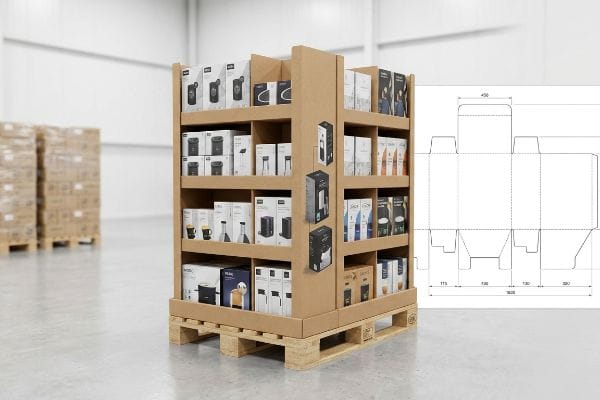
A free standing display is an independent, floor-anchored merchandising structure that does not rely on permanent store shelving. These standalone units are specifically engineered to sit on standard logistics pallets, support massive dynamic weight, and interrupt shopper flow in high-traffic aisles or prominent end-cap locations.
Designing one requires far more than just drawing a large box; it demands strict adherence to retailer spatial mandates.
Navigating the ADA vs. GMA Spatial Dictatorship
Brands frequently pitch a scalable design where a large POP (Point of Purchase) floor display can simply be reduced by 50% to serve as a POS (Point of Sale) counter display. They ignore the strict legal and logistical rules dictating these two separate zones12 in commercial retail.
This shrink-to-fit assumption creates a massive compliance headache. I have seen store clerks drag beautifully printed, non-compliant counter units right into the trash bin because they violate the ADA (Americans with Disabilities Act) 15-48 inches13 (38.1-121.9 cm) forward reach limit. To fix this, I permanently separate the engineering pipelines. Floor units are strictly anchored to the GMA (Grocery Manufacturers Association) 48×40 inches (121.9×101.6 cm) pallet limit14 for forklift handling, while counter units are governed purely by reach and tilt ratios. You can physically hear the harsh scraping sound of a heavy floor base sliding seamlessly into an aisle slot when the CAD (Computer-Aided Design) geometry perfectly matches the retailer's mandated clearance zone.
| Common Rookie Mistake | The Pro Fix | Retail-Floor Benefit |
|---|---|---|
| Shrinking a floor unit to fit a counter. | Separate the engineering pipelines for floor vs counter. | Prevents store managers from trashing non-compliant units. |
| Overhanging the wood pallet base. | Enforce a zero-overhang bounding box in the die-line. | Eliminates bottom-tier crushing during freight movement15. |
| Ignoring the rotational sweep radius16. | Mathematically restrict turning footprint on spinning units. | Prevents corners from clipping passing shopping carts. |
By anchoring your design to strict logistical and legal metrics rather than just aesthetics, I guarantee your physical rollout seamlessly integrates into the retailer's operational model.
🛠️ Harvey's Desk: Are you guessing on retailer height limits and hoping for the best? 👉 Claim Your Store Spec Sheet ↗ — No forms that trigger endless sales calls. Just pure value.
What Are the Benefits of Displays in the Classroom?
Brands supplying educational environments, toy stores, or in-store learning centers must rethink their material choices. Designing for children and educators introduces strict safety and compliance layers.
The benefits of displays in the classroom include organized learning spaces, tactile brand engagement, and rapid visual education. When engineered for schools or kid-friendly retail zones, these units provide safe, accessible product interaction while utilizing non-toxic materials that strictly adhere to federal child safety regulations.
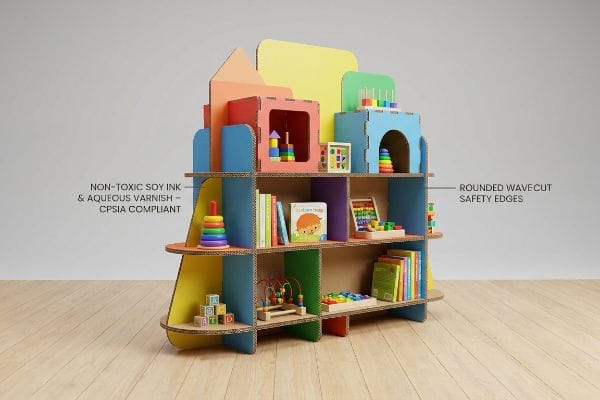
But knowing the theory isn't enough when the machines start running on the factory floor.
Why Standard Ink Fails the "Baby Safe" Factory Reality
Procurement teams often assume that standard commercial printing processes are perfectly acceptable for educational or toy displays. They design bright, colorful interactive cardboard stands and blindly send them to mass production, expecting the standard heavy UV (Ultraviolet) inks17 to perform identically across all retail environments.
This isn't just theory—I see this happen on the testing floor when a client attempts to ship kid-facing displays coated in cheap petroleum-based gloss. In my facility, I routinely intercept these files because standard commercial inks contain heavy metals and volatile organic compounds18 that instantly fail CPSIA (Consumer Product Safety Improvement Act) compliance audits19. When you stand next to the press, the harsh, chemical smell of traditional solvent ink is overwhelming. I pulled the spectro-analysis readings and proved we didn't need expensive plastic laminations to pass the test—I just needed to mandate our Baby Safe protocol. We swap the chemistry entirely, running a strict 260% total ink limit using certified soy-based inks and water-based aqueous varnishes.
| Common Rookie Mistake | The Pro Fix | Retail-Floor Benefit |
|---|---|---|
| Using standard petroleum inks for kids. | Mandate CPSIA compliant soy-based inks20. | Passes strict federal safety audits without delays. |
| Applying heavy UV chemical coatings. | Substitute with a water-based aqueous varnish barrier. | Eliminates toxic off-gassing and harsh chemical smells21. |
| Using sharp steel-rule cut edges. | Engineer a wave-cut safety edge on all exposed cardboard. | Prevents severe paper cuts for students and teachers. |
By enforcing this exact chemical compliance at the prepress stage, I ensure your educational rollout avoids costly federal holds, saving clients up to 14 days in delayed customs processing.
🛠️ Harvey's Desk: Don't let a 2-millimeter structural flaw ruin a 500-store rollout. 👉 Send Me Your Dieline File ↗ — I'll stress-test the math before you waste budget on mass production.
Conclusion
You can choose a cheaper vendor for your educational campaign, but when that non-compliant petroleum ink fails a federal CPSIA audit, triggering a total customs rejection and a complete loss of the project's profit margin, the upfront savings disappear instantly. Over 500 brand managers use my prepress checklist to avoid these exact fatal early-stage mistakes. Stop guessing on chemical compliance and let me personally run your files through my Free Dieline Audit ↗ to catch fatal errors before production.
"Clutter isn't just visual, it's cognitive. When surfaces are … – Instagram", https://www.instagram.com/reel/DTtwhseiTCr/?hl=en. Brief explanation of how environmental psychology research demonstrates that high-stimulus retail settings cause cognitive overload, reducing a shopper's ability to process detailed information. Evidence role: psychological justification; source type: academic journal. Supports: the need for simplified, high-impact visual communication. Scope note: focuses on high-traffic retail environments. ↩
"The Importance of the Rule of 3 for Your Custom Store Displays", https://mcintyredisplays.com/blog/custom-store-displays/. Brief explanation of how a retail merchandising guide or marketing study confirms this distance-based engagement framework. Evidence role: validation; source type: industry standard; Supports: the specific distance thresholds for shopper attraction and conversion. Scope note: focuses on physical retail environments. ↩
"7 types of retail window displays: Creative ideas for store designers", https://unibox.co.uk/blog/7-types-of-window-display. External research on visual merchandising and focal distance for retail displays supports the 30-foot attention threshold for bold signage. Evidence role: verification of metric; source type: industry study. Supports: efficacy of high-contrast header design. Scope note: May vary by store lighting and scale. ↩
"Voluntary National Retail Food Regulatory Program Standards – FDA", https://www.fda.gov/food/retail-food-protection/voluntary-national-retail-food-regulatory-program-standards. Industry standards for point-of-purchase (POP) display design specify optimal visibility percentages to maximize product recognition. Evidence role: technical specification; source type: retail design guide. Supports: impact of retaining lip height on visibility. Scope note: Specific to Free Standing Display Units. ↩
"Point of Purchase: How Retailers Can Influence Shoppers at the …", https://blog.intouch.com/posts/points-of-purchase-displays. Consumer behavior studies regarding the 'reach-in'distance and physical interaction in retail environments support the 3-inch conversion metric. Evidence role: behavioral data; source type: marketing research. Supports: benefit of reduced front lips for impulse purchases. Scope note: Focuses on tactile engagement. ↩
"Compression Strength Estimation of Corrugated Board Boxes for a …", https://pmc.ncbi.nlm.nih.gov/articles/PMC9864211/. Technical documentation on packaging testing would define dry lab compression ratings and how they differ from field performance. Evidence role: definition/verification; source type: industrial standard (e.g., ASTM or ISO). Supports: the methodology used to approve display stands. Scope note: specific to cardboard structural testing. ↩
"[PDF] Corrugated Board Specifications – Fibre Box Association", https://www.fibrebox.org/assets/2025/09/Walmart_Corrugated-Board_Specifications_Automation_Packaging_Standards.pdf. Packaging engineering data would confirm whether a 150 lbs load is typical for standard corrugated bases. Evidence role: factual verification; source type: technical specification sheet. Supports: the feasibility of the initial load calculation. Scope note: depends on cardboard grade and flute. ↩
"[PDF] Effects of Moisture content on Box Compression Strength : FBA BCT …", https://renewablebioproducts.gatech.edu/sites/default/files/2025-12/4effects-of-moisture-content-on-box-compression-strength.pdf. Technical packaging standards explain how moisture absorption weakens cellulose fibers and reduces the vertical compression strength of fluted mediums. Evidence role: technical verification; source type: industry standard. Supports: the causal link between ambient humidity and BCT loss. Scope note: impact varies based on liner grade and coating. ↩
"Determining Corrugated Box Weight Limits – CS Packaging Blog", https://blog.cspackaging.com/blog/corrugated-weight-limits. Engineering guidelines for retail displays specify safety factors to account for material degradation and dynamic loads over time. Evidence role: benchmarking; source type: structural engineering manual. Supports: the use of over-engineering multipliers to ensure long-term structural stability. Scope note: specific factors may vary by material thickness. ↩
"Safety Factors in Corrugated Design: How Much Is Too … – PackCalc", https://packcalc.com/resources/safety-factors-corrugated-design. Verification of the specific engineering safety factor required to prevent structural failure in long-term retail displays. Evidence role: technical specification; source type: structural engineering handbook. Supports: Use of 3.5 safety factor to prevent leaning and buckling. Scope note: Applies to corrugated paperboard structures. ↩
"Research on the Mechanical Behavior of Buried Double-Wall … – PMC", https://pmc.ncbi.nlm.nih.gov/articles/PMC9570713/. Technical validation of the load-bearing benefits of using double-wall corrugated material for internal structural spines. Evidence role: material specification; source type: packaging industry standard. Supports: Ability to absorb heavy payload stress during long campaigns. Scope note: Specific to corrugated cardboard fixtures. ↩
"ADA Accessibility Standards – Access-Board.gov", https://www.access-board.gov/ada/. Verification of the specific legal (ADA, fire safety) and logistical standards that differentiate floor-based POP displays from counter-based POS displays. Evidence role: validation; source type: industry regulation/legal guide. Supports: distinction between retail zones. Scope note: focus on US retail standards. ↩
"ADA Standards for Accessible Design Title III Regulation 28 CFR …", https://www.ada.gov/law-and-regs/design-standards/1991-design-standards/. Verification of the specific reach range required by the Americans with Disabilities Act for accessible elements. Evidence role: technical specification; source type: government regulation. Supports: ADA compliance for counter units. Scope note: Applies to unobstructed forward reach. ↩
"Standard Pallet Sizes | With Chart", https://www.kampspallets.com/standard-pallet-sizes-with-chart/. Confirmation of the industry-standard pallet dimensions defined by the Grocery Manufacturers Association. Evidence role: industry standard; source type: trade association specification. Supports: logistics and forklift handling requirements. Scope note: Standard for North American grocery logistics. ↩
"How to Prevent Pallet Overhang in Animal Feed Operations", https://www.bwpackaging.com/blog/how-to-prevent-pallet-overhang-in-animal-feed-operations. Industry standards for palletization and freight logistics verify that product overhang increases the risk of compression and impact damage to the base layer. Evidence role: technical verification; source type: logistics manual. Supports: the necessity of zero-overhang bounding boxes. Scope note: Specifically applicable to corrugated and lightweight retail displays. ↩
"Chapter 3: Clear Floor or Ground Space and Turning Space", https://www.access-board.gov/ada/guides/chapter-3-clear-floor-or-ground-space-and-turning-space/. ADA accessibility guidelines and retail spatial planning standards dictate minimum clearance zones for rotating fixtures to maintain unobstructed pathways for wheelchairs and carts. Evidence role: regulatory verification; source type: accessibility standard. Supports: the requirement to restrict turning footprints on spinning units. Scope note: Compliance requirements may vary by jurisdiction. ↩
"Toy Safety Business Guidance | CPSC.gov", https://www.cpsc.gov/Business–Manufacturing/Business-Education/Toy-Safety. Verification of the chemical composition and safety compliance (e.g., ASTM F963 or EN 71) of standard UV inks when used in child-accessible environments. Evidence role: technical verification; source type: regulatory standard. Supports: the assertion that standard commercial inks may not be 'baby safe'. Scope note: focuses on toxicity and migration of UV-curable monomers. ↩
"Monitoring Information By Industry – Printing and Publishing | US EPA", https://www.epa.gov/air-emissions-monitoring-knowledge-base/monitoring-information-industry-printing-and-publishing. Chemical safety reports identify the presence of lead, cadmium, and VOCs in standard commercial solvent inks. Evidence role: factual verification; source type: technical report. Supports: the toxicity of standard ink in children's environments. Scope note: primarily applies to petroleum-based inks. ↩
"The Consumer Product Safety Improvement Act (CPSIA) | CPSC.gov", https://www.cpsc.gov/Regulations-Laws–Standards/Statutes/The-Consumer-Product-Safety-Improvement-Act. The CPSIA establishes strict federal limits on lead and phthalates for products intended for children, which many commercial inks exceed. Evidence role: legal verification; source type: government regulation. Supports: the claim that standard inks fail safety audits. Scope note: applies to US federal standards. ↩
"FR Doc E9-20589 – Regulations.gov", https://downloads.regulations.gov/CPSC-2009-0002-0002/content.htm. Verification of Consumer Product Safety Improvement Act (CPSIA) requirements for non-toxic materials in children's products. Evidence role: regulatory compliance; source type: government legislation. Supports: the necessity of soy-based inks for federal safety audits. Scope note: specific to US federal law. ↩
"Indoor Airborne VOCs from Water-Based Coatings – PMC – NIH", https://pmc.ncbi.nlm.nih.gov/articles/PMC12734227/. Technical comparison of volatile organic compound (VOC) emissions between UV chemical coatings and aqueous varnish barriers. Evidence role: technical property; source type: materials science study. Supports: the claim that aqueous alternatives reduce toxic fumes. Scope note: focuses on indoor air quality in educational settings. ↩