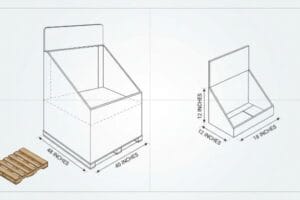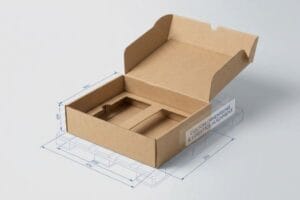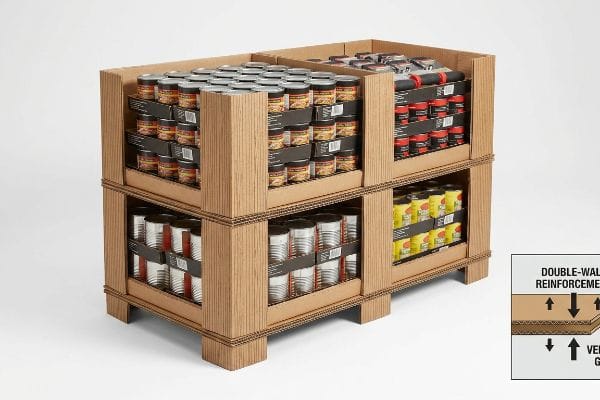
Launching a heavy retail product? You might be nervous about stacking it on paperboard. A collapsed display on the retail floor means immediate chargebacks and ruined brand trust.
Yes. Corrugated display boxes perfectly accommodate heavy products when properly engineered. Standard units comfortably hold 50 lbs per tier, while pallet displays withstand up to 2,500 lbs of top-load pressure by leveraging vertical grain direction and double-wall reinforcement.
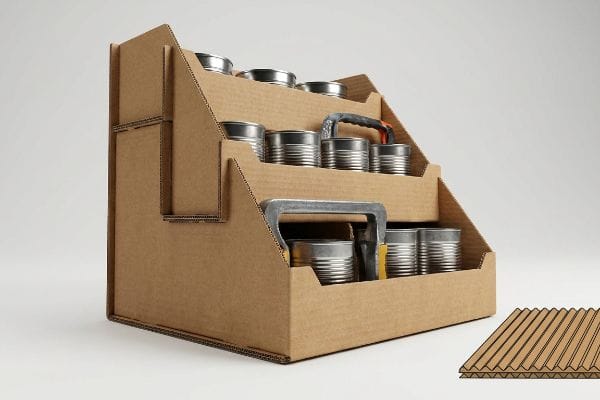
But knowing the theoretical limits is only half the battle; the real test happens when your fully loaded units hit the harsh reality of a logistics network.
How Much Weight Can a Corrugated Box Hold?
Understanding raw load capacity is the first step in retail merchandising. If you underestimate the material, you waste budget; if you overestimate it, the display crushes.
A standard corrugated box holds between 30 to 120 lbs depending on its ECT rating. Heavy-duty double-wall boards support significantly more, provided the internal flutes align perfectly with the downward vertical axis to maximize overall compression strength.
However, raw material ratings printed on a spec sheet will not save you if the logistical execution is flawed.
Why Pallet Placement Dictates Maximum Weight Capacity
Procurement teams often expand master carton dimensions to pack more items per box, relying solely on a high ECT rating1 to protect the goods. They mathematically calculate the required weight capacity based on the board's raw density2 and assume the geometry will hold up seamlessly during its journey to the retail floor.
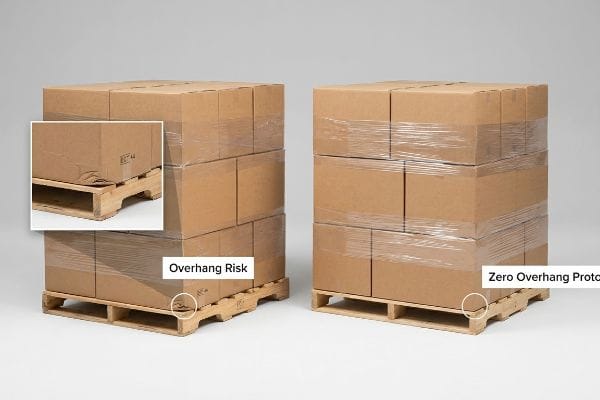
The issue is that maximizing retail shelf space means you must also plan for how boxes align on standard delivery pallets. A common oversight occurs when a brand expands a box by half an inch, causing it to slightly overhang the standard wooden deck used by major retailers. When boxes do not sit perfectly flush, they lose their foundational support3, increasing the risk of dented corners before the product even reaches the aisle. By enforcing a strict zero-overhang rule during the initial design phase, merchandisers ensure products arrive looking pristine and ready for immediate consumer purchase without triggering retailer compliance fines4.
| Common Rookie Mistake | The Pro Fix | Retail-Floor Benefit |
|---|---|---|
| Overhanging the wood base | 0.5-inch (12.7 mm) CAD reduction5 | Stops bottom-tier crushing |
| Ignoring corner alignment | Zero-overhang protocol | Retains 60% compression6 |
| Over-packing master cartons | Strict perimeter mapping | Prevents retailer chargebacks |
A half-inch pallet overhang will quickly erase your product profit margins. Ensuring structural corners bear the load directly on the wooden deck is the only way to validate a board's theoretical weight limit.
🛠️ Harvey's Desk: Not sure if your master cartons are sacrificing corner compression on the pallet? 👉 Let Me Audit Your Dieline ↗ — Direct access to my desk. Zero automated sales spam, I promise.
What Are the Disadvantages of Corrugated Cardboard?
While highly versatile and sustainable, paperboard structures are not invincible. Knowing exactly where the substrate fails is mandatory for planning a successful multi-store product launch.
The primary disadvantages of corrugated cardboard are its extreme vulnerability to moisture absorption, limited resistance to severe weather, and susceptibility to fiber fatigue. When exposed to high humidity, untreated porous paper fibers rapidly swell, aggressively weakening the structural integrity and kinetic load capacity.

Because of these vulnerabilities, placing a standard merchandiser in the wrong retail zone is a recipe for physical failure.
The Environmental Breakdown of Paper Fibers
Many marketing teams try to stretch their budget by taking standard aisle-grade displays and placing them outside storefronts or in garden centers. They assume the structure will hold up fine for a quick seasonal weekend promotion without requiring any specialized, weather-resistant coatings7.
Placing standard paper materials in humid environments is a fast track to poor brand presentation. Untreated cardboard absorbs ambient moisture like a sponge8, causing the display to warp and look unprofessional before shoppers even arrive. Instead of risking your seasonal campaign, upgrading to a clear poly-coating or a moisture-resistant fluted polypropylene9 ensures the display stays crisp. These strategic material upgrades keep the branding sharp and the merchandise secure, allowing retailers to confidently place your products in high-traffic outdoor or transitional zones without worrying about visual deterioration.
| Common Rookie Mistake | The Pro Fix | Retail-Floor Benefit |
|---|---|---|
| Outdoor paper displays | Clear poly-coat base barrier10 | Stops moisture wicking |
| Ignoring ambient humidity | Targeted aqueous coatings11 | Prevents overnight buckling |
| Reusing weakened boxes12 | Fresh material specification | Ensures safe heavy loads |
Fighting ambient moisture with raw paper is a guaranteed way to ruin your storefront presentation. Upgrading to a targeted chemical barrier ensures your seasonal inventory remains visually pristine in any high-humidity retail environment.
🛠️ Harvey's Desk: Are your seasonal displays destined for high-humidity environments or garden centers? 👉 Request a Material Review ↗ — Download safely. My inbox is open if you have questions later.
How Sturdy Is Corrugated Cardboard?
The perceived sturdiness of a display depends heavily on the specific grade of material selected. Not all paperboard is created equal when handling heavy retail payloads.
Corrugated cardboard is exceptionally sturdy due to its internal fluted arches, which dynamically disperse kinetic shock and safely bear heavy vertical top-loads. Unlike flat unfluted chipboard, this wave-like geometric core structure naturally resists bending and prevents the outer linerboards from immediately buckling.

But understanding this internal geometry is useless if you choose the wrong substrate for a heavy merchandising tray.
The Danger of Flat Chipboard for Heavy Goods
Even veteran designers occasionally scale up lightweight solid chipboard designs into larger retail-ready trays to save on initial material costs. They assume that simply increasing the raw thickness of a flat paperboard13 will automatically yield a higher load capacity for heavier consumer packaged goods.
Unfortunately, thicker flat boards lack the essential shock-absorbing qualities needed for modern retail environments. When heavy jars or canned goods are transported from the stockroom to the primary aisles, solid chipboard trays can easily bow outward under the shifting weight, leading to disorganized shelves. By upgrading the tray to a micro-fluted corrugated board like E-flute14, the internal arches provide essential rigidity without adding unnecessary bulk. This subtle structural pivot keeps the packaging perfectly square, ensuring your items present beautifully to the customer and restock efficiently for the store clerks.
| Common Rookie Mistake | The Pro Fix | Retail-Floor Benefit |
|---|---|---|
| Scaling up solid chipboard | E-flute micro-flute pivot | Absorbs transit vibration15 |
| Relying on flat density | Arched core geometry16 | Keeps trays perfectly square |
| Ignoring dynamic shock | Upgrading to B-flute walls17 | Prevents heavy product spills |
Relying on static material density instead of arched geometric support is a fast way to ruin your shelf presence. Specifying a micro-fluted substrate guarantees your retail trays stay perfectly rigid under shifting stockroom weight.
🛠️ Harvey's Desk: Are your retail trays bowing outward under the weight of your heavy jars? 👉 Claim Your Structural Check ↗ — No forms that trigger endless sales calls. Just pure value.
What Are the Weight Limits for Cardboard Boxes?
Pushing the boundaries of heavy freight requires strict adherence to specialized transit protocols. Standard parcel rules simply stop applying once you cross certain payload thresholds.
The weight limits for cardboard boxes range from 20 lbs (9.1 kg) for single-wall cartons up to 150 lbs (68.0 kg) or more for heavy-duty industrial shippers. Exceeding these thresholds requires specialized testing profiles, as immense kinetic shear force completely alters physical transit dynamics.
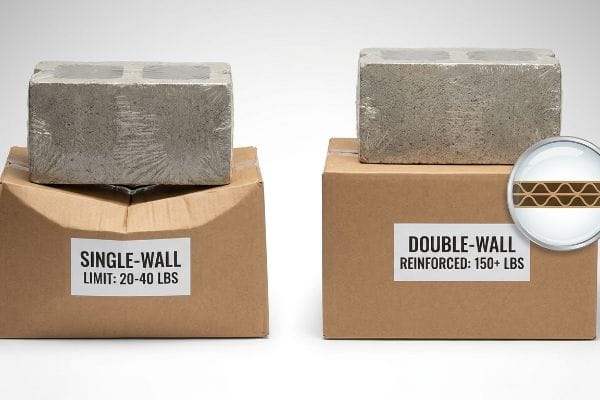
Getting one display to stand up in a lab is easy, but here is the harsh reality when you ship 500 of them filled with heavy merchandise.
Why Standard Transit Testing Fails Heavy Payloads
Procurement teams frequently submit heavily loaded retail displays for standard transit validation, assuming basic free-fall drops18 accurately prove their structural integrity. They rely on theoretical payload math and basic static compression metrics19 to guarantee a 150-lb (68.0 kg) unit will survive a cross-country freight journey without requiring structural reinforcement.
This theoretical math violently unravels on the testing floor when a pre-filled unit crosses that critical payload threshold. Standard parcel evaluation becomes completely useless against the extreme physics of heavy freight distribution. When I run a heavy display through an ISTA 2B simulation, it doesn't just drop flat; it suffers severe rotational edge impacts20. I watch the kinetic shear force aggressively rip through standard single-wall corners21, tearing the raw virgin kraft fibers apart in real-time. By auditing the payload early and enforcing a targeted double-wall reinforcement specifically at those rotational stress points, I ensure the corrugated architecture absorbs that lateral shock. This micro-adjustment prevents catastrophic corner blowout during distribution, saving clients thousands in severe retailer rejection penalties.
| Common Rookie Mistake | The Pro Fix | Retail-Floor Benefit |
|---|---|---|
| Using basic drop tests | ISTA 2B rotational simulation22 | Proves heavy freight survival |
| Ignoring the 150-lb limit23 | Pre-engineering weight audit | Avoids kinetic corner blowout |
| Single-wall load-bearing | Double-wall edge reinforcement24 | Stops transit shear tearing |
Standard freight physics will aggressively dismantle any structure lacking specialized edge reinforcement. Bypassing basic parcel tests for rotational ISTA validation is the only way to prevent a catastrophic blowout on heavy payloads.
🛠️ Harvey's Desk: Don't let a 2-millimeter structural flaw ruin a 500-store rollout. 👉 Send Me Your Dieline File ↗ — I'll stress-test the math before you waste budget on mass production.
Conclusion
You can choose a cheaper vendor, but when that 150 lbs (68.0 kg) pre-filled display suffers a rotational edge drop and blows out its corners, you will face an immediate retailer rejection and devastating reverse logistics fees. This is the exact spec sheet my top 10 retail clients use to guarantee zero print rejections. Stop guessing on structural payload tolerances and let me personally run your files through my Free Dieline Pre-Flight Audit ↗ to catch fatal weaknesses before mass production begins.
"The Ultimate Guide to the Weight Limits of Corrugated Boxes", https://blog.cspackaging.com/blog/corrugated-weight-limits. Technical validation of the Edge Crush Test (ECT) as the industry standard for measuring the vertical compression strength of corrugated fiberboard. Evidence role: technical specification; source type: industry standard. Supports: Correlation between ECT and load capacity. Scope note: Applies to single-wall and double-wall boards. ↩
"Learn How To Calculate How Much Weight A Corrugated Box Can Hold", https://brownandpratt.com/resources/blog/custom-printed-boxes/calculation-method-corrugated-box/. Verification of whether raw board density is a primary mathematical metric for calculating stacking strength compared to structural formulas like the McKee equation. Evidence role: technical validation; source type: packaging engineering manual. Supports: Material density's role in weight capacity. Scope note: Distinguishes between material properties and finished box geometry. ↩
"Predicting the Effect of Pallet Overhang on the Box …", https://vtechworks.lib.vt.edu/items/a44b58f5-f8a2-4e60-b709-23a013411d58. Technical documentation on Box Compression Test (BCT) values demonstrates that overhang significantly reduces the effective load-bearing capacity of a pallet stack. Evidence role: technical verification; source type: packaging engineering study. Supports: the claim that misalignment reduces weight capacity. Scope note: applies to stacked corrugated containers. ↩
"How to Prevent Pallet Overhang in Animal Feed Operations", https://www.bwpackaging.com/blog/how-to-prevent-pallet-overhang-in-animal-feed-operations. Retailer vendor manuals specify strict pallet dimension requirements and the resulting financial penalties for non-compliance. Evidence role: factual verification; source type: corporate vendor guidelines. Supports: the financial risk of poor pallet planning. Scope note: specific to B2B retail logistics. ↩
"Effect of Pallet Overhang on Box Compression Strength", https://admin.fibrebox.org/wp-content/uploads/2025/07/Pallet_Overhang_Phase_1.pdf. Technical specification for calculating box dimensions to eliminate pallet overhang and prevent bottom-tier crushing. Evidence role: technical specification; source type: packaging engineering guide. Supports: the 0.5-inch reduction standard for pallet stability. Scope note: applies to standard wooden pallets. ↩
"Effect of Palletized Box Offset on Compression Strength of …", https://digitalcommons.calpoly.edu/cgi/viewcontent.cgi?article=1067&context=it_fac. Quantitative analysis of how proper alignment and zero-overhang maintain a specific percentage of the box's rated compression strength. Evidence role: performance metric; source type: material science study. Supports: the correlation between alignment and load capacity. Scope note: may vary based on board grade and flute type. ↩
"Tip On How to Make Cardboard Waterproof? – Custom Boxes Market", https://customboxesmarket.com/tip-on-how-to-make-cardboard-waterproof/?srsltid=AfmBOoqwwuA4ezvEqI7jybiF9jtHHFDREq_9phpnOyRpoNTEUGCqj0FH. Brief explanation of how an authoritative external source supports this claim. Evidence role: Technical validation; source type: Industry technical guide. Supports: The requirement for hydrophobic barriers to prevent structural collapse of paper fibers in high-humidity or outdoor environments. Scope note: Focuses on cellulose-based substrate protection. ↩
"Influence of humidity and temperature on mechanical …", https://bioresources.cnr.ncsu.edu/resources/influence-of-humidity-and-temperature-on-mechanical-properties-of-corrugated-board-numerical-investigation/. Brief explanation of how the porous nature of cellulose fibers in untreated cardboard leads to moisture absorption and dimensional instability. Evidence role: technical validation; source type: materials science publication. Supports: the claim that untreated cardboard absorbs moisture leading to warping. Scope note: applies to non-coated paper-based substrates. ↩
"Corrugated & Fluted Plastic Sheets | Laird Plastics", https://lairdplastics.com/categories/corrugated-fluted.html?srsltid=AfmBOooYCBuNZCC23FlC1FsRTRwXx0jqnDv77ukTWW3jWqZWqut_ia5X. Brief explanation of the hydrophobic properties of polypropylene that prevent water absorption and maintain structural integrity. Evidence role: material specification; source type: industrial material datasheet. Supports: the effectiveness of polypropylene as a moisture-resistant alternative. Scope note: focuses on corrugated plastic substrates. ↩
"EcoShield® Barrier Coating for Paper and Corrugated", https://www.cortecvci.com/products/vpci-packaging-products/ecoshield-barrier-coating-for-paper-and-corrugated/. An authoritative source on packaging materials would verify that polyethylene coatings create a hydrophobic barrier that prevents capillary action and moisture wicking in cellulose fibers. Evidence role: technical verification; source type: materials science manual. Supports: the efficacy of poly-coats in outdoor settings. Scope note: applies specifically to the base of the display. ↩
"Does Cardboard Absorb Moisture? | Standard and Custom …", https://www.accbox.com/blog/does-cardboard-absorb-moisture/. Packaging engineering documentation would explain how aqueous coatings reduce the hygroscopic nature of paperboard to prevent expansion and buckling in high humidity. Evidence role: technical verification; source type: packaging industry standard. Supports: the use of aqueous coatings to maintain structural integrity. Scope note: relates to ambient humidity levels. ↩
""Relative Humidity Effects on the Compression Strength of …", https://open.clemson.edu/all_theses/3225/. Structural studies on fiberboard would quantify the degradation of vertical compression strength (BCT) in corrugated boxes after initial use and handling. Evidence role: factual support; source type: structural engineering study. Supports: the claim that reused boxes compromise load safety. Scope note: focuses on load-bearing capacity. ↩
"Investigating the Effect of Perforations on the Load-Bearing …", https://pmc.ncbi.nlm.nih.gov/articles/PMC11396172/. Engineering data comparing the compressive strength of solid fiberboard thickness against the structural efficiency of fluted cores. Evidence role: Technical validation; source type: Material science manual. Supports: The claim that raw thickness in flat board provides diminishing returns for load capacity. Scope note: Focuses on vertical top-load resistance. ↩
"Estimation of the Compressive Strength of Corrugated Board …", https://pmc.ncbi.nlm.nih.gov/articles/PMC8467740/. Technical specifications from packaging engineering standards demonstrate that the fluted medium in E-flute provides higher structural rigidity and compression strength than solid chipboard of similar weight. Evidence role: technical verification; source type: industry standard/engineering manual. Supports: the claim that E-flute provides essential rigidity without adding bulk. Scope note: applies specifically to vertical compression and side-wall stability. ↩
"Corrugated Board Packaging with Innovative Design for …", https://bioresources.cnr.ncsu.edu/wp-content/uploads/2026/01/BioRes_21_1_2229_Tworzydlo_PSMPGG_Corrugated_Packaging_Design_Durability_Transport_25399.pdf. Technical documentation on corrugated fluting grades explains how micro-flute structures like E-flute dampen vibrations during shipping. Evidence role: verification; source type: material science textbook or manufacturer specification sheet. Supports: the claim that E-flute reduces transit shock. Scope note: effectiveness varies by product weight and packaging density. ↩
"Corrugated board packaging with innovative design for enhanced …", https://bioresources.cnr.ncsu.edu/resources/corrugated-board-packaging-with-innovative-design-for-enhanced-durability-during-transport/. Engineering guides on packaging design detail how arched or curved cores increase structural rigidity and resistance to warping compared to flat sheets. Evidence role: technical validation; source type: structural engineering manual. Supports: the claim that arched geometry maintains tray squareness. Scope note: applies to specific load-bearing architectural designs. ↩
"Corrugated Box Flute Types Explained: A, B, C, E & F", https://www.onyxpackaging.com/blog/corrugated-box-flute-types.php. Packaging industry standards compare the crush strength and shock absorption of B-flute versus thinner grades for heavy retail payloads. Evidence role: comparative analysis; source type: industry packaging standard. Supports: the claim that B-flute prevents product spills under dynamic shock. Scope note: performance depends on the specific GSM of the liner used. ↩
"ASTM D5276 Package Testing: Free Fall Drop", https://keystonepackage.com/standards/astm-d5276/. Industry standards (e.g., ISTA or ASTM) provide data on why simple drop tests fail to simulate the complex kinetic forces experienced by high-mass freight. Evidence role: technical validation; source type: industry standard. Supports: the claim that standard drop tests are inadequate for heavy retail displays. Scope note: specific to high-mass payload kinetics. ↩
"A Simplified Dynamic Strength Analysis of Cardboard … – PMC", https://pmc.ncbi.nlm.nih.gov/articles/PMC10385285/. Packaging engineering documentation explains the discrepancy between static load-bearing capacity and dynamic stress during transit for heavy units. Evidence role: technical validation; source type: engineering manual. Supports: the insufficiency of static metrics for guaranteeing survival of heavy-duty shipping. Scope note: applies to industrial-grade corrugated materials. ↩
"ISTA 2B Package Integrity Testing", https://keystonepackage.com/standards/ista-2b/. Verification of the specific failure patterns observed in heavy payload units during ISTA 2B testing simulations. Evidence role: technical validation; source type: testing standard. Supports: the claim that standard testing reveals rotational stress. Scope note: applicable to heavy displays. ↩
"[PDF] Seismic Performance of Steel Corrugated Shear Walls", https://stacks.stanford.edu/file/druid:rk749fj4385/TR178_Vigh_0.pdf. Analysis of how kinetic shear force causes structural failure in single-wall corrugated kraft fiber. Evidence role: material science validation; source type: technical manual. Supports: the mechanism of corner blowout in heavy freight. Scope note: refers to raw virgin kraft fibers. ↩
"Procedure Changes & Development – International Safe Transit Association", https://ista.org/procedure_changes_developmen.php. Verification that ISTA 2B standards involve rotational simulation to validate packaging for heavy or fragile items. Evidence role: Technical validation; source type: Industry standard (ISTA). Supports: Use of rotational simulation for heavy freight. Scope note: Specific to ISTA packaging protocols. ↩
"What Are the Package Size Limits for Different Carriers", https://www.uprinting.com/package-size-limits-for-different-carriers.html?srsltid=AfmBOopzQbNgx2f_yF6rpfaq5Uw5CIqpTH8a-p5fSwA7v7KfG9tHP1SO. Verification of the industry threshold where standard parcel shipping rules typically transition to LTL freight requirements. Evidence role: Fact check; source type: Carrier shipping guidelines. Supports: The existence of a 150-lb limit for standard transit. Scope note: Limit may vary by specific carrier. ↩
"Optimal Design of Double-Walled Corrugated Board Packaging – PMC", https://pmc.ncbi.nlm.nih.gov/articles/PMC8950760/. Technical explanation of how increased corrugated wall thickness and edge reinforcement mitigate shear forces in heavy loads. Evidence role: Material science validation; source type: Packaging engineering manual. Supports: Prevention of transit shear tearing. Scope note: Applies to corrugated fiberboard constructions. ↩