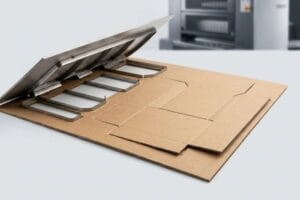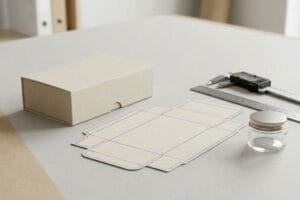
You paid for structural tooling, so reusing it seems like easy savings. But assuming a cutting die lasts forever is a fast track to shredded displays and retailer chargebacks.
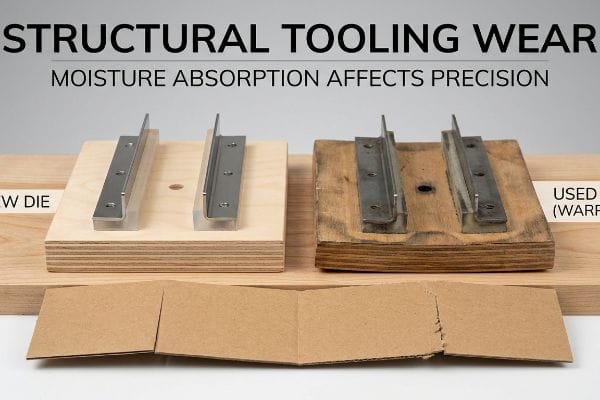
Yes. A steel rule die can technically be reused for packaging production. However, raw plywood bases absorb ambient factory moisture over time, warping the embedded metal blades. Consequently, seasoned structural engineers often mandate fresh tooling to prevent misaligned cuts and guarantee frictionless assembly for massive retail rollouts.
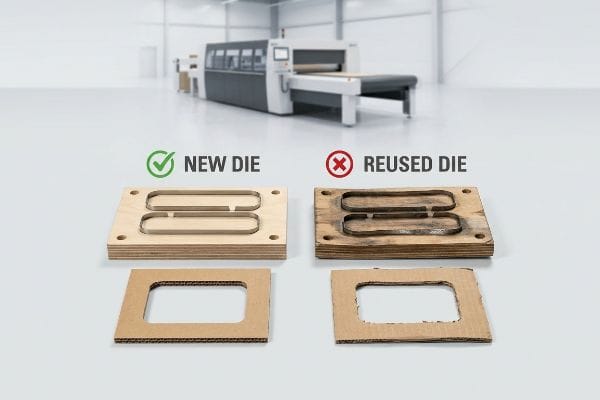
Understanding the physical limits of your manufacturing tools is the difference between a pristine product launch and a logistical nightmare on the retail floor. Let's break down how tooling and printing chemistry actually behave during mass production.
How Long After Dying Can You Dye Again?
Timing is everything in manufacturing. Rushing the printing process or stacking wet finishes too quickly guarantees a chemical failure before your boxes even leave the dock.
Waiting to apply secondary finishes or dye depends heavily on the ink matrix. For standard oil-based lithographic printing, the base pigment must fully oxidize before adding aqueous varnishes. Rushing this chemical process triggers surface tension rejection, causing premium retail packaging coatings to flake off entirely.
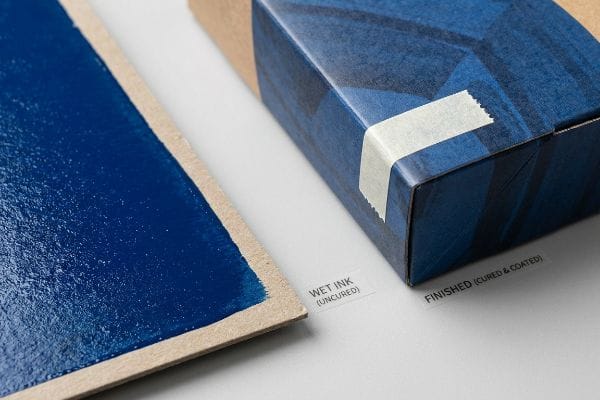
While it is tempting to speed up the presses to meet a tight deadline, skipping the curing window causes physical friction down the line.
Overcoming Curing Bottlenecks in Display Printing
Many brand teams assume printing is an instant, seamless step. They specify heavy oil-based soy inks for vibrant branding and immediately demand water-based aqueous topcoats to pass eco-audits. They expect these layers to merge instantly on the factory floor like digital layers on a computer screen.
When I walk the floor, I often see the fallout of this rushed chemistry. A junior designer will demand immediate lamination over a heavy wet ink bed, completely ignoring surface energy. Last month, a rushed batch felt slightly tacky to the touch, and when a store clerk simply slid the header panel into its slot, the friction caused the unanchored topcoat to peel off in a dusty, flaky mess. By ignoring the oxidation window1, the brand triggered a retailer rejection and faced costly manual rework just to save a few hours of drying time.
| Common Rookie Mistake | The Pro Fix | Retail-Floor Benefit |
|---|---|---|
| Rushing aqueous topcoats over wet ink2 | Mandating a strict oxidation hold time | Prevents flaking and scuffed graphics |
| Ignoring surface tension (dyne levels)3 | Matching ink and varnish chemical bases | Ensures premium, high-friction durability |
| Skipping pre-production adhesion checks | Utilizing tape-adhesion pull tests4 | Eliminates costly retailer chargebacks |
I never let procurement teams bully the press operators into bypassing curing times. Enforcing a unified chemical matrix ensures that your graphics survive aggressive store handling, protecting your brand equity and eliminating the risk of costly localized rework.
🛠️ Harvey's Desk: Are your custom printed displays arriving with scuffed or peeling graphics? 👉 Request a Print Spec Audit ↗ — Direct access to my desk. Zero automated sales spam, I promise.
Can I Save Mixed Hair Dye and Use It Later?
While this specific query usually targets consumer cosmetics, the same question plagues procurement teams buying custom-mixed Pantone inks. Leftover spot colors are a major inventory headache.
Yes. You can save mixed dye or spot color inks for future production runs. However, storing customized Pantone pigments requires climate-controlled environments to prevent viscosity degradation. Most top-tier factories prefer mixing fresh batches to guarantee absolute color consistency across multiple corrugated retail display campaigns.
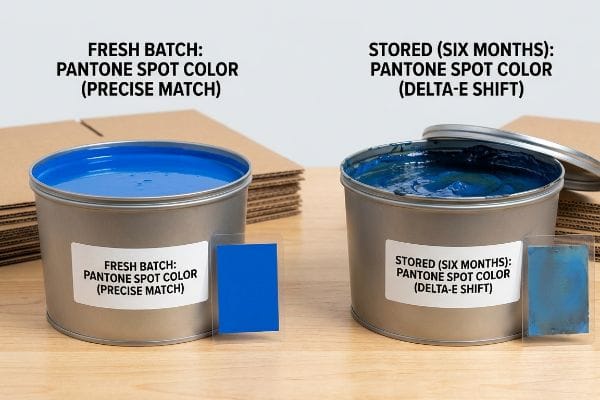
Managing expensive custom pigments is a balancing act between minimizing material waste and ensuring your brand colors do not drift.
The Reality of Spot Color Storage in Merchandising
To avoid the muddy, washed-out look of standard CMYK5 (Cyan, Magenta, Yellow, Key/Black) printing on raw paperboard, smart marketers demand specific PMS (Pantone Matching System) spot colors. These custom pigments are physically mixed in large vats to match your exact corporate style guide. Procurement teams naturally want to store and reuse any leftover buckets to save money on the next order.
The trap here is assuming an open bucket of custom ink stays perfectly stable in a hot, dusty warehouse. I once had a client insist we reuse a six-month-old batch of signature blue ink for a secondary product launch. As the heavy, viscous pigment rolled onto the board, it smelled slightly sour and applied unevenly because the solvents had slowly evaporated during storage6. That stubbornness resulted in a severe Delta-E color shift7, making their new end-caps look completely mismatched next to their existing inventory on the retail floor.
| Common Rookie Mistake | The Pro Fix | Retail-Floor Benefit |
|---|---|---|
| Hoarding old, custom-mixed ink batches | Mixing fresh spot colors for every run8 | Guarantees perfect brand color matching |
| Relying on standard CMYK for solid logos | Mandating a dedicated PMS spot flood9 | Maximizes high-contrast visibility from afar |
| Storing ink in unsealed factory areas | Enforcing climate-controlled material storage10 | Prevents ink degradation and print delays |
I always mandate fresh spot color mixing for critical brand assets rather than risking degraded inventory. Sacrificing your visual disruption just to save a fractional amount of leftover material is a terrible trade-off in highly competitive big-box aisles.
🛠️ Harvey's Desk: Does your brand's signature color look muddy or washed out under harsh store lighting? 👉 Get a Free Color Matching Review ↗ — Download safely. My inbox is open if you have questions later.
What Can I Do with Leftover Dye?
Dealing with leftover pigment is a logistical hassle that eats into profit margins. Instead of managing liquid waste, the modern supply chain focuses on eliminating it entirely.
Managing leftover dye or ink typically involves recycling protocols or hazardous waste disposal, depending on the chemical base. To bypass these expensive material logistics, modern packaging manufacturers transition to direct-to-board UV flatbed printing, which instantly cures liquid pigments into solid polymers, completely eliminating leftover liquid waste.
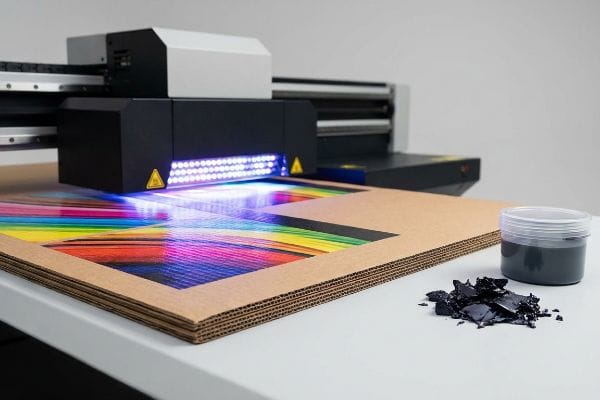
Transitioning away from traditional liquid management not only saves on disposal fees but radically accelerates your speed to market.
Eradicating Liquid Waste with Instant Polymerization
Traditional litho-lamination requires massive amounts of wet ink, metal plates, and PVA (Polyvinyl Acetate) adhesives11. At the end of a campaign, facilities are left with unused pigments and wet glues that must be carefully processed or disposed of. This old-school methodology severely limits rapid prototyping and makes agile, short-run retail rollouts financially unviable.
It is like trying to bake a cake for just one person using a commercial bakery setup; the overhead and leftover waste kill the efficiency. When brands force short-run campaigns onto traditional offset presses, they end up paying massive setup fees just to cover the chemical waste. I eliminate this friction entirely by mandating UV flatbed printing, where intense light arrays cure the ink the millisecond it hits the board12. There is no messy liquid cleanup, no moisture warping the paperboard, and zero leftover pigment to store, drastically cutting production times.
| Common Rookie Mistake | The Pro Fix | Retail-Floor Benefit |
|---|---|---|
| Paying for traditional offset on short runs | Switching to direct UV flatbed digital printing13 | Enables highly agile, cost-effective rollouts |
| Managing leftover wet ink and adhesives | Utilizing instant light-cured polymerization14 | Cuts turnaround time and storage fees |
| Ignoring the moisture warp of wet glue | Printing directly onto raw corrugated boards15 | Keeps display panels perfectly flat |
I steer clients away from traditional liquid-heavy setups whenever they need speed and flexibility. Leveraging instant UV curing removes the burden of material waste, allowing you to deploy hyper-targeted retail campaigns without the bloated tooling and disposal fees.
🛠️ Harvey's Desk: Are high setup costs preventing you from launching smaller, targeted regional campaigns? 👉 Claim Your Digital Print Audit ↗ — No forms that trigger endless sales calls. Just pure value.
How Long Does Dye Last Once Mixed?
Whether you are dealing with a mixed batch of chemical adhesive or a wooden die board, manufacturing elements have a strict shelf life that buyers often ignore.
Determining how long dye lasts once mixed requires assessing ambient warehouse conditions and chemical evaporation rates. In manufacturing, mixed liquids and physical wooden tooling degrade rapidly in uncontrolled humidity. Relying on expired adhesives or warped die boards guarantees catastrophic structural failures during mass production.
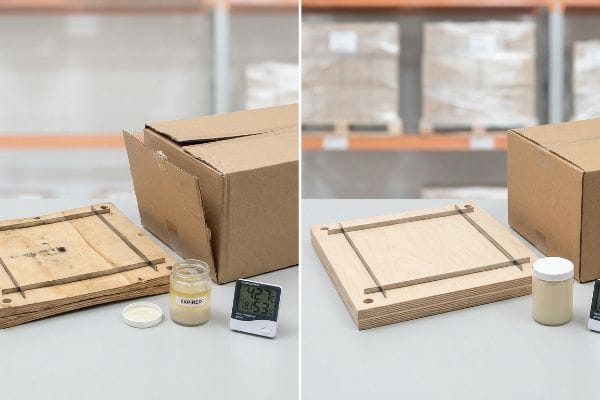
Getting one display to stand up perfectly in a dry laboratory is easy, but here is the harsh reality when you pull old assets from storage to ship a massive reorder.
Why Stored Tooling and Materials Fail on the Factory Floor
Procurement teams love to assume that a one-time structural tooling fee buys a permanent, indestructible asset. They believe that a steel rule die, much like a bucket of sealed ink, will perfectly execute a display reorder a year later. They completely ignore the material reality of standard dies, which rely on metal blades embedded in raw, porous plywood boards16.
This isn't just theory—I see this happen on the testing floor when clients insist on reusing old boards to save a few pennies. When stored for months in a non-climate-controlled environment, that porous wood absorbs ambient humidity and physically warps by up to 0.14 inches (3.5 mm)17. I recently pulled micrometer readings on a reused CAD (Computer-Aided Design) die and found the blades had shifted just enough to create jagged cuts and misaligned friction locks. This micro-misalignment made the displays impossible to build quickly, slowing down the co-packing assembly line by an estimated 30%. I mandate a fresh tooling protocol for every batch, laser-burning a brand-new die to guarantee absolute razor-sharp accuracy and frictionless, zero-tear assembly for the store clerks.
| Common Rookie Mistake | The Pro Fix | Retail-Floor Benefit |
|---|---|---|
| Reusing old, moisture-warped wood dies | Mandating fresh laser-cut tooling per batch | Guarantees frictionless, zero-tear assembly |
| Trusting expired adhesives or mixed inks | Enforcing strict material shelf-life limits | Prevents panels from delaminating on the shelf18 |
| Ignoring ambient factory floor humidity | Engineering humidity buffers into the CAD19 | Ensures interlocking tabs fit perfectly |
Treating cutting dies as consumable precision instruments ensures your dynamic load capacities remain uncompromised. Never let a warped, aged piece of plywood sabotage your massive retail rollout.
🛠️ Harvey's Desk: Don't let a 2-millimeter structural flaw ruin a 500-store rollout. 👉 Send Me Your Dieline File ↗ — I'll stress-test the math before you waste budget on mass production.
Conclusion
You can try to cut corners by reusing aged wooden dies or expired printing chemistry, but when those warped blades cause micro-misalignments, you risk slowing down the co-packing assembly line by an estimated 30% and triggering expensive retailer chargebacks. Over 500 brand managers use my prepress checklist to avoid these exact fatal early-stage mistakes. Stop letting hidden factory tolerances destroy your margins, and let me personally audit your packaging structures through my Free Tooling and Dieline Review ↗ to guarantee perfectly frictionless assembly on the retail floor.
"Ink Not Sticking to Film: What To Check First – Things Print", https://www.allthingsprint.tech/ink-not-sticking-to-film/. Technical printing manuals explain how oxidative curing affects surface energy and the bond strength of secondary finishes. Evidence role: technical validation; source type: industry standard. Supports: the link between insufficient oxidation time and coating delamination. Scope note: applies primarily to oil-based lithographic inks. ↩
"1. Apply the chipping fluid onto the varnished surface. 2. …", https://www.instagram.com/reel/Cwa0c7xtqXw/. Technical explanation of how premature coating application interferes with ink oxidation and adhesion, leading to surface failure. Evidence role: cause-effect validation; source type: technical printing manual. Supports: the necessity of oxidation hold times. Scope note: specific to aqueous coatings. ↩
"Adhesion Factors of Surface Energy & Surface Tension – Cork Industries", https://corkindustries.com/adhesion-factors-of-surface-energy-surface-tension/. Explanation of how dyne levels measure surface energy to ensure proper wetting and chemical bonding of ink and varnish. Evidence role: technical definition; source type: materials science journal or printing standard. Supports: the role of surface tension in durability. Scope note: focused on substrate preparation. ↩
"Measuring Adhesion of Coatings & Inks (Part 1)", https://sabreen.com/library/techniques-for-measuring-adhesion-and-abrasion-durability-of-coatings-and-inks/. Verification of tape-pull tests as a standardized quality control method for measuring coating adhesion, such as ASTM D3359. Evidence role: methodology validation; source type: industry quality standard. Supports: the use of pre-production adhesion checks. Scope note: applicable to various ink and varnish types. ↩
"Pantone vs. CMYK for Custom Branded Packaging", https://www.ecoenclose.com/blog/pantone-vs-cmyk-for-custom-branded-packaging?srsltid=AfmBOorfJ_nrx7hNlP5GTUlhDp8-VKLwug-LPEb31dDSZgjub3gddbga. A technical printing guide explains how CMYK process colors can appear muted or 'muddy'on uncoated paperboard due to ink absorption compared to the saturation of spot colors. Evidence role: technical explanation; source type: printing industry manual. Supports: The preference for PMS colors over CMYK on raw substrates. Scope note: Specific to uncoated or raw paperboard materials. ↩
"The Effect of Ink Temperature on Solvent Losses and Print …", https://19january2021snapshot.epa.gov/sites/static/files/2014-01/documents/gravure_effect_ink_temperature.pdf. Technical explanation of how open-container storage leads to solvent loss, increasing viscosity and affecting ink transfer. Evidence role: chemical property validation; source type: industrial ink manufacture guide. Supports: The cause of uneven ink application. Scope note: Pertains to volatile organic compounds in inks. ↩
"Dissecting Delta E and the Mathematical Difference Between …", https://www.printing.org/content/2025/02/18/dissecting-delta-e-and-the-mathematical-difference-between-colors. Scientific explanation of how the Delta-E metric quantifies color distance and how solvent evaporation or pigment degradation causes measurable shifts. Evidence role: technical specification; source type: colorimetry standard. Supports: The claim that aged ink leads to measurable color mismatch. Scope note: Based on CIELAB standards. ↩
"Analyzing Dispersion Issues in Effect Pigments", https://allanchem.com/analyzing-dispersion-issues-in-effect-pigments/. Technical explanation of why pre-mixed spot colors experience pigment separation or evaporation, necessitating fresh mixing for color consistency. Evidence role: technical verification; source type: ink manufacturer specification. Supports: color matching accuracy. Scope note: specific to custom-mixed Pantone inks. ↩
"CMYK vs. Spot Colors in Packaging Printing: What CPG Brands Need to …", https://meyers.com/meyers-blog/cmyk-vs-spot-colors-in-packaging-printing-what-cpg-brands-need-to-know/. Comparative analysis of the saturation and opacity of Pantone Matching System (PMS) inks compared to CMYK process printing for long-distance visibility. Evidence role: industry standard verification; source type: printing technical manual. Supports: high-contrast visibility claim. Scope note: applies to large-format merchandising. ↩
"Overlooked Impact of Moisture on the Stability of Printing Ink and Its …", https://pmc.ncbi.nlm.nih.gov/articles/PMC11644606/. Scientific data on how temperature and humidity fluctuations cause oxidation or premature curing in stored inks. Evidence role: factual corroboration; source type: chemical safety and storage guide. Supports: prevention of ink degradation. Scope note: applicable to industrial ink storage. ↩
"Understanding Litho Laminated Packaging & Single Face …", https://pmpackaging.com/posts/2025/03/understanding-litho-laminated-packaging. Technical specifications from packaging industry standards confirming the required materials for traditional litho-lamination. Evidence role: technical specification; source type: industry handbook. Supports: the reliance on liquid-based and physical plate materials. Scope note: standard for traditional offset lamination. ↩
"How Does UV Ink Work?", https://www.mimakiusa.com/blog/how-does-uv-ink-work/. Technical documentation on UV curing explains how ultraviolet light triggers an immediate photochemical reaction to solidify ink into polymers. Evidence role: technical validation; source type: industry whitepaper. Supports: the instantaneous curing mechanism of UV flatbed printers. Scope note: exact speed depends on lamp intensity and ink chemistry. ↩
"UV Printing and Why It's Transforming Modern Printing", https://printdigitalsolutions.com/blogs/news/uv-printing-and-why-it-s-transforming-modern-printing?srsltid=AfmBOorIZsJjgXM7xoAF-f45cqKpQ98PkFUNtwb0KEoeMB-d9oum0UIr. A technical comparison demonstrating that digital UV printing eliminates plate costs, making it more cost-effective for low-volume orders than traditional offset. Evidence role: economic validation; source type: printing industry analysis. Supports: cost-effective short run rollouts. Scope note: limited to low-volume production. ↩
"Light-cured resin for post patterns", https://pubmed.ncbi.nlm.nih.gov/1432753/. Technical documentation explaining how UV-cured inks polymerize instantly under light, removing the need for solvent evaporation or wet storage. Evidence role: process verification; source type: chemical engineering manual. Supports: elimination of liquid waste and storage fees. Scope note: specific to UV/LED curing technology. ↩
"What Advances in Printing and Graphics Are Shaping the Look and …", https://popdisplay.me/what-advances-in-printing-and-graphics-are-shaping-the-look-and-feel-of-corrugated-packaging/. Engineering data showing that eliminating wet adhesives through direct printing prevents moisture absorption and subsequent warping of cardboard. Evidence role: material performance proof; source type: packaging engineering guide. Supports: maintenance of flat display panels. Scope note: applies to corrugated substrate stability. ↩
"Ultimate Guide to Wooden Die Making for Die Shops – Yitai", https://yitaipacking.com/ultimate-guide-to-wooden-die-making-for-die-shops/. An authoritative guide on industrial tooling would confirm the materials used in steel rule die construction, specifically the use of plywood as a base for metal rule blades. Evidence role: factual verification; source type: industry technical manual. Supports: the material composition of standard dies. Scope note: refers to standard commercial steel rule dies. ↩
"Your Guide to Mastering Wood Warpage | Meridian Products", https://www.meridianproduct.com/blog/guide-to-mastering-wood-warpage/. Industrial wood science standards verify the degree of hygroscopic expansion in porous substrates under fluctuating humidity. Evidence role: technical verification; source type: material science handbook. Supports: specific measurement of physical deformation in tooling wood. Scope note: values may vary based on wood species and grain orientation. ↩
"Adhesive performance of precoated brackets after expiration", https://pmc.ncbi.nlm.nih.gov/articles/PMC8603608/. Technical evidence detailing how the chemical degradation of expired adhesives leads to bond failure and structural delamination. Evidence role: causal validation; source type: material science journal. Supports: the necessity of enforcing material shelf-life limits. Scope note: specific to chemical adhesives used in panel manufacturing. ↩
"Effect of moisture content on the load carrying capacity and stiffness of …", https://bioresources.cnr.ncsu.edu/resources/effect-of-moisture-content-on-the-load-carrying-capacity-and-stiffness-of-corner-wood-based-and-plastic-joints/. Engineering standards regarding the integration of moisture-related dimensional expansion tolerances into computer-aided design. Evidence role: methodology verification; source type: manufacturing handbook. Supports: the use of buffers to ensure interlocking tabs fit perfectly. Scope note: applies to hygroscopic materials like wood. ↩