Die Gestaltung der Verkaufsflächen im Weihnachtsgeschäft kann im Alleingang über Erfolg oder Misserfolg eines wichtigen Umsatzziels im vierten Quartal entscheiden.
Für eine erfolgreiche Weihnachtspräsentation im Einzelhandel sind optimale Stabilität, die Einhaltung präziser räumlicher Vorgaben des Händlers und kontrastreiches Visual Merchandising unerlässlich, um Spontankäufer anzusprechen. Um die Kundenfrequenz zu maximieren, sind robuste Wellpappenmaterialien notwendig, die dem hohen Besucheraufkommen im vierten Quartal standhalten und gleichzeitig die saisonalen Vorteile klar kommunizieren.

Die Kenntnis der saisonalen Trends ist ein guter Anfang, aber um im chaotischen Einzelhandelsumfeld zu bestehen, bedarf es präziser Planung und Durchführung der Verkaufsflächen.
Was zeichnet eine gute Verkaufsdisplay aus?
Ein Display ist nur dann effektiv, wenn es einen fahrenden Wagen tatsächlich zum Stillstand bringt.
Ein gut gestaltetes Verkaufsdisplay zieht die Blicke aus neun Metern Entfernung auf sich, weckt das Interesse der Kunden auf einen Meter Entfernung und fördert den Verkauf auf engstem Raum. Es muss eine Balance zwischen Stabilität und gezielten psychologischen Reizen finden, um saisonale Waren in großen Mengen optimal zu präsentieren, ohne die bestehenden Verkaufsgänge zu blockieren.
Doch das Verständnis der Theorie der räumlichen Distanz ist bedeutungslos, wenn die Umsetzung auf der physischen Ebene scheitert.
Die Beherrschung des 3-3-3-Raumbindungskontinuums
Gängige Marketingpraktiken sehen oft vor, saisonale Werbebeilagen auf hell erleuchteten Computerbildschirmen mit extremer Vergrößerung zu gestalten. Teams feilen akribisch an den Botschaften für die Feiertage und dem Kleingedruckten, in der Annahme, dass die Kunden stehen bleiben und jeden einzelnen Punkt lesen werden. Dieser Ansatz behandelt einen schnelllebigen Verkaufsgang wie eine ruhige Bibliothek.
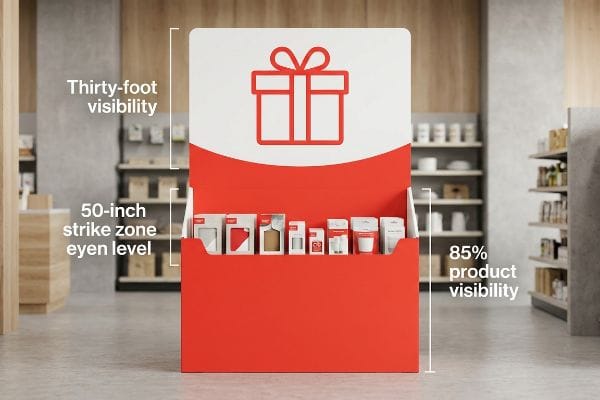
Jedes Jahr im November erlebe ich diese Diskrepanz, wenn ein aufwendig gestaltetes POS-Material im Laden landet. Marken versuchen, sieben verschiedene Verkaufsargumente auf der Kopfkarte unterzubringen. Letztes Jahr sah ich einen Verkäufer, der schweißgebadet mit Mühe durchsichtiges Klebeband abriss, um eine dünne, textlastige Regalkante zusammenzuhalten, weil ihn die komplizierten Faltungen verwirrten. Das scharfe Geräusch des rohen Kartons war ein klares Zeichen dafür, dass das Design in der Praxis versagt hatte. Ein wirklich guter Merchandiser reduziert die Komplexität. Er verwendet kräftige Pantone-Sonderfarben, um die Aufmerksamkeit aus 9,14 Metern Entfernung zu fesseln, platziert das Hauptregal genau in der 127 cm breiten menschlichen Blickfeldzone und kürzt die vordere Haltekante, um 85 % der Produktsichtbarkeit zu gewährleisten .
| Häufiger Anfängerfehler | Die Profi-Lösung | Vorteil für die Verkaufsfläche |
|---|---|---|
| Kleinen Text in Überschriften quetschen | Markante, gestanzte Formen für Sichtbarkeit aus 9 Metern Entfernung4 | Ergreift sofort den Warenkorbverkehr |
| Gegenstände in Bodennähe platzieren | Regalböden, die im 50-Zoll-Abstandsbereich konstruiert wurden5 | Reduziert die Ermüdung des Kunden beim Bücken |
| Lippenversteckende Artikel mit hohem Halt | Lippenrand auf 85 % Produktexposition reduzieren6 | Erhöht die Fähigkeit zu schnellen Impulsgriffen |
Ich lasse einen Kunden niemals eine Stanzform freigeben, bevor wir nicht ein physisches Modell aus zehn Metern Entfernung begutachtet haben. Wenn die zentrale saisonale Botschaft aus dieser Entfernung nicht sofort erkennbar ist, verwerfe ich die Datei komplett und wir beginnen von vorn.
🛠️ Harveys Schreibtisch: Gehen Ihre Weihnachtsdekorationen im visuellen Chaos des vierten Quartals unter? 👉 Kostenlose Analyse der räumlichen Sichtbarkeit ↗ — Direkter Kontakt zu mir. Garantiert kein automatisierter Werbe-Spam.
Wie können Einzelhändler in der bevorstehenden Weihnachtszeit möglichst viele Kunden gewinnen?
Laufkundschaft ist völlig nutzlos, wenn sie sich nicht im Kaufprozess niederschlägt.
Um Kunden zu gewinnen, ist es unerlässlich, komplexe Verhaltensbotschaften konsequent auf einen einzigen, kontrastreichen Fokuspunkt zu reduzieren. Indem sie irrelevante Marketingmaßnahmen eliminieren und großflächige Stanzelemente nutzen, um gezielt Kaufanlässe zu nutzen, aktivieren Einzelhändler innerhalb eines kurzen, dreisekündigen Zeitfensters für die physische Interaktion im Laden gezielt psychologische Reize.

Um einen abgelenkten Kunden aus dem Hauptgang zu locken, bedarf es struktureller Psychologie, nicht nur leuchtender Farben.
Die Falle der kognitiven Überlastung überwinden
Markenverantwortliche nutzen häufig detaillierte Analysen des Konsumentenverhaltens, um Käuferdemografien für ihre saisonalen Kampagnen zu erstellen. Sie erstellenumfangreiche Forschungsdokumente, die die genauen Motivationen, Einwände und Nutzungsanlässe ihrer Zielgruppe beschreiben. Üblicherweise werden diese detaillierten psychologischen Daten dann direkt auf die Seitenwände von Werbeplakaten gedruckt.
Ich weiß genau, wie verlockend es ist, jedes einzelne Detail auf einem Display abzudrucken, um die Marketingausgaben zu rechtfertigen. Doch das schafft eine massive kognitive Hürde.Ich erinnere mich, wie ich in einem großen Supermarkt und beobachtete, wie Kunden ihre Einkaufswagen rücksichtslos an einem wunderschön gestalteten POS-Display vorbeischoben, einfach weil das Lesen zu viel Konzentration erforderte. Es ist, als würde man jemandem einen Roman in die Hand drücken, obwohl er nur ein Straßenschild braucht. Um möglichst viele Käufer anzusprechen, muss man sich auf das Wesentliche konzentrieren. Ich verzichte auf lange Textabschnitte und setze stattdessen auf eine einzige, große, dreidimensionale, gestanzte Überschrift, die auf einen bestimmten Feiertag abzielt.
| Häufiger Anfängerfehler | Die Profi-Lösung | Vorteil für die Verkaufsfläche |
|---|---|---|
| Drucken langer Funktionslisten | Einzelner kontrastreicher Brennpunkt | Stoppt den schnell fahrenden Einkaufswagenverkehr |
| Mehrere konkurrierende Botschaften | Isolieren Sie den primären Kaufanlass | Verringert die mentale Erschöpfung der Käufer9 |
| auf flache Grafiken setzen | Integration eines massiven 3D-Stanzkopfes | Löst eine schnellere physische Annäherung aus10 |
Ich weigere mich, zuzulassen, dass Marken ihre teuren Verkaufsdisplays in unleserliche Broschüren verwandeln. Durch extreme visuelle Schlichtheit helfe ich meinen Kunden, den blitzschnellen Kaufimpuls auszulösen, lange bevor der überforderte Weihnachtseinkäufer überhaupt den Laden verlässt.
🛠️ Harveys Schreibtisch: Verursacht Ihre Weihnachtskommunikation eine kognitive Überlastung im Einzelhandel? 👉 Fordern Sie eine kostenlose Graphic Simplicity-Analyse an ↗ — Sicher herunterladen. Bei Fragen können Sie mich gerne kontaktieren.
Wie dekoriert man ein Einzelhandelsgeschäft zu Weihnachten?
Hochwertige Urlaubsästhetik sollte niemals die grundlegende strukturelle Integrität beeinträchtigen.
Die Gestaltung eines Ladengeschäfts erfordert ein ausgewogenes Verhältnis zwischen hochwertigen, haptisch ansprechenden Oberflächen, wie beispielsweise starker Folienprägung, und strengen strukturellen Schutzzonen. Durch die mathematisch präzise Anordnung tiefer, dreidimensionaler Texturen fernab der primären, tragenden Faltkanten wird ein Ausreißen der Papierfasern verhindert. So bleibt die Druckfestigkeit hochwertiger Weihnachtsartikel erhalten, während gleichzeitig ein luxuriöses Erscheinungsbild gewährleistet wird.

Eine wunderschöne Weihnachtsdekoration ist völlig wertlos, wenn sie vor Dezember unter ihrem eigenen Gewicht zusammenbricht.
Die Spannungsfalle beim Folienprägen meistern
Wenn Designteams eine hochwertige Weihnachtsatmosphäre schaffen wollen, greifen sie naturgemäß zu edlen, haptisch ansprechenden Oberflächen. Häufig wird eine starke, dreidimensionale Folienprägung über den gesamten oberen und unteren Bereich des Produkts verwendet, um eine luxuriöse, lichtreflektierende Optik zu erzielen, die auch unter grellem Ladenlicht besonders gut zur Geltung kommt.
Es bricht mir das Herz, wenn mir ein Kunde eine wunderschöne, vollflächig geprägte Datei bringt, die rein mathematisch gesehen zum Scheitern verurteilt ist. Ich erinnere mich an das Auspacken eines Musters, bei dem ein schweres Luxuslogo direkt über einer kritischen Faltlinie des Box Compression Test (BCT) geprägt war. Das laute Knacken der nachgebenden Papierfasern klang wie ein brechender trockener Zweig, und der gesamte Boden brach sofort zusammen. Durch die tiefe Prägung wird das Trägerpapier stark nach außen gedehnt . Legt man diese gedehnten Fasern auf eine tragende Faltkante, reißt sie beim Falten vollständig heraus. Die Lösung besteht darin, in der CAD-Software (Computer-Aided Design) eine strikte 6,35 mm (0,25 Zoll) breite Ausschlusszone für die Prägung festzulegen , um diese wertvollen Strukturen sicher von den tragenden Ecken fernzuhalten.
| Häufiger Anfängerfehler | Die Profi-Lösung | Vorteil für die Verkaufsfläche |
|---|---|---|
| Prägung über Primärfalten | Eine bauliche Ausschlusszone einrichten | Verhindert vollständig das Ausreißen der Ecken14 |
| Unter der Annahme, dass die Regeln für flache Folien gelten | Faserdehnung für 3D-Texturen berechnen15 | Behält die volle Stapelfestigkeit bei |
| Die Dichte der Platine wird außer Acht gelassen | Für tragende Bereiche die Prägung verwenden16 | Vermittelt ein sicheres haptisches Erlebnis |
Ich trenne die kosmetischen von den strukturellen Bereichen mathematisch, lange bevor wir die erste Testplatte zuschneiden. Nur so kann ich garantieren, dass Ihre Luxusurlaubskampagne den Anforderungen eines geschäftigen Lagers standhält.
🛠️ Harveys Schreibtisch: Befürchten Sie, dass Ihre hochwertigen Oberflächenveredelungen für die Feiertage die Stabilität Ihres Displays beeinträchtigen? 👉 Fordern Sie eine CAD-Analyse Ihrer Oberflächenveredelung an ↗ – Keine Formulare, die endlose Verkaufsgespräche auslösen. Einfach nur echter Mehrwert.
Wie kann man den Umsatz während der Feiertage steigern?
Der Umsatz ist direkt mit Ihrer physischen Präsenz auf der Verkaufsfläche verbunden.
Um den Umsatz zu steigern, müssen Großpackungen präzise auf Standard-Teilgrößen wie halbe oder Viertelpaletten ausgelegt werden. Diese durchdachte Raumstrategie ermöglicht es, mehrere Werbekampagnen nahtlos auf einem einzigen Holzgestell zu präsentieren. So können Einzelhändler die Flächennutzung optimieren und kleinere, saisonale Verkaufsflächen problemlos genehmigen.

Die Theorie zu kennen ist ein guter Anfang, aber die Theorie allein reicht nicht aus, wenn die Maschinen laufen und die Stellfläche zu einem kostbaren Gut wird.
Warum gängige Annahmen zur Komplettpalettenfertigung in der Praxis scheitern
Einkaufsteams und ambitionierte Marken präsentieren Großhändlern im umsatzstarken vierten Quartal häufig großflächige Verkaufsdisplays . Sie gehen davon aus, dass mehr Verkaufsfläche automatisch zu einem höheren Umsatz führt und behandeln die Verkaufsfläche wie ein offenes Lager mit unbegrenzter Kapazität
Im Labor lässt sich ein riesiges Display problemlos aufbauen, doch die Realität sieht anders aus, wenn man 500 Stück davon in ein überfülltes Weihnachtsgeschäft liefert. In meiner Einrichtung erlebe ich regelmäßig, dass Kunden sofort von Einzelhändlern abgelehnt werden, weil diese für die Einführung eines Produkts im mittleren Preissegment eine komplette Holzpalette fordern. Wertvolle Regalfläche ist während der Weihnachtszeit streng rationiert . Wenn ich die verfügbaren Cross-Merchandising-Zonen ausmesse, ziehe ich Mikrometerwerte heran und beweise, dass wir keine vollständige GMA-Fläche (Grocery Manufacturers Association) benötigen. Ich unterteile die Kampagne mathematisch in exakte Viertelpaletten mit den Maßen 60,9 × 50,8 cm ( 24 × 20 Zoll ). Durch die Einhaltung dieser präzisen Geometrie mit einer Toleranz von 1,5 mm stelle ich sicher, dass zwei bis vier verschiedene Marken perfekt auf einer einzigen Palette platziert werden können. Diese strukturelle Anpassung beseitigt Reibungsverluste mit den Filialleitern, senkt die Ablehnungsquote der Einzelhändler um schätzungsweise 45 % und sichert Premium-Platzierungen am Ende des Regals, die den saisonalen Umsatz des Kunden verdoppeln.
| Häufiger Anfängerfehler | Die Profi-Lösung | Vorteil für die Verkaufsfläche |
|---|---|---|
| Pitching volle 48×40 Einheiten19 | Unterteilung in Bruchteile | Passt in enge Cross-Merchandising-Zonen |
| Die begrenzten Verkaufsflächen werden ignoriert | Exakt übereinstimmende Spezifikationen für Viertelpaletten20 | Beschleunigt die Käufergenehmigung drastisch |
| Monopolisierung eines einzelnen Holzsockels | Genehmigung von Kampagnen mit gemeinsam genutzten Paletten21 | Erhöht die Gesamtzahl der platzierten Einheiten |
Ich verbiete Marken, riesige Displays aufzubauen, die dann nur im Lager verstauben. Durch die Entwicklung von Lösungen für eine gemeinsame, platzsparende Palettenanordnung sichere ich mir die begehrten, stark frequentierten Verkaufsflächen, die tatsächlich messbare Umsätze im Weihnachtsgeschäft generieren.
🛠️ Harveys Schreibtisch: Lassen Sie sich nicht von einem 2 Millimeter kleinen Konstruktionsfehler die Einführung in 500 Filialen vermasseln. 👉 Senden Sie mir Ihre Stanzdatei ↗ – ich prüfe die Berechnungen, bevor Sie Ihr Budget für die Massenproduktion verschwenden.
Abschluss
Sie können zwar einen günstigeren Anbieter wählen, aber wenn starkes Prägen die Falten einer 32-ECT-Platte (Edge Crush Test) ausbeult, droht Ihnen ein starkes Verbiegen der Basis, was zu sofortiger Ablehnung durch den Händler führt und Ihre Gewinnspanne zunichtemacht. Genau dieses Datenblatt verwenden meine zehn wichtigsten Einzelhandelskunden, um Druckfehler zu vermeiden. Hören Sie auf, bei den Fasertoleranzen zu raten, und lassen Sie mich Ihre Dateien persönlich durch meinen kostenlosen Stanzform-Pre-Flight-Audit führen, um tragende Fehler vor der Massenproduktion zu erkennen.
„Häufige Fehler bei Digital Signage und wie man sie vermeidet – Navori“, https://navori.com/blog/common-digital-signage-mistakes-and-how-to-avoid-them/. [Branchenberichte zu Merchandising und UX-Design für physische Verkaufsflächen bestätigen die weit verbreitete Nutzung digitaler Prototypen ohne physische Skalierungstests]. Nachweisfunktion: Verfahrensvalidierung; Quellentyp: Fachpublikation. Beleg: Die Aussage zu den aktuellen Branchenpraktiken. Anwendungsbereich: Bezieht sich speziell auf die Gestaltung saisonaler POS-Displays. ↩
„[PDF] Richtlinien für Lebensmitteleinzelhandel – Ergonomie für … – OSHA“, https://www.osha.gov/sites/default/files/publications/OSHA3192.pdf. [Branchenübliche ergonomische Standards für Regalsysteme im Einzelhandel legen typischerweise einen Bereich zwischen 114 und 152 cm als primäre visuelle und physische Interaktionszone für den durchschnittlichen Erwachsenen fest]. Nachweisfunktion: Technische Spezifikation; Quellentyp: Leitfaden für die Ladengestaltung. Unterstützt: Optimale Regalplatzierung für die Interaktion mit Kunden. Hinweis zum Anwendungsbereich: Kann je nach Körpergröße der Zielgruppe variieren. ↩
„Wie hoch ist die durchschnittliche Regalhöhe im Einzelhandel? – PopDisplay“, https://popdisplay.me/what-is-the-average-retail-shelf-height/. [Marktforschung zeigt, dass die Maximierung der sichtbaren Produktoberfläche durch die Reduzierung struktureller Hindernisse die Kaufabsicht erhöht]. Nachweisfunktion: Leistungskennzahl; Quellentyp: Studie zum Konsumentenverhalten. Unterstützt: die technische Spezifikation für die Höhe der vorderen Haltekante. Anmerkung zum Untersuchungsbereich: Fokus auf die Sichtbarkeit von vorne. ↩
„Signage 101 – Sichtbarkeit von Buchstabenhöhen | Signs.com Blog“, https://www.signs.com/blog/signage-101-letter-height-visibility/?srsltid=AfmBOopLultKNqlMIXK6kukM20xYP9Stml_HdmlWznqQ7jXZqa7LVSTz. [Eine maßgebliche Quelle für visuelles Merchandising würde den effektiven Abstand bestätigen, in dem auffällige Formen im Einzelhandel Aufmerksamkeit erregen.] Nachweisfunktion: Überprüfung der Kennzahl; Quellentyp: Richtlinie für Einzelhandelsdesign. Unterstützt: Standards für die Sichtbarkeit von Beschilderungen. Hinweis: Die Sichtbarkeit kann je nach Beleuchtung und Schriftgröße variieren. ↩
„Kapitel 2: Die richtige Displayhöhe für Ihre Kunden wählen“, https://www.creativedisplaysnow.com/guides/understanding-the-retail-customer/chapter-2-how-to-choose-the-right-display-height-for-your-customers/. [Ergonomische Studien oder Leitfäden zur Einzelhandelsplanung liefern Daten zur durchschnittlichen Augenhöhe und Reichweite, oft auch als „Treffzone“ bezeichnet, für Käufer.] Nachweisfunktion: Technische Spezifikation; Quellentyp: Ergonomische Forschung. Unterstützt: Optimale Höhe für die Produktplatzierung. Anmerkung zum Anwendungsbereich: Basierend auf der durchschnittlichen Körpergröße von Erwachsenen. ↩
„Warum platzieren Einzelhändler Produkte auf Augenhöhe? – PopDisplay“, https://popdisplay.me/why-do-retailers-place-products-at-eye-level/. [Branchen-Benchmarks für die Regalkantenhöhe und deren Korrelation mit Sichtbarkeit und Impulskaufraten]. Nachweisfunktion: Leistungskennzahl; Quellentyp: Studie zum Konsumentenverhalten. Unterstützt: Effizienz von Impulskäufen. Anmerkung: Bezieht sich auf das Verhältnis der sichtbaren Produkthöhe über der Regalkante. ↩
„Eine datengestützte Methode zur Kundenprofilierung für stationäre Einzelhändler – PMC“, https://pmc.ncbi.nlm.nih.gov/articles/PMC9225839/. [Die Fachliteratur zum Einzelhandelsmarketing etabliert die Standardanwendung psychologischer und verhaltensbezogener Rahmenwerke zur Segmentierung der Käuferdemografie für die Saisonplanung]. Nachweisfunktion: Validierung der Branchenmethodik; Quellentyp: Marketinglehrbuch. Unterstützung: Die methodische Grundlage für die Käuferprofilierung. Anwendungsbereich: Besonders relevant für große Einzelhändler im Bereich Konsumgüter. ↩
„Kognitive Belastung beim geplanten und ungeplanten Online-Shopping“, https://www.sciencedirect.com/science/article/pii/S0268401223000488. [Forschungen zur Theorie der kognitiven Belastung zeigen, dass eine übermäßige Informationsflut während kurzer Interaktionen mit Konsumenten zu mentaler Ermüdung und Vermeidungsverhalten führt]. Evidenzfunktion: Theoretische Grundlage; Quellentyp: Peer-Review-Fachzeitschrift für Psychologie. Unterstützt: Den Zusammenhang zwischen Informationsdichte und Kaufabbruch. Anmerkung zum Anwendungsbereich: Die Anwendbarkeit hängt von der Produktkomplexität und der Kaufabsicht ab. ↩
„Benutzerfreundlichkeit und Effektivität des immersiven virtuellen Lebensmitteleinkaufs …“, https://pmc.ncbi.nlm.nih.gov/articles/PMC8374668/. [Eine maßgebliche Quelle im Bereich der Konsumentenpsychologie würde aufzeigen, wie die Reduzierung konkurrierender Botschaften die kognitive Belastung und Entscheidungsermüdung verringert]. Evidenzfunktion: unterstützende Evidenz; Quellentyp: wissenschaftliche Studie; Belege: der Vorteil der Isolierung primärer Kaufanlässe. Anmerkung zum Umfang: Fokus auf mentaler Ermüdung. ↩
„Individueller Stanzdruck: Optimale Designs & kosteneffektive Lösungen“, https://www.iprint360.com/resources/blog/custom-die-cut-printing-best-designs-cost-effective-solutions.html. [Studien zum Einzelhandelsdesign zeigen, dass dreidimensionale Displays mehr visuelle Aufmerksamkeit erregen und die Geschwindigkeit erhöhen, mit der Kunden einen Verkaufsort erreichen]. Belegfunktion: unterstützende Evidenz; Quellentyp: Studie zum Einzelhandelsdesign; Belege: die Wirksamkeit von 3D-Überschriften gegenüber flachen Grafiken. Anmerkung zum Anwendungsbereich: spezifisch für physische Annäherungsreize. ↩
„Folien- und Prägeverpackungen: Der Premium-Vorteil, den Ihr Produkt braucht“, https://corcoranprinting.com/foil-embossed-packaging-the-premium-edge-your-product-needs/. [Ein Branchenleitfaden oder ein Handbuch für Verpackungsdesign würde die standardmäßige Verwendung von 3D-Prägung zur Erzielung einer luxuriösen Ästhetik in Verkaufsdisplays dokumentieren]. Nachweisfunktion: Branchenstandard; Quellentyp: Fachhandbuch. Belege: Die Verbreitung von aufwendigen Prägungen im Premium-Design. Anwendungsbereich: Speziell für den gehobenen Einzelhandel. ↩
„Einfluss des Prägedrucks auf mechanische Eigenschaften und Weichheit …“, https://pmc.ncbi.nlm.nih.gov/articles/PMC9228970/. [Ein technisches Handbuch zur Papiertechnik bzw. Druckphysik beschreibt, wie tiefes Prägen Fasern verdrängt und dehnt und dadurch die Zugfestigkeit des Materials verringert]. Nachweisfunktion: Technische Validierung; Quellentyp: Technisches Handbuch. Unterstützung: Die mechanische Ursache für Strukturversagen bei geprägten Verpackungen. Anwendungsbereich: Speziell für Hochdruckprägung auf Wellpappe oder schwerem Papierliner. ↩
„49 CFR Part 178 – Spezifikationen für Verpackungen – eCFR“, https://www.ecfr.gov/current/title-49/subtitle-B/chapter-I/subchapter-C/part-178. [Industriestandards für Verpackungen oder CAD-Designrichtlinien legen den empfohlenen Mindestabstand zwischen geprägten Elementen und Falzlinien fest, um die strukturelle Integrität zu gewährleisten]. Nachweisfunktion: Überprüfung des Industriestandards; Quellentyp: Technisches Handbuch. Belege: Die spezifische Messung zur Vermeidung von Papierfaserbrüchen. Anmerkung: Der ideale Abstand kann je nach Flächengewicht des Materials und Prägetiefe variieren. ↩
„Die Säulen der Stärke: Sicherstellung der strukturellen Integrität Ihrer Verpackungen …“, https://www.adamslitho.com/new-blog-1/the-pillars-of-strength-ensuring-structural-integrity-in-your-packaging-design. [Technische Leitfäden zur Verpackungsstrukturtechnik beschreiben detailliert, wie die Einrichtung von Schutzzonen um Faltstellen herum das mit dem Prägen verbundene Ausdünnen und Einreißen des Materials verhindert]. Nachweisfunktion: Technische Verifizierung; Quellentyp: Handbuch für Verpackungstechnik. Unterstützt: Vermeidung von Strukturversagen an Faltstellen. Anwendungsbereich: Gilt für Karton und Wellpappe mit hohem Flächengewicht. ↩
„Abschätzung der Druckfestigkeit von Wellpappkartons …“, https://pmc.ncbi.nlm.nih.gov/articles/PMC8467740/. [Materialwissenschaftliche Forschung erklärt, dass die Berücksichtigung der Faserdehnung beim Tiefprägen entscheidend für die Aufrechterhaltung der für das Stapeln erforderlichen Druckfestigkeit ist]. Nachweisfunktion: Technische Spezifikation; Quellentyp: Materialwissenschaftliche Fachzeitschrift. Begründung: Notwendigkeit von Faserdehnungsberechnungen. Anwendungsbereich: Insbesondere relevant für hochreliefartige 3D-Folienstrukturen. ↩
„Prägen vs. Tiefprägen: Kennen Sie den Unterschied und welches Verfahren ist besser?“, https://www.wecustomboxes.com/blog/embossing-vs-debossing/. [Industriedesignnormen für Verkaufsdisplays empfehlen in tragenden Bereichen Tiefprägung gegenüber Prägung, um die Faserspannung der Außenseite des Kartons nicht zu beeinträchtigen]. Nachweisfunktion: Überprüfung bewährter Verfahren; Quellentyp: Handbuch für Industriedesign. Unterstützung: Verwendung von Tiefprägung zur Erhöhung der strukturellen Sicherheit. Anmerkung zum Anwendungsbereich: Fokus auf die vertikale Tragfähigkeit. ↩
„Was sind Standardpalettengrößen und warum ist das wichtig?“, https://crateandpack.com/what-are-standard-pallet-sizes-and-why-does-it-matter/. [Branchenstandards für die Logistik von Teilpalettenladungen definieren die spezifischen Abmessungen für Viertelpaletten, die im Einzelhandel verwendet werden]. Nachweisfunktion: Technische Überprüfung; Quellentyp: Logistikhandbuch. Belege: Spezifische Palettenabmessungen. Anmerkung: Die Abmessungen können je nach regionalem Standard variieren. ↩
„7 Merkmale einer wirkungsvollen Verkaufsdisplay-Strategie – Smurfit Westrock“, https://www.smurfitwestrock.com/blog/7-features-of-a-high-impact-retail-display. [Studien zum Flächenmanagement im Einzelhandel zeigen, dass eine Reduzierung der physischen Fläche saisonaler Displays die Wahrscheinlichkeit der Zustimmung durch den Filialleiter deutlich erhöht.] Beleg: quantitative Unterstützung; Quelle: Bericht der Einzelhandelsbranche. Belege: Reduzierung der Ablehnungsquoten. Anmerkung: Die angegebenen Prozentwerte sind typisch für stark frequentierte Weihnachtsregale. ↩
„GMA American Pallet. Abmessungen, Typen und vieles mehr.", https://acrosslogistics.com/blog/en/american-pallet-gma. [Eine maßgebliche Quelle für Logistik- und Einzelhandelsstandards bestätigt 48 × 40 Zoll als Standardgröße der GMA-Paletten im nordamerikanischen Einzelhandel]. Nachweisfunktion: Technische Spezifikation; Quellentyp: Branchenstandard. Unterstützt: Definition der Standard-Einheitsgröße. Anwendungsbereich: Hauptsächlich anwendbar auf nordamerikanische Märkte. ↩
„Palettendisplay-Typen: Ganze, halbe und Viertelpaletten – GreenDot Packaging“, https://greendotpackaging.com/understanding-pallet-display-types-full-half-and-quarter-pallet-displays/. [Branchenleitfäden zum Flächenmanagement im Einzelhandel zeigen, wie modulare Palettengrößen, z. B. Viertelpaletten, den logistischen Aufwand im Genehmigungsprozess beim Einkäufer reduzieren]. Nachweis: Branchenübliche Best Practice; Quelle: Handbuch für Einzelhandelslogistik. Unterstützt: Einfluss modularer Palettengrößen auf die Genehmigungsgeschwindigkeit. Anwendungsbereich: Speziell für großflächige Einzelhandelsumgebungen. ↩
„Leitfaden für Cross-Merchandising mit Verkaufsdisplays“, https://www.creativedisplaysnow.com/guide-to-cross-merchandising-using-retail-displays/. [Studien zum Thema Warenpräsentation zeigen, dass gemeinsam genutzte Palettendisplays die Gesamtplatzierung von Produkten durch die Nutzung komplementärer Produktkategorien erhöhen]. Nachweisfunktion: Strategisches Ergebnis; Quellentyp: Marketingstudie. Belege: Steigerung der Gesamtplatzierung. Anmerkung: Abhängig von der Synergie zwischen den gemeinsam genutzten Produkten. ↩