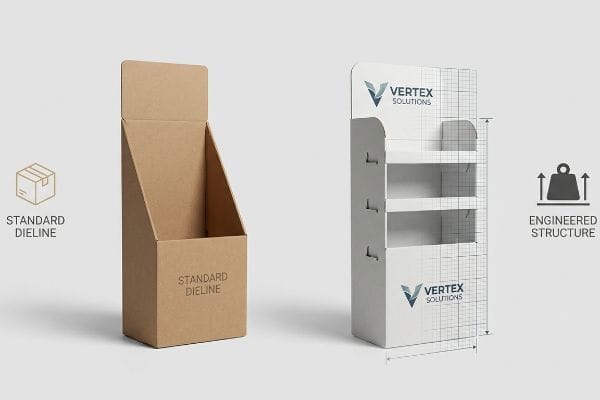
When launching a retail campaign, relying on generic templates often leads to compromised aesthetics, while tailored structures demand rigorous engineering to survive the physical realities of the supply chain.
Custom versus pre-designed POP (Point of Purchase) displays depend heavily on your campaign timeline and product weight. Pre-designed units offer rapid deployment using standardized dielines, whereas custom structures deliver engineered load capacities, precise branding integration, and specific spatial compliance required for heavy-duty big-box retail rollouts.
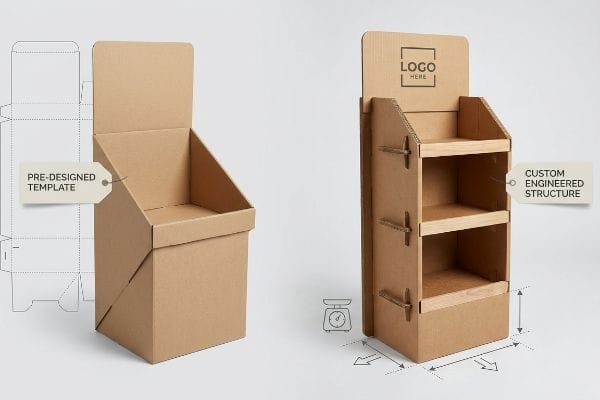
Understanding the difference between a cheap off-the-shelf box and a meticulously engineered merchandiser is the fastest way to protect your brand equity. However, the real danger lies in how these structures handle the brutal physics of global freight and high-speed in-store assembly.
What Are the Different Types of POP Displays?
Whether anchoring an aisle or sitting near the register, physical retail space is ruthlessly calculated by store managers looking to maximize their daily sales per square foot.
The different types of POP displays primarily include heavy-duty floor merchandisers, compact countertop units, high-visibility end-caps, interactive sidekicks, and robust fractional pallet configurations. Each specific format demands completely isolated structural footprints and distinct dimensions to survive dynamic store traffic and strict retailer placement guidelines.
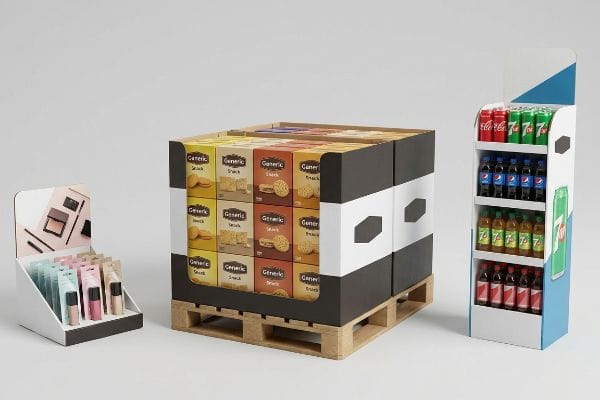
Trading physical space for visual impact requires understanding that a massive display does not automatically guarantee higher sales. It often just guarantees a swift rejection from store management.
The Fractional Footprint Strategy
When planning a new product launch, many marketing teams automatically request full-size pallet displays, assuming that a massive physical presence is necessary to capture shopper attention. They design large, sprawling structures intended to dominate the center aisles, completely disregarding the severe spatial limitations of modern big-box retailers. This theoretical desk-work assumes that store managers will happily sacrifice their valuable floor space just to accommodate a highly stylized promotional campaign.
In actual retail environments, aisle space is strictly rationed, and oversized merchandisers are instantly rejected because they actively block high-traffic intersections. Successful brands avoid this trap by utilizing quarter-pallet or half-pallet configurations that fit seamlessly into established store layouts. By strictly adhering to these compact, retailer-approved footprint guidelines, marketers ensure their displays are quickly approved and positioned in high-visibility zones, maximizing product exposure without disrupting the natural flow of shopping cart traffic.
| Retail Metric | Assumption | Retail Reality |
|---|---|---|
| Store Footprint | Full pallet dominance | Compact fractional sizing1 |
| Manager Approval | Assumed automatic | Strict spatial guidelines2 |
| Shopper Traffic | Blocks main aisles | Seamless cart navigation3 |
Adapting your display footprint to respect retailer spatial limits is the easiest way to guarantee your campaign actually makes it onto the sales floor.
🛠️ Harvey's Desk: Are your oversized floor merchandisers actively triggering retailer rejections before the campaign even begins? 👉 Get a Free Spatial Density Audit ↗ — I review every structural file personally within 24 hours.
What Are the Disadvantages of POP Displays?
A poorly planned merchandiser acts as a massive liability, destroying both visual product appeal and long-term brand perception simultaneously during critical seasonal promotions.
The disadvantages of POP displays usually involve hidden setup complexities, unexpected material wear during extended campaigns, and assembly friction on the retail floor. Generic paperboard structures inherently absorb ambient humidity, causing the unit to look unprofessional and fail under the weight of heavy retail products.
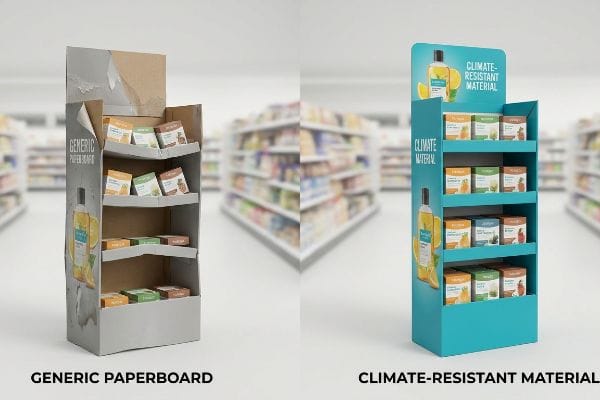
Theoretical designs always assemble beautifully in air-conditioned digital presentations. The actual financial bleeding starts when those same designs hit the demanding, uncontrolled climate of a real retail store.
The Material Climate Challenge
Procurement teams frequently attempt to cut campaign costs by selecting the thinnest, most generic cardboard available for their temporary promotional displays. They assume that since the merchandiser is only meant to last for a few weeks, any standard paperboard material will easily withstand the journey from the distribution center to the storefront. This blind spot is devastating because it treats highly porous, generic paper materials4 as if they are impervious to environmental changes and constant customer interaction.
The actual physical reality is that standard paperboard reacts aggressively to its surrounding environment, especially in humid or high-traffic store lobbies. When these generic structures absorb moisture, they warp and sag5, causing the vibrant branded graphics to peel and the shelves to buckle. By upgrading to strategically coated, climate-resistant materials6, brands can effectively prevent this rapid structural decay. This simple material adjustment ensures that the display maintains its pristine, professional appearance throughout the entirety of the retail campaign, consistently attracting shoppers rather than driving them away.
| Durability Metric | Generic Approach | Retail Reality |
|---|---|---|
| Material Grade | Thinnest cardboard possible | Climate-resistant options |
| Visual Lifespan | Rapid warping and sagging7 | Sustained brand image |
| Customer Impact | Cheapens brand perception8 | Professional presentation |
Upgrading your fundamental material choices prevents embarrassing mid-campaign collapses and actively protects your valuable brand equity.
🛠️ Harvey's Desk: Are flimsy materials turning your retail promotion into a costly, slow-motion disaster? 👉 Request a Free Friction Tolerance Check ↗ — 100% confidential. Your unreleased retail designs are safe with me.
How Much Does a POP Display Cost?
Comparing basic manufacturing quotes without evaluating the overall supply chain strategy is a guaranteed way to bleed out on unexpected logistical surcharges.
A POP display costs highly variable amounts depending on structural design, but the true expense is hidden in logistical volume. Basic counter trays cost dollars, while permanent freestanding fixtures cost hundreds, often incurring massive freight penalties by shipping empty spatial air.
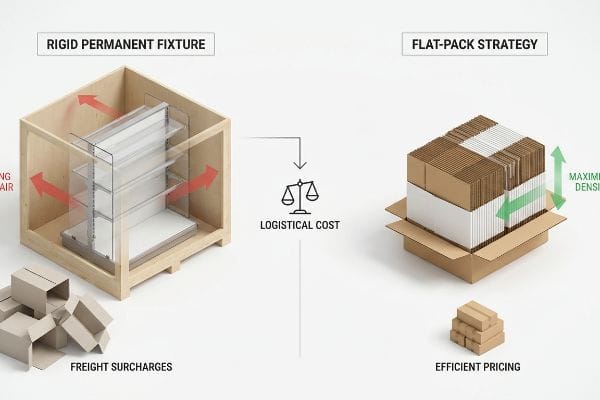
A heavy-duty acrylic rack might look like a great long-term investment on a spreadsheet. However, when retail campaigns rarely outlast a single season, that permanent hardware becomes an operational anchor.
The Flat-Pack Logistical Advantage
When evaluating overall campaign ROI, many brands automatically default to heavy-duty permanent fixtures, assuming that rigid materials visually justify a significantly higher unit cost. They isolate the raw manufacturing quote and completely ignore the punishing logistical realities associated with moving fully assembled hardware9 across the country. These marketing teams assume that shipping pre-built units will save time, failing to realize how completely transportation surcharges will decimate their carefully calculated promotional budgets.
The rigid truth is that permanent fixtures cannot be folded for transit, meaning brands are forced to pay premium shipping rates just to move large boxes of empty air. Temporary corrugated displays solve this expensive problem by utilizing smart, flat-pack logistics. Because engineered cardboard structures ship completely flat and assemble quickly on-site, they maximize the internal density of every shipping container10. This strategic flat-pack approach allows brands to drastically cut outbound transportation costs11, freeing up capital to invest back into the actual retail product.
| Budget Metric | Rigid Permanent Fixtures | Flat-Pack Strategy |
|---|---|---|
| Transit Volume | Shipping massive dead air | Maximized container density12 |
| Freight Cost | Premium bulk surcharges13 | Highly efficient pricing |
| Budget Focus | Drained by logistics | Reinvested into marketing |
Prioritizing flat-pack corrugated designs over permanent hardware is the most reliable way to eliminate wasted shipping expenses from your promotional budget.
🛠️ Harvey's Desk: Are you paying thousands of dollars to ship empty air because your permanent fixtures refuse to fold? 👉 Claim Your Freight Density Audit ↗ — No account managers in the middle. You talk directly to structural engineers.
What Are the Five Types of Displays?
Executing a multi-channel retail rollout requires deploying specific architectures tailored to the strict physical dimensions of distinct store zones.
The five types of displays generally recognized in retail encompass freestanding floor merchandisers, inline shelf trays, end-cap architectures, checkout countertop units, and heavy-duty club store pallets. Each format relies on highly specific base geometries to navigate aggressive shopping cart traffic and localized store limits.
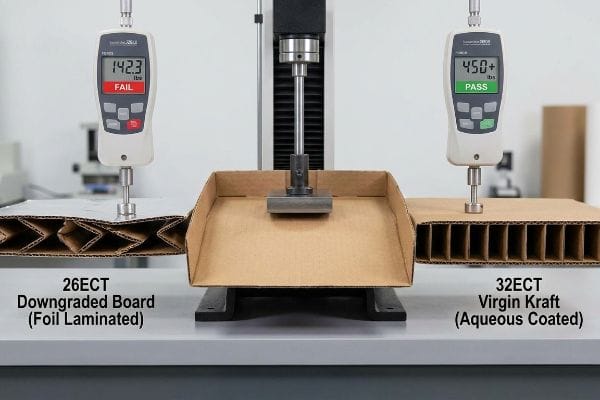
Designing a beautiful end-cap means nothing if it collapses under the weight of your own product. Visual communication always relies on the underlying paper architecture remaining perfectly square.
The Cosmetic ECT Downgrade Trap
I regularly intercept RFQs where procurement teams treat expensive cosmetic finishes, like full-coverage metallic foil laminations, as mandatory marketing elements. To offset the high production costs of these shiny films, they secretly hollow out the internal structural board grade. They assume that dropping a fraction of a millimeter in paper thickness will go unnoticed. This is a severe blind spot. Stripping critical fiber density from the core fluting14 creates a visually stunning box that possesses zero internal arch support. When these weakened structures are placed in the brutal environment of an active retail aisle, they cannot dynamically disperse the kinetic shock of restocking15 or heavy product payloads.
In my facility, I routinely see this exact scenario fail during pre-production compression testing. Recently, a brand submitted a design for a heavy checkout tray where they downgraded the base from a robust 32ECT to a weak 26ECT16 just to save $0.07 per unit for a glossy foil wrap. When I ran the physical prototype through our dynamic load press, the 26ECT flutes buckled catastrophically at just 142.3 lbs (64.5 kg) of top pressure, causing the entire tray to warp outward and snap the glued seams. I immediately intervened and stripped the bloated foil from the BOM. I pulled the micrometer readings and proved we did not need expensive cosmetic films; we needed structural survival. I reverted the substrate back to virgin 32ECT kraft and achieved their desired premium aesthetic using a high-solid, water-based gloss aqueous coating17 applied directly on our 6-color litho press. By enforcing this material realignment, I completely eliminated the risk of base buckling, ensuring the loaded trays survived transit and saving the client from thousands in imminent retailer chargebacks due to crushed inventory.
| Structural Metric | Generic Approach | Engineered Reality |
|---|---|---|
| Material Strength | 26ECT downgraded board18 | 32ECT virgin kraft19 |
| Coating Physics | Heavy foil lamination | Gloss aqueous coating20 |
| Load Survival | Buckled under top weight | Zero transit crushing |
Once the procurement team allowed me to adjust the underlying material physics, the corrugated board itself did all the heavy lifting to protect their bottom line.
🛠️ Harvey's Desk: Is a secret material downgrade causing your heavy-duty checkout trays to warp and tear under standard product weight? 👉 Get a Free Structural Board Audit ↗ — I review every structural file personally within 24 hours.
Conclusion
When your oversized footprint clashes with strict store limits, or when bloated permanent hardware annihilates your freight density, basic aesthetic design is no longer enough to save your margins. Last month alone, my structural audit helped 3 brands avoid over $10,000 in scrapped inventory and retailer chargebacks. If you are tired of watching theoretical structures fail in actual retail stores, let me personally run your structural files through my Free Freight Density Audit ↗ to guarantee your next rollout is engineered for profit.
"When to Use Partial Pallets & Display Skirts – TPH Global Solutions", https://www.tphinc.com/custom-point-of-purchase-pop-pos-retail-store-displays-packaging-blog/when-to-use-partial-pallets-display-skirts/. Evidence showing the industry shift toward smaller point-of-purchase displays to optimize store layout and sales per square foot. Evidence role: Trend validation; source type: Retail industry report. Supports: The adoption of fractional footprints over full pallets. Scope note: Applicable to modern retail space management. ↩
"Merchandising Best Practices: Compliance – Vanguard Companies", https://www.vanguardpkg.com/merchandising-best-practices-compliance/. Documentation of the standard operating procedures retail managers use to approve and regulate display placements. Evidence role: Process verification; source type: Retail management handbook. Supports: The claim that manager approval depends on spatial rules. Scope note: Guidelines vary by retail chain. ↩
"POINT-OF-PURCHASE INSIGHTS: THE IMPACT OF RETAIL POP …", https://www.bcipkg.com/point-of-purchase-insights-the-impact-of-retail-pop-displays-on-consumer-behavior/. Studies on how display sizing and strategic placement affect shopper flow and the ability to navigate carts without obstruction. Evidence role: Technical validation; source type: Consumer behavior study. Supports: The necessity of non-obstructive display designs. Scope note: Focuses on customer experience metrics. ↩
"Transient moisture diffusion through paperboard materials", https://experts.esf.edu/esploro/outputs/journalArticle/Transient-moisture-diffusion-through-paperboard-materials/99892400904826. Industry data on the moisture absorption rates and porous nature of standard paperboard and its effect on structural integrity in retail environments. Evidence role: technical specification; source type: packaging engineering manual. Supports: the claim that generic paperboard is susceptible to environmental changes. Scope note: applies to non-coated or low-grade cardboard. ↩
"Influence of humidity and temperature on mechanical properties of …", https://bioresources.cnr.ncsu.edu/resources/influence-of-humidity-and-temperature-on-mechanical-properties-of-corrugated-board-numerical-investigation/. Technical data explaining the hygroscopic nature of paperboard and how moisture absorption leads to structural failure in retail settings. Evidence role: technical verification; source type: material science study. Supports: the claim that humidity causes warping and sagging. Scope note: applies specifically to standard uncoated paperboard. ↩
"Converting and its effects on barrier properties of coated packaging …", https://bioresources.cnr.ncsu.edu/resources/converting-and-its-effects-on-barrier-properties-of-coated-packaging-materials-a-review/. Specifications on moisture-barrier coatings and their efficacy in stabilizing paper-based materials in varying climates. Evidence role: solution validation; source type: industrial manufacturing guide. Supports: the claim that coatings prevent structural decay. Scope note: limited to specialized retail-grade coatings. ↩
"Are Your POP Displays Suitable for Outdoor Use?", https://popdisplay.me/are-your-pop-displays-suitable-for-outdoor-use/. Technical explanation of how low-grade corrugated cardboard reacts to humidity and temperature fluctuations in retail environments. Evidence role: technical validation; source type: materials science or packaging industry guide. Supports: claim that generic material choices lead to structural degradation. Scope note: specifically refers to non-treated paper-based materials. ↩
"Influence of Customer Quality Perception on the Effectiveness … – PMC", https://pmc.ncbi.nlm.nih.gov/articles/PMC4789549/. Marketing research demonstrating the correlation between the physical quality of POS displays and consumer perceived brand value. Evidence role: psychological validation; source type: consumer behavior study or marketing journal. Supports: claim that poor material choices negatively impact brand image. Scope note: applicable to physical retail environments. ↩
"Flat-Pack vs Fully Assembled: Which Is More Cost-Effective", https://www.samtop.com/flat-pack-vs-fully-assembled-display/. Analysis of volumetric weight and freight charges for pre-assembled versus flat-packed retail fixtures. Evidence role: validation of cost overhead; source type: supply chain industry report. Supports: the claim that pre-built hardware increases logistical expenses. Scope note: Costs vary by carrier and shipping volume. ↩
"Custom Corrugated POP Displays – Brown Packaging", https://brownpackaging.com/custom-packaging-products/pop-displays/corrugated/. An industry logistics report or supply chain study demonstrating how flat-pack designs increase volumetric efficiency compared to pre-assembled fixtures. Evidence role: validation of technical benefit; source type: logistics whitepaper. Supports: the claim that flat-packing optimizes container space. Scope note: Focuses on volume optimization rather than weight limits. ↩
"How Much Does Point of Purchase Display Assembly Cost?", https://www.industrialpackaging.com/blog/point-of-purchase-display-cost. Financial analysis or comparative case studies showing the difference in freight costs between pre-assembled permanent fixtures and flat-packed temporary displays. Evidence role: quantitative proof of cost reduction; source type: industry cost analysis. Supports: the claim that flat-packing reduces transportation expenses. Scope note: Actual savings depend on shipment volume and carrier rates. ↩
"Flat Pack Containers Explained | Pros, Cons And Costs – Bosh Boxes", https://boshboxes.store/flat-pack-containers-explained/. Technical evidence demonstrating the increase in shipping volume efficiency for flat-pack versus pre-assembled displays. Evidence role: validation; source type: logistics industry whitepaper. Supports: the volumetric efficiency of flat-pack transit. Scope note: focused on shipping container utilization rates. ↩
""POP Display Cost (2026):Price Ranges – GMS Industries", https://feeds.gmsindustries.com/blog/pop-display-cost. Documentation regarding freight premiums and surcharges applied to oversized, non-collapsible shipping units. Evidence role: cost verification; source type: freight carrier pricing guide. Supports: the higher cost of shipping rigid fixtures. Scope note: specific to oversized load tariffs. ↩
"Compressive Strength of Corrugated Paperboard Packages with …", https://pmc.ncbi.nlm.nih.gov/articles/PMC10054506/. Technical documentation on corrugated board production explains how reducing fiber density in the fluting medium diminishes the vertical load-bearing capacity. Evidence role: Technical validation; source type: Material science manual. Supports: Correlation between fiber density and structural arch support. Scope note: Specific to corrugated fiberboard. ↩
"A Simplified Dynamic Strength Analysis of Cardboard Packaging …", https://pmc.ncbi.nlm.nih.gov/articles/PMC10385285/. Packaging engineering literature demonstrates that materials with lower compression strength fail to absorb kinetic energy during handling and restocking. Evidence role: Technical validation; source type: Engineering study. Supports: Vulnerability of downgraded boards to retail shocks. Scope note: Pertains to dynamic stress analysis. ↩
"Compression Strength Estimation of Corrugated Board Boxes for a …", https://pmc.ncbi.nlm.nih.gov/articles/PMC9864211/. Technical specifications for corrugated board would confirm that 32 ECT (Edge Crush Test) provides higher vertical compression strength than 26 ECT. Evidence role: technical specification; source type: industry standard. Supports: The assertion that 26ECT is structurally inferior to 32ECT. Scope note: Comparison assumes similar flute profiles. ↩
"What is Aqueous Coating? Benefits, Applications, and Why It Matters …", https://millionpack.com/aqueous-coating/. Printing industry standards would verify that aqueous coatings provide a high-gloss finish without the weight or cost of foil films. Evidence role: process validation; source type: technical manual. Supports: The use of aqueous coatings as a premium, structurally neutral alternative to foil wraps. Scope note: Effectiveness depends on the litho press capabilities. ↩
"Estimation of the Compressive Strength of Corrugated Board Boxes …", https://pmc.ncbi.nlm.nih.gov/articles/PMC8467740/. Analysis of the structural failure rates and compression strength of 26ECT recycled or downgraded board under load. Evidence role: comparative performance analysis; source type: packaging white paper. Supports: the risks associated with the 'cosmetic ECT downgrade trap'. Scope note: focuses on structural instability in retail zones. ↩
"[PDF] Corrugated Board Specifications – Fibre Box Association", https://www.fibrebox.org/assets/2025/09/Walmart_Corrugated-Board_Specifications_Automation_Packaging_Standards.pdf. Technical verification of the load-bearing capacity and material integrity of 32ECT virgin kraft in corrugated packaging. Evidence role: technical validation; source type: industry engineering specification. Supports: the claim that 32ECT is the superior engineered standard for material strength. Scope note: specific to corrugated cardboard ECT ratings. ↩
"What is Aqueous Coating for Printing & Packaging?", https://www.customboxmakers.com/what-is-aqueous-coating/?srsltid=AfmBOopxZM4qcbrdSCrq9oqN67f58cDU307Za56GXNMuKkJkf8JiU4vW. Comparison of the physical properties and durability of aqueous coatings versus foil laminations in retail environments. Evidence role: technical comparison; source type: printing and packaging industry standard. Supports: the efficacy of aqueous coating for engineered display physics. Scope note: focused on surface finish and structural adhesion. ↩