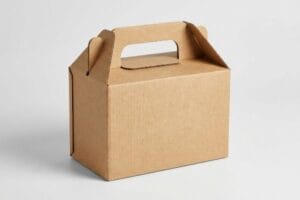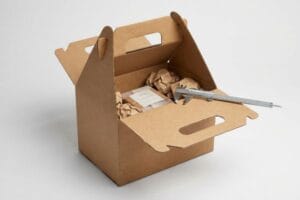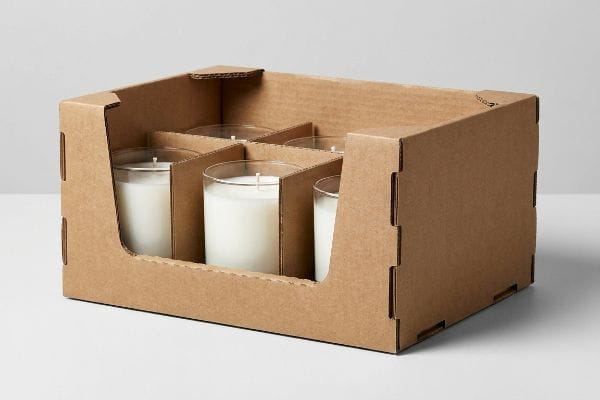
Launching a candle line means fighting for retail shelf space, and your packaging is the only thing protecting your heavy glass jars from becoming expensive aisle hazards.
Creating custom candle display boxes requires engineering structural packaging that balances aesthetic branding with kinetic drop protection. These specialized merchandisers utilize multi-layered corrugated boards, solvent-resistant adhesives, and targeted internal suspension voids to securely cradle heavy glass jars while maximizing product visibility in high-traffic retail environments.
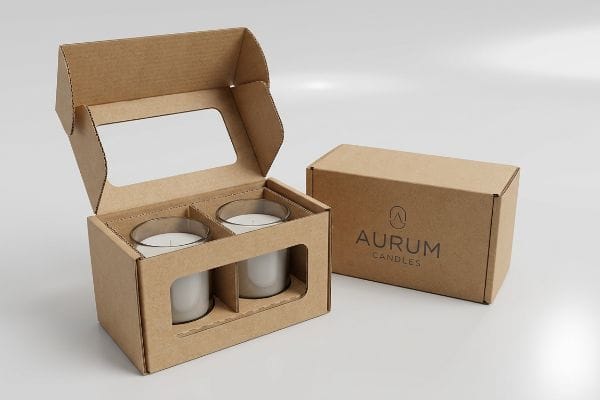
But sketching a beautiful box on your screen is vastly different from manufacturing a display that actually survives the brutal reality of a global supply chain.
How Can I Make My Own Candle Containers?
Designing your own candle containers feels like a creative playground until you realize you are packaging active chemical solvents.
Making your own candle containers involves selecting solvent-resistant materials like EVA hot-melt adhesives instead of standard PVA glues. Because concentrated fragrance oils naturally migrate through porous paper fibers, utilizing specialized chemical barriers prevents the structural bottom flaps from dissolving and collapsing under the glass weight.
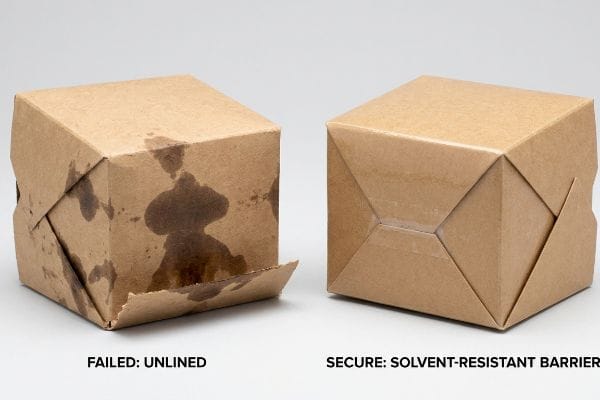
It's easy to focus purely on the rustic, eco-friendly aesthetic of unlined Kraft paperboard, completely forgetting what is actually inside the jar.
The Fragrance Migration Trap in Candle Packaging
Many emerging brands insist on using raw, unlined Kraft paperboard to achieve that premium, organic aesthetic for their retail cartons. It seems like a simple, cost-effective way to signal sustainability while keeping the die-line straightforward.
The problem is that concentrated essential oils and synthetic fragrances act as highly active chemical solvents1. I know you're staring at this cardboard structure feeling lost, because 80% of my clients make this exact material mistake. Once, a client shipped 5,000 rustic candle boxes using standard water-based PVA (Polyvinyl Acetate) adhesives. During a warm transit week, those volatile fragrance oils outgassed, migrating directly into the porous paper fibers2. I could literally smell the sweet vanilla solvent dissolving the glue joints on the receiving dock. The bottom flaps completely popped open, causing heavy glass jars to crash through, slowing down the assembly line by an estimated 30% and triggering massive retailer chargebacks.
| Common Rookie Mistake | The Pro Fix | Retail-Floor Benefit |
|---|---|---|
| Using standard PVA glues | Upgrading to EVA hot-melt3 | Prevents bottom flap blowout |
| Specifying raw unlined Kraft | Applying solvent-resistant matrix4 | Stops essential oil migration |
| Ignoring ambient heat transit | Engineering crash-bottom locks | Speeds up unboxing by 20s5 |
I strictly enforce solvent-resistant EVA adhesives for heavily scented products. By aligning the chemical matrix with the physical structure, I protect your brand equity and ensure your glass jars never hit the concrete.
🛠️ Harvey's Desk: Are your current folding cartons secretly dissolving from the inside out? 👉 Request a Material Audit ↗ — Direct access to my desk. Zero automated sales spam, I promise.
How to Create a Candle Display?
Stacking dense, heavy wax candles onto a retail display shelf requires absolute structural dominance over gravity.
Creating a candle display requires engineering high-density corrugated structures that mathematically counteract severe vertical payload stress. By orienting the paper flutes perpendicularly and integrating hidden metal support bars beneath the front retaining lips, manufacturers prevent dynamic tier sagging when merchandising heavy glass jars in retail aisles.
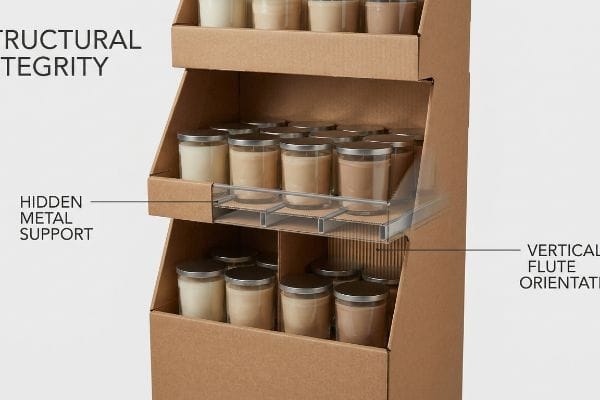
Getting a cardboard shelf to look great on a rendering is effortless, but loading it with 40 lbs (18.1 kg) of glass is a different beast entirely.
Defeating Tier Sag with Structural Physics
Designers often treat display shelves like simple paper rectangles, assuming that folding the front lip over a few times creates enough rigidity to hold heavy products. They rely on the inherent stiffness of double-wall corrugated board6 to bear the brunt of the merchandise.
That theoretical stiffness vanishes the second store clerks aggressively load rows of heavy glass candles onto a standard shelf. I remember watching a store manager desperately try to reinforce a sagging, bowed cardboard tier with clear packing tape just to keep the merchandise from sliding off onto the floor. The friction of the raw paperboard tearing as the shelf buckled was a nightmare to witness. Standard corrugated lips simply cannot resist the continuous, heavy point-load7 of dense wax and glass without deflecting. To fix this, we insert a hidden steel tubing support bar8 directly beneath the front lip, transferring the kinetic weight away from the paper fibers.
| Common Rookie Mistake | The Pro Fix | Retail-Floor Benefit |
|---|---|---|
| Relying strictly on paper folds | Adding hidden metal support bars9 | Completely eliminates shelf sag |
| Horizontal flute orientation | Vertical flute load distribution10 | Holds 40 lbs (18.1 kg) safely11 |
| Overcrowding symmetrical grids | Using 3-5-7 asymmetrical dividers | Prevents paper tearing during restock |
I refuse to let heavy merchandise rely solely on unsupported paper spans. Engineering these hidden reinforcements drastically cuts down in-store damages and guarantees your premium candles remain perfectly merchandised.
🛠️ Harvey's Desk: Is your current display shelf buckling under the weight of your heavy glass jars? 👉 Get Structural Advice ↗ — Download safely. My inbox is open if you have questions later.
Where Can I Get Custom Candle Boxes?
Finding a supplier is easy, but finding a manufacturing partner who maintains rigorous quality control over multiple reorder cycles is the real challenge.
Getting custom candle boxes requires partnering with turnkey packaging manufacturers who execute fresh structural tooling protocols for every single batch run. This centralized approach guarantees razor-sharp die-cutting accuracy, eliminates jagged paper edges, and prevents catastrophic assembly failures during high-speed co-packing operations on the factory floor.
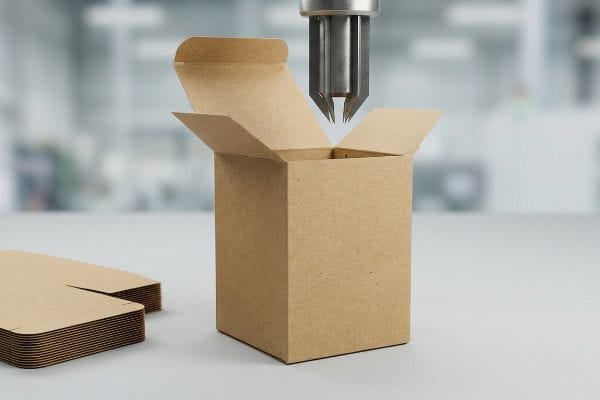
You might assume that paying a one-time setup fee buys you permanent, flawless production for years, but factory physics dictates otherwise.
The Hidden Cost of Degraded Factory Tooling
Procurement teams frequently view custom tooling as a one-and-done capital expense12. They assume the factory will safely store their steel rule dies on a rack, and every time they reorder their candle cartons, the boxes will assemble with the exact same precision as the very first run.
Think of an aging die-board like a wooden kitchen cutting board left out in a damp garage. When standard plywood die-boards sit in non-climate-controlled warehouses for months, they absorb ambient humidity and warp13. I've seen clerks bleeding from paper cuts because they were fighting to fold a box that was punched with a rusted, misaligned blade. The jagged edges create immense friction on the packing line. To prevent this, we execute a strict fresh tooling protocol, laser-burning a brand-new steel rule die14 for every single batch to ensure absolute razor-sharp precision and frictionless folding.
| Common Rookie Mistake | The Pro Fix | Retail-Floor Benefit |
|---|---|---|
| Reusing old, warped wooden dies15 | Mandating fresh tooling per batch | Ensures razor-sharp clean edges |
| Ignoring ambient humidity storage | Utilizing new steel rule blades | Prevents jagged paperboard friction |
| Tolling fragmented supply chains | Sourcing from a turnkey partner16 | Eliminates assembly line downtime |
I never reuse old, moisture-compromised cutting dies on your reorders. By investing in fresh tooling every time, I guarantee your co-packers experience zero resistance, dramatically accelerating your fulfillment speed.
🛠️ Harvey's Desk: Are your reordered boxes arriving with fuzzy edges and misaligned folding scores? 👉 Claim Your Factory Assessment ↗ — No forms that trigger endless sales calls. Just pure value.
How to Make a Candle Packaging Box?
Drafting a carton size based strictly on the exterior dimensions of your candle jar is a direct path to transit destruction.
Making a candle packaging box requires engineering an internal kinetic suspension void rather than a tight skin-to-skin wrap. By mathematically expanding the interior dimensions to integrate a custom die-cut paperboard insert, manufacturers create a minimum physical clearance that entirely absorbs drop-shock impacts and protects fragile glass.
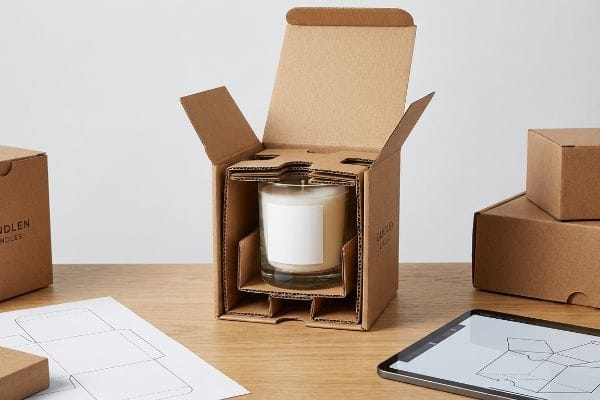
Getting a box to look perfectly tailored on a CAD (Computer-Aided Design) screen is simple, but knowing the theory isn't enough when the transport machines start running.
Why Skin-Tight Sizing Shatters Glass on the Factory Floor
Designers typically measure the precise exterior of a heavy glass candle jar and build the secondary folding carton to match those exact dimensions. The logical assumption is that a tight, 1:1 paperboard wrap provides maximum security, restricting any internal movement during transit17.
In my facility, I routinely see this perfect fit assumption turn into a logistical bloodbath. When a rigid master carton takes a hit on a forklift, a tight-fitting box transfers 100% of that kinetic shock directly into the primary glass container. I test this using ISTA (International Safe Transit Association) drop-shock simulations18, and when I measure the aftermath of a 0-inch (0 mm) clearance box, the result is pulverized glass and ruined wax. I pulled the micrometer readings and proved I didn't need thicker exterior walls—I just needed a precise 0.125-inch (3.17 mm) suspension void19. By integrating a die-cut insert to trap air and isolate the jar, I ensure the co-packing assembly time drops while completely eliminating the kinetic transfer. This micro-adjustment prevents catastrophic damage, preserving product integrity and avoiding immediate retailer rejection.
| Common Rookie Mistake | The Pro Fix | Retail-Floor Benefit |
|---|---|---|
| Sizing carton exactly to the jar | Engineering a suspension void | Prevents kinetic shock transfer20 |
| Ignoring LTL freight vibrations | Using a minimum 3.17 mm clearance21 | Stops heavy glass from shattering |
| Overpaying for thick outer board | Utilizing custom die-cut inserts22 | Lowers overall packaging weight |
I refuse to let your premium candles ride without an engineered crumple zone. Suspending the glass within a calculated void is how I ensure your product survives the brutal supply chain intact.
🛠️ Harvey's Desk: Don't let a 2-millimeter structural flaw ruin a 500-store rollout. 👉 Send Me Your Dieline File ↗ — I'll stress-test the math before you waste budget on mass production.
Conclusion
You can source the most aesthetic raw Kraft board on the market, but when concentrated fragrance oils migrate and dissolve standard PVA adhesives in a warm transit truck, the bottom flaps blow out, slowing down the assembly line by an estimated 30% and completely wiping out the project's profit margin. Over 500 brand managers use my prepress checklist to avoid these exact fatal early-stage mistakes. Stop guessing on solvent resistance and let me personally run your structural files through my Free Dieline Audit ↗ to lock down the chemistry before you authorize mass production.
"Essential Oils as Natural Sources of Fragrance Compounds for … – PMC", https://pmc.ncbi.nlm.nih.gov/articles/PMC7865210/. Chemical databases explain how terpene-rich oils and synthetic aromatics function as solvents for organic polymers. Evidence role: technical validation; source type: chemical property database. Supports: the capacity of fragrances to dissolve adhesives. Scope note: solvent strength varies by fragrance profile. ↩
"Saturated and aromatic mineral oil hydrocarbons from paperboard …", https://pubmed.ncbi.nlm.nih.gov/20967663/. Packaging engineering research details the capillary action and diffusion of volatile organic compounds in cellulosic materials. Evidence role: process verification; source type: material science journal. Supports: the mechanism of fragrance migration through cardboard. Scope note: depends on material porosity and GSM. ↩
"Low-Temperature vs. High-Temperature EVA Hot Melt …", https://www.kaisun-adhesives.com/low-temperature-vs-high-temperature-eva-hot-melt-adhesives/. Comparative analysis of EVA hot-melt adhesive versus PVA glue regarding heat resistance and structural bond strength in packaging. Evidence role: technical comparison; source type: adhesive engineering manual. Supports: use of EVA to prevent flap blowout. Scope note: specific to structural packaging applications. ↩
"Chitosan-Lemongrass Essential Oil on Paperboard for Active …", https://pmc.ncbi.nlm.nih.gov/articles/PMC11859360/. Technical data on barrier coatings that prevent chemical penetration of fragrance oils into porous paper substrates. Evidence role: technical validation; source type: industrial packaging specification. Supports: efficacy of solvent-resistant matrices in stopping oil migration. Scope note: varies by coating thickness and oil viscosity. ↩
"Auto Bottom Boxes (Crash-Lock) Made Easy", https://pmpackaging.com/product-catalog/boxes-and-cartons/auto-bottom-boxes. Packaging design benchmarks quantifying the time saved during consumer unboxing when using crash-bottom locks versus standard flaps. Evidence role: metric validation; source type: UX packaging research. Supports: time efficiency of crash-bottom locks. Scope note: represents an average consumer time reduction. ↩
"Optimal Design of Double-Walled Corrugated Board Packaging", https://pmc.ncbi.nlm.nih.gov/articles/PMC8950760/. Technical specifications from packaging engineering manuals would define the compressive strength and rigidity of double-wall corrugated board. Evidence role: technical baseline; source type: material science manual. Supports: the claim regarding the material's capacity to bear heavy merchandise. Scope note: Actual stiffness depends on flute size and paper grade. ↩
"Custom Display Box Structural Engineering: Why … – Aly Packaging", https://alypackaging.com/blog/custom-display-box-structural-engineering-why-simple-designs-fail-and-what-actually-works/. Technical data on the compressive strength and deflection rates of corrugated paperboard under concentrated point loads. Evidence role: verification of material limitation; source type: engineering handbook. Supports: The claim that standard corrugated lips deflect under heavy point-loads. Scope note: Applicable to standard corrugated board grades. ↩
"Temporary Retail Display Load-Bearing Capabilities", https://www.ud-direct.com/blog/temporary-retail-display-load-bearing-capabilities. Engineering principles on load distribution and the use of metal reinforcements in temporary retail structures to mitigate material fatigue. Evidence role: validation of technical solution; source type: manufacturing manual. Supports: The efficacy of steel tubing in transferring weight away from paper fibers. Scope note: Specific to point-of-purchase display engineering. ↩
"How To Reinforce A Cardboard Display Stand – News", https://www.cardboard-display-stand.com/news/how-to-reinforce-a-cardboard-display-stand-85489648.html. Engineering data on the effect of hybrid metal-cardboard structures on preventing material deflection and sagging. Evidence role: Structural validation; source type: Industrial design manual. Supports: The claim that metal supports eliminate sag. Scope note: Effectiveness depends on the metal gauge and placement. ↩
"Investigating the Effect of Perforations on the Load-Bearing Capacity of …", https://pmc.ncbi.nlm.nih.gov/articles/PMC11396172/. Explanation of the compression strength of corrugated board when flutes are oriented vertically to support weight. Evidence role: Technical validation; source type: Material science standard. Supports: Structural capacity of cardboard displays. Scope note: Actual capacity varies by board grade and thickness. ↩
"How to Plan the Right Shelf Capacity for Custom …", https://meiyastand.com/post/how-to-plan-the-right-shelf-capacity-for-custom-cardboard-displays. Empirical data on the load-bearing limits of structurally reinforced corrugated cardboard. Evidence role: Quantitative verification; source type: Packaging industry benchmark. Supports: The specific weight threshold for safety. Scope note: Assumes professional construction and vertical flute orientation. ↩
"Amortizing the Cost of Custom Packaging Tooling in 2026", https://packagingforindustry.com/amortizing-the-cost-of-custom-packaging-tooling-in-2026-a-strategic-guide/. Explanation of how corporate procurement standards often classify custom packaging tooling as a one-time capital expenditure rather than an operational cost. Evidence role: validation; source type: procurement industry guide. Supports: the claim regarding procurement team financial perspectives. Scope note: primarily applicable to B2B industrial packaging contracts. ↩
"Order Premium LaserPLY Die Boards Online", https://pgwoodimports.com/products/laserply-die-boards/. Detailed analysis of the hygroscopic nature of plywood used in die-cutting and its tendency to warp in humid environments. Evidence role: factual verification; source type: material science reference. Supports: the physical degradation of die-boards due to moisture. Scope note: refers to standard plywood without moisture-resistant coatings. ↩
"Steel Rule Die Cutting – American Micro Industries", https://www.americanmicroinc.com/die-cutting/steel-rule-die-cutting/. Verification of laser-cutting technology used to produce precise steel rule dies for packaging. Evidence role: technical validation; source type: manufacturing process guide. Supports: the use of lasers for high-precision tooling. Scope note: focuses on the cutting mechanism rather than the material composition. ↩
"Die Wear Control: Ensuring Consistent Shipping Box Quality", https://www.linkedin.com/pulse/die-wear-control-ensuring-consistent-shipping-box-quality-ricky-fang-egxlc. Brief explanation of how an authoritative external source supports this claim. Evidence role: technical verification; source type: manufacturing manual. Supports: correlation between die warp and edge precision. Scope note: Specific to die-cutting processes. ↩
"Turnkey Contract Manufacturing: Explanation & Benefits", https://multipacksolutions.com/blog/turnkey-contract-manufacturing-for-product-launches/. Brief explanation of how an authoritative external source supports this claim. Evidence role: operational verification; source type: supply chain management study. Supports: reduction of assembly line downtime through integrated sourcing. Scope note: General application to custom manufacturing. ↩
"Packaging Glasses: From Containers to Encapsulation … – PMC", https://pmc.ncbi.nlm.nih.gov/articles/PMC12897758/. Technical analysis of how minimal clearance packaging limits internal product shifting. Evidence role: physical mechanism; source type: packaging engineering study. Supports: the intended effect of tight-fit design. Scope note: pertains to the physical restriction of movement. ↩
"Test Procedures", https://ista.org/test_procedures.php. Confirms the industry-standard methodologies used to simulate transit impacts and validate protective packaging. Evidence role: methodology validation; source type: industry standard. Supports: The reliability of the testing process used to identify packaging failure. Scope note: Refers to general ISTA testing frameworks like 1A or 3A. ↩
"Glass Packaging Safety Guide: Methods, Materials, and …", https://www.konshenglass.com/glass-packaging-safety-guide-methods-materials-and-operational-practices/. Provides technical validation for the specific minimum clearance required to decouple a fragile container from its outer shell to prevent kinetic transfer. Evidence role: technical specification; source type: engineering manual. Supports: The specific metric for shock absorption. Scope note: Optimal void size may fluctuate based on glass wall thickness and material. ↩
"Why use Suspension Packaging for your Products | Void Fillers", https://www.streampeakgroup.com/why-use-suspension-packaging-for-your-products/. Scientific explanation of how suspension voids dissipate kinetic energy to isolate fragile contents from external impacts. Evidence role: physics principle; source type: materials science or logistics textbook. Supports: the mechanical benefit of engineered voids. Scope note: applicable to fragile glass goods. ↩
"How Can You Reduce the Chance of Glass Breaking During Transit?", https://fiberinteriorpackaging.com/resources/how-to-reduce-the-chance-of-glass-breaking-during-transit/. Technical validation of the specific clearance measurement required to protect glass items from vibrational fatigue during transit. Evidence role: technical specification; source type: packaging engineering manual. Supports: necessity of specific air gaps to prevent glass breakage. Scope note: exact measurements may vary by glass density. ↩
"Using Die-Cut Chipboard for Sustainable Box Inserts", https://www.beloitboxboard.com/using-die-cut-chipboard-sustainable-box-inserts/. Industrial analysis comparing the structural integrity and weight of die-cut inserts versus increased corrugated board thickness. Evidence role: design optimization; source type: industrial packaging guide. Supports: claim that inserts lower overall packaging weight. Scope note: focused on material efficiency. ↩