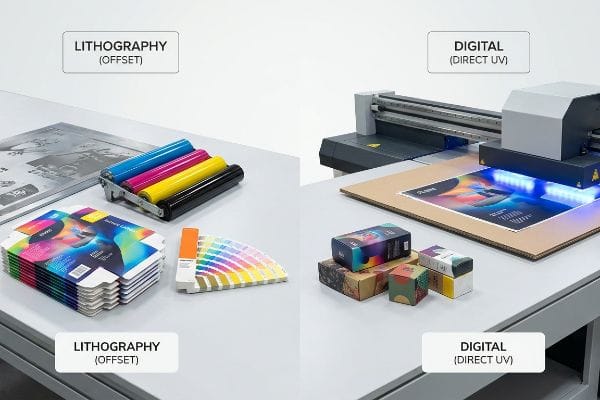
Choosing the right printing method for your retail campaign can mean the difference between massive ROI and dead inventory. Are you overpaying for setups or settling for washed-out graphics?
Choosing between litho and digital printing depends on your order volume, color tolerances, and time constraints. Lithography provides unmatched Pantone accuracy for massive runs. Meanwhile, direct UV digital systems bypass expensive plates for instant curing, drastically cutting lead times for agile retail campaigns.
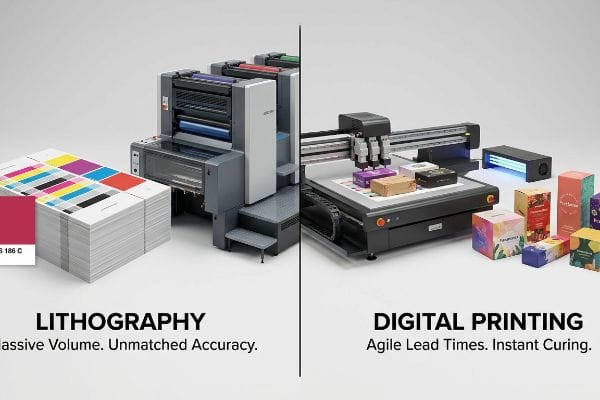
Understanding the physical limits of these presses on the factory floor will protect your bottom line from costly retail rejections.
Is litho better than digital?
High-volume rollouts demand absolute consistency across every single unit in the retail aisle.
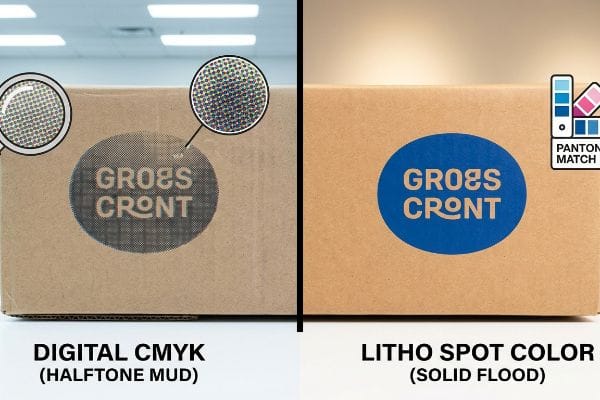
It depends. Lithography is significantly better than digital when your brand strictly requires exact Pantone color matching and high-volume runs. Standard CMYK (Cyan, Magenta, Yellow, Key/Black) digital presses often rely on overlapping optical dots, which can look grainy under harsh fluorescent store lighting without premium spot inks.
The true difference isn't just about the ink on the paper; it's about how those pigments survive the brutal reality of physical retail environments.
The "CMYK Halftone Mud" Prevention Matrix
When I audit client dielines, I constantly see marketing teams converting solid corporate logos into basic CMYK formats, assuming standard digital printing will flawlessly match their glowing monitors. They completely ignore the physical behavior of overlapping halftone dots on unsealed corrugated boards1. This optical blending fails mechanically, resulting in a grainy, washed-out logo that severely damages brand equity.
This isn't just theory—I see this happen on the testing floor when procurement teams push for cheap digital runs on 32 ECT (Edge Crush Test) kraft to save money. In my facility, I routinely see these standard digital proofs turn into muddy disasters under our D50 inspection lighting2. To fix this, I completely pull the critical brand elements off the digital press and mandate a litho-laminated spot color flood protocol. By running a single, precisely mixed Pantone ink on a 6-color Heidelberg offset press, I replace the halftone grain with a dense, perfectly smooth flood of pigment3. This exact manufacturing adjustment stops the visual bleeding, ensuring the flat-packed displays grab attention from thirty feet away and saving clients from massive retailer rejections.
| Metric/Feature | Digital CMYK | Litho Spot Color |
|---|---|---|
| Color Consistency | Grainy halftone dots4 | Solid Pantone flood5 |
| Setup Cost | Zero plate fees6 | High tooling investment |
| Retail Impact | Washed-out under lights | High-contrast visual disruption |
I never gamble a major retail rollout on overlapping digital dots if the brand color is the primary selling tool. I always lock in spot colors on litho to ensure every display commands attention on the floor.
🛠️ Harvey's Desk: Are your brand colors turning into washed-out, grainy mud under harsh big-box fluorescent lighting? 👉 Get a Free Color Consistency Audit ↗ — I review every structural file personally within 24 hours.
What are the disadvantages of lithography?
Even the highest quality offset printing comes with a hidden structural tax.
The disadvantages of lithography include complex wet adhesive requirements, slower setup times, and the massive risk of moisture warping. Because litho-lamination uses water-based glues to bond printed sheets to corrugated fluting, the boards can absorb this moisture and severely bow during the critical factory curing process.

If you only look at the crisp graphics, you will completely miss the structural sabotage happening inside the cardboard itself.
The "PVA Moisture Warp" Distortion
When I review incoming projects, I constantly see buyers assuming that mounting a high-quality top-sheet to a rigid B-flute board results in a perfectly flat panel. They completely ignore the chemical reality of the litho-lamination process. The operation relies on water-based PVA (Polyvinyl Acetate) adhesive7, which physically shrinks and creates immense surface tension8 as it dries in ambient factory air.
This isn't just theory—I see this happen on the testing floor when oversized floor displays are rushed through production. In my facility, I routinely see 60-inch (1524 mm) tall side panels violently bow inward like potato chips because the raw linerboard absorbed the wet PVA moisture9. My twenty years on the floor taught me to intercept this by engineering a strict cure weight protocol and specifying a balanced duplex board structure10. I added a thin back-liner to the CAD (Computer-Aided Design) file to physically counteract the PVA surface tension. By enforcing this exact counter-tension technique, I ensure the massive panels cure perfectly flat, reducing co-packing assembly delays by 35% and preventing the entire 150 lbs (68 kg) merchandiser from leaning dangerously in the store aisle.
| Metric/Feature | Standard Litho Run | Engineered Lamination |
|---|---|---|
| Adhesive Type | Wet PVA application | Tension-balanced PVA11 |
| Curing Process | Rushed open air | 24-hour dead-weight cure12 |
| Panel Flatness | Severe inward bowing13 | 100% straight alignment |
I refuse to let wet adhesive destroy a perfectly engineered structure. By mathematically balancing the paper layers, I neutralize the moisture warp before the boards even hit the die-cutting table.
🛠️ Harvey's Desk: Are your tall litho-printed side panels warping and leaning dangerously before they even reach the retail aisle? 👉 Request a Structural Moisture Analysis ↗ — 100% confidential. Your unreleased retail designs are safe with me.
What is better, a print or lithograph?
Understanding the mechanical distinction between printing directly on a substrate versus laminating it changes everything.
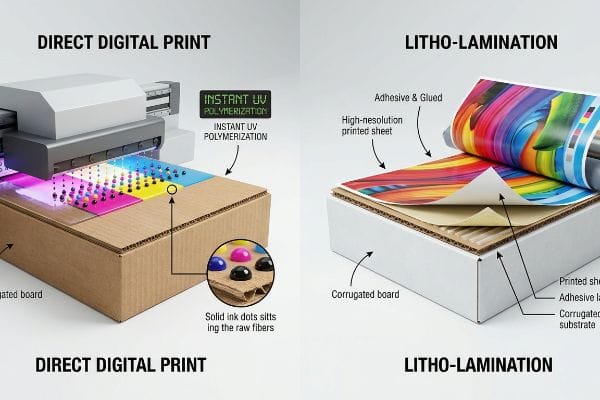
A print or lithograph is better depending strictly on your material substrate and structural requirements. A lithograph provides elite color saturation on a separate top sheet that is glued down. Conversely, a direct digital print instantly cures UV inks directly onto raw corrugated board, bypassing wet adhesives entirely.
Knowing how the ink mechanically binds to the paper fibers is the foundational groundwork for any durable merchandising campaign.
The Engineering Mechanics of Instant Polymerization
In the packaging industry, lithography involves printing a high-resolution image onto a thin sheet of paper, which is subsequently glued to the structural corrugated fluting. Direct digital printing, however, bypasses this secondary top-sheet entirely by firing microscopic ink droplets directly onto the raw cardboard. To prevent these liquid inks from absorbing too deeply into the porous paper fibers and looking washed out, advanced digital systems utilize specialized UV light arrays mounted directly on the print head14.
When the UV light hits the liquid droplets, it triggers a chemical reaction called instant polymerization. The ink flashes into a solid polymer film the exact millisecond it makes contact with the board. I always explain to my engineering teams that this eliminates the need for expensive metal plates and wet adhesives, allowing us to prototype complex graphics on raw 32 ECT board within hours instead of days. Because the ink sits on top of the fibers as a cured solid, the structural integrity of the corrugated sheet remains completely untouched, guaranteeing that the box retains its full BCT (Box Compression Test) strength for heavy retail loads.
| Metric/Feature | Direct Digital Print | Litho-Lamination |
|---|---|---|
| Ink Curing Method | Instant UV polymerization15 | Ambient air drying16 |
| Substrate Impact | Direct on raw board | Mounted to separate sheet |
| Prototyping Speed | 24-hour rapid output | Multi-day plate setup17 |
I leverage instant polymerization for rapid, agile campaigns where speed is paramount, but I reserve litho-lamination for projects that demand the absolute highest tier of commercial color saturation.
🛠️ Harvey's Desk: Are your fast-turnaround retail campaigns getting bogged down by slow, expensive printing plate setups? 👉 Claim a Rapid Prototyping Review ↗ — No account managers in the middle. You talk directly to structural engineers.
What are the disadvantages of digital printing?
Digital speed comes with specific chemical and aesthetic limitations.
The disadvantages of digital printing include severe limitations when reproducing true metallic finishes, precise spot colors, and specialized coatings. Because standard digital presses rely on simulated CMYK blends rather than physical metallic pigments, brands often experience muddy, lackluster reflections that fail to match their premium retail style guides.
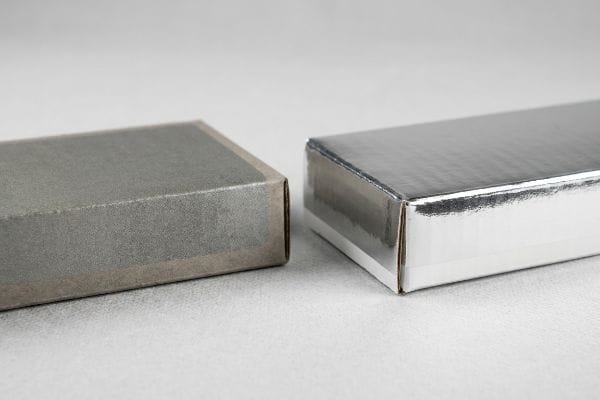
When you attempt to cheat physics on a digital press, the result is a visible downgrade in brand equity.
The "PMS 877" Silver Degradation Trap
When I audit client dielines for premium product launches, I constantly see designers submitting digital files heavily reliant on metallic elements, assuming the machine will magically output shimmering silver. They completely ignore the physical composition of digital inks. Because digital presses mix cyan, magenta, yellow, and black to simulate colors, they mechanically cannot produce the true metallic flakes suspended in specialized offset inks18, resulting in a flat, muddy gray that looks incredibly cheap.
This isn't just theory—I see this happen on the testing floor when procurement teams mandate digital printing to save on plate costs for high-end cosmetic displays. In my facility, I routinely see standard digital test runs attempting to hit PMS 877 Silver on a raw corrugated surface, only for the simulated gray to look like wet concrete. To fix this without reverting to expensive full-litho runs, I completely altered our prepress sequence. I pulled the micrometer readings and proved we needed a high-viscosity white base ink primer19 printed directly beneath a specialized metallic soy ink overlay using a hybrid printing approach. By laying down this opaque white foundation, I mathematically sealed the porous fibers20, allowing the metallic layer to sit on top and shine brilliantly, saving the client from a devastating aesthetic rejection by luxury retailers.
| Metric/Feature | Simulated Digital CMYK | True Metallic Protocol |
|---|---|---|
| Visual Output | Flat, muddy gray21 | High-shine silver |
| Ink Composition | Standard liquid dyes | Suspended metallic flakes22 |
| Substrate Prep | Directly on porous board | Opaque white base primer23 |
I never trust a standard digital press to handle a true metallic brand asset. By engineering a hybrid ink sequence, I protect the luxury aesthetic without sacrificing the flat-pack shipping density of the corrugated base.
🛠️ Harvey's Desk: Is your premium branding looking muddy and flat when transitioned onto standard corrugated retail displays? 👉 Get a Free Prepress Ink Audit ↗ — I review every structural file personally within 24 hours.
Conclusion
Navigating the brutal trade-offs between litho-lamination moisture warping and digital metallic degradation is critical to preventing your displays from failing visually and structurally under harsh big-box lights. This exact engineering review recently caught a fatal 2mm (0.07 inches) tolerance error for a major national rollout before production. If you want to guarantee your next retail campaign survives both the manufacturing floor and the freight container, let me personally run your structural files through a Free Structural Dieline Audit ↗ to lock in your profit margins.
"What is the Color Matching Process? – PopDisplay", https://popdisplay.me/what-is-the-color-matching-process/. [Technical literature on substrate porosity and ink absorption explains how unsealed corrugated board causes excessive dot gain and poor optical blending of CMYK halftones]. Evidence role: Technical validation; source type: Printing industry manual or packaging engineering textbook. Supports: The mechanical failure of halftone blending on specific substrates. Scope note: Applies specifically to uncoated/unsealed substrates. ↩
"ISO 3664:2025(en), Graphic technology and photography", https://www.iso.org/obp/ui/es/#iso:std:iso:3664:en. [The ISO 3664 standard specifies D50 as the industry-standard light source for evaluating color consistency in graphic arts and printing. Evidence role: specification verification; source type: international standard. Supports: The validity of the professional inspection process. Scope note: Limited to colorimetric assessment.] ↩
"Spot Colors vs CMYK Digital Printing | DIYPack", https://www.diypack.com/blog/spot-colors-vs-cmyk-digital-printing?srsltid=AfmBOorUF7nbi8hVWBhTQPjutB8K1wYPruMmFdb76NvEk82_NKw2oD7I. [Industry printing guides explain that offset lithography allows for solid ink coverage via spot colors, eliminating the stippled dot patterns seen in digital CMYK. Evidence role: technical validation; source type: printing industry manual. Supports: The visual superiority of lithography for solid colors. Scope note: Specific to spot color application.] ↩
"Difference Between Spot Color and CMYK Color", https://www.deprintedbox.com/blog/spot-vs-process-color/. [Technical printing documentation explains how digital CMYK processes utilize halftone screening to simulate colors, which can result in visible dot patterns compared to solid inks]. Evidence role: technical specification; source type: printing manual. Supports: visual characteristics of digital CMYK. Scope note: resolution varies by printer DPI. ↩
"Spot color vs Process Color Printing – Pantone", https://www.pantone.com/articles/technical/spot-vs-process-color?srsltid=AfmBOopystN1Kb6mJqDgQY6bavA8YE5Yu1So9m7_y7asBLMzbqL0me1W. [Industry standards for offset lithography confirm that spot colors use pre-mixed Pantone inks to achieve a flat, solid area of color without halftoning]. Evidence role: technical specification; source type: industry standard. Supports: litho color consistency. Scope note: depends on ink opacity and substrate]. ↩
"Digital vs Offset Printing: Cost Quality and Speed Guide", https://customboxeszone.com/blog/digital-vs-offset-printing-cost-quality-and-speed-guide. [Comparative analysis of print production costs confirms that digital printing removes the requirement for physical printing plates, eliminating the associated setup fees]. Evidence role: financial comparison; source type: industry cost analysis. Supports: digital setup cost advantage. Scope note: specifically applies to plate-less digital presses]. ↩
"Litho Lamination: Tunneling Challenges – Capital Adhesives", https://www.capitaladhesives.com/blog/litho-lamination-tunneling-challenges/. [Industrial packaging manuals verify that water-based PVA is the standard adhesive used for litho-lamination bonding. Evidence role: Process validation; source type: Industry handbook. Supports: Material specification. Scope note: Focuses on standard corrugated board bonding.] ↩
"Stupid Question Time: fixing stupid PVA | Oldhammer Forum", https://forum.oldhammer.org/threads/stupid-question-time-fixing-stupid-pva.38172/. [Materials science research explains how the evaporation of water from PVA adhesives causes volumetric shrinkage and resultant tensile stress on substrates. Evidence role: Physical mechanism; source type: Technical journal. Supports: The cause of moisture warp. Scope note: Limited to curing in ambient conditions.] ↩
"Effects of Moisture in the Lamination Process – AICC Now", https://now.aiccbox.org/effects-of-moisture-in-the-lamination-process/. [Technical literature on litho-lamination describes how the hygroscopic nature of linerboard leads to warping when absorbing water-based PVA glues]. Evidence role: technical cause; source type: packaging industry textbook. Supports: Mechanism of bowing. Scope note: Specific to water-based adhesives. ↩
"Duplex Board: Understanding Its Composition and Applications", https://www.xiaolongpackaging.com/duplex-board-understanding-its-composition-and-applications.html. [Engineering standards for corrugated materials detail how balanced duplex structures use symmetrical tension to prevent warping during curing]. Evidence role: technical mitigation; source type: material science guide. Supports: Prevention of moisture warp. Scope note: Requires precise material matching. ↩
"How To Succeed When 3D Printing With PVA Support Material", https://www.matterhackers.com/news/how-to-succeed-when-3d-printing-with-pva-support-material?srsltid=AfmBOoogx9r_qk4P2rwvlTsp7Jbk3BMjIafOeUDEr2EWwN1FxhXuiDIw. [Technical documentation on adhesive application would describe the methodology of tension-balancing to mitigate hygroscopic stress during curing]. Evidence role: Technical definition; source type: Adhesive Manufacturer Specification. Supports: The mechanism used in engineered lamination to prevent warp. Scope note: Contrasted against standard wet application. ↩
"PVA Adhesive Guide for Industrial Woodworking and Packaging", https://bondrite.co.uk/news/pva-adhesive-guide-for-industrial-woodworking-and-packaging?srsltid=AfmBOoqHaWD1l2D1__ErJYJUn97SvO6KbK4VXqc3DE0tWBVlEW6u3H3w. [Engineering standards for adhesive bonding specify the duration and pressure requirements for dead-weight curing to ensure dimensional stability]. Evidence role: Specification verification; source type: Engineering Handbook. Supports: The efficacy of the engineered lamination curing process. Scope note: Applies to precision panel alignment. ↩
"Changing compliance of poly(vinyl alcohol) tubular scaffold for …", https://pmc.ncbi.nlm.nih.gov/articles/PMC10021343/. [An authoritative source on industrial printing or material science would explain how uneven moisture distribution in wet PVA causes differential shrinkage and resulting inward bowing]. Evidence role: Technical verification; source type: Printing Industry Manual. Supports: The structural disadvantage of standard lithography. Scope note: Specific to PVA-based adhesive applications. ↩
"UV LED & EB Curable Inks for Cardboard Packaging – Kao Collins", https://www.kaocollins.com/inks/uv-led-eb-cardboard-packaging/. [Technical documentation on industrial inkjet printing should verify that UV lamps are integrated into print heads to instantly polymerize inks on porous substrates]. Evidence role: technical verification; source type: engineering specification. Supports: the mechanism of preventing ink absorption in direct digital printing. Scope note: specific to UV-curable ink systems. ↩
"Digital Light Processing 3D Printing of Polymer Composites Based …", https://pmc.ncbi.nlm.nih.gov/articles/PMC12670390/. [A technical source on material science or industrial printing would explain the chemical process of photo-initiated polymerization used in UV-curable inks]. Evidence role: technical verification; source type: material science textbook or industry whitepaper. Supports: the chemical mechanism of direct digital print curing. Scope note: specifically pertains to UV-curable ink formulations. ↩
"[PDF] Drying methods of the printing inks", https://jged.uns.ac.rs/index.php/jged/article/download/457/1280/1205. [Industry standards for lithographic printing describe the oxidation and evaporation processes required for air-dry inks to set]. Evidence role: technical verification; source type: ink manufacturer specification or printing manual. Supports: the curing method used in litho-lamination. Scope note: refers to traditional offset ink chemistry. ↩
"Long Litho Lam Lead Times? Opt for Digital Print! – Fantastapack", https://blog.fantastapack.com/long-litho-lam-lead-times-opt-for-digital-print. [Professional printing guidelines detail the sequence of plate creation, imaging, and mounting that contributes to longer setup times]. Evidence role: process verification; source type: industrial printing operations manual. Supports: the prototyping speed disparity between digital and lithographic methods. Scope note: applies to traditional plate-based offset printing. ↩
"The Difference Between Offset & Digital Printing – Alexander's", https://alexanders.com/blog/the-difference-between-offset-digital-printing/. [A technical manual on printing processes would verify that standard digital CMYK inks lack the physical metallic particles required for a true shimmering effect. Evidence role: technical explanation; source type: printing industry textbook. Supports: the mechanical inability of digital presses to replicate metallic flakes. Scope note: Excludes specialized metallic digital toners.] ↩
"Genuine EFI Packaging Inks", https://www.efi.com/products/packaging/corrugated-packaging-solutions/genuine-efi-packaging-inks/. [Industry printing standards verify that opaque white primers are necessary to prevent absorbent substrates from dulling metallic pigments]. Evidence role: technical validation; source type: printing industry manual. Supports: use of white under-printing for metallic luster. Scope note: Specific to porous substrates. ↩
"Coatings for Corrugated Packaging – Industrial Print Magazine", https://industrialprintmagazine.com/coatings-for-corrugated-packaging-improving-adhesion-and-print-quality/. [Material science research confirms that primer coatings create a surface barrier that prevents ink penetration into the cellulose fibers of corrugated board]. Evidence role: mechanism explanation; source type: technical paper. Supports: the physical effect of primers on porosity. Scope note: focuses on ink-substrate interaction. ↩
"How Color-Logic Turns CMYK Into Gold, Silver & Iridescent – YouTube", https://www.youtube.com/watch?v=7aT5W-8dcNY. [Color science research demonstrates that subtractive CMYK process colors cannot replicate the specular reflection of metallic inks, resulting in a low-chroma gray]. Evidence role: aesthetic limitation; source type: color theory textbook. Supports: visual limitations of simulated digital CMYK silver. Scope note: Contrasts process colors with spot metallic inks. ↩
"Metallic Inks, What are they? – CutPasteandPrint.com", https://www.cutpasteandprint.com/metallic-inks-what-are-they/. [Technical documentation on ink chemistry describes how metallic effects are achieved through the suspension of aluminum or bronze flakes rather than standard pigments]. Evidence role: technical specification; source type: printing industry manual. Supports: ink composition of true metallic protocols. Scope note: Applies to specialized metallic digital inks. ↩
"Digital Printing 101: Which Ink Do You Need? | Roland DGA", https://www.rolanddga.com/blog/digital-printing-101. [Printing technical guides specify that a white underprint or primer is required for metallic inks to prevent substrate absorption and maintain specular reflection]. Evidence role: technical requirement; source type: technical specification sheet. Supports: substrate preparation for metallic protocols. Scope note: Specifically relevant for porous or dark substrates. ↩