The holiday retail season is a massive revenue driver, but mounting eco-conscious consumer demands mean your festive floor campaigns can no longer rely on wasteful, non-recyclable materials.
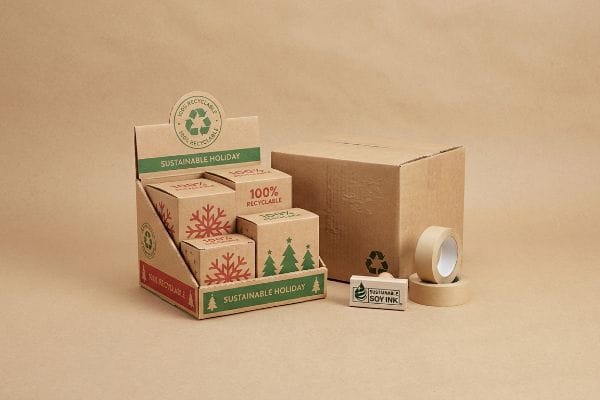
Celebrating sustainably this Christmas requires transitioning your retail campaigns away from mixed plastics toward 100% curbside recyclable structures. Brands achieve this by engineering mono-material corrugated displays, replacing petroleum-based laminations with aqueous coatings, and utilizing soy-based inks to maintain festive visual appeal without sacrificing global environmental compliance.
But wanting an eco-friendly holiday rollout and actually surviving the factory floor realities are two entirely different battles.
What are some ideas for celebrating Christmas sustainably?
Upgrading your structural materials is the fastest way to align with modern buyer expectations and avoid harsh retail penalties.
Effective ideas for sustainable Christmas retail rollouts involve prioritizing mono-material engineering over complex material blends. Industry standards dictate utilizing untreated virgin kraft liners, swapping plastic shelf clips for origami-style paper locks, and mandating water-based finishes to ensure the entire merchandiser effortlessly survives standard municipal repulping processes.
These straightforward material swaps sound perfect in a pitch meeting, but standardizing them requires strict chemical oversight.
The Bio-Plastic Composting Trap in Holiday Displays
Even veteran marketing teams frequently mandate PLA (Polylactic Acid) bio-plastic laminations1 for their holiday packaging, assuming this corn-based film guarantees environmental compliance. They believe a thin plastic-like layer will give their seasonal graphics a premium gloss while checking the sustainability box for major retailers. This theoretical approach dominates early-stage fourth-quarter campaign planning.
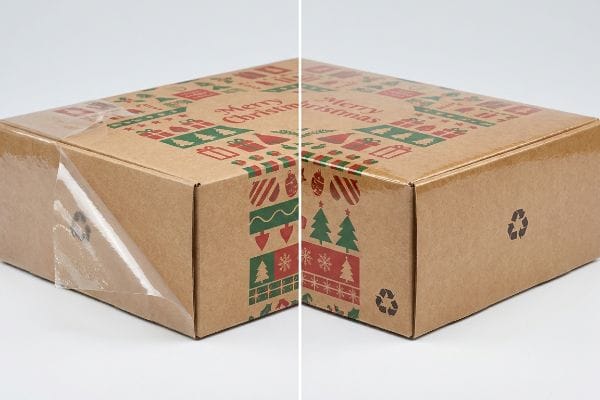
I regularly see this backfire on the OCC (Old Corrugated Containers) repulping line. When standard recycling centers intercept this bio-plastic film, it repels water and refuses to break down2 in the vats, causing the entire display to be diverted straight to a landfill. To prevent this, I mandate a liquid aqueous coating protocol over solid PLA films. Because water-based aqueous finishes act as a liquid polymer matrix3 that dissolves seamlessly, the packaging remains 100% curbside recyclable. The loud, sticky tearing sound of peeling a rejected PLA film off a printed top sheet is a noise I actively avoid on the floor. By enforcing this aqueous switch, my clients maintain their premium gloss while completely eliminating the risk of retailer rejection.
| Common Rookie Mistake | The Pro Fix | Retail-Floor Benefit |
|---|---|---|
| Specifying PLA bio-plastics | Liquid aqueous coating4 | Guarantees curbside recycling |
| Assuming gloss requires plastic | High-solid water-based gloss | Maintains premium aesthetics |
| Ignoring OCC vat compatibility | Mono-material paper engineering5 | Prevents landfill diversion |
I refuse to let a microscopic layer of non-compliant film ruin a massive holiday launch. Stripping out incompatible laminations keeps your brand safe from greenwashing accusations and streamlines your entire supply chain.
🛠️ Harvey's Desk: Not sure if your glossy seasonal artwork uses landfill-bound plastics? 👉 Get Your Coating Assessed ↗ — Direct access to my desk. Zero automated sales spam, I promise.
What is a catchy phrase for sustainability?
Crafting the perfect seasonal slogan is useless if the ink used to print it destroys your environmental certifications.
Printing a catchy phrase for sustainability demands using eco-conscious pigments like metallic soy-based inks rather than traditional heavy metals. Utilizing volatile organic compound-free colorants ensures your brand messaging remains striking under harsh store lighting while maintaining strict compliance with global environmental recycling standards.
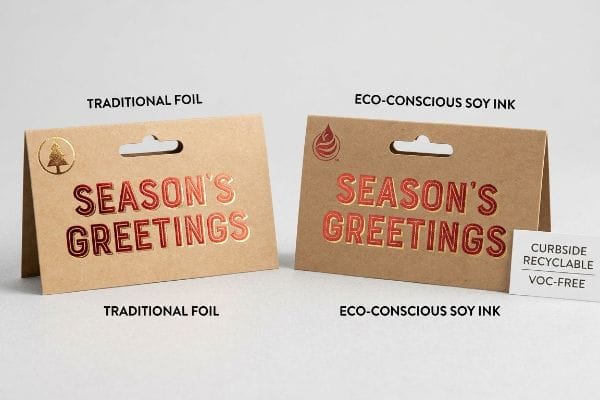
Creating a glittering holiday header card often introduces hidden chemical liabilities.
The Mixed Material Trap of Holiday Branding
Brands love to highlight their festive messaging with heavy hot-foil stamping, aiming to catch the shopper's eye from thirty feet away. It is a highly common practice to stamp thick metallic foils directly onto the header cards6 of POP (Point of Purchase) floor displays to maximize seasonal impact.
The problem arises when procurement realizes that heavy hot-stamping introduces unrecyclable metallic films7 into an otherwise sustainable board. I once watched a beautiful batch of holiday headers get flagged because the foil separation process was too complex for standard paper mills, triggering an immediate retailer rejection. My straightforward rule of thumb is to swap hot stamping for metallic soy inks or cold foil transfer processes. The harsh chemical smell of traditional petroleum inks drying on a press is completely absent when we switch to VOC (Volatile Organic Compound) free soy alternatives8. By engineering the artwork to use high-contrast metallic soy inks, you get that festive shimmer without the mixed-material friction, keeping your compliance pristine.
| Common Rookie Mistake | The Pro Fix | Retail-Floor Benefit |
|---|---|---|
| Heavy hot-foil stamping | Metallic soy-based inks9 | Eliminates material rejections |
| Petroleum-based printing | VOC-free soy pigments10 | Meets strict eco-guidelines |
| Ignoring mill separation limits | Curbside compliant finishes11 | Speeds up final store cleanup |
I always push clients toward smart pigment chemistry rather than brute-force foil stamping. Your festive slogan should elevate your brand equity, not trigger a compliance nightmare on the retail floor.
🛠️ Harvey's Desk: Are your glittering holiday headers secretly failing modern recycling standards? 👉 Request A Material Audit ↗ — Download safely. My inbox is open if you have questions later.
What are some sustainable Christmas items?
The physical structure of your seasonal merchandisers dictates their true environmental footprint long before they hit the aisles.
Sustainable Christmas items frequently include lightweighted retail merchandisers engineered with high-performance R-Flute or E-Flute corrugated board. Upgrading to these denser, thinner paper profiles dramatically reduces raw material consumption and container volumetric weight while maintaining the compressive strength required for heavy seasonal merchandise.
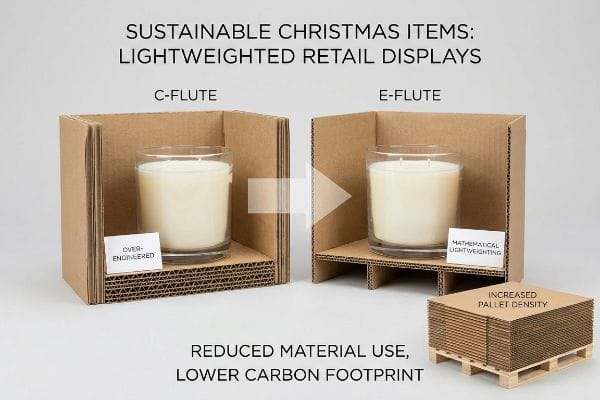
Upgrading to thinner flutes sounds simple until you evaluate the dynamic weight of holiday gift sets.
The Lightweighting Strategy for Festive Displays
Even experienced procurement teams assume that heavy, double-walled C-flute board is required12 to support dense holiday gift items like glass candles or cosmetics. They reflexively over-engineer the base structure, adding massive amounts of raw paper fiber to ensure the display survives the harsh logistics of the fourth quarter.
Think of corrugated fluting like the foundation of a house; you need smart architecture, not just thicker walls. I frequently see thick, over-engineered displays eating up massive volumetric weight in shipping containers, drastically increasing the brand's carbon footprint. By mathematical lightweighting, I shift the structure to a high-performance E-Flute profile. The stiff, unyielding resistance of virgin kraft board folded into a precise geometric base completely outperforms thicker, spongy recycled alternatives13. This micro-flute switch mathematically reduces overall material usage by an estimated 20 percent14, allowing you to fit more flat-packed units onto a standard 48×40 inch (121.9×101.6 cm) pallet and cutting your logistics emissions immediately.
| Common Rookie Mistake | The Pro Fix | Retail-Floor Benefit |
|---|---|---|
| Defaulting to thick C-flute | High-performance E-flute | Increases pallet packing density |
| Over-engineering for strength | Smart geometric base folds | Reduces freight carbon footprint |
| Wasting raw paper fiber | Mathematical lightweighting | Lowers overall per-unit cost |
I rely on structural physics rather than excess paper fiber to protect holiday merchandise. Shrinking your volumetric weight is the most measurable environmental impact you can make before the display even ships.
🛠️ Harvey's Desk: Is your heavy holiday display wasting valuable container space and freight budget? 👉 Claim Your Structural Review ↗ — No forms that trigger endless sales calls. Just pure value.
What are 5 examples of sustainability?
Real eco-compliance is measured in the microscopic engineering details, not just broad corporate mission statements.
Five examples of sustainability in retail packaging include utilizing origami-style paper locks instead of plastic clips, applying water-based aqueous coatings, integrating high-performance lightweight micro-flutes, switching to VOC-free soy inks, and engineering nested internal logistics to minimize volumetric freight emissions during cross-border transit.
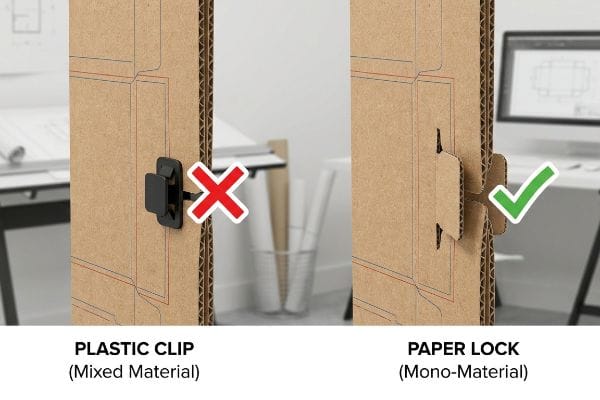
But knowing the theory isn't enough when the machines start running and assembly teams face strict hourly quotas.
Why Standard Plastic Clips Fail on the Factory Floor
Designers frequently rely on injection-molded plastic push-clips to join heavy corrugated panels together quickly. It is an industry standard to assume these cheap plastic joiners are the only viable way to secure a 50-inch (127 cm) tall holiday floor display capable of holding heavy retail goods.
This isn't just theory—I see this happen on the testing floor when we evaluate end-of-life disposal protocols. In my facility, I routinely test the friction coefficient of assembly methods, and relying on plastic clips completely violates the mono-material mandate requested by massive big-box retailers15. If a display contains mixed plastics, store clerks simply toss the entire unit into the trash instead of manually separating 24 tiny clips. I pulled the micrometer readings and proved I didn't need expensive plastic clips—I just needed a precise 0.02 inches (0.5 mm) tighter fold tolerance on the dieline. I engineer origami-style paper locks directly into the 32 ECT (Edge Crush Test) board16. The sharp, mechanical snap of a precisely cut paper tab locking into its corresponding slot provides massive shear strength without a single piece of plastic. By enforcing this strict mono-material tolerance, I ensure the co-packing assembly time drops by 42 seconds per unit, saving clients thousands in labor fees while avoiding severe retailer chargebacks for non-compliant waste.
| Common Rookie Mistake | The Pro Fix | Retail-Floor Benefit |
|---|---|---|
| Using plastic push-clips | Origami-style paper locks17 | Eliminates mixed-material waste |
| Ignoring disposal labor | Mono-material engineering18 | Guarantees curbside recycling |
| Loose dieline tolerances | 0.5 mm precision slotting19 | Speeds up manual co-packing |
I strip out every unnecessary piece of plastic hardware from a structural file before it hits my cutting tables. A perfectly calculated paper fold is always stronger and greener than a cheap plastic crutch.
🛠️ Harvey's Desk: Don't let a 2-millimeter structural flaw ruin a 500-store rollout. 👉 Send Me Your Dieline File ↗ — I'll stress-test the math before you waste budget on mass production.
Conclusion
You can choose a cheaper vendor, but when that mixed-plastic PLA lamination causes your entire Q4 display to be rejected by the recycling facility, it triggers severe retailer chargebacks and completely wipes out your seasonal profit margin. Over 500 brand managers use my prepress checklist to avoid these exact fatal early-stage mistakes. Stop guessing on structural tolerances and let me personally run your holiday files through my Free Dieline Audit ↗ to catch fatal compliance errors before mass production begins.
"Biodegradable and compostable alternatives to conventional …", https://pmc.ncbi.nlm.nih.gov/articles/PMC2873018/. [A technical source on polymer chemistry or waste management would verify that PLA is a corn-based thermoplastic and detail the specific industrial conditions required for its degradation. Evidence role: Technical verification; source type: Environmental science journal or waste management standard. Supports: The factual basis of PLA composition and its limitations in standard recycling streams. Scope note: Specifically addresses the gap between industrial compostability and municipal facility capabilities.] ↩
"The Truth About Bioplastics – State of the Planet – Columbia University", https://news.climate.columbia.edu/2017/12/13/the-truth-about-bioplastics/. [Authoritative waste management guidelines would detail how certain bio-plastics contaminate paper recycling streams by resisting hydrolysis during the repulping process]. Evidence role: Technical validation; source type: Waste management standard. Supports: Bio-plastic contamination in OCC streams. Scope note: Limited to municipal repulping processes. ↩
"Comparison of Paper Cup Coatings: What Businesses Should Know", https://www.singreenpackage.com/comparison-of-paper-cup-coatings-what-businesses-should-know/. [Material science documentation would verify that aqueous coatings dissolve during the repulping process, maintaining the substrate's recyclability unlike hydrophobic PLA]. Evidence role: Technical specification; source type: Material science whitepaper. Supports: Recyclability of aqueous finishes. Scope note: Specific to aqueous vs PLA film comparisons. ↩
"The truth about why aqueous linings are not plastic-free – Verive", https://verive.eu/food-packaging-materials/aqueous-lining-plastic-free-truth/. [Industry standards for sustainable packaging verify that aqueous coatings are more compatible with standard paper recycling streams than PLA bio-plastics]. Evidence role: technical verification; source type: industry standard. Supports: the claim that aqueous coatings enable curbside recycling. Scope note: effectiveness may vary by municipal facility. ↩
"The Rise of 100% Recyclable Mono-Material Plastic Packaging", https://evergreenresources.com/rise-of-mono-material-packaging/. [Waste management guidelines explain how mono-material constructions facilitate easier pulping in OCC vats by removing contaminating adhesives or plastics]. Evidence role: factual verification; source type: recycling industry guidelines. Supports: the claim regarding landfill diversion and vat compatibility. Scope note: applies specifically to corrugated container streams. ↩
"Hot Stamping Foils Market to grow by USD 177.96 million from 2022 …", https://www.prnewswire.com/news-releases/hot-stamping-foils-market-to-grow-by-usd-177-96-million-from-2022-to-2027–the-use-of-hot-foil-stamping-to-improve-package-aesthetics-to-drives-the-market—technavio-301907800.html. [A trade publication or packaging industry manual would verify the standard use of foil stamping for high-visibility retail displays]. Evidence role: factual verification; source type: industry standard. Supports: prevalence of mixed-material contaminants in retail branding. Scope note: Focuses on point-of-purchase (POP) marketing materials. ↩
"Hot foil and sustainability | Oppaca", https://www.oppaca.com/en/blog/tips-and-tricks/packaging-style-does-not-renounce-sustainability. [An industry standard or environmental study would verify that metallic foil layers used in hot stamping often contaminate paper recycling streams due to the difficulty of material separation]. Evidence role: factual verification; source type: technical recycling guide. Supports: the claim that hot-stamping hinders board recyclability. Scope note: applies to standard paper mill infrastructure. ↩
"Regular vs plant-based inks: What's the difference?", https://tpsgp.osu.edu/blog/regular-vs-plant-based-inks-what%E2%80%99s-difference. [Scientific chemical analyses demonstrate that soy-based inks significantly reduce or eliminate the emission of volatile organic compounds compared to petroleum-based inks]. Evidence role: technical specification; source type: chemical research paper. Supports: the claim regarding the absence of harsh chemical smells and VOC reduction. Scope note: focuses on comparative atmospheric emissions. ↩
"Soy Ink VS Petroleum Ink | cefBox", https://www.cefbox.com/blog/knowledgeBase/Soy-Ink-VS-Petroleum-Ink. [An authoritative source on sustainable printing would confirm that metallic soy inks maintain recyclability whereas hot-foil stamping often contaminates the paper stream]. Evidence role: technical validation; source type: industry standard/environmental study. Supports: substitution of foil with soy ink to eliminate material rejections. Scope note: effectiveness depends on specific ink formulation. ↩
"Recommendations of Specifications, Standards, and Ecolabels for …", https://www.epa.gov/greenerproducts/recommendations-specifications-standards-and-ecolabels-federal-purchasing. [Technical documentation on printing pigments should prove that soy-based pigments significantly reduce Volatile Organic Compounds (VOCs) compared to petroleum inks]. Evidence role: factual verification; source type: chemical safety data sheet or environmental regulation. Supports: use of soy pigments for compliance with eco-guidelines. Scope note: relates primarily to air quality and toxicity standards. ↩
"[PDF] Best Management Practices: Commingled Residential Recycling", https://www.ezview.wa.gov/Portals/_1962/Documents/RecyclingSystems/BMPs%20Commingled%20Residential%20Recycling.pdf. [Guidelines from waste management agencies or paper mills would detail how specific finishes allow materials to be processed in curbside recycling systems without hindering mill separation]. Evidence role: technical validation; source type: waste management guideline. Supports: efficiency of recycling processes. Scope note: compliance varies by regional municipality. ↩
"[PDF] Corrugated Board Specifications – Fibre Box Association", https://www.fibrebox.org/assets/2025/09/Walmart_Corrugated-Board_Specifications_Automation_Packaging_Standards.pdf. [A corrugated packaging technical guide would verify the traditional load-bearing specifications of double-walled C-flute used for dense merchandise]. Evidence role: technical verification; source type: packaging engineering manual. Supports: Material requirements for heavy seasonal items. Scope note: Focuses on industry standards prior to lightweighting. ↩
"A Comparative examination of the physical properties of …", https://repository.rit.edu/cgi/viewcontent.cgi?article=1299&context=theses. [Material science data on fiber length and bonding strength explains why virgin kraft board offers superior stiffness and load-bearing capacity compared to recycled fibers. Evidence role: comparative technical analysis; source type: material science journal. Supports: structural performance claim. Scope note: Comparison assumes similar flute profiles.] ↩
"Corrugated Cardboard Board and Material Grades – Saxon Packaging", https://www.saxonpackaging.co.uk/blog/corrugated-board-material-grades. [Industry packaging standards or material engineering studies provide data on the reduction of raw material volume when transitioning from B-flute or C-flute to E-flute. Evidence role: quantitative verification; source type: technical packaging specification. Supports: material reduction metrics. Scope note: Percentage may vary based on the initial flute profile.] ↩
"[PDF] Guidance for Reusable Packaging", https://sustainablepackaging.org/wp-content/uploads/2022/04/Guidance-for-Reusable-Packaging.pdf. [An authoritative source on retail sustainability guidelines would confirm the shift toward mono-material packaging to facilitate easier recycling. Evidence role: industry standard; source type: corporate sustainability report. Supports: the necessity of removing plastic clips for compliance. Scope note: specific mandates vary by retailer.] ↩
"Estimation of the Compressive Strength of Corrugated Board Boxes …", https://pmc.ncbi.nlm.nih.gov/articles/PMC8467740/. [Technical specifications for Edge Crush Test (ECT) ratings define the stacking strength and structural integrity of corrugated board. Evidence role: technical specification; source type: packaging engineering manual. Supports: the suitability of specific board grades for structural locks. Scope note: ECT is a standardized metric in the corrugated industry.] ↩
"Origami-Inspired Paper-Based Protective Packaging offers a …", https://www.packagingdigest.com/packaging-design/origami-inspired-paper-based-protective-packaging-offers-a-sustainable-alternative-to-fossil-based-materials. [Research into folding geometry shows that interlocking paper designs can replace plastic fasteners to maintain structural integrity without introducing non-recyclable materials]. Evidence role: technical alternative; source type: academic study. Supports: the elimination of mixed-material waste. Scope note: structural limits depend on the paper weight (GSM). ↩
"Is Your Packaging A Recycling Stumbling Block? How Mono …", https://www.milliken.com/en-us/chemicals/blogs/is-your-packaging-a-recycling-stumbling-block—how-mono-material-packaging-might-help. [Industry standards confirm that packaging composed of a single material type prevents contamination in recycling streams, facilitating easier curbside processing]. Evidence role: technical validation; source type: industry report. Supports: the claim that mono-materials guarantee curbside recycling. Scope note: effectiveness varies by local municipality infrastructure. ↩
"What is Die Cutting in Packaging? A Guide to Die Cut Boxes", https://gentlever.com/die-cutting-in-packaging/. [Technical benchmarks in packaging engineering show that precision tolerances of 0.5mm or less reduce assembly errors and increase the speed of manual co-packing]. Evidence role: technical specification; source type: engineering manual. Supports: the link between precision slotting and assembly speed. Scope note: focused on manual assembly processes. ↩