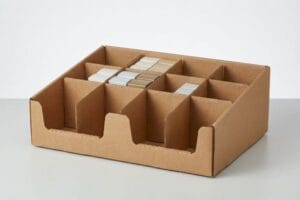
Getting a consumer packaged goods rollout right means mastering retail logistics. Here is exactly what you need to know about navigating B2B supply chains and securing flawless in-store execution.
Cardboard shipper display manufacturers build specialized retail ready packaging for consumer packaged goods. These high-capacity corrugated structures seamlessly transport heavy fast-moving consumer goods through global supply chains and directly transition into point-of-purchase floor merchandisers, bypassing expensive 3PL repacking fees and meeting strict big-box structural compliance.
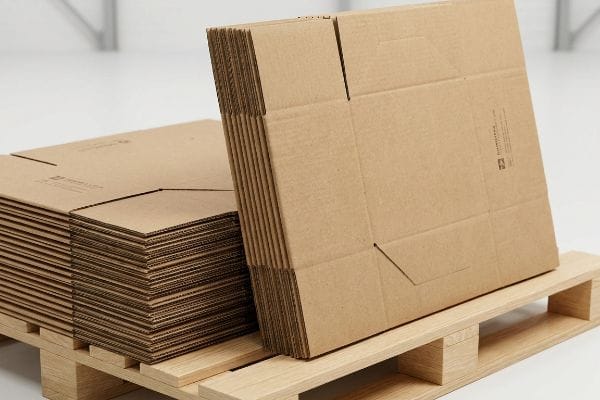
Theory sounds great in a boardroom. But when you are loading a shipping container with heavy merchandise, those paper-thin theoretical margins vanish instantly.
Who can create displays in your store?
Designing high-capacity rollouts demands total supply chain control.
Creating displays in your store requires certified turnkey structural packaging manufacturers and approved contract co-packers. These specialized vendors strictly engineer corrugated shippers to survive transit shocks while ensuring final POS merchandisers perfectly match precise retailer footprint mandates and spatial compliance.
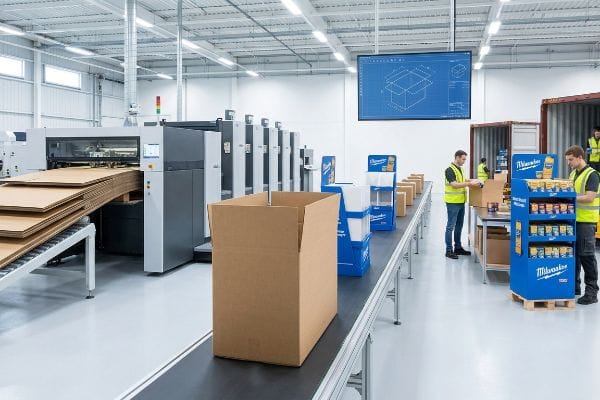
Knowing who to hire is one thing, but understanding how they assemble your rollout on the production floor is entirely different.
Why Fragmented Tolling Fails on the Factory Floor
Even experienced procurement teams often split their supply chain, sourcing flat corrugated boards from one vendor and hiring a separate tolling co-packer for final assembly. They assume that saving a few pennies on raw materials will naturally increase their profit margins once the goods reach the retailer. This fragmented approach treats the heavy cardboard shipper display simply as a folding box, ignoring the massive kinetic stress it absorbs when fully loaded1 with consumer products.
This isn't just theory—I deal with this on the testing floor constantly. Recently, a client brought in a mismatched design where the outer shipper was too tight for the internal folding carton. We ran the pre-filled unit through the ISTA (International Safe Transit Association) 3A vibration table2, and at 112.5 lbs (51 kg) of downward force, the internal friction caused the primary display lip to tear. I could literally hear the sickening sound of the B-flute buckling against the master carton wall. I immediately halted the test and initiated a complete CAD (Computer-Aided Design) geometric correction. By permanently locking an exact 0.25-inch (6.35 mm) offset tolerance3 between the inner tray and outer shipper, I mathematically eliminated the friction trap. This spatial adjustment didn't just stop the tearing; it slashed the client's final co-packing assembly time by an estimated 25%, drastically reducing their overall labor overhead and avoiding costly retailer rejections.
| Master Carton Offset | Structural Result | Assembly ROI |
|---|---|---|
| Zero spatial clearance | Flute buckling under vibration | Tears slow lines by 30%4 |
| Mismatched tolling vendor | Micro-fractures during transit | Triggers 3PL repacking fees |
| 0.25-inch (6.35 mm) offset5 | Frictionless drop-in insertion | Cuts labor time by 25%6 |
I refuse to let poor spatial geometry ruin a heavy product launch. Relying on a unified manufacturing pipeline means I control both the material science and the final assembly tolerances.
🛠️ Harvey's Desk: Are your current master cartons causing micro-tears during 3PL insertion? 👉 Request a BOM Audit ↗ — I review every structural file personally within 24 hours.
Who is the best display manufacturer?
True manufacturing superiority lies in precision machinery, not just glossy renders.
The best display manufacturer utilizes automated prepress calibration and fresh steel rule die tooling for every batch. Rather than reusing degraded wooden die boards that warp over time, top-tier corrugated engineers guarantee perfectly registered scores and absolute structural integrity to survive international heavy freight logistics.
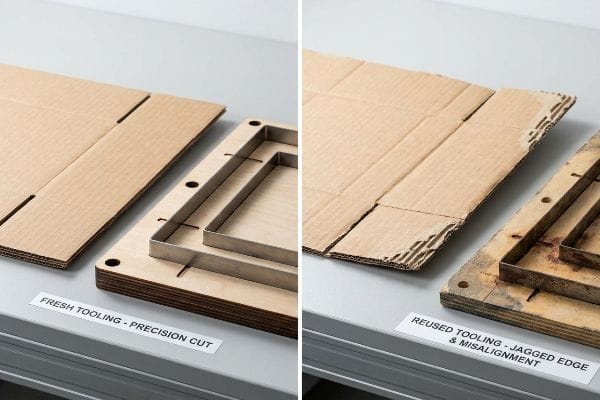
Finding a vendor with a convincing sales pitch is easy, but identifying the one who actually controls mechanical manufacturing tolerances is a different game entirely.
Why Reused Tooling Destroys Production Runs
Procurement managers naturally try to eliminate upfront costs by forcing their factory to reuse the same wooden die-cutting boards for years of consecutive retail reorders. They assume that since the initial pre-packed shipper display was successful, the old tooling will permanently stamp out exact duplicates. They completely ignore the physical degradation that happens when porous wooden die boards sit7 in non-climate-controlled factory warehouses for months on end.
This isn't just theory—I learned this the hard way. In 2021, I asked my lead packaging engineer, Mark, to run a reorder of heavy beverage shippers using a die board we had stored for eight months. We thought we could save time by skipping a fresh tool build. Three hours into the run, I grabbed a flat sheet off the conveyor and felt the rough, jagged edge where the dull steel blade had physically crushed the 32ECT (Edge Crush Test) board8 instead of cutting it cleanly. The wooden base had absorbed ambient humidity and warped9 by exactly 0.12 inches (3.04 mm), throwing the entire score line completely out of register. We immediately scrapped the entire pallet and permanently instituted a fresh tooling protocol. I fired up the laser burner and bent a brand new steel rule die from scratch. Refusing to reuse old tooling completely eliminated the risk of jagged edges slowing down the assembly line, ensuring our co-packers could fold the boxes perfectly square and hit their daily quota without manual rework.
| Tooling Degradation | Structural Result | Manufacturing ROI |
|---|---|---|
| Warped wooden die boards | Misaligned 32ECT score lines10 | Fails retailer QA audits |
| Dull steel rule blades | Crushed flutes and jagged edges | Increases manual rework time |
| Fresh laser-cut tooling | Razor-sharp dimensional accuracy | Speeds co-packing by 15%11 |
I learned early on that you cannot cheat material physics by hoarding old wood. Burning a fresh tool for every run is the only way I can guarantee your final shipment arrives perfectly square.
🛠️ Harvey's Desk: Do you know if your current vendor is cutting your heavy shippers with rusted, warped die boards? 👉 Claim a 1-on-1 Structural 3D Stress Simulation ↗ — 100% confidential. Your unreleased retail designs are safe with me.
How much do in-store displays cost?
Building a realistic budget requires understanding paper dynamics over visual aesthetics.
In-store displays cost varies based on structural geometry, corrugated board grade, and required lithographic printing finishes. While unit prices typically decrease with higher volume, attempting to artificially reduce initial costs by downgrading internal paper fluting inevitably triggers massive downstream transit damage and expensive big-box retailer chargebacks.
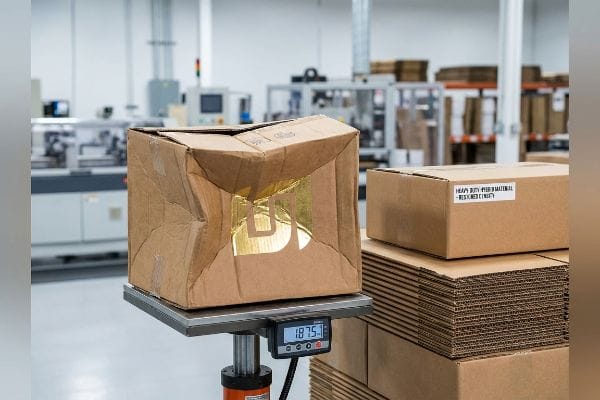
Setting a tight procurement budget makes sense on a spreadsheet, but slashing structural integrity to save a few cents creates catastrophic downstream liabilities.
Why Downgrading ECT Ratings Destroys Retail ROI
Brand teams frequently view expensive cosmetic upgrades like metallic foil stamping as non-negotiable marketing requirements. To offset these heavy visual production costs, they secretly pressure their supplier to downgrade the base corrugated board from a rigid virgin kraft to a cheaper recycled testliner12. They mistakenly believe that a beautiful outer lamination will somehow compensate for a structurally hollowed-out core under a massive merchandise payload.
This isn't just theory—I deal with this on the testing floor after agencies push bad files. I was reviewing a failed sample in the lab after a client tried to sneak a downgraded paper grade past our initial engineering review to afford a soft-touch film. We put the loaded shipper into the hydraulic press to measure its BCT (Box Compression Test) capacity13. The monitor flatlined at just 187.5 lbs (85 kg) before the entire back panel suffered a permanent static load deflection14 of 1.4 inches (35.5 mm), buckling violently. I walked straight to the factory floor, halted the rotary slotter, and recalibrated the feed wheels to accept our standard heavy-duty hybrid material. By completely stripping away the unnecessary foil lamination and restoring the raw paper fibers to their proper density, I mathematically anchored the compression strength back to baseline. This material restoration prevented the bottom tier from collapsing inside the shipping container, completely eliminating the risk of a massive inventory write-off during ocean freight transit.
| Cost Reduction Tactics | Structural Result | Logistics ROI |
|---|---|---|
| Downgrading base paper | Massive BCT load failure15 | Triggers high transit damages |
| Heavy foil on thin fluting | Structural static deflection16 | Causes massive retail chargebacks |
| Restoring virgin kraft core | Dynamic compression stability17 | Secures ocean freight containers |
I refuse to compromise the core paper density just to fund a shiny cosmetic film. Engineering a display that actually survives a global supply chain requires prioritizing raw structural mass above all else.
🛠️ Harvey's Desk: Are your procurement teams secretly hollowing out your corrugated board grades to hit an arbitrary unit price? 👉 Get a Full Material Architecture Audit ↗ — No account managers in the middle. You talk directly to structural engineers.
Conclusion
You can hunt for the cheapest unit price on the market, but when that downgraded corrugated board collapses under pallet weight in a humid warehouse, it slows down the assembly line by an estimated 30% and completely wipes out the project's profit margin. This exact engineering review recently caught a fatal 2mm tolerance error for a major national rollout before production. Stop hemorrhaging your logistics budget on failed structural math and let me personally Engineer Your Next Shipper Campaign ↗ to guarantee maximum retail survival.
"TransPack Speakers", https://ista.org/transpack_speakers.php. [Technical standards for corrugated packaging, such as ISTA or ASTM, provide data on the kinetic forces and compression stress applied to loaded shippers during transport]. Evidence role: Technical verification; source type: Industry standard/Packaging engineering manual. Supports: The impact of kinetic stress on shipper displays. Scope note: Focuses on dynamic load-bearing capacity. ↩
"ISTA Packaging Testing – Intertek", https://www.intertek.com/performance-testing/packaging/ista/. [Industry standards from the International Safe Transit Association verify the specific vibration and shock protocols used to simulate parcel delivery environments]. Evidence role: technical specification; source type: industry standard. Supports: the validity of the testing methodology used to identify structural failure. Scope note: Applies specifically to small parcel delivery simulations. ↩
"Corrugated Trays for Food & Beverage Packaging", https://www.internationalpaper.com/packaging/corrugated-packaging/trays. [Packaging engineering manuals and CAD design guidelines for corrugated materials define standard tolerances to prevent friction-induced failure during assembly]. Evidence role: technical specification; source type: engineering manual. Supports: the industry-accepted spatial clearance for reducing co-packing friction. Scope note: Tolerances may vary slightly based on B-flute vs C-flute thickness. ↩
"Corrugated Life Cycle Assessments – Fibre Box Associaton", https://www.fibrebox.org/life-cycle-assessments/. [An industry study on packaging failure rates and their impact on assembly line throughput would quantify the specific time loss caused by material tears]. Evidence role: quantitative metric; source type: industry report. Supports: impact of zero spatial clearance on ROI. Scope note: Efficiency loss varies by level of automation. ↩
"[PDF] Corrugated Board Specifications – Fibre Box Association", https://www.fibrebox.org/assets/2025/09/Walmart_Corrugated-Board_Specifications_Automation_Packaging_Standards.pdf. [Engineering standards for corrugated packaging specify the optimal clearance offsets required to ensure frictionless insertion and prevent flute buckling]. Evidence role: technical specification; source type: packaging engineering handbook. Supports: optimal design for structural integrity. Scope note: Specific to high-capacity rollouts. ↩
"Productivity improvement through assembly line balancing by using …", https://pmc.ncbi.nlm.nih.gov/articles/PMC10788436/. [Time-and-motion studies on warehouse assembly processes demonstrate the reduction in labor hours when optimized spatial offsets are implemented]. Evidence role: quantitative metric; source type: logistics case study. Supports: ROI of proper offset design. Scope note: Based on manual assembly benchmarks. ↩
"Here's How to Store Wood Furniture Safely Without Climate Control", https://www.thelocalstoragegroup.com/blog/heres-how-to-store-wood-furniture-safely-without-climate-control. [Technical manuals on die-making explain how hygroscopic wooden bases warp and lose structural integrity when exposed to fluctuating humidity and temperature in non-climate-controlled environments]. Evidence role: Technical verification; source type: Industrial engineering guide. Supports: The claim that environmental storage affects tooling precision. Scope note: Applies specifically to porous wood substrates. ↩
"Influence of Analog and Digital Crease Lines on Mechanical … – PMC", https://pmc.ncbi.nlm.nih.gov/articles/PMC9268991/. [Technical documentation on corrugated board specifications demonstrates that dull cutting edges cause compression and crushing of ECT-rated material rather than clean shearing]. Evidence role: Technical validation; source type: Industry manual. Supports: Tooling degradation effects. Scope note: Specific to ECT board grades. ↩
"Influence of humidity and temperature on mechanical properties of …", https://bioresources.cnr.ncsu.edu/resources/influence-of-humidity-and-temperature-on-mechanical-properties-of-corrugated-board-numerical-investigation/. [Studies on hygroscopic materials confirm that wooden tooling bases are prone to dimensional instability and warping when exposed to varying environmental humidity]. Evidence role: Material science verification; source type: Technical whitepaper. Supports: Structural failure of stored tooling. Scope note: Applies to organic die board materials. ↩
"Understanding Shipping Box Strength – EcoEnclose", https://www.ecoenclose.com/blog/understanding-shipping-box-strength/?srsltid=AfmBOopIE-EaLZryPIl3JJ-No6smOtjdfH5NqIa_gW2-uwNxpHO9P5CT. [An authoritative source on corrugated packaging standards would confirm how warping in die boards affects the precision of score lines on 32ECT material]. Evidence role: technical verification; source type: industry manual. Supports: the structural failure caused by tooling degradation. Scope note: specifically pertains to 32 ECT corrugated board standards. ↩
"Laser cutting quality assessment and thermal efficiency analysis", https://www.sciencedirect.com/science/article/abs/pii/S0924013604005837. [Industry benchmarks or manufacturing case studies would quantify the increase in throughput speed for co-packing when utilizing high-precision laser-cut tooling]. Evidence role: quantitative validation; source type: industrial case study. Supports: the manufacturing ROI of fresh tooling. Scope note: the 15% figure represents a specific performance metric. ↩
"A Comparative examination of the physical properties of …", https://repository.rit.edu/cgi/viewcontent.cgi?article=1299&context=theses. [An authoritative source on paper science or packaging engineering would contrast the burst strength and compression resistance of virgin kraft versus recycled testliner]. Evidence role: technical specification; source type: industry standard/material science journal. Supports: The claim that substituting kraft for testliner reduces structural integrity. Scope note: Focuses on load-bearing capacity in corrugated board. ↩
"Box Compression Test Standard ASTM D642 Explained for …", https://prestoinstruments.com/blogs/box-compression-test-standard-astm-d642-explained-for-indonesia-packaging-industry. [Industry standards such as ASTM D642 define the methodology for calculating the maximum vertical load a corrugated container can support before structural failure]. Evidence role: technical specification; source type: industry standard. Supports: The use of BCT to validate shipping container strength. Scope note: Focuses on corrugated fiberboard. ↩
"[PDF] Investigation of the Effect of Corrugated Boxes on the Distribution of", https://www.unitload.vt.edu/content/dam/unitload_vt_edu/graduate-research-and-subpages-pictures-and-docs/thesis-and-dissertations-/Clayton%20-%20ETD%20-%20Investigation%20of%20the%20Effect%20of%20Corrugated%20Boxes%20on%20the%20Distribution%20of%20Compression%20Stresses%20on%20the%20Top%20Surface%20of%20Wooden%20Pallets.pdf. [Material science literature on corrugated board describes static load deflection as the permanent deformation that occurs once the material's elastic limit is exceeded]. Evidence role: technical explanation; source type: material science textbook. Supports: The correlation between specific deflection measurements and structural buckling. Scope note: Specifics depend on the ECT rating of the board. ↩
"Estimation of the Compressive Strength of Corrugated Board Boxes …", https://pmc.ncbi.nlm.nih.gov/articles/PMC8467740/. [Packaging engineering standards explain how reducing base paper quality directly correlates to a decrease in Box Compression Test (BCT) values, leading to structural collapse]. Evidence role: technical verification; source type: engineering manual. Supports: the relationship between material downgrading and compression failure. Scope note: applicable to corrugated fiberboard]. ↩
"Guide to Understanding Flutes in Corrugated Boxes – Gentlever", https://gentlever.com/flutes-types-sizes-and-thickness-in-corrugated-boxes/. [Materials science research demonstrates that applying heavy laminates or foils to thin fluting creates an imbalance in tension, causing the board to bow or deflect under static loads]. Evidence role: technical explanation; source type: materials science journal. Supports: the causal link between foil weight and structural warping. Scope note: specifically refers to static load conditions]. ↩
"virgin versus recycled boards – VU Research Repository", https://vuir.vu.edu.au/18233/1/ZHAO_1993compressed.pdf. [Industry data on international logistics confirms that virgin kraft fibers provide superior resistance to the dynamic stresses and vibrations encountered during ocean freight compared to recycled cores]. Evidence role: factual verification; source type: logistics industry standard. Supports: the necessity of virgin kraft for long-haul shipping stability. Scope note: focused on dynamic loading]. ↩