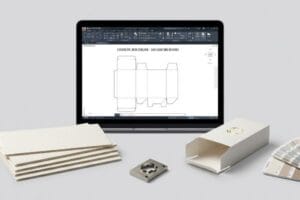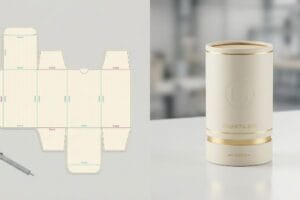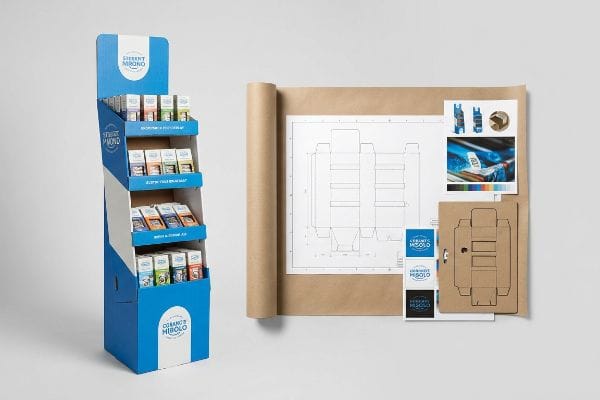
Design customization is what separates a structural cardboard box from a high-impact retail experience. When executed properly, packaging geometry aggressively defends your specific brand identity against crowded retail aisles.
Yes. A floor pop display can be fully customized to seamlessly match your brand's specific design guidelines. By utilizing advanced digital printing technologies and custom die-cutting techniques, structural engineers ensure every physical component perfectly reflects your unique marketing aesthetics while maintaining rigorous retail weight capacities.
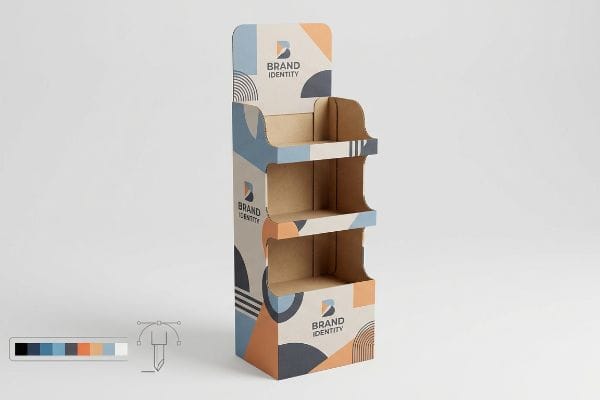
Understanding that design flexibility exists is only the first phase. The real challenge is maintaining that custom brand equity when theoretical digital artwork meets physical manufacturing constraints.
What is the difference between POS and POP displays?
Many brands blur the lines between spatial merchandising strategies, assuming all cardboard units serve the same behavioral function. Understanding the physical boundaries dictates your structural design path.
The difference between POS (Point of Sale) and POP (Point of Purchase) displays lies in their physical retail placement. POS units sit directly on checkout counters to capture impulse buys, while POP merchandisers occupy larger floor footprints throughout store aisles to interrupt standard shopper traffic patterns.
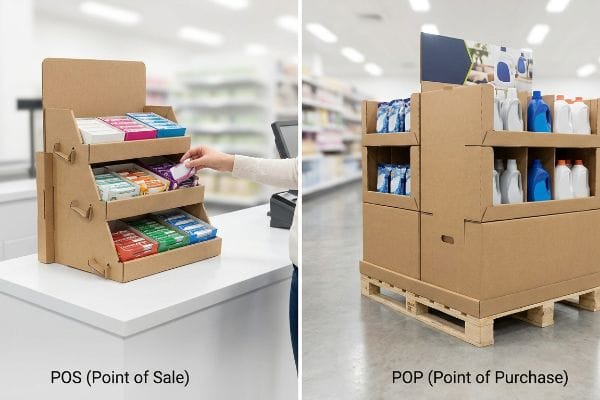
While the definitions seem simple, confusing these two spatial environments during the initial design phase triggers massive retailer compliance failures.
The ADA vs. GMA Spatial Spatial Limits
Even experienced procurement teams often try to design a "scalable" merchandiser, attempting to simply shrink a large floor unit by 50% to serve as a checkout unit. This approach ignores the strict legal and logistical rules1 dictating these two completely separate zones in North American retail channels.
I see this trap constantly. A client asks me to downsize a massive floor unit into a counter tray. They don't realize that floor units are strictly engineered around the 48×40 inch (121.9×101.6 cm) GMA (Grocery Manufacturers Association) pallet limit to withstand 2,500 lbs (1,133.9 kg) of dynamic warehouse load. Alternatively, counter units are governed by strict ADA (Americans with Disabilities Act) forward reach compliance windows, meaning products must sit precisely between 15 and 48 inches (38.1 and 121.9 cm) off the ground. If you just scale the CAD (Computer-Aided Design) file down without completely rebuilding the mathematical structure, you end up with an illegally sized base. I once watched a store manager attempt to force a poorly scaled counter unit into position, resulting in the loud scrape of a massive corrugated base wedging tightly against a metal checkout aisle before they immediately threw the entire batch into the recycling bin, wiping out the project's return on investment.
| Common Rookie Mistake | The Pro Fix | Retail-Floor Benefit |
|---|---|---|
| Shrinking floor files for counters | Rebuilding ADA-compliant structures2 | Prevents immediate store rejections |
| Ignoring dynamic pallet load limits | Anchoring to GMA base dimensions3 | Survives heavy double-stacking |
| Guessing optimal product heights | Designing for legal reach limits4 | Eliminates inaccessible merchandise |
I permanently separate the engineering pipelines for floor and counter units. Enforcing these strict spatial boundaries upfront prevents devastating chargebacks from angry store managers rejecting non-compliant register displays.
🛠️ Harvey's Desk: Not sure if your "scalable" design is secretly violating strict checkout aisle compliance limits? 👉 Let Me Check Your Specs ↗ — Direct access to my desk. Zero automated sales spam, I promise.
How do you ensure that promotional displays are set up correctly?
A custom design means nothing if the retail team cannot figure out how to put it together on the busy shop floor.
Ensuring promotional displays are set up correctly requires engineered structural tolerances and foolproof visual instructions. Brands achieve this by implementing clear interlocking tab mechanisms, pre-glued modular trays, and step-by-step graphical assembly manuals, drastically reducing human error during rapid retail deployment on the bustling shop floor.
Beyond visual instructions, the unseen physics of the cardboard itself determine whether an assembly process takes two minutes or twenty.
Preventing Moisture Swelling During Assembly
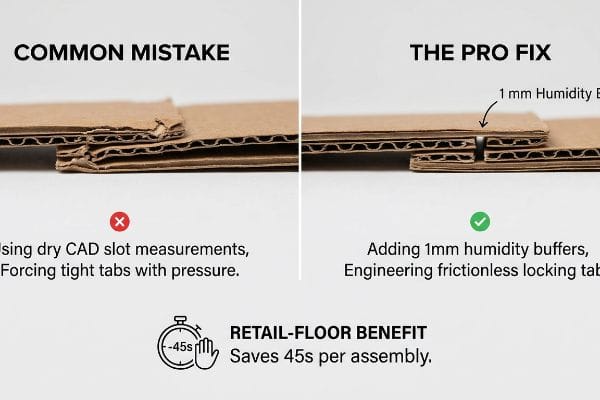
Designers working in climate-controlled offices often set folding tolerances based strictly on the exact dry caliper5 of the board. They assume a slot measuring exactly 3.17 mm (0.12 inches) will perfectly fit a tab of the same thickness everywhere in the world.
This theoretical math falls apart when flat-packs ship to humid climates. When a porous 32ECT (Edge Crush Test) testliner6 absorbs ambient warehouse moisture, the physical paper fibers swell. I frequently intercept files where the slots are far too tight for real-world conditions. Without compensation, a co-packer in Florida will find themselves sweating to force a swollen tab into a rigid slot. You can physically hear the tearing sound of raw paperboard ripping apart as the flutes crush under manual pressure, forcing the assembly team to ruin the brand image with messy clear packing tape. To prevent this, I automatically engineer a 0.04 inch (1 mm) "Humidity Buffer"7 into every receiving slot heading to a humid transit route. This mathematically accounts for fiber expansion, guaranteeing frictionless setup regardless of ambient warehouse weather.
| Common Rookie Mistake | The Pro Fix | Retail-Floor Benefit |
|---|---|---|
| Using dry CAD slot measurements | Adding 1 mm humidity buffers8 | Stops tabs from ripping |
| Forcing tight tabs with pressure | Calculating regional moisture swelling9 | Saves 45s per assembly10 |
| Relying on clear tape for fixes | Engineering frictionless locking tabs | Maintains premium brand aesthetics |
Adding this tiny structural clearance ensures the co-packing assembly team drops their labor time by an estimated 20%, saving thousands in manual handling fees.
🛠️ Harvey's Desk: Are you worried your current structural tabs will physically swell and jam up during a humid summer rollout? 👉 Claim Your Structural Audit ↗ — Download safely. My inbox is open if you have questions later.
What is pop display in marketing?
Physical merchandising acts as a localized advertising channel, converting passive foot traffic into active engagements. Understanding its function prevents you from designing a beautiful but invisible box.
A POP display in marketing is a specialized physical structure engineered to highlight specific consumer goods outside their standard shelf space. These standalone corrugated cardboard units utilize high-contrast graphics and strategic aisle placement to actively disrupt shopper behavior and aggressively drive localized brand visibility.
However, just because the structure is standing in the aisle does not mean the marketing message is actually reaching the shopper's eye.
The "Strike Zone" Human Height Heat Map
Brands frequently waste their marketing budget by plastering their most important messaging across every available inch of the corrugated surface. They assume shoppers inspect merchandising units from top to bottom, much like reading a digital web page.
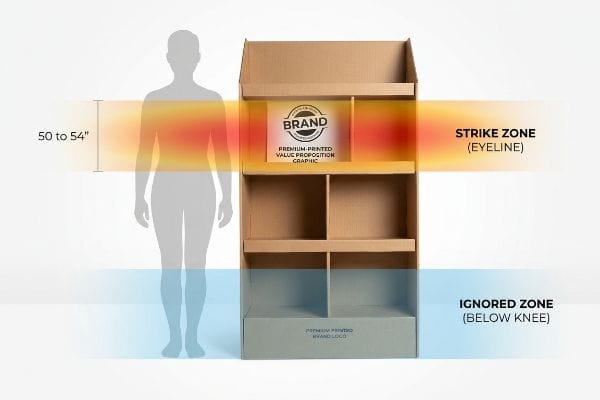
Think of an aisle display like a highway billboard; if you position the core message below the driver's dashboard, it becomes completely invisible. Shoppers consistently ignore graphics positioned below the knee. The most valuable marketing real estate is the "Strike Zone," which sits precisely 50 to 54 inches11 (127 to 137.1 cm) from the floor. When brand teams ignore this human heat map, they mistakenly print expensive metallic foils on the bottom base wrap. I regularly run my hands over these lower panels, feeling the stiff resistance of the thick corrugated board wrapped in premium ink, knowing no shopper will ever see it. By relocating the primary brand logo and value proposition upward into the 54-inch (137.1 cm) window, you actively intercept the standard adult eyeline, drastically increasing the chance of an impulse interaction without spending an extra dime on printing costs.
| Common Rookie Mistake | The Pro Fix | Retail-Floor Benefit |
|---|---|---|
| Printing logos near the floor | Moving graphics to the 54-inch zone12 | Intercepts standard adult eyelines |
| Wasting foil ink on bottom bases | Reserving premium print for headers | Lowers overall production costs |
| Treating the whole unit as a canvas | Focusing on human heat maps13 | Triggers faster impulse engagements |
I actively restrict premium print finishes to the upper physical zones, saving clients money on wasted bottom-tier ink while maximizing optical visibility.
🛠️ Harvey's Desk: Is your primary marketing message accidentally buried below the retail eyeline where no one will ever see it? 👉 Get Your Heat Map Review ↗ — No forms that trigger endless sales calls. Just pure value.
Which is an example of a pop point-of-purchase display?
Identifying practical examples helps ground abstract marketing concepts in physical retail realities. Not every rollout requires a massive, store-dominating footprint.
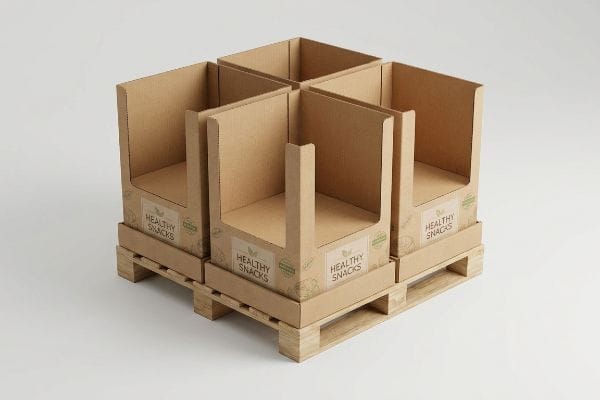
An example of a POP point-of-purchase display is a freestanding corrugated cardboard fractional pallet unit. These mathematically engineered merchandisers occupy exactly one quarter of a standard wooden base, allowing smaller CPG (Consumer Packaged Goods) to secure premium intersection space without dominating the entire retail floor.
Knowing the definition is helpful, but the reality of scaling these smaller, hyper-specific geometries on an automated factory floor often breaks standard engineering assumptions.
Why Standard Full Pallets Fail on the Factory Floor
In my facility, I routinely see procurement teams pitch full-size 48×40 inch (121.9×101.6 cm) floor units14 to massive big-box retailers, only to face immediate rejection. The systemic trap is assuming a promotional campaign must monopolize an entire wooden base to be effective, ignoring how strictly valuable aisle space is rationed.
This isn't just theory—I see this exact failure when clients try to force oversized CAD files through our automated Kongsberg CNC cutters without checking retailer floor plans first. When a buyer forces a massive footprint, it triggers immediate space rejections. The reality crash happens when I pull the dimensional specs and physically measure the layout constraints. Rather than wasting raw material, I engineer bulk merchandisers precisely to standard fractional dimensions: Quarter Pallets at exactly 24×20 inches (60.9×50.8 cm)15. Handling these micro-footprints introduces a severe manufacturing variable; I can feel the powdery feel of die-cutting dust in the air as we calibrate the steel rule dies to ensure these narrower, taller structures maintain strict vertical compression strength16. By enforcing this fractional geometry, I guarantee that four distinct promotional campaigns can perfectly share a single wooden base.
| Common Rookie Mistake | The Pro Fix | Retail-Floor Benefit |
|---|---|---|
| Pitching full floor footprints | Designing fractional 24×20 units17 | Secures tight intersection space |
| Over-sizing the master base | Subdividing standard wooden pallets18 | Allows multi-brand floor sharing |
| Ignoring vertical load ratios | Engineering narrow compression strength19 | Prevents tall structures from bowing |
Transitioning to a quarter-pallet math model allows retail buyers to seamlessly maximize their floor density, cutting freight volumes by up to 35% while keeping the merchandiser fully upright.
🛠️ Harvey's Desk: Do you know if your current display footprint will survive a strict big-box floor space audit next quarter? 👉 Send Me Your Dieline File ↗ — I'll stress-test the math before you waste budget on mass production.
Conclusion
You can spend weeks perfecting your brand's digital artwork, but when a porous 32ECT base completely swells in a humid warehouse, the resulting structural collapse slows down the co-packing assembly line by an estimated 30% and triggers immediate retailer rejections. Over 500 brand managers use my prepress checklist to avoid these exact fatal early-stage mistakes. Stop guessing on complex material tolerances and let me personally audit your flat files through my Free Pre-Production Design Review ↗ to catch these physical failures long before you pay for mass printing.
"ADA Update: A Primer for Small Business", https://www.ada.gov/resources/title-iii-primer/. [Authoritative retail design standards and ADA accessibility regulations define the distinct spatial and legal requirements for checkout counters (POS) versus floor displays (POP)]. Evidence role: validation of regulatory constraints; source type: legal and industry standards. Supports: The claim that POS and POP zones are governed by separate rules. Scope note: Specific to North American retail channels. ↩
"ADA Accessibility Standards – Access-Board.gov", https://www.access-board.gov/ada/. [Official ADA Standards for Accessible Design specify the required clearances and reach ranges for retail fixtures to ensure accessibility for all consumers]. Evidence role: technical specification; source type: legal regulatory guide. Supports: the requirement for ADA compliance to prevent store rejection. Scope note: pertains to physical accessibility laws. ↩
"Standard pallet sizes — 48×40 GMA and 6 other common dimensions", https://www.wearewarp.com/standard-pallet-sizes. [The Grocery Manufacturers Association (GMA) provides industry-standard dimensions for pallets that ensure load stability and compatibility with warehouse stacking systems]. Evidence role: industry standard; source type: technical specification. Supports: the claim that GMA dimensions enable stable double-stacking. Scope note: focused on North American logistics standards. ↩
"ADA Standards for Accessible Design Title III Regulation 28 CFR …", https://www.ada.gov/law-and-regs/design-standards/1991-design-standards/. [Regulatory guidelines define the maximum height at which merchandise can be placed to remain accessible to individuals in wheelchairs]. Evidence role: legal constraint; source type: regulatory guideline. Supports: the claim that designing for reach limits prevents inaccessible merchandise. Scope note: specifically refers to ADA reach range requirements. ↩
"[PDF] Relative Humidity Effects on the Compression … – Clemson OPEN", https://open.clemson.edu/context/all_theses/article/4232/viewcontent/Brown_clemson_0050M_15634.pdf. [Technical guides on paperboard and corrugated engineering explain that relying on dry caliper measurements fails to account for hygroscopic expansion in humid environments]. Evidence role: technical validation; source type: industry standard. Supports: the risk of using dry caliper for global assembly. Scope note: applies specifically to moisture-sensitive substrates. ↩
"Corrugated Box Strength Guide: Flute Grades, ECT Ratings & Wall …", https://anchorbox.com/corrugated-box-strength/. [Industry standards for Edge Crush Test (ECT) rated materials detail the porosity and hygroscopic nature of testliners, which leads to expansion in humid conditions]. Evidence role: Technical verification; source type: Packaging material standard. Supports: The susceptibility of 32ECT board to moisture. Scope note: Specific to non-coated liners. ↩
"Complete Guide to Corrugated Box Dimension Tolerance – Upack", https://www.upack.in/blog/post/complete-guide-on-corrugated-box-dimension-tolerance?srsltid=AfmBOorU3LL4U1bjzytfTeSW2fiXNKx-sxP4WlgnqOn9oKLTUbks9Dc9. [Technical packaging manuals provide standard tolerances, such as 1mm buffers, to ensure assembly fit when material expansion is expected due to climate]. Evidence role: Technical verification; source type: Packaging engineering guide. Supports: The use of a specific 0.04 inch offset for moisture. Scope note: May vary based on board thickness. ↩
"Engineering Boxes for Relative Humidity in the Distribution …", https://www.packagingstrategies.com/articles/91064-engineering-boxes-for-relative-humidity-in-the-distribution-environment. [An authoritative source on packaging engineering or material science would verify the standard tolerance for humidity buffers to prevent structural failure in fiber-based materials]. Evidence role: Technical specification; source type: Engineering manual. Supports: The use of specific measurement buffers to prevent ripping. Scope note: Effectiveness may vary based on material grade. ↩
"Influence of humidity and temperature on mechanical properties of …", https://bioresources.cnr.ncsu.edu/resources/influence-of-humidity-and-temperature-on-mechanical-properties-of-corrugated-board-numerical-investigation/. [Material science research on hygroscopic expansion explains how varying regional humidity levels affect the dimensional stability of corrugated board]. Evidence role: Factual mechanism; source type: Material science study. Supports: The necessity of adjusting designs for regional moisture. Scope note: Specific to moisture-sensitive materials. ↩
"Full article: Tolerance Optimization Considerations Applied …", https://www.tandfonline.com/doi/full/10.1080/16864360.2014.914413. [A time-motion study or operational efficiency report on retail merchandising would provide benchmarks for the time saved when parts fit without forcing]. Evidence role: Quantitative metric; source type: Operational study. Supports: The efficiency gain from optimized fit. Scope note: Based on typical promotional display complexity. ↩
"A Visual Approach to the Strike Zone and Go Zone by Count", https://www.discussfastpitch.com/threads/a-visual-approach-to-the-strike-zone-and-go-zone-by-count.10152/. [Industry standards for point-of-purchase merchandising and consumer eye-tracking studies verify the specific height range for optimal visual engagement. Evidence role: technical specification; source type: trade manual. Supports: the definition of the Strike Zone height. Scope note: values may fluctuate based on regional demographic averages.] ↩
"What Is the Average Eye Level Height? – PopDisplay", https://popdisplay.me/what-is-the-average-eye-level-height/. [Industry standards for point-of-purchase displays identify the optimal visual strike zone based on average human eyeline measurements for adults]. Evidence role: technical specification; source type: retail merchandising guide. Supports: the effectiveness of the 54-inch zone for visual intercept. Scope note: Measurements may vary slightly by target demographic height.] ↩
"The role of social presence in impulsive buying during live … – PMC", https://pmc.ncbi.nlm.nih.gov/articles/PMC12750860/. [Studies in consumer psychology and eye-tracking technology demonstrate that positioning products in high-visibility 'heat map'zones increases the speed of impulse conversions]. Evidence role: behavioral evidence; source type: marketing research study. Supports: the link between heat map placement and engagement speed. Scope note: Results may vary based on product category and store layout.] ↩
"Heat Treated Wood GMA Pallet – 48 x 40" H-1260 – ULINE", https://www.uline.com/Product/Detail/H-1260/Pallets/Heat-Treated-Wood-GMA-Pallet-48-x-40. [An authoritative logistics or supply chain source would confirm that 48×40 inches is the standard dimension for GMA pallets used in North American retail]. Evidence role: technical specification; source type: industry standard. Supports: standardized pallet size. Scope note: primarily applies to North American market standards. ↩
"What are Standard Pallet Sizes and Why Does it Matter?", https://crateandpack.com/what-are-standard-pallet-sizes-and-why-does-it-matter/. [An industry standard guide for pallet sizes or retail merchandising specifications would verify the standard dimensions of a fractional quarter pallet]. Evidence role: technical specification; source type: industry standard. Supports: precise dimensional specifications for fractional pallets. Scope note: may vary by regional standard. ↩
"Estimation of the Compressive Strength of Corrugated Board Boxes …", https://pmc.ncbi.nlm.nih.gov/articles/PMC8467740/. [Packaging engineering manuals detail how precision in die-cutting and folding prevents buckling and maximizes the vertical load-bearing capacity of corrugated structures]. Evidence role: technical validation; source type: engineering manual. Supports: structural integrity of narrow cardboard displays. Scope note: specific to corrugated cardboard physics. ↩
"[PDF] Pop Mini Air RGB_Product Sheet_EN – Fractal Design", https://www.fractal-design.com/app/uploads/2022/06/Pop-Mini-Air-RGB_Product-Sheet_EN.pdf. [Industry retail design standards confirm 24×20 inch footprints as a standard for fractional point-of-purchase displays to fit narrow aisles]. Evidence role: technical specification; source type: industry manual. Supports: specific dimensions for small-footprint displays. Scope note: dimensions may vary by specific retailer requirements. ↩
"Easy Set Up – Custom Retail Pallet Displays", https://blingblingpackaging.com/pop-displays/pallet-displays/. [Retail logistics and space planning documentation describe the methodology of dividing standard pallet footprints to enable multiple brands to share floor space]. Evidence role: operational practice; source type: retail logistics guide. Supports: multi-brand floor sharing. Scope note: refers to the layout footprint rather than physical modification of the pallet]. ↩
"[PDF] Strength of masonry walls under compressive and transverse loads", https://www.govinfo.gov/content/pkg/GOVPUB-C13-cbd9e73eb0ff58cfe671dbd6d5b23c4d/pdf/GOVPUB-C13-cbd9e73eb0ff58cfe671dbd6d5b23c4d.pdf. [Structural engineering guidelines for retail displays specify the compression strength necessary to prevent structural failure in vertical POP units]. Evidence role: engineering principle; source type: structural guideline. Supports: prevention of bowing in tall structures. Scope note: specifically applies to corrugated or plastic molded materials. ↩