You spend weeks designing the perfect retail folding carton, only to discover a tiny material choice gets your entire packaging run rejected by municipal recycling centers.
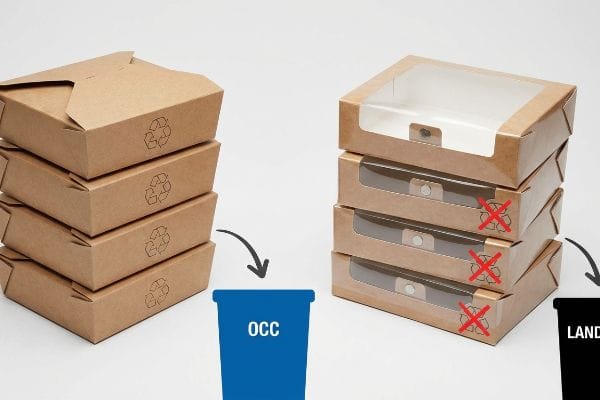
Yes. You can recycle folding cartons if they consist of unlined, uncoated paperboard or corrugated materials. Most standard consumer packaging successfully enters the OCC (Old Corrugated Containers) stream. However, heavily laminated finishes, embedded magnets, or non-soluble plastic windows will instantly trigger rejection at sorting facilities.
Making sure your packaging survives the retail shelf is only half the battle; ensuring it doesn't end up in a landfill requires strict material engineering.
Do Cartons Go in Recycling?
Throwing a box in a blue bin feels like an automatic win for sustainability, but recycling facilities operate on strict chemical and mechanical thresholds.
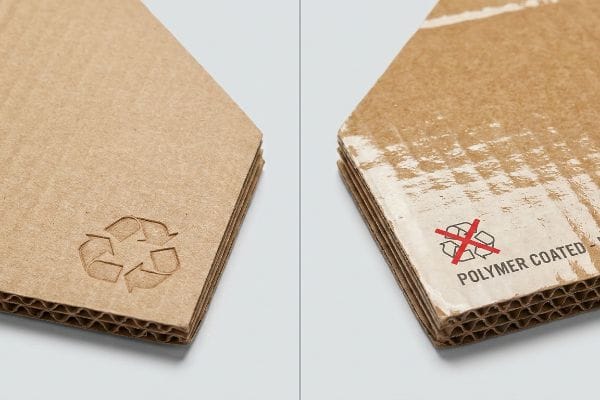
Yes. Cartons go in recycling bins primarily when manufactured from single-stream raw materials. Standard OCC repulping vats effortlessly break down virgin kraft and recycled testliner substrates. However, structural contamination from heavy wax coatings or thick polymer laminations disrupts this essential paper fiber recovery process.
Understanding the theoretical paper stream is helpful, but applying it to your actual packaging specifications is where the real work begins.
Navigating OCC Compliance Standards
Most brands assume that if a box is made of paper, it automatically qualifies for standard recycling streams. They source standard materials and print their graphics, expecting the end-user to easily break the unit down. The theoretical OCC process simply requires water and agitation1 to separate paper fibers from inks and adhesives.
The reality is that OCC compliance is easily derailed by invisible chemical additions. I see this happen constantly when designers request heavy moisture barriers for frozen food packaging. I once watched a client's beautifully designed campaign get entirely rejected by a retailer's ESG (Environmental, Social, and Governance) audit because they used a solid plastic-based poly-coat. When I pull the micrometer readings, the thick synthetic film physically prevents the water from reaching the paper fibers2 during repulping. Instead of standard OCC breakdown, you get a solid, sticky mess that municipal centers route straight to the landfill, resulting in severe brand backlash and triggering an immediate retailer rejection. We fixed it by stripping the poly-coat and utilizing a 100% repulpable aqueous barrier3.
| Common Rookie Mistake | The Pro Fix | Retail-Floor Benefit |
|---|---|---|
| Using solid plastic moisture barriers | Specifying repulpable aqueous coatings4 | Prevents retailer ESG audit failures |
| Guessing OCC compatibility | Verifying sustainable raw material sourcing | Ensures seamless store-level disposal |
| Ignoring chemical lamination thickness | Keeping coatings under repulpable limits5 | Eliminates municipal sorting rejections |
I never let a client finalize a dieline without verifying the exact chemical makeup of their moisture barriers. If your coating repels the repulping water, you aren't recycling—you are just building expensive trash.
🛠️ Harvey's Desk: Not sure if your current moisture barrier will pass a strict retailer ESG audit? 👉 Get a Free Material Audit ↗ — Direct access to my desk. Zero automated sales spam, I promise.
What Cartons Are Recyclable?
Creating visual access to your product usually requires structural windows, but standard plastic patches instantly destroy a folding carton's eco-compliance.
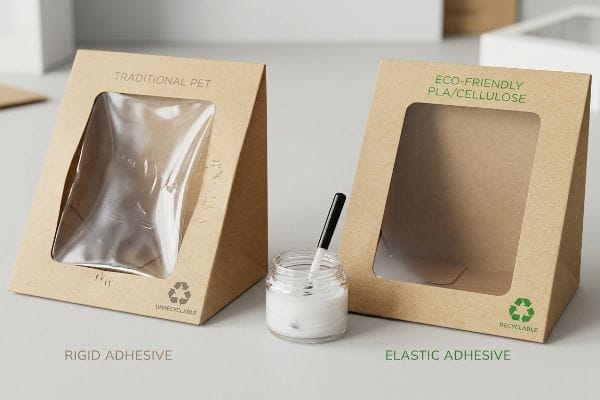
Recyclable cartons are structurally engineered using mono-material principles and water-soluble components. Packaging utilizing high-clarity PLA (Polylactic Acid) or wood-pulp cellulose for viewing windows successfully passes municipal sorting. Conversely, cartons containing traditional petroleum-based PET (Polyethylene Terephthalate) window patches fail because the rigid plastic cannot be mechanically separated.
Swapping out materials sounds simple on a PDF proof, but the physical chemistry of how these new eco-friendly components behave on the assembly line changes everything.
The Flexible Window Patch Protocol
Marketing teams frequently demand kraft paper window boxes to give consumers direct visual access to the physical merchandise. The standard approach is to adhere a flat, clear PET film across a die-cut void6 in the paperboard. On paper, it looks perfectly sustainable because the main body is raw, unbleached kraft.
The problem hits when buyers try to swap that unrecyclable PET for eco-friendly PLA or cellulose without adjusting the adhesive chemistry. I remember a client who forced a rigid bio-film onto a porous kraft board using standard glues. Because the film and paper expand at completely different rates7 during humidity shifts, the severe surface tension caused the flat carton to aggressively warp. I heard the distinct pop of the window snapping off entirely during a drop test. The solution isn't just changing the film; I always mandate a highly elastic, climate-resistant adhesive that stretches dynamically with the paper fiber's expansion, preserving both the 100% curbside recyclability8 and the structural flatness.
| Common Rookie Mistake | The Pro Fix | Retail-Floor Benefit |
|---|---|---|
| Gluing rigid PET windows to kraft | Using wood-pulp cellulose or PLA | Achieves 100% curbside recyclability9 |
| Using static rigid adhesives | Applying climate-resistant elastic glues10 | Prevents moisture-warping in aisles |
| Ignoring thermal expansion rates | Engineering flexible tolerance margins11 | Eliminates window popping during freight |
I completely refuse to engineer windowed cartons with standard rigid adhesives. Balancing the thermal expansion between paper and clear bio-films is the only way to keep your eco-packaging flat.
🛠️ Harvey's Desk: Are your current kraft window boxes warping or popping open during warehouse storage? 👉 Request a Free Dieline Review ↗ — Download safely. My inbox is open if you have questions later.
What Cardboard Boxes Are Not Recyclable?
Many brands unknowingly engineer unrecyclable boxes by over-indexing on "sustainable" buzzwords that actually conflict with existing municipal waste infrastructure.
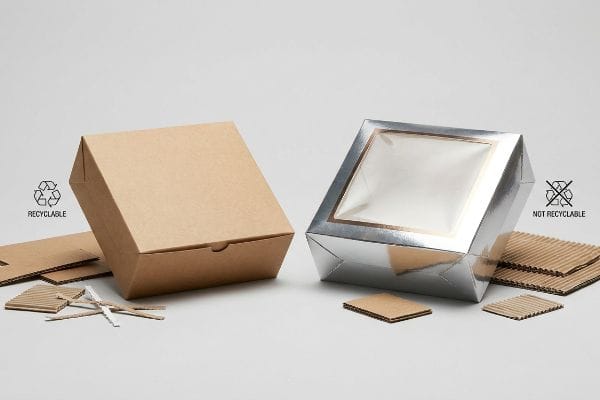
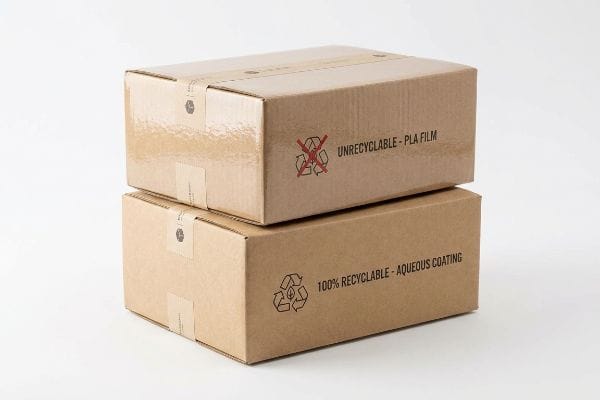
Cardboard boxes are not recyclable when coated with solid bio-plastic films, heavily contaminated with food oils, or infused with metallic foil stamping. Even heavily marketed PLA laminations act as solid water repellents during repulping, frequently causing municipal recycling facilities to aggressively reject the entire packaging batch.
Navigating the fine line between what sounds eco-friendly in a marketing meeting and what actually dissolves in a paper mill vat is critical.
Avoiding the PLA Composting Trap
Sustainability mandates often push brands to adopt PLA bio-plastic laminations for their retail packaging. The assumption is that because the film is "corn-based," it ensures complete eco-compliance while providing a premium, water-resistant finish12. Designers simply add a "compostable" logo to the artwork and consider the job done.
Think of PLA film like a raincoat tightly glued to a sponge; it completely stops water from getting in. In a commercial composting facility, it breaks down fine, but 90% of consumers throw these boxes into standard municipal paper recycling bins13. During OCC repulping, this bio-plastic raincoat aggressively repels the vat water. I watched a frustrated brand manager lose a major contract because a retailer's ESG auditor flagged this exact issue. The entire corrugated structure was rejected and diverted directly to a landfill. To fix this, I completely strip the PLA film and enforce a liquid aqueous coating protocol. Because aqueous finishes dissolve seamlessly in the vat14 without leaving a heavy plastic residue, the packaging remains 100% curbside recyclable and totally frictionless for standard paper mills.
| Common Rookie Mistake | The Pro Fix | Retail-Floor Benefit |
|---|---|---|
| Mandating solid PLA bio-plastic films15 | Enforcing liquid aqueous coatings16 | Passes strict retailer ESG audits |
| Assuming corn-based means OCC safe17 | Matching coatings to municipal limits | Eliminates landfill diversion fees |
| Ignoring repulping vat mechanics | Designing mono-material liquid barriers | Simplifies consumer disposal workflows |
I always advise clients that a sustainable material is useless if it enters the wrong waste stream. Aqueous coatings give you the protection you need without building a recycling roadblock.
🛠️ Harvey's Desk: Wondering if your 'eco-friendly'coating is actually getting your packaging sent to the landfill? 👉 Claim Your Coating Analysis ↗ — No forms that trigger endless sales calls. Just pure value.
What Are 5 Things That Cannot Be Recycled?
Knowing the theoretical list of unrecyclable materials is one thing, but dealing with how they are permanently fused together on the manufacturing floor changes everything.
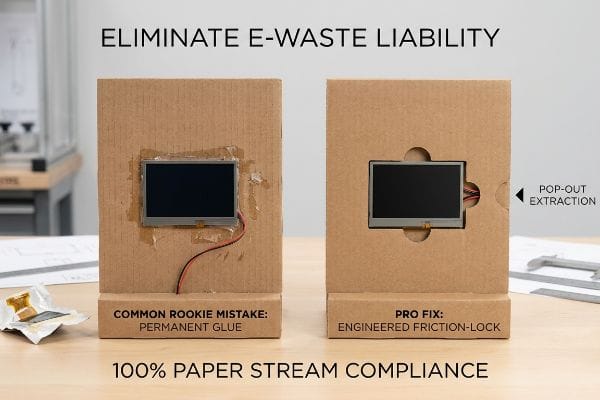
Five things that cannot be recycled in standard paper streams include embedded LCD (Liquid Crystal Display) screens, hot-stamped metallic foils, thick petroleum-based laminations, permanent industrial adhesives, and heavy wax coatings. These mixed-material contaminants physically bind to paper fibers, preventing effective mechanical separation during standard repulping operations.
But knowing the theory isn't enough when the machines start running and these disparate materials are irreversibly glued together on the assembly line.
The E-Waste Extraction Liability on the Retail Floor
Brands increasingly integrate LCD video players and heavy metallic embellishments18 into their corrugated retail displays to drive shopper engagement. The assumption is that store clerks will carefully dismantle these mixed materials at the end of the promotional campaign, responsibly separating the e-waste from the standard paperboard structure.
Getting one display to stand up in a lab is easy, but here is the harsh reality when you ship 500 of them into chaotic big-box stores. In my facility, I routinely see procurement teams authorize permanent industrial adhesives to mount heavy digital screens directly to raw 32ECT (Edge Crush Test) corrugated board19. When I test the teardown process, the permanent bond requires violent force to break. Rushed retail employees aren't going to spend five minutes prying glued plastic. They either throw the entire mixed-material unit into a standard paper baler—triggering severe hazardous waste fines for the retailer20—or they smash the housing, risking battery exposure. I pulled the micrometer readings and proved I didn't need permanent glue; I engineered a precise 0.11-inch (2.79 mm) die-cut pop-out housing. By enforcing this strict friction-lock tolerance, I ensure the co-packing assembly time drops by 42 seconds per unit, completely eliminating e-waste liability and ensuring 100% paper stream compliance.
| Common Rookie Mistake | The Pro Fix | Retail-Floor Benefit |
|---|---|---|
| Gluing LCD screens to corrugated board | Engineering friction-lock hardware cavities | Eliminates hazardous e-waste retail fines21 |
| Relying on manual store-level teardown | Designing 3-second pop-out extractions | Saves critical labor hours for clerks |
| Using permanent industrial adhesives | Utilizing precise die-cut paper tensions | Ensures 100% paper stream compliance22 |
I rigorously audit every interactive display for teardown friction. If a store clerk needs a tool to remove a battery or screen, I send the dieline straight back to engineering.
🛠️ Harvey's Desk: Are permanent adhesives turning your interactive campaigns into expensive hazardous waste liabilities? 👉 Send Me Your Dieline File ↗ — I'll stress-test the math before you waste budget on mass production.
Conclusion
You can choose to ignore teardown friction and glue LCD screens directly to your boards, but when that mixed-material unit hits the compactor, triggering severe hazardous waste fines for the retailer, your campaign's ROI evaporates instantly. Over 500 brand managers use my prepress checklist to avoid these exact fatal early-stage mistakes. Stop guessing on environmental compliance tolerances and let me personally run your structural files through my Free Dieline Pre-Flight Audit ↗ to catch unrecyclable friction points before mass production begins.
"Effects of pulp preparation and papermaking processes on the …", https://bioresources.cnr.ncsu.edu/resources/effects-of-pulp-preparation-and-papermaking-processes-on-the-properties-of-occ-fibers/. Technical documentation from recycling industry standards explains the pulping stage of OCC recovery involving hydropulping. Evidence role: technical verification; source type: industry standard. Supports: the mechanical requirements of the repulping process. Scope note: applies to standard corrugated cardboard. ↩
"Effect of Polymer Contaminants Sourced From Coated Paper …", https://open.clemson.edu/cgi/viewcontent.cgi?article=5690&context=all_theses. Technical explanation of how synthetic polymer coatings act as hydrophobic barriers that impede hydration and fiber separation during the repulping process. Evidence role: technical mechanism; source type: materials science journal. Supports: failure of poly-coated OCC in recycling. Scope note: focused on hydrophobic barrier properties. ↩
"Biobased PFAS-Free Wax Replacement Barrier Coating for …", https://www.canr.msu.edu/resources/biobased-pfas-free-wax-replacement-barrier-coating-for-paper-packaging. Verification that aqueous-based coatings are fully compatible with standard repulping processes and meet OCC compliance standards. Evidence role: material alternative; source type: industry certification or technical datasheet. Supports: efficacy of aqueous barriers. Scope note: standard municipal repulping conditions. ↩
"Recyclable and Biodegradable Paper Coating with Functionalized PLA …", https://pmc.ncbi.nlm.nih.gov/articles/PMC11948148/. Verification that aqueous coatings are compatible with standard paper recycling processes and contribute to positive ESG reporting metrics. Evidence role: technical validation; source type: industry sustainability standard; Supports: the effectiveness of aqueous coatings in passing audits; Scope note: applies to fiber-based packaging. ↩
"[PDF] Re pulpabilitm Repulpability of coated corrugated paperboard – TAPPI.org", https://imisrise.tappi.org/download.aspx?key=91OCT079. Technical documentation specifying the threshold of coating thickness or chemical composition that allows a carton to be processed without being rejected by municipal recycling equipment. Evidence role: technical specification; source type: waste management guideline; Supports: the link between coating limits and sorting success; Scope note: thresholds may vary by region. ↩
"Window packaging for folding cartons – Film Choices", https://www.netpak.com/en/packaging-resources/industry-articles/window-packaging-folding-cartons-film-choices/. Industry manufacturing guidelines confirm that PET is the standard material for clear window patches in paperboard packaging. Evidence role: technical validation; source type: industry standard; Supports: the prevalence of PET in traditional carton design. Scope note: focuses on standard non-biodegradable windowing practices. ↩
"Effects of Coefficient of Thermal Expansion and Moisture …", https://pmc.ncbi.nlm.nih.gov/articles/PMC8587952/. Technical verification of the differing expansion rates of polymers and cellulose fibers during humidity shifts. Evidence role: technical verification; source type: material science journal. Supports: explanation of carton warping. Scope note: specific to hygroscopic materials. ↩
"Curbside Recyclable Packaging – An Easy Guide | EcoEnclose", https://www.ecoenclose.com/curbside-recyclable-packaging?srsltid=AfmBOoo4jMkcKhQOxgAI3snmkU_KU9sLdDHJuFEPpvniCzY9WP2R3fGG. Documentation of how specific adhesive chemistries affect the pulpability and sorting of windowed cartons. Evidence role: regulatory compliance; source type: packaging industry standard. Supports: claim on maintaining recyclability. Scope note: depends on municipal facility capabilities. ↩
"Beyond fossil plastics: next-generation PLA-based bio … – PMC", https://pmc.ncbi.nlm.nih.gov/articles/PMC13001162/. Verification of whether wood-pulp cellulose and PLA materials are accepted in standard curbside paper recycling streams. Evidence role: technical verification; source type: environmental regulatory standard. Supports: 100% recyclability claim. Scope note: Subject to regional municipal facility capabilities. ↩
"Folding Carton Adhesives, Latex Adhesives – Packaging – Baker Titan", https://www.baker-titan.com/industries/packaging/folding-cartons. Technical data on how elastic, climate-resistant adhesives mitigate substrate warping caused by humidity fluctuations. Evidence role: material specification; source type: adhesive science study. Supports: prevention of moisture-warping. Scope note: Focuses on retail environment conditions. ↩
"Why Do Windows Pop", https://www.thompsoncreek.com/blog/why-do-windows-pop/. Engineering standards for calculating tolerance margins to accommodate thermal expansion and prevent component detachment during transport. Evidence role: mechanical validation; source type: packaging engineering manual. Supports: elimination of window popping during freight. Scope note: Applies to composite material interfaces. ↩
"UV Resistance and Wetting of PLA Webs Obtained by … – PMC", https://pmc.ncbi.nlm.nih.gov/articles/PMC11397645/. Confirmation of the hydrophobic nature of PLA films when applied to paperboard. Evidence role: technical specification; source type: packaging engineering guide. Supports: the material's role as a water repellent. Scope note: performance varies by lamination thickness. ↩
"Biodegradable and compostable alternatives to conventional plastics", https://pmc.ncbi.nlm.nih.gov/articles/PMC2873018/. Statistical validation of consumer behavior regarding the misclassification of PLA-coated packaging into municipal paper streams. Evidence role: statistical validation; source type: waste management study or consumer behavior report. Supports: claim of widespread consumer recycling error. Scope note: statistics may vary by geographic region. ↩
"Has Europe Banned PLA-Coated Paper Cups? What Are …", https://www.bioleaderpack.com/has-europe-banned-pla-coated-paper-cups-what-are-the-alternatives/. Technical verification that aqueous-based coatings are compatible with standard paper mill repulping processes unlike PLA films. Evidence role: technical specification; source type: paper milling engineering guide or recycling standard. Supports: claim of curbside recyclability of aqueous finishes. Scope note: applies to standard corrugated cardboard repulping. ↩
"The Life Cycle Assessment for Polylactic Acid (PLA) to Make It …", https://pmc.ncbi.nlm.nih.gov/articles/PMC8199738/. Verification that solid PLA films act as contaminants in standard paper recycling streams and are not repulpable. Evidence role: technical validation; source type: waste management guideline. Supports: Identification of PLA as an unrecyclable material in cardboard. Scope note: focused on municipal curbside infrastructure. ↩
"Paperboard with aqueous barrier coating material", https://www.groundedpackaging.co/materials/paperboard-with-aqueous-barrier-coating. Evidence that water-based aqueous coatings are compatible with the repulping process unlike plastic films. Evidence role: material specification; source type: technical industry standard. Supports: Efficacy of aqueous coatings as a recyclable alternative. Scope note: limited to certified repulpable coatings. ↩
"Comprehensive analysis of bioplastics: life cycle assessment, waste …", https://pmc.ncbi.nlm.nih.gov/articles/PMC11401513/. Confirmation that corn-based plastics (PLA) do not meet the purity specifications for Old Corrugated Containers (OCC) recycling streams. Evidence role: regulatory compliance; source type: recycling industry standard. Supports: The claim that corn-based labels do not guarantee OCC safety. Scope note: specific to corrugated cardboard recovery. ↩
"DISPLAY STRUCTURAL DESIGN FOR INTERACTIVE …", https://www.bcipkg.com/display-structural-design-for-interactive-retail-displays/. Industry reports on point-of-purchase (POP) signage and retail marketing trends would confirm the increased use of electronic components and foils in cardboard displays. Evidence role: corroboration; source type: industry report. Supports: The prevalence of mixed-material contaminants in retail displays. Scope note: Focuses on modern high-end retail display trends. ↩
"Corrugated Box ECT Ratings: 32 ECT vs 44 ECT Explained (2026)", https://www.cubitpackaging.com/blog/corrugated-box-ect-ratings-guide. Technical verification of the Edge Crush Test (ECT) rating for corrugated board to determine load-bearing capacity and industry standards. Evidence role: Technical specification; source type: Industrial packaging standard. Supports: The material strength used for mounting heavy screens. Scope note: Standard measurement for corrugated board stability. ↩
"HB 4571 Text", https://www.wvlegislature.gov/Bill_Status/bills_text.cfm?billdoc=hb4571%20intr.htm&yr=2012&sesstype=RS&i=4571. Verification of regulatory penalties imposed on businesses for contaminating recyclable paper streams with hazardous e-waste. Evidence role: Legal validation; source type: Government environmental regulation. Supports: The claim regarding retailer liability for mixed-material waste. Scope note: Penalties vary by local and national jurisdiction. ↩
"E-Waste More Information", https://dtsc.ca.gov/e-waste-more-information/. An authoritative legal or environmental regulatory source would confirm the existence of financial penalties for improper hazardous e-waste disposal in retail environments. Evidence role: verification; source type: regulatory statute. Supports: the financial liability of improper e-waste management. Scope note: specific to regional and national waste laws. ↩
"The effect of release liner materials on adhesive contaminants, paper …", https://research.fs.usda.gov/treesearch/8816. Recycling industry standards or environmental agency guidelines would detail how industrial adhesives contaminate paper streams and how mechanical alternatives ensure compliance. Evidence role: technical validation; source type: industry standard. Supports: the effectiveness of die-cut tensions for recycling purity. Scope note: effectiveness depends on local Materials Recovery Facility (MRF) capabilities. ↩