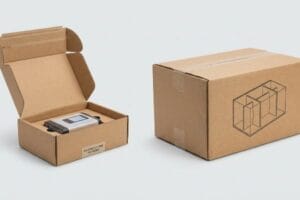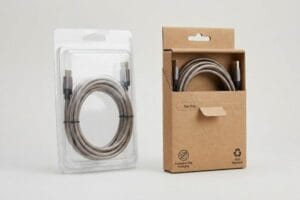
Buyers often panic when large e-commerce platforms mandate the removal of plastic clamshells and EPS foam, assuming their high-ticket items will shatter during cross-country transit operations.
Yes. Frustration Free Packaging can protect products equally well by replacing rigid plastics with engineered corrugated suspension voids and micro-fluted paperboard. This methodology absorbs kinetic transit shocks through structural geometry rather than raw material mass, guaranteeing strict ISTA 6 compliance while completely eliminating hazardous blister packs and zip ties.
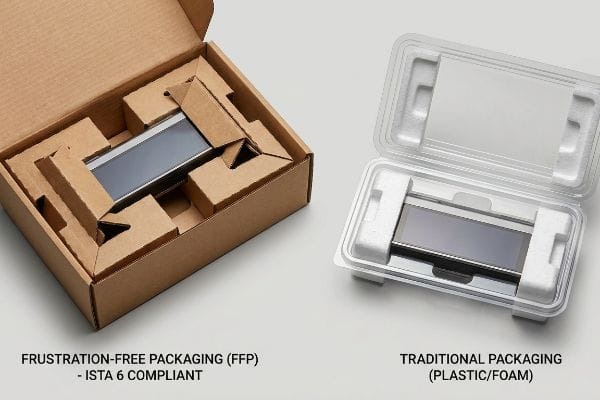
Achieving that level of structural armor without relying on thick petroleum plastics isn't magic—it requires ruthless mathematical precision and advanced material engineering on the factory floor.
What Is the Difference Between Frustration Free Packaging and Standard Packaging?
Separating standard consumer boxes from optimized e-commerce shippers comes down to analyzing absolute material efficiency.
The primary difference between Frustration Free Packaging and standard packaging lies in material homogeneity. Standard systems rely on mixed plastics, metal twist-ties, and styrofoam, whereas optimized frustration-free designs utilize mono-material corrugated structures, deploying origami-style paper locks to secure components without requiring razor blades for unboxing.
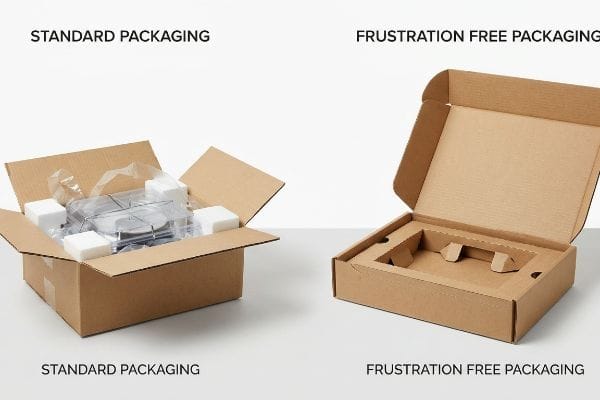
Understanding this paradigm shift means looking past colorful graphic design and focusing strictly on the internal structural physics of the carton.
The Mechanics of Mono-Material Origami Locks
Traditional retail packaging uses what I call brute-force containment. Brands seal products inside heavy PVC (Polyvinyl Chloride) clamshells1 or tape down EPS (Expanded Polystyrene) foam blocks simply to prevent internal movement. FFP (Frustration Free Packaging) replaces these disparate mixed-material barriers with engineered corrugated geometry. Instead of utilizing sharp metal zip ties or permanent industrial glues, we deploy precise die-cut male-female paper tabs that interlock seamlessly2 to grip the internal merchandise.
To execute this structurally, I rely on the inherent kinetic absorption of fluted paperboard. When designing a protective inner void, the flutes act as microscopic mechanical shock absorbers3. By folding a single sheet of E-flute board4 into a custom suspension bridge around the product, the packaging deflects external compression forces away from the fragile center. This mono-material approach ensures the product remains completely immobile during freight transit, while allowing the end consumer to dismantle the entire structure using only their bare hands in under ten seconds.
| Structural Feature | Standard Approach | FFP Engineering Reality |
|---|---|---|
| Product Anchoring | Metal wire twist-ties | Origami-style paper tabs5 |
| Void Fill Material | EPS foam blocks | Die-cut corrugated suspension6 |
| Opening Mechanism | Heat-sealed blister edges | Tear-strip perforation lines7 |
I strictly mandate mono-material designs for all high-volume e-commerce shippers. Eliminating mixed plastics drastically reduces the overall tare weight, instantly cutting downstream logistics fees while hitting peak consumer satisfaction metrics.
🛠️ Harvey's Desk: Are your current e-commerce shippers inflating your freight costs with unnecessary plastic void fill? 👉 Get a Free Freight Density Audit ↗ — I review every structural file personally within 24 hours.
What Are the 7 Types of Packaging?
Classifying your physical inventory correctly prevents catastrophic logistical failures during fast-paced global transit operations.
The 7 types of packaging generally include primary consumer boxes, secondary retail folding cartons, tertiary master cartons, protective void fill, retail-ready shelf trays, point-of-purchase floor displays, and transit pallets. Each distinct category requires specific structural tolerances and load-bearing flute alignments to survive the global commercial supply chain.
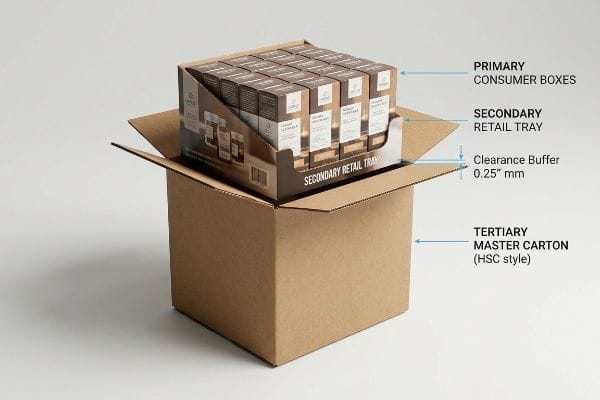
While listing these categories on a spreadsheet is simple, managing the physical friction between a secondary carton and a tertiary shipper is a brutal mechanical challenge.
The Nested Friction Clearance Hazard
Even veteran designers often overlook the precise dimensional relationship between primary cartons and secondary retail-ready packaging. They build the outer tertiary shipper to the exact 1:1 exterior dimensions of the inner display tray8, assuming a perfectly tight fit will maximize freight density inside the shipping container. On paper, it looks incredibly efficient to eliminate all internal empty space.
In my facility, I routinely see the aftermath of this theoretical assumption. Raw corrugated testliner possesses immense surface tension9. Last quarter, I audited a shipment where 24-inch (609.6 mm) retail trays were jammed into identical 24-inch (609.6 mm) HSC (Half Slotted Container) master shippers. During our factory unpacking tests, the friction lock was so severe that pulling the tray forced the porous corrugated walls to aggressively bind, tearing the printed front retaining lip completely off before the unit even reached the aisle. I immediately pulled the micrometer readings and mathematically expanded the internal cavity of the master carton by exactly 0.25 inches (6.35 mm). This precise offset tolerance broke the surface friction, allowing the inner display unit to slide out effortlessly.
| Packaging Metric | Theoretical Design | My Floor Reality |
|---|---|---|
| Master Carton Fit | 1:1 exact nested ratio | 0.25 in (6.35 mm) buffer10 |
| Surface Friction | Presumed smooth sliding | Aggressive fiber binding11 |
| Unboxing Speed | 2 minutes of struggling | 15 seconds per unit |
I refuse to approve nested dimensions without running a physical friction test first. Adding a fractional millimeter of clearance completely eliminates torn retaining lips, ensuring retail clerks can actually deploy the tray rapidly.
🛠️ Harvey's Desk: Are retail clerks destroying your expensive merchandisers just trying to wrestle them out of the shipping box? 👉 Claim Your Structural Dieline Audit ↗ — 100% confidential. Your unreleased retail designs are safe with me.
What Is a Frustration Free Packaging?
Meeting official e-commerce certification standards requires vastly more strategic planning than just removing plastic shrink wrap.
A Frustration Free Packaging is an officially certified e-commerce structure engineered to ship in its own container without requiring an overbox. These minimalist designs must pass rigorous transit validations, ensuring product protection while utilizing entirely curbside-recyclable materials that open easily without specialized tools.
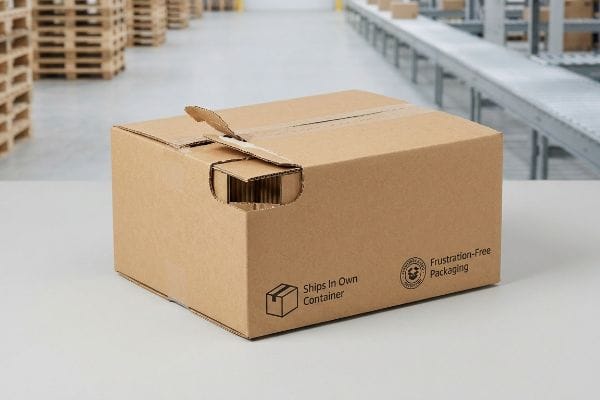
The true test of these independent systems happens during compliance validation long before a consumer touches the box.
The SIOC E-Commerce Validation
To qualify for genuine Frustration Free status12, retail packaging must transition from standard shelf display formats to strict e-commerce shipping requirements. Brand managers often assume that adopting the SIOC (Ships In Own Container) protocol13 simply means slapping a shipping label on their existing retail box. On a supply chain spreadsheet, eliminating the secondary brown overbox looks like an incredibly fast way to slash packaging costs.
In reality, stripping away the exterior overbox exposes the primary consumer carton to the chaotic realities of e-commerce fulfillment centers. Without that secondary protective layer, the primary box must be structurally redesigned to survive standard warehouse handling14 independently. By upgrading the internal corrugated partitions, the package anchors the product securely, ensuring the brand avoids expensive retailer chargebacks for damaged goods15 while keeping the final unboxing experience incredibly simple for the buyer.
| Testing Variable | Standard Fulfillment | SIOC Certified Protocol |
|---|---|---|
| Exterior Protection | Heavy corrugated overbox | Ships in own container16 |
| Transit Validation | Basic static compression | Standard handling validation17 |
| Consumer Experience | Razor blade required | Tool-free opening18 |
Integrating SIOC standards into early structural design completely eliminates the need for expensive exterior overboxes. This proactive strategy drastically cuts dimensional weight fees and shields e-commerce brands from crippling retailer chargebacks.
🛠️ Harvey's Desk: Is your current e-commerce packaging failing strict SIOC requirements and getting hit with massive retailer chargebacks? 👉 Request a Free SIOC Compliance Check ↗ — No account managers in the middle. You talk directly to structural engineers.
What Are Some Sustainable Alternatives to Plastic Packaging?
Phasing out petroleum plastics often leads brands into dangerous chemical dead ends if they misinterpret raw material data.
The most effective sustainable alternatives to plastic packaging include water-based aqueous coatings, high-performance micro-fluted corrugated boards, and wood-pulp cellulose window films. These materials eliminate the need for petroleum-based clamshells and rigid PET windows, maintaining robust structural integrity while remaining perfectly repulpable within standard municipal curbside recycling streams.
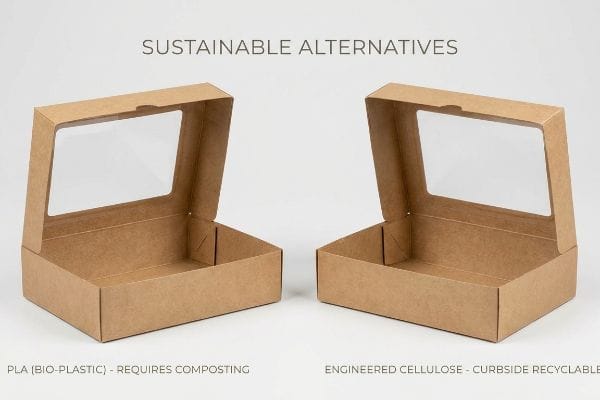
Unfortunately, many procurement teams accidentally sabotage their own eco-friendly initiatives by blindly selecting the wrong alternative materials on a spreadsheet.
The PLA Composting Recycling Trap
It is a common trap that catches even experienced procurement teams: mandating PLA (Polylactic Acid) bio-plastic films19 to replace standard PVC windows or laminations. They assume that because PLA is plant-based, it automatically guarantees eco-compliance. On a theoretical spec sheet, a corn-based plastic20 sounds like the perfect sustainable upgrade for a premium retail carton moving through a high-traffic grocery chain.
In my facility, I routinely see how this bio-plastic actually behaves in real-world repulping scenarios. PLA creates a highly solid, hydrophobic film. When I tested these laminations against standard OCC (Old Corrugated Containers) repulping conditions, the physical plastic film aggressively repelled the water vats. Municipal recycling centers simply intercept this solid bio-layer and divert the entire attached box straight to a landfill21. I immediately stripped the PLA mandate from the client's BOM (Bill of Materials). Instead, I applied a liquid aqueous coating over the heavily printed areas and used die-cut cellulose for the clear windows. This simple chemical pivot maintained the waterproof barrier but allowed the carton to dissolve seamlessly, ensuring 100% curbside recyclability22 without triggering a massive EOL (End of Life) disposal penalty.
| Material Strategy | Bio-Plastic (PLA) | Engineered Cellulose/Aqueous |
|---|---|---|
| Water Resistance | Solid hydrophobic film | Dissolvable liquid polymer |
| Recycling Stream | Requires commercial compost23 | Standard curbside OCC24 |
| Retailer ESG Score | High rejection risk | 100% compliant pass |
I strictly ban solid PLA films for any client aiming for mass-market curbside recycling. Switching to aqueous coatings instantly secures high ESG compliance and eliminates severe retailer disposal fines without inflating the raw material budget.
🛠️ Harvey's Desk: Are hidden bio-plastics actively triggering retailer ESG rejections on your supposedly sustainable packaging? 👉 Request a Free Eco-Material Audit ↗ — I review every structural file personally within 24 hours.
Conclusion
Replacing mixed plastics with frustration-free corrugated architecture demands absolute precision, where a single nested friction lock or failed SIOC drop test can completely wipe out your logistics margins. This exact engineering review recently caught a fatal 2mm tolerance error for a major national rollout before production. Stop letting theoretical material choices trigger heavy retailer chargebacks; let me personally run your structural files through a Free Structural Dieline Audit ↗ to mathematically guarantee your next packaging campaign survives the supply chain.
"Understanding Plastic Clamshell Packaging Materials", https://indepak.com/understanding-plastic-clamshell-packaging-materials/. Documentation of materials commonly used in traditional retail packaging for product containment. Evidence role: factual verification; source type: industry report. Supports: the reliance of standard packaging on mixed plastics. Scope note: standard retail packaging. ↩
"What Is Frustration-Free Packaging?", https://www.vistaprint.com/hub/frustration-free-packaging?srsltid. Technical verification of mono-material interlocking mechanisms used in FFP to replace glues and ties. Evidence role: technical validation; source type: packaging engineering specification. Supports: the use of corrugated geometry for securement. Scope note: FFP design standards. ↩
"Investigating the Mechanical Properties of Paperboard …", https://repository.rit.edu/cgi/viewcontent.cgi?article. Brief explanation of how an authoritative material science source explains the structural mechanics of corrugation in cushioning impact. Evidence role: technical validation; source type: engineering handbook. Supports: kinetic absorption claim. Scope note: focuses on corrugated board physics. ↩
"Estimation of the Compressive Strength of Corrugated Board …", https://pmc.ncbi.nlm.nih.gov/articles/PMC8467740/. Brief explanation of the technical specifications of E-flute corrugated board regarding its thickness and compression resistance for inner packaging. Evidence role: specification verification; source type: industry standard. Supports: choice of material for force deflection. Scope note: specifically E-flute grade. ↩
"Frustration-Free Packaging", https://www.aboutamazon.eu/news/innovation/frustration-free-packaging. Verification of the use of folded paper geometries for securing items in FFP to eliminate plastic. Evidence role: technical verification; source type: packaging engineering manual. Supports: use of mono-material locking mechanisms. Scope note: specific to paper-based FFP. ↩
"How to Choose Packaging Materials", https://indexpackaging.com/resources/how-to-choose-packaging-materials/?srsltid. Confirmation that FFP replaces expanded polystyrene (EPS) with corrugated suspension systems to reduce environmental impact. Evidence role: material comparison; source type: industry sustainability report. Supports: material efficiency claims. Scope note: applicable to e-commerce shipping. ↩
"Tear Strip for Opening and Re-sealing", https://www.thepackagingportal.com/industry-news/tear-strip-for-opening-and-re-sealing/. Technical documentation of the shift from heat-sealed blister packs to perforated tear-strips for improved accessibility. Evidence role: specification validation; source type: packaging design guideline. Supports: ease of opening metrics. Scope note: focused on consumer accessibility. ↩
"How Many Types of Retail Boxes Are in the Packaging World?", https://popdisplay.me/how-many-types-of-retail-boxes-are-in-the-packaging-world/. Technical guidelines for corrugated packaging specify required clearances between inner trays and outer shippers to prevent structural failure and friction. Evidence role: technical specification; source type: industry standard/engineering handbook. Supports: the claim that 1:1 sizing is a design error. Scope note: applies to nested cardboard packaging. ↩
"Coefficient of Friction Testing", https://unitload.vt.edu/facilities/corrugated-packaging-lab/cof-testing.html. Technical analysis of the coefficient of friction and surface roughness of uncoated linerboards used in corrugated packaging. Evidence role: technical validation; source type: materials science handbook. Supports: the physical cause of binding between nested containers. Scope note: Focuses on raw, uncoated materials. ↩
"Tolerance for Manufacturers'Joint on RSC – AICC Now", https://now.aiccbox.org/tolerance-for-manufacturers-joint-on-rsc/. Verification of industry standard clearance gaps for nested cardboard packaging to prevent structural binding. Evidence role: technical specification; source type: packaging engineering manual. Supports: the necessity of a specific buffer for logistics efficiency. Scope note: applies to standard corrugated cardboard. ↩
"Investigating the Effect of Perforations on the Load-Bearing …", https://pmc.ncbi.nlm.nih.gov/articles/PMC11396172/. Technical explanation of how corrugated fiber surfaces interlock, increasing static friction during extraction. Evidence role: physical mechanism; source type: materials science study. Supports: the claim that smooth sliding is often theoretical in corrugated materials. Scope note: dependent on material GSM and finish. ↩
"Frustration-Free Packaging: An [Updated] Guide for …", https://www.monks.com/articles/frustration-free-packaging-updated-guide-amazon-sellers-2020. Official e-commerce certification guidelines would outline the necessary transition from retail to shipping-ready packaging. Evidence role: requirement; source type: certification standard. Supports: conditions for Frustration Free status. Scope note: Specific to e-commerce platforms like Amazon. ↩
"Guide to Amazon's SIOC Packaging (+ How You Can Do it …", https://www.shipbob.com/blog/sioc-packaging/. Logistics and packaging manuals define the SIOC protocol as a method to eliminate secondary overboxing for shipping efficiency. Evidence role: definition; source type: technical manual. Supports: the identification of the SIOC protocol. Scope note: Broadly used in sustainable e-commerce logistics. ↩
"SIOC Packaging: Transforming Ecommerce Fulfillment and …", https://dclcorp.com/blog/shipping/sioc-packaging/. Technical guidelines from e-commerce certification bodies detailing the structural requirements for Ships In Own Container (SIOC) packaging to withstand automated fulfillment processes. Evidence role: technical specification; source type: industry standard. Supports: the necessity of structural redesign for overbox removal. Scope note: Specifically pertains to FFP and SIOC standards. ↩
"Vendor Compliance: How to Reduce Retail Chargebacks", https://www.quickbox.com/blog/vendor-compliance-retail-chargebacks. Logistics and supply chain documentation explaining the financial penalties (chargebacks) imposed by retailers on vendors for shipments that arrive damaged due to inadequate packaging. Evidence role: economic justification; source type: logistics industry report. Supports: the financial risk of insufficient packaging. Scope note: Chargeback rates vary by retailer agreement. ↩
"Amazon's Ships in Own Container (SIOC) Standard", https://megalabinc.com/environmental/package/amazons-ships-in-own-container-sioc-standard-a-comprehensive-overview-and-update/. Verification from e-commerce platform standards confirming the definition of SIOC as shipping without an overbox. Evidence role: definition; source type: industry standard. Supports: SIOC packaging requirements. Scope note: applies to certified vendors. ↩
"Test Procedures", https://ista.org/test_procedures.php. Technical documentation detailing the specific drop, vibration, and compression tests required for SIOC validation. Evidence role: technical specification; source type: certification manual. Supports: Transit validation process. Scope note: specific to e-commerce logistics. ↩
"Standard Packaging vs Frustration-Free: Key Differences", https://fiberinteriorpackaging.com/resources/standard-packaging-vs-frustration-free-packaging/. Guidelines on consumer experience requirements for FFP, explicitly forbidding the need for tools like razor blades. Evidence role: requirement; source type: packaging guideline. Supports: Consumer experience standards. Scope note: specific to FFP certification. ↩
"A review on bio-based polymer polylactic acid potential … – PMC", https://pmc.ncbi.nlm.nih.gov/articles/PMC11091039/. Technical documentation confirming the industrial application of Polylactic Acid as a bio-based alternative to Polyvinyl Chloride in windowed packaging. Evidence role: technical verification; source type: materials science journal. Supports: use of PLA as a PVC substitute. Scope note: specific to flexible films. ↩
"What is PLA | A Comprehensive Guide to Polylactic Acid", https://www.goodstartpackaging.com/guide-to-pla-polylactic-acid/?srsltid. Chemical analysis confirming that Polylactic Acid is synthesized from fermented plant starch, typically corn. Evidence role: factual verification; source type: chemical industry specification. Supports: the raw material composition of PLA. Scope note: primarily relevant to North American production. ↩
"Containers and Packaging: Product-Specific Data", https://www.epa.gov/facts-and-figures-about-materials-waste-and-recycling/containers-and-packaging-product-specific. Verification that PLA-coated fiber products are typically not repulpable in standard paper mills and are frequently diverted to landfills by MRFs. Evidence role: validation; source type: waste management industry report. Supports: the systemic failure of PLA in municipal recycling streams. Scope note: outcome may vary by local facility technology. ↩
"Recyclable and Biodegradable Paper Coating with … – PMC", https://pmc.ncbi.nlm.nih.gov/articles/PMC11948148/. Technical data confirming that aqueous coatings and cellulose-based films are fully compatible with standard municipal hydropulping processes. Evidence role: technical specification; source type: materials science study. Supports: the efficacy of aqueous/cellulose alternatives over PLA. Scope note: refers to standard paper recycling streams. ↩
"PLA/PHB-Based Materials Fully Biodegradable under Both …", https://pmc.ncbi.nlm.nih.gov/articles/PMC9572414/. Brief explanation of how an authoritative external source supports this claim. Evidence role: technical specification; source type: environmental standards. Supports: the necessity of high-heat industrial facilities for PLA degradation. Scope note: excludes home composting capabilities. ↩
"Sustainable coating for recyclable packaging papers", https://www.interpack.com/en/Media_News/interpack_Magazin/FOOD_INDUSTRY_PACKAGING/Food_Industry_News/Sustainable_coatings_for_packaging_papers. Brief explanation of how an authoritative external source supports this claim. Evidence role: technical specification; source type: recycling industry guidelines. Supports: the compatibility of aqueous-coated cellulose with Old Corrugated Containers (OCC) streams. Scope note: refers to standard paper recycling infrastructure. ↩