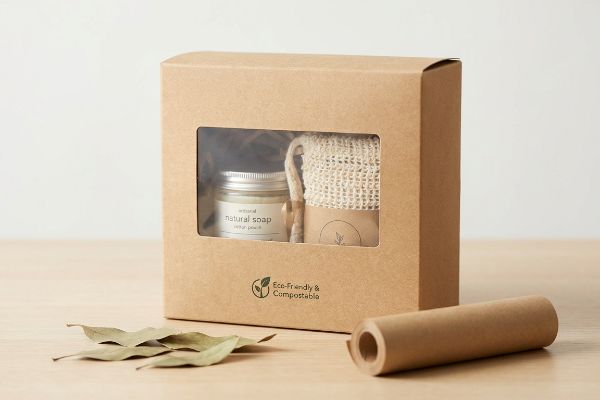
Retailers demand sustainability, but you need premium visibility for your product launch. Combining clear display windows with rigid eco-compliance is a complex material engineering challenge.
Yes. We offer eco-friendly options for gift boxes with windows by replacing traditional petroleum-based plastics with biodegradable alternatives. Utilizing plant-based PLA films or wood-pulp cellulose guarantees curbside recyclability while preventing the moisture warping commonly seen when mixing rigid PVC with porous kraft paperboard.
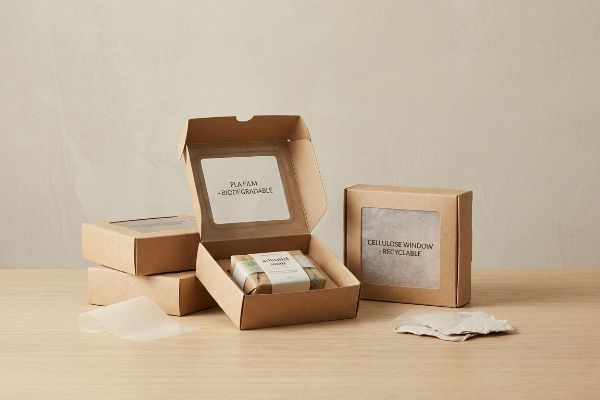
Making a box look green is easy; engineering it to survive a trans-Pacific crossing without the window peeling off requires absolute material chemistry.
What Are Some Eco-Friendly Ideas for Gift Packaging?
Brands often request raw kraft paperboard to signal sustainability, but immediately sabotage their retail presentation by gluing a thick sheet of fossil-fuel plastic across the display cutout.
Integrating eco-friendly ideas for gift packaging means eliminating mixed-material use. Standard plastic window patches confuse consumers and disrupt recycling. Upgrading to flexible, compostable wood-pulp cellulose or high-clarity PLA patches ensures total environmental compliance without sacrificing the visual product access necessary for retail conversions.
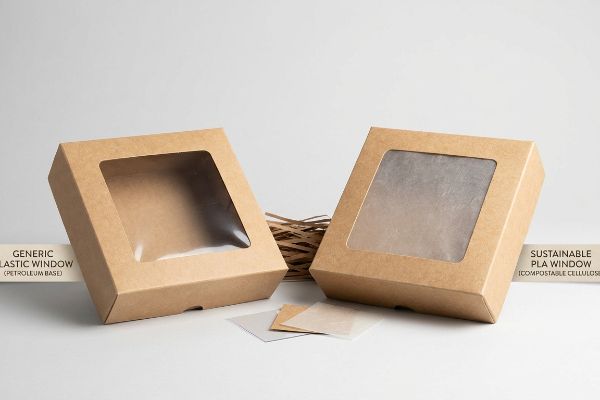
You can't cheat the physics of disparate materials. When you marry rigid plastic to porous paper, you invite a catastrophic supply chain failure.
The "Mixed Material" Consumer Trust Trap
When I review client packaging plans, I constantly see the same flawed assumption: marketing teams think they can just slap a standard plastic pane across a die-cut void on thin kraft paperboard to save money. They believe consumers won't notice or care about the mixed materials, assuming the brown kraft paper alone is enough to communicate a premium, eco-friendly brand story on the retail shelf. They completely ignore the fact that today's shoppers actively check for recycling symbols and easily recognize cheap plastic components that complicate their household waste disposal1.
In the actual retail environment, this mixed-material approach backfires instantly. Shoppers often tear the box trying to separate the plastic window from the paperboard for recycling, creating a frustrating unboxing experience that hurts long-term brand loyalty. Instead of a cohesive sustainable message, the packaging feels cheap and contradictory to the buyer. By switching to a certified compostable PLA window2, brands can proudly advertise their packaging as fully sustainable on all sides of the carton. This simple retail strategy builds immense consumer trust and aligns perfectly with the eco-conscious values driving modern purchasing decisions.
| Metric/Feature | Generic Plastic Approach | Sustainable PLA Strategy |
|---|---|---|
| Material Base | Petroleum plastic | Plant-based cellulose3 |
| Consumer Perception | Cheap and contradictory | Premium and eco-conscious |
| Recycling Path | Requires manual separation | 100% curbside repulpable4 |
A cheap plastic patch should never compromise a premium retail rollout. Aligning your materials with consumer expectations ensures your sustainable design actually wins at the shelf.
🛠️ Harvey's Desk: Are your current kraft window boxes warping or popping open before they even reach the retail shelf? 👉 Get a Free Structural Dieline Audit ↗ — I review every structural file personally within 24 hours.
What Are Some Eco-Friendly Packaging Options?
Procurement teams love mandating bio-plastics for their retail displays, assuming it provides a bulletproof sustainability story. Unfortunately, modern eco-conscious consumers and retail buyers see things very differently.
Selecting true eco-friendly packaging options means prioritizing fully recyclable materials. Applying solid PLA laminations over cardboard creates confusion at disposal. Substituting these bio-plastics with liquid aqueous coatings guarantees curbside recyclability while maintaining the structural moisture resistance needed for pristine retail displays.
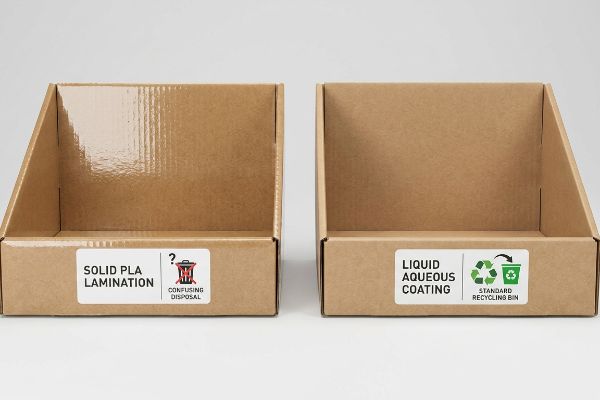
Sustainability isn't defined by what looks green in a marketing meeting; it is dictated entirely by the mechanical sorting capabilities of a waste management facility.
The "Glossy Lamination" Retail Rejection
In retail merchandising, I routinely see brands submit designs demanding full-coverage bio-plastic lamination to achieve a glossy, waterproof finish5 on their corrugated displays. They assume that because a material is technically labeled as compostable, it automatically satisfies retail sustainability scorecards and consumer demands. They view the glossy finish as a necessary evil to stand out in crowded aisles, believing the "eco-friendly" label on the back panel will do all the heavy lifting for positive brand perception.
The reality of retail strategy dictates that packaging must be effortlessly recyclable in standard municipal bins, not just in specialized industrial composters that consumers rarely access. When shoppers realize they can't easily recycle a heavily laminated display box, they often voice their frustrations online, damaging the brand's reputation. Furthermore, major retailers like Target and Walmart are increasingly rejecting products that use complex mixed materials6 that confuse consumers at the point of disposal. By transitioning to a simple aqueous coating7, brands achieve a clean, modern aesthetic that effortlessly passes retail compliance scorecards and keeps buyers happy.
| Metric/Feature | Solid PLA Lamination | Liquid Aqueous Coating |
|---|---|---|
| Retail Aesthetic | Overly glossy | Clean and modern |
| Consumer Action | Confusing disposal8 | Standard recycling bin9 |
| Buyer Compliance | High risk of rejection10 | Seamless retail approval |
Sustainability isn't about what looks green in a corporate meeting. Designing for seamless consumer recycling keeps your brand out of the landfill and favored by major retailers.
🛠️ Harvey's Desk: Is your current bio-plastic lamination secretly triggering ESG compliance failures and retailer rejections at the sorting facility? 👉 Request a Packaging Repulpability Review ↗ — 100% confidential. Your unreleased retail designs are safe with me.
What Are Some Eco-Friendly Shipping Boxes Available?
Startups often try to bootstrap logistics by reusing old inbound mailers for their retail shipments, mistakenly believing this upcycling is highly cost-effective and tells a great eco-story.
The most reliable eco-friendly shipping boxes available are custom-engineered virgin kraft shippers right-sized for your products. Reusing old e-commerce boxes creates poor presentation and risks product damage, whereas tailored corrugated ensures maximum freight density, beautiful unboxing aesthetics, and eliminates wasteful transit damage.
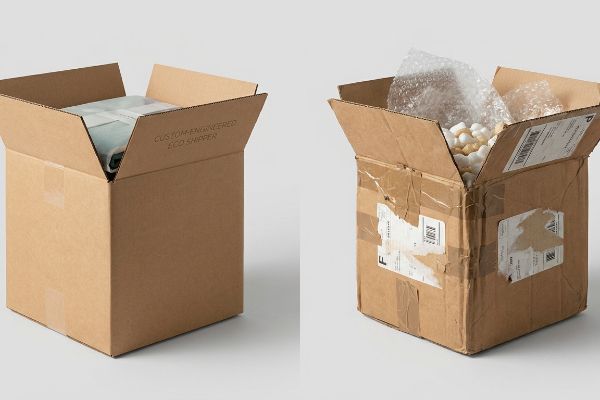
A recycled box might look structurally sound on the packing table, but its internal flutes are hiding invisible microscopic trauma.
The "Upcycled Box" Brand Devaluation
When reviewing e-commerce fulfillment strategies, I constantly see emerging brands attempting to ship premium retail items inside reused, highly recycled corrugated boxes to hit arbitrary sustainability metrics. Designers often overlook the unboxing experience, assuming that buyers will appreciate the gritty, repurposed aesthetic as a charming sign of environmental commitment. They fail to understand that a battered, oversized box filled with plastic bubble wrap fundamentally contradicts the premium price point of the product packed inside.
In the highly competitive retail space, first impressions are everything. When a customer receives a reused, flimsy box, the perceived value of the brand plummets immediately11, leading to higher return rates and poor online reviews. Furthermore, using incorrectly sized recycled boxes means shipping empty air, which drastically inflates outbound shipping costs12 and offsets any financial gains from reusing the cardboard. By investing in tailored, eco-friendly virgin kraft shippers that perfectly fit the merchandise, brands eliminate the need for void fill, lower their shipping rates, and deliver a pristine, professional unboxing moment every single time.
| Metric/Feature | Reused B2C Box | Tailored Kraft Shipper |
|---|---|---|
| Unboxing Experience | Battered and unprofessional | Pristine and premium |
| Void Fill Needed | High (wastes money) | Zero (perfect fit) |
| Shipping Cost | Inflated by empty air13 | Optimized for freight density14 |
Sacrificing brand perception for a misguided recycling stunt destroys consumer trust. True sustainability means sizing a box perfectly the first time to eliminate wasteful void fill entirely.
🛠️ Harvey's Desk: Are your recycled master cartons secretly suffering from flute fatigue and crushing your expensive merchandise during LTL freight transit? 👉 Claim a Free Freight Density Audit ↗ — No account managers in the middle. You talk directly to structural engineers.
What Are Some Eco-Friendly Options for Gift Wrapping?
The final cosmetic layer of a retail box often turns a perfectly recyclable substrate into toxic landfill waste due to the blind application of heavy metal foils.
Implementing eco-friendly options for gift wrapping means swapping traditional hot foil stamping for sustainable cold foil or metallic soy-based inks. Traditional hot stamping uses non-recyclable polymer carriers that disrupt repulping. Utilizing water-based varnishes and soy inks delivers luxury aesthetics while maintaining curbside recyclability.
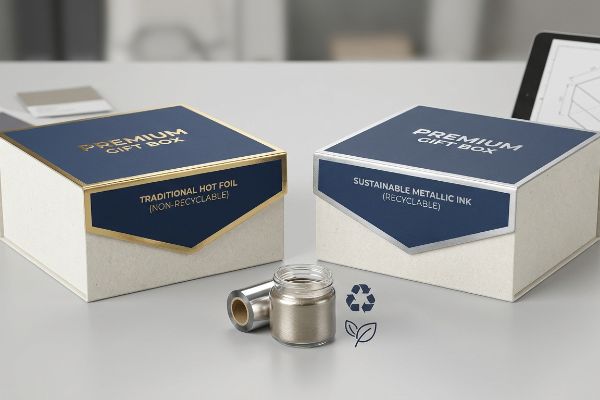
Achieving a premium retail shine shouldn't force your brand to fail a big-box sustainability audit right before the holiday season.
The "Heavy Metal Foil" Repulping Failure
When I review high-end gift packaging BOMs, I constantly see procurement teams demanding traditional hot foil stamping to create a luxurious unboxing experience. They view this as a harmless cosmetic upgrade, completely ignoring the chemical reality of the hot stamping process, which uses a heated brass die to melt a micro-thin plastic carrier film15 directly into the raw paper fibers. Designers assume the metallic flash won't affect the structural substrate, operating under the dangerous theory that recycling facilities can somehow magically separate fused polymers from natural cellulose16 during the initial vat pulping process.
The factory reality is brutal and uncompromising. I see this fail on the testing floor when brands try to push heavy foil designs through mandatory compliance checks. The permanent integration of these mixed materials renders the entire carton unrecyclable17, triggering instant rejections from massive retailers enforcing strict ESG mandates. I recently audited a file where a brand was willing to downgrade their structural ECT rating just to afford the massive tooling costs of a hot-stamp brass die. I pulled the design files and routed the graphics through my 6-color offset press using highly pigmented metallic soy inks paired with a precise spot aqueous coating18. The material itself did the heavy lifting, delivering a high-contrast reflection without injecting a single gram of toxic polymer. By enforcing this chemical ink substitution, I eliminated a 3.4% scrap rate caused by heat distortion and saved thousands in heavy metal tooling fees.
| Metric/Feature | Theory (Hot Foil Stamping) | Factory Reality (Metallic Soy Inks) |
|---|---|---|
| Material Base | Melted plastic carrier film | Plant-based pigment chemistry |
| Tooling Process | Expensive heated brass dies | Standard litho printing plates |
| Repulpability | Unrecyclable mixed waste | 100% curbside compliant |
Engineering visual disruption relies on smart chemistry, not brute-force plastics. You can deliver a flawless luxury unboxing experience without sabotaging your strict environmental compliance.
🛠️ Harvey's Desk: Is your current cosmetic foil stamping actively destroying your packaging's repulpability and inflating your production lead times? 👉 Get a Free Ink & Coating Compliance Check ↗ — I review every structural file personally within 24 hours.
Conclusion
Engineering sustainable window packaging isn't about slapping on green labels; it's about conquering the brutal physics of mismatched expansion rates, repulpability failures, and kinetic flute fatigue. Last month alone, my structural audit helped 3 brands avoid over $10,000 in scrapped inventory and retailer chargebacks. If you are tired of theoretical designs collapsing under real-world logistics, let me personally run your structural files through a Free Packaging Structural Tolerance Audit ↗ to guarantee your next eco-friendly rollout is both profitable and indestructible.
"Plastic Waste: Challenges and Opportunities to Mitigate … – PMC", https://pmc.ncbi.nlm.nih.gov/articles/PMC9857911/. Technical guidelines or environmental studies explaining how mixed-material components (like plastic windows in paperboard) hinder recyclability and cause consumer confusion in waste streams. Evidence role: technical verification; source type: waste management report. Supports: The claim that mixed materials complicate household recycling. Scope note: Impact varies based on regional Materials Recovery Facility (MRF) capabilities. ↩
"A U.S. Packaging Producer's Guide to the New Rules — and …", https://www.canr.msu.edu/resources/compostable-packaging-a-u-s-packaging-producer-s-guide-to-the-new-rules-and-the-science-beneath-them. Verification of PLA (polylactic acid) certifications under standards such as ASTM D6400 or EN 13432 to validate claims of sustainability. Evidence role: technical verification; source type: certification body; Supports: the claim that PLA windows are a viable compostable alternative to plastic. Scope note: Certification usually applies to industrial composting facilities rather than home composting. ↩
"Beyond fossil plastics: next-generation PLA-based bio … – PMC", https://pmc.ncbi.nlm.nih.gov/articles/PMC13001162/. Verification of the chemical precursors and plant-based origins of PLA materials. Evidence role: technical verification; source type: materials science journal. Supports: the material base of the sustainable strategy. Scope note: PLA is typically derived from fermented plant starch rather than pure cellulose. ↩
"Closing the loop: Recycling PLA waste from 3D printing into …", https://bioresources.cnr.ncsu.edu/resources/closing-the-loop-recycling-pla-waste-from-3d-printing-into-value-added-filament-at-nc-state-university/. Validation of whether PLA-based materials are compatible with standard municipal paper repulping processes. Evidence role: factual verification; source type: waste management industry standard. Supports: the recycling path of the PLA strategy. Scope note: effectiveness varies by regional recycling infrastructure. ↩
"Tip On How to Make Cardboard Waterproof?", https://customboxesmarket.com/tip-on-how-to-make-cardboard-waterproof/?srsltid=AU7gw4WRl1tTJxcC_vF-aKIysE_x7jtDTZFFQbtysS2_AP4BPu96wR6E. Confirmation of the technical ability of bio-plastic laminations to provide moisture barriers and high-gloss aesthetics on paper-based substrates. Evidence role: technical specification; source type: material science handbook. Supports: the functional properties of bio-plastic coatings. Scope note: may vary by polymer type (e.g., PLA). ↩
"Walmart says it's unlikely to meet 2025 plastic, recycling …", https://www.packagingdive.com/news/walmart-packaging-sustainability-goals-plastic/741982/. Verification of corporate procurement guidelines from major retailers regarding the prohibition of non-recyclable mixed-material packaging. Evidence role: factual verification; source type: corporate sustainability report. Supports: retail rejection of complex materials. Scope note: Focused on large-scale US retail compliance. ↩
"What is Aqueous Coating for Printing and Packaging?", https://popdisplay.me/what-is-aqueous-coating-for-printing-and-packaging/. Technical evidence confirming that aqueous coatings maintain the recyclability of cardboard in municipal streams compared to plastic laminates. Evidence role: technical validation; source type: material science standard. Supports: the use of aqueous coatings for compliance. Scope note: Specifically for paper-based displays. ↩
"Consumers confused 'Where to dispose biodegradable … – PMC", https://pmc.ncbi.nlm.nih.gov/articles/PMC11373150/. An authoritative source on waste management would explain how the requirement for industrial composting facilities makes PLA laminates misleading for consumers using curbside recycling. Evidence role: factual verification; source type: industry report. Supports: the difficulty of PLA waste sorting. Scope note: varies by regional infrastructure. ↩
"Aqueous Coating Cups: The Future of 100% Recyclable …", https://www.zidanpackaging.com/blogs-detail/aqueous-coating-cups-the-future-of-recyclable-paper-cups. Technical specifications from recycling agencies would confirm that aqueous coatings are generally compatible with standard paper repulping processes unlike plastic films. Evidence role: technical validation; source type: regulatory guideline. Supports: recyclability of aqueous coatings. Scope note: depends on the chemical composition of the coating. ↩
"Definitive Guide to PLA Packaging: Smart Sourcing &", https://www.cospaks.com/it/definitive-guide-to-pla-packaging-smart-sourcing/. Market analysis would demonstrate a shift in retail procurement away from bio-plastic laminates due to greenwashing concerns and lack of composting infrastructure. Evidence role: trend verification; source type: market research. Supports: retail buyer preference for aqueous coatings. Scope note: specific to eco-conscious retail sectors. ↩
"Package design as a branding tool in the cosmetic industry", https://pmc.ncbi.nlm.nih.gov/articles/PMC9123395/. Studies in consumer psychology and neuromarketing demonstrate that packaging quality directly influences perceived product value. Evidence role: empirical support; source type: academic marketing research; Supports: the link between presentation and brand devaluation. Scope note: effects can vary by industry. ↩
"How to Balance Package Size and Dimensional Weight", https://www.idrivelogistics.com/blog/ecommerce-packaging-optimization-how-to-balance-package-size-and-dimensional-weight/. Industry standards for dimensional weight (DIM weight) explain how shipping volume increases costs regardless of actual weight. Evidence role: technical support; source type: logistics carrier guidelines; Supports: the financial penalty of oversized packaging. Scope note: applies to major parcel carriers. ↩
"Dimensional Weight Calculator (DIM) | UPS, FedEx, USPS …", https://packwire.com/dim-weight-calculator?srsltid=AU7gw4VJMkhYzaRKakPfzf8T1mUvCPhbBkb-lFzAXarGRNbtAbry1ytN. Explanation of how dimensional weight (DIM weight) pricing penalizes packages with excessive empty space. Evidence role: technical explanation; source type: logistics industry standard. Supports: the cost inefficiency of oversized reused boxes. Scope note: Applicable to major global parcel carriers. ↩
"Packaging Cost Reduction | TEN-E", https://www.ten-e.com/consulting/packaging-cost-reduction. Technical analysis of how precision-fit packaging increases freight density to lower per-unit shipping costs. Evidence role: factual verification; source type: logistics research. Supports: the financial benefit of tailored shippers. Scope note: Effects vary by carrier and shipping volume. ↩
"Foil Stamping Guide: Stamp, Die, Foil & Paper Stock …", https://thepremierpackaging.com/foil-stamping-guide/?srsltid=AU7gw4X7orxS5uL0RHRM8KYJv4rtwVPF5VUn8qs5PmtCCGbMoexsOdiK. Technical verification of the hot foil stamping mechanism involving thermal fusion of plastic carrier films to paper substrates. Evidence role: process verification; source type: packaging engineering manual. Supports: the chemical nature of hot stamping adhesion. Scope note: specific to traditional hot foil stamping. ↩
"Packaging with style that does not renounce sustainability", https://www.oppaca.com/en/blog/tips-and-tricks/packaging-style-does-not-renounce-sustainability. Scientific evidence demonstrating the failure of standard paper repulping processes to remove fused plastic films from cellulose fibers. Evidence role: technical limitation; source type: environmental engineering study. Supports: the claim that hot foil disrupts recyclability. Scope note: applies to standard curbside pulping. ↩
"Why Multi-Material Packaging Is the Biggest Challenge in …", https://recyclenation.com/2025/11/why-multi-material-packaging-is-the-biggest-challenge-in-modern/. Technical explanation of how polymer-based foils contaminate the paper pulping process, preventing fiber recovery. Evidence role: supporting factual claim; source type: waste management standard. Supports: the claim that mixed materials prevent recycling. Scope note: specifically applies to curbside paper recycling. ↩
"Foil Stamping for Packaging: Hot Foil vs. Cold Foil", https://www.arkay.com/resources/foil-stamping. Comparative analysis of soy-based metallic inks and aqueous coatings versus polymer foils for luxury packaging aesthetics and recyclability. Evidence role: technical specification; source type: sustainable printing guide. Supports: the effectiveness of soy inks as an eco-friendly luxury alternative. Scope note: focused on visual performance and recyclability. ↩