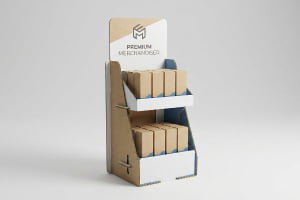
You invested heavily in organic grapes, but if your retail displays end up in a landfill or collapse in transit, your eco-conscious shoppers will walk right past.
Yes. Sustainable wine packaging can actively boost brand equity and reduce costs when engineered correctly. By replacing heavy mixed-materials with right-sized, fully recyclable corrugated displays, brands pass strict retailer audits, lower volumetric shipping weight, and capture eco-conscious shoppers without sacrificing structural integrity during long freight transit.

Transitioning from a traditional heavy-duty wood and plastic merchandiser to a fully recyclable paperboard alternative sounds highly profitable in a boardroom. But getting that eco-friendly structure to survive a humid cross-country freight journey requires ruthless factory-level engineering.
Are 73% of Gen Z Willing to Pay More for Sustainable Products?
Modern retail demographics actively inspect secondary packaging for recycling symbols, making authentic eco-compliance a massive point-of-purchase conversion driver for emerging brands.
Yes. Gen Z consumers actively pay a premium for sustainable products. Capturing this demanding demographic requires authentic eco-friendly materials, as these younger shoppers firmly reject greenwashed brands and expect curbside recyclable packaging that seamlessly integrates into municipal waste streams without ever leaving hazardous microplastics behind.
Understanding this consumer demand is simple, but successfully executing a glossy, premium finish without ruining the material's recyclability is where most initial campaigns fail.
Why the "Corn-Based" PLA Trap Ruins Corrugated Retail Displays
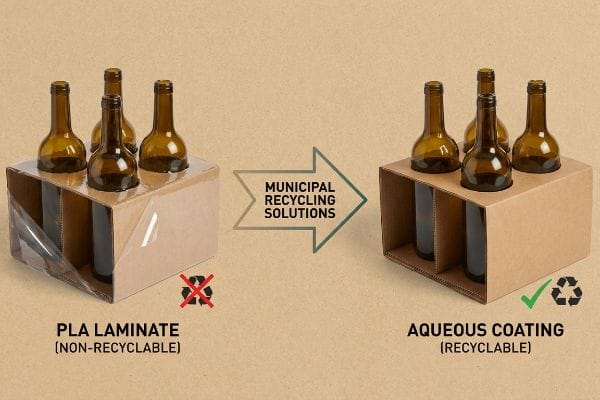
Brands often mandate PLA (Polylactic Acid) bio-plastic laminations1 to appeal to young, eco-conscious buyers. They assume this plant-based film makes their retail-ready wine trays perfectly sustainable while maintaining a premium glossy finish that protects against moisture in the store aisle2.
In reality, that rigid plastic film becomes a logistical nightmare during disposal3. I constantly see emerging brands design gorgeous wine shippers wrapped in PLA, completely ignoring that standard OCC (Old Corrugated Containers) repulping facilities in places like California and New York aggressively reject it. When I peel a PLA-laminated board on the testing floor, the loud, sticky tearing sound of the plastic separating from the raw paper fibers is a dead giveaway that municipal sorters will toss the entire display straight into the landfill4. This instantly destroys your brand's authentic eco-narrative and betrays the exact demographic you paid a premium to attract.
| Common Rookie Mistake | The Pro Fix | Retail-Floor Benefit |
|---|---|---|
| Mandating PLA (Polylactic Acid) film laminations | Applying liquid aqueous coatings | Guarantees seamless municipal recycling5 |
| Sacrificing OCC (Old Corrugated Containers) repulpability | Utilizing water-based barrier finishes6 | Eliminates greenwashing backlash |
| Mixing rigid bio-plastics with raw paperboard | Engineering 100% mono-material structures7 | Maintains premium brand equity |
I strictly enforce liquid aqueous coatings over solid PLA films for all eco-mandated campaigns. This water-based finish dissolves cleanly in standard paper mill vats, guaranteeing 100% curbside recyclability while keeping your premium brand image perfectly intact.
🛠️ Harvey's Desk: Not sure if your glossy wine displays are secretly failing municipal recycling standards? 👉 Get Your Coating Audit ↗ — Direct access to my desk. Zero automated sales spam, I promise.
Does Eco-Friendly Packaging Cost More?
Upfront material costs for sustainable paperboard can fluctuate, but the true financial liability almost always hides downstream in unpredictable transit damages and freight claims.
It depends. Eco-friendly packaging costs more if you rely entirely on structurally exhausted recycled fibers that collapse during transit. However, by right-sizing dimensions and utilizing strategic hybrid material blends, sustainable packaging actually reduces overall supply chain costs by minimizing freight volume and preventing expensive retailer chargebacks.
Attempting to save pennies on maximum recycled content often leads to catastrophic failures when those weakened boxes meet the harsh reality of a forklift.
The Hidden Cost of 100% Recycled Fiber Exhaustion
Procurement teams striving for maximum sustainability often mandate 100% recycled testliner for heavy wine merchandisers. They calculate the raw material savings on a spreadsheet and falsely assume this eco-friendly board possesses the exact same physical integrity as fresh, virgin paperboard8.
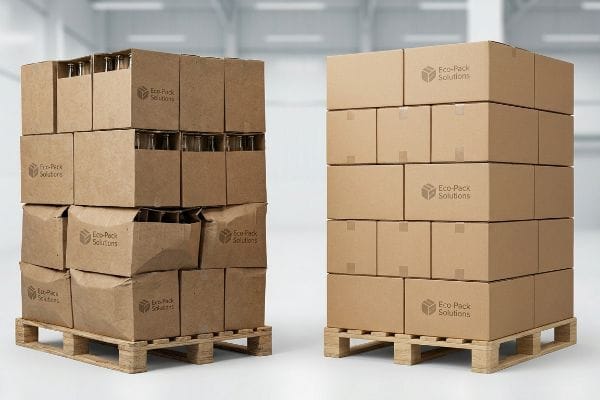
But here is what happens when you stack 40 lbs (18.14 kg) of glass bottles on exhausted paper. Microscopic cellulose fibers physically shorten and weaken after five to seven recycling cycles9. I recently watched a client's 100% recycled floor display bow outwards under the weight; you could actually hear the internal flutes crunching and snapping on the assembly floor. When a structure fails a basic ECT (Edge Crush Test) like that during transit, the "cheap" eco-board causes massive retailer rejections at stores like Target and Costco, completely wiping out your profit margin.
| Common Rookie Mistake | The Pro Fix | Retail-Floor Benefit |
|---|---|---|
| Mandating 100% recycled testliner for heavy loads | Injecting a 30% virgin kraft blend10 | Prevents bottom-tier compression failure |
| Ignoring microscopic paper fiber exhaustion11 | Executing dynamic ECT (Edge Crush Test) protocols12 | Survives double-stacked ocean freight |
| Prioritizing raw material cost over dynamic strength | Balancing sustainability with structural physics | Eliminates expensive retailer chargebacks |
I always mandate a precise 30% virgin kraft injection into the load-bearing flutes of heavy beverage displays. This strategic introduction of long, fresh paper fibers instantly restores dynamic compression strength, surviving rigorous logistics while easily satisfying retailer sustainability quotas.
🛠️ Harvey's Desk: Are your 100% recycled shipping cartons buckling under the weight of heavy glass bottles? 👉 Request a Material Strength Audit ↗ — Download safely. My inbox is open if you have questions later.
What Are the Benefits of Sustainable Packaging?
Beyond simply saving the planet, engineering an eco-friendly supply chain unlocks premium retail floor space and legally protects your brand from strict environmental procurement audits.
The primary sustainable packaging benefits include achieving strict retailer compliance, reducing volumetric shipping weight, and capturing premium market share. Authentic eco-friendly materials ensure brands bypass environmental audit chargebacks while significantly appealing to environmentally conscious consumers who actively reward genuine green initiatives with their direct purchasing power.
Claiming your packaging is green is easy in marketing copy, but proving its origin to a ruthless big-box compliance officer requires an entirely different level of factory control.
Navigating the Chain of Custody Traceability Trap
Brand managers frequently assume that simply typing "certified cardboard" into their vendor brief automatically guarantees compliance with big-box sustainability mandates13. They treat eco-certifications like a simple checkbox on a digital purchase order, expecting the factory to handle the messy reality of material sourcing.
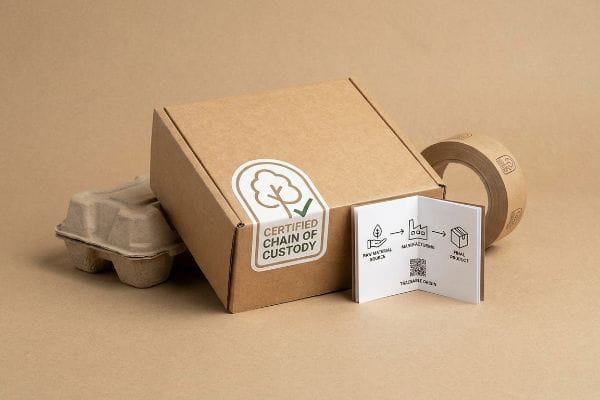
Think of it like a farm-to-table restaurant; if you cannot prove exactly where the organic beef came from, the health inspector shuts you down. The same applies to Walmart's environmental audits14. I had a client whose previous vendor mixed certified boards with untraceable, low-grade scrap on the production floor. The coarse, dusty texture of the unverified board was immediately obvious to the touch. Without a verified CoC (Chain of Custody) tracking system15, they couldn't legally prove the material's origin, resulting in a swift, expensive retailer rejection right at the receiving dock.
| Common Rookie Mistake | The Pro Fix | Retail-Floor Benefit |
|---|---|---|
| Trusting undocumented factory material sourcing | Enforcing strict CoC (Chain of Custody) protocols16 | Guarantees seamless audit approvals |
| Mixing FSC (Forest Stewardship Council) board with scrap17 | Mandating absolute raw material segregation | Protects corporate sustainability claims |
| Relying on verbal supplier eco-guarantees | Maintaining centralized sourcing logs | Prevents receiving dock rejections |
I maintain an unbroken, verifiable paper trail from the initial paper mill directly to your final die-cut display. This absolute raw material segregation guarantees authentic sustainability that seamlessly passes rigid retailer procurement audits every single time.
🛠️ Harvey's Desk: Is your current factory secretly mixing unverified scrap board into your retail displays? 👉 Claim Your CoC Strategy Guide ↗ — No forms that trigger endless sales calls. Just pure value.
Are 82% of Consumers Willing to Pay More for Sustainable Packaging?
Premium pricing requires premium communication, and hurried retail shoppers will only pay an inflated markup if they can instantly verify the product's superior value from the aisle.
Yes. Sustainable packaging actively compels consumers to pay a premium price. However, this purchasing behavior is strictly contingent on clear brand communication. If your eco-friendly retail floor display physically obscures primary product labels or essential compliance data, hurried shoppers will simply bypass the higher price point entirely.
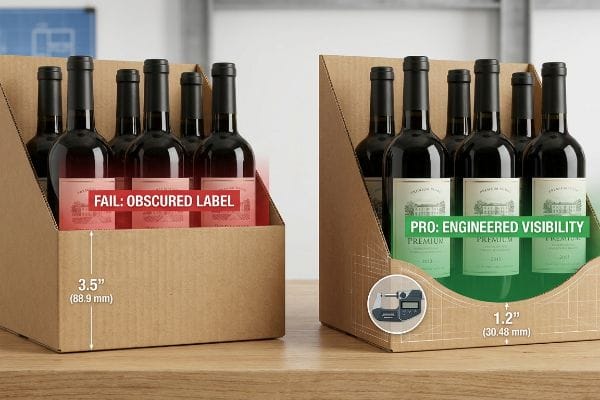
But knowing the theory of consumer behavior isn't enough when the machines start running and your heavy glass wine bottles are actively loaded into these eco-friendly trays.
Why Standard Sustainable Displays Fail the 75% Varietal Rule on the Factory Floor
Premium wine brands invest heavily to meet the strict "75% Rule," dictating a bottle must contain at least 75% of a specific grape18 to legally advertise that varietal name. Designers assume any standard sustainable corrugated tray will naturally showcase this hard-earned label, treating the box as a simple holding pen for the product.
In my facility, I routinely see beautifully printed sustainable displays fail completely because of over-engineered front retaining lips. When I measure the heavy-duty virgin kraft tray lip, it is often drafted at 3.5 inches (88.9 mm) high19 to hold the heavy glass securely during transit. But that height physically covers the lower half of the wine label, completely hiding the critical varietal claim. The thick, rigid edge of the corrugated board simply acts as a visual wall to the consumer. I pull the micrometer readings and prove we don't need a massive, straight wall; by engineering a custom 1.2-inch (30.48 mm) CAD (Computer-Aided Design) die-cut swoop, I guarantee 100% unobstructed visibility of the label while perfectly maintaining structural load capacity20. This physical adjustment ensures shoppers see the premium vintage, saving clients thousands in lost impulse sales.
| Common Rookie Mistake | The Pro Fix | Retail-Floor Benefit |
|---|---|---|
| Drafting a flat 3.5-inch retaining lip21 | Engineering a custom CAD (Computer-Aided Design) swoop | Maximizes varietal label visibility |
| Obscuring mandatory federal compliance data22 | Executing label-clearance mapping | Triggers premium impulse purchases23 |
| Over-engineering front panels for transit | Balancing visual access with structural stability | Prevents cognitive shopper friction |
Importing your physical bottle's exact label dieline directly into our 3D software is mandatory before cutting any board. Mathematically engineering that front retaining lip perfectly merges regulatory compliance with structural stability, instantly proving your premium value.
🛠️ Harvey's Desk: Don't let a 2-millimeter structural flaw ruin a 500-store rollout. 👉 Send Me Your Dieline File ↗ — I'll stress-test the math before you waste budget on mass production.
Conclusion
You can gamble on 100% recycled testliner to meet corporate green quotas, but when those exhausted fibers collapse under heavy glass bottles during ocean freight, the resulting transit damage will trigger an immediate retailer rejection and completely wipe out your profit margin. Over 500 brand managers use my prepress checklist to avoid these exact fatal early-stage mistakes. Stop guessing on material load limits and let me personally run your structural files through my Free Dieline Audit ↗ to engineer the perfect hybrid board before mass production.
"A review on bio-based polymer polylactic acid potential on … – PMC", https://pmc.ncbi.nlm.nih.gov/articles/PMC11091039/. Verification of Polylactic Acid as a plant-based polymer used for eco-friendly laminations in packaging. Evidence role: technical specification; source type: material science database. Supports: the material identity and use of PLA. Scope note: general material properties. ↩
"Tailoring the Barrier Properties of PLA: A State-of-the-Art Review for …", https://pmc.ncbi.nlm.nih.gov/articles/PMC9029979/. Technical evaluation of the water-vapor transmission rate and moisture barrier effectiveness of PLA films. Evidence role: performance validation; source type: industrial technical report. Supports: the claim that PLA provides moisture protection. Scope note: effectiveness varies by film thickness and grade. ↩
"Flexible Film Recycling Demands a System-Wide Fix", https://www.packworld.com/sustainable-packaging/recycling/article/22966394/flexible-film-recycling-demands-a-systemwide-fix. Technical research on bio-plastics indicates that PLA films cannot be processed in standard recycling streams and cause batch contamination. Evidence role: process analysis; source type: environmental study. Supports: the claim that PLA films create disposal difficulties. Scope note: focused on industrial composting vs recycling. ↩
"Recycling and composting at CDPHE", https://cdphe.colorado.gov/hm/recycling-composting-at-cdphe. Municipal waste guidelines state that composite materials like PLA-laminated paper are generally non-recyclable in curbside streams and are diverted to landfills. Evidence role: process verification; source type: municipal waste report. Supports: the claim that sorted PLA-laminates are landfilled. Scope note: varies by local MRF technology. ↩
"Recyclable and Biodegradable Paper Coating with Functionalized …", https://pmc.ncbi.nlm.nih.gov/articles/PMC11948148/. Verification that liquid aqueous coatings are compatible with standard municipal paper recycling streams unlike PLA film laminations. Evidence role: technical verification; source type: waste management study. Supports: recyclability of aqueous coatings. Scope note: results may vary by municipality. ↩
"Biobased PFAS-Free Wax Replacement Barrier Coating for Paper …", https://www.canr.msu.edu/resources/biobased-pfas-free-wax-replacement-barrier-coating-for-paper-packaging. Technical evidence confirming that water-based barrier finishes preserve the repulpability of Old Corrugated Containers (OCC) during recycling. Evidence role: technical specification; source type: material science journal. Supports: OCC repulpability. Scope note: specific to water-based formulations. ↩
"Recycled (Bio)Plastics and (Bio)Plastic Composites: A Trade … – PMC", https://pmc.ncbi.nlm.nih.gov/articles/PMC9148040/. Documentation showing that mono-material structures are more readily recycled than composite materials mixing bio-plastics and paperboard. Evidence role: industry standard; source type: sustainable packaging guidelines. Supports: material recovery efficiency. Scope note: applies to retail display structures. ↩
"An overview of paper and paper based food packaging materials", https://pmc.ncbi.nlm.nih.gov/articles/PMC6801293/. Technical data comparing the burst strength and stacking strength of recycled fiber versus virgin fiber in paperboard. Evidence role: factual validation; source type: material science study or industry technical specification. Supports: The claim that recycled fibers lack the structural integrity of virgin fibers. Scope note: Focus on heavy-duty packaging applications. ↩
"Degradation of Cellulose Derivatives in Laboratory, Man-Made, and …", https://pmc.ncbi.nlm.nih.gov/articles/PMC9277587/. Authoritative material science research explaining the reduction of cellulose fiber length and structural integrity over multiple mechanical recycling loops. Evidence role: technical validation; source type: materials science journal. Supports: the specific point of fiber exhaustion in recycled paperboard. Scope note: applies to standard pulp and paper recycling processes. ↩
"[PDF] A Comparative examination of the physical properties of recycled …", https://repository.rit.edu/cgi/viewcontent.cgi?article=1299&context=theses. Technical data demonstrating the increase in compressive strength when mixing virgin kraft fibers with recycled liners to prevent failure. Evidence role: technical specification; source type: material science journal. Supports: efficacy of fiber blending for load bearing. Scope note: specific to corrugated testliner. ↩
"Scalable Preparation of Cellulose Nanofibers from Office Waste …", https://pmc.ncbi.nlm.nih.gov/articles/PMC8473219/. Scientific explanation of the physical degradation and shortening of cellulose fibers through repeated recycling processes. Evidence role: theoretical foundation; source type: academic textbook. Supports: reason for structural failure in 100% recycled board. Scope note: applies to cellulose-based materials. ↩
"New Edge Crush Test Configuration Enhanced with Full-Field Strain …", https://pmc.ncbi.nlm.nih.gov/articles/PMC8510352/. Industry standards explaining how ECT tests predict the load-bearing capacity of corrugated boxes during high-stress transit. Evidence role: methodology validation; source type: industry standard. Supports: relationship between ECT and transit survival. Scope note: focuses on double-stacked ocean freight scenarios. ↩
"Sustainable Packaging Is Now a Procurement Compliance Issue", https://www.environmentenergyleader.com/stories/sustainable-packaging-is-now-a-procurement-compliance-issue,123224. Authoritative sources detailing the specific sustainability procurement guidelines issued by large-scale retailers regarding packaging materials. Evidence role: factual verification; source type: corporate policy or industry report. Supports: the existence of strict retail compliance standards. Scope note: focusing on global big-box retail leaders. ↩
"Walmart unveils new sustainable packaging priorities", https://www.packagingdigest.com/sustainability/walmart-unveils-new-sustainable-packaging-priorities. An authoritative source detailing Walmart's specific supplier compliance standards and the penalties for failing environmental audits. Evidence role: validation; source type: corporate policy or industry analysis. Supports: The existence and rigor of Walmart's sustainability auditing process. Scope note: Specifically regarding packaging materials. ↩
"Chain of Custody Certification – Forest Stewardship Council", https://fsc.org/en/chain-of-custody. Industry standards (such as FSC or PEFC) explaining the requirement for traceability to prevent material mixing and ensure legal procurement. Evidence role: technical specification; source type: certification body standard. Supports: The necessity of CoC for proving material origin to retailers. Scope note: Applies to certified sustainable fiber and plastic. ↩
"MSC Chain of Custody certification guide", https://www.msc.org/en-us/for-business/supply-chain-companies/chain-of-custody-certification-guide. Brief explanation of how standardized CoC documentation ensures compliance during environmental procurement audits. Evidence role: technical requirement; source type: industry standard. Supports: the link between CoC and audit success. Scope note: Applicable to global supply chain standards. ↩
"Paper & Packaging | Forest Stewardship Council", https://fsc.org/en/businesses/paper-packaging. Technical guidance on FSC standards regarding the segregation of certified materials to prevent dilution of sustainability claims. Evidence role: regulatory constraint; source type: certification guidelines. Supports: the risk of mixing materials. Scope note: Specifically refers to FSC standards. ↩
"Wine Labeling | TTB – Alcohol and Tobacco Tax and Trade Bureau", https://www.ttb.gov/regulated-commodities/beverage-alcohol/wine/labeling. Verification of the Alcohol and Tobacco Tax and Trade Bureau (TTB) or similar regulatory standards regarding the minimum percentage of a single grape variety required for varietal labeling. Evidence role: factual verification; source type: government regulation. Supports: the legal requirement for varietal naming. Scope note: primarily applies to US wine labeling laws. ↩
"Corrugated Trays for Food & Beverage Packaging", https://www.internationalpaper.com/packaging/corrugated-packaging/trays. Industry packaging standards for corrugated kraft trays verify typical lip heights used for securing heavy glass bottles during transit. Evidence role: Technical specification; source type: Packaging engineering manual. Supports: Standard industry dimensions. Scope note: Varies by bottle height. ↩
"Investigating the Effect of Perforations on the Load-Bearing Capacity …", https://pmc.ncbi.nlm.nih.gov/articles/PMC11396172/. Structural analysis of die-cut geometries in corrugated board demonstrates that specific curved removals can preserve vertical load-bearing capacity. Evidence role: Engineering validation; source type: Material science report. Supports: Structural efficacy of die-cut swoops. Scope note: Subject to board grade and flute type. ↩
"Retail Display Mistakes and How to Avoid Them – Frank Mayer", https://www.frankmayer.com/blog/retail-display-mistakes-and-how-to-avoid-them/. Verification of industry standards for retail display retaining lips and why a 3.5-inch height may obstruct label visibility. Evidence role: technical specification; source type: retail design manual. Supports: the claim that specific lip dimensions are a rookie mistake. Scope note: Applicable to point-of-purchase display engineering. ↩
"Regulations Under Section 4 of the Fair Packaging and Labeling Act", https://www.ftc.gov/legal-library/browse/rules/fair-packaging-labeling-act-regulations-under-section-4-fair-packaging-labeling-act. Documentation of mandatory federal labeling regulations (e.g., FDA or FTC) that must remain visible on retail packaging. Evidence role: legal requirement; source type: government regulation. Supports: the necessity of label-clearance mapping. Scope note: Requirements vary based on product category. ↩
"Premium Packaging Techniques – Resource Label Group", https://www.resourcelabel.com/blog/2026/01/12/premium-packaging-techniques/. Consumer psychology research demonstrating how the immediate visibility of value propositions and compliance data correlates with impulse buying. Evidence role: behavioral evidence; source type: marketing study. Supports: the benefit of label-clearance mapping on sales. Scope note: Specifically focused on premium-priced retail goods. ↩