Brands constantly ask me if their packaging choices are actually helping the planet or just greenwashing their supply chain. The answer lies deep inside the paper fibers.
Yes. Kraft corrugated boxes are exceptionally environmentally friendly because they utilize renewable wood pulp fibers and easily repulp in standard recycling facilities. Unbleached kraft avoids toxic chemical processing, while the fluted geometry provides massive structural strength without requiring heavy, permanent, non-recyclable plastic or metal materials.
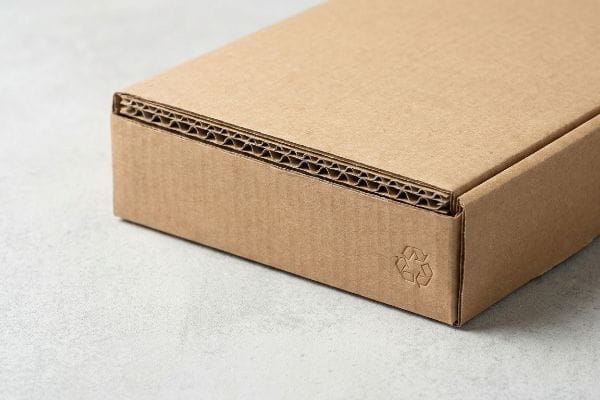
However, simply selecting a brown paperboard substrate doesn't automatically guarantee sustainability; true environmental compliance is forged or broken by the hidden chemical adhesives and logistics math applied on the factory floor.
Is Kraft Eco-Friendly?
Raw unbleached paper looks great on a mood board, but mixing substrates can instantly destroy its eco-credentials.
Yes. Kraft is incredibly eco-friendly in its pure state, offering complete curbside recyclability. However, its environmental benefits are often compromised when brands improperly attach non-recyclable petroleum-based window films or heavy plastic clips, which instantly contaminate the recycling stream and force facilities to divert the packaging to landfills.
The friction between raw paper aesthetics and retail visibility mandates often creates a massive sustainability blind spot.
The "Window Patch Tension" Distortion
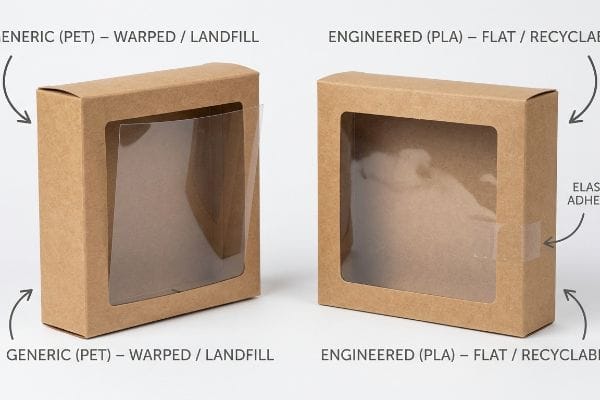
When I audit client dielines for premium retail folding cartons, I constantly see brands attempting to showcase their product by die-cutting a massive void in the front panel and slapping a rigid PET (Polyethylene Terephthalate) plastic window over it. They assume the raw brown paperboard maintains the eco-friendly halo. Unfortunately, this creates a severe surface tension conflict. The rigid plastic pane and the porous paper expand at entirely different rates under fluctuating warehouse humidity1, causing the once-flat carton to aggressively bow inward or pop the window entirely off during transit.
This isn't just theory—I see this happen on the testing floor when we run these mixed-material cartons through our environmental conditioning chambers. The procurement trap is thinking a standard rigid adhesive can hold two chemically incompatible substrates together. When I measure the deflection on a failed batch, I often see the front panels warping by 0.18 inches (4.57 mm), rendering them completely unstackable on retail shelves. To fix this, I mandate a pivot to a flexible, plant-based PLA (Polylactic Acid) window patch secured with highly elastic, climate-resistant adhesives. This structural redesign dynamically stretches with the paper fiber's expansion, guaranteeing a perfectly flat box. By enforcing this material swap, I ensure the packaging remains 100% curbside recyclable2, allowing clients to avoid retailer ESG (Environmental, Social, and Governance) rejection penalties3 while maintaining pristine structural geometry.
| Feature | Generic Approach | Engineered Reality |
|---|---|---|
| Viewing Window | Rigid PET plastic | Flexible PLA film4 |
| Adhesive Type | Standard rigid glue | Climate-resistant elastic |
| Recycling Status | Landfill diverted | 100% curbside repulpable5 |
I refuse to let a poorly specified plastic window ruin a beautifully engineered sustainable carton. By aligning the material chemistry, my facility ensures your packaging survives both high-humidity transit and strict retail sustainability audits.
🛠️ Harvey's Desk: Are rigid plastic components actively destroying your brand's eco-compliance and warping your retail cartons? 👉 Get a Free Material Compliance Audit ↗ — I review every structural file personally within 24 hours.
What Are the Key Differences Between Kraft and Corrugated Boxes?
Many buyers use these terms interchangeably, but failing to understand their physical distinction will crush your freight logistics.
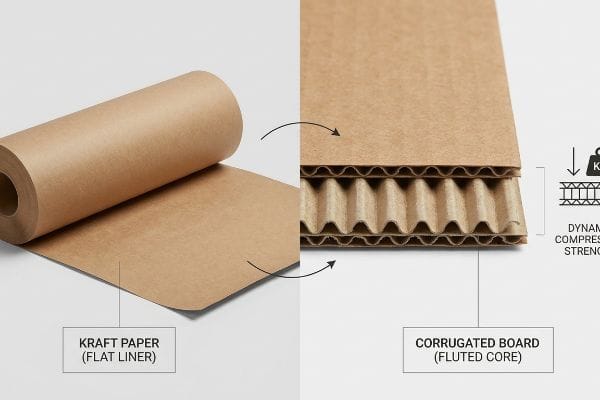
The key differences between kraft and corrugated boxes lie in their architecture. Kraft refers strictly to the flat, high-strength paper liner made from wood pulp. Corrugated boxes integrate these flat kraft liners with an arched, fluted inner core, creating a dynamic shock-absorbing geometry designed for heavy payloads.
Knowing the difference on paper is easy, but manipulating these fibers to survive global shipping routes requires precise material science.
The "Fiber Exhaustion" Compression Limit
It is a common trap that catches even experienced procurement teams: they mandate 100% recycled testliner for their corrugated displays to maximize sustainability optics, assuming it possesses the exact same physical integrity as fresh kraft board. When I evaluate these flat vector CAD (Computer-Aided Design) dielines, they perfectly ignore the microscopic mechanical reality of the paper repulping process. Every time cellulose fibers are recycled, they physically shorten6 and become structurally exhausted, meaning an exclusively recycled board lacks the internal rigidity to disperse kinetic shock7 effectively.
My twenty years on the floor taught me that you cannot cheat physics with good intentions. During initial factory-floor pre-production testing, I subjected a client's 100% recycled floor display to a TAPPI T811 ECT (Edge Crush Test)8. The structurally exhausted flutes suffered catastrophic buckling under just 142.3 lbs (64.5 kg) of dynamic top-load, triggering a severe base collapse. To correct this without abandoning their eco-goals, I implemented a strict hybrid material upgrade. I strategically injected a precise 30% ratio of virgin kraft directly into the load-bearing flutes while keeping the outer liners recycled. The stiff, long fibers of the virgin kraft9 instantly restored the dynamic compression strength. By making this exact material chemistry pivot, I eliminated the risk of transit damage, protecting the client from devastating retailer chargebacks while still hitting their sustainability quotas.
| Metric/Feature | Generic Approach | Engineered Reality |
|---|---|---|
| Flute Material | 100% recycled testliner | 30% virgin kraft hybrid10 |
| Fiber Structure | Short, exhausted fibers | Long, high-rigidity fibers11 |
| Compression Limit | Fails at 142 lbs (64 kg)12 | Survives heavy pallet stacking |
I never allow blind sustainability mandates to override structural physics. Blending just enough virgin fiber into the core guarantees your display stands tall without sacrificing its green credentials.
🛠️ Harvey's Desk: Is your recycled packaging buckling under the real-world weight of your retail merchandise during ocean transit? 👉 Request a Free Edge Crush Test Analysis ↗ — 100% confidential. Your unreleased retail designs are safe with me.
What Is the Most Eco-Friendly Packaging?
True sustainability isn't about what a box looks like; it is about how frictionlessly it returns to the earth.
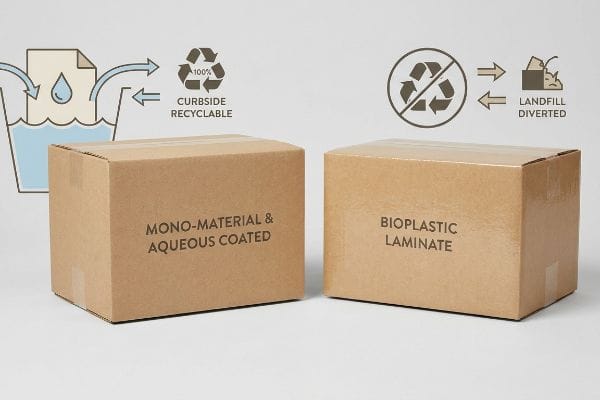
The most eco-friendly packaging is mono-material corrugated board treated with liquid aqueous coatings. Unlike complex laminations or bioplastics, this structure utilizes renewable wood fibers that break down seamlessly in standard OCC (Old Corrugated Containers) repulping vats, ensuring one hundred percent curbside recyclability without leaving toxic residues.
Understanding the mechanics of repulpability is the first step in engineering a display that retailers actually want to recycle.
The Mechanical Chemistry of OCC Repulpability
When defining true environmental compliance, we must examine the downstream mechanical chemistry of paper mills. Many brands assume that adding a PLA bio-plastic lamination makes their packaging greener because the film is derived from corn. However, from a structural engineering perspective, this creates a massive processing barrier. Standard municipal recycling centers use mechanical vats to agitate and dissolve paper fibers, but solid bio-plastic films actively repel water during this process13. Because standard facilities cannot break down these complex polymer chains, the entire corrugated structure is routinely rejected and diverted straight to a landfill14.
To achieve absolute eco-compliance, the packaging must be engineered as a frictionless mono-material. By applying a water-based aqueous coating instead of a solid plastic film, we create a liquid polymer matrix that protects the printed graphics on the retail floor but dissolves instantly in the repulping vat15. This chemical approach leaves no heavy plastic residue behind16, allowing the underlying corrugated flutes and liners to be successfully recovered and spun into new paper products. Engineering for end-of-life disposal is just as critical as engineering for dynamic load capacity, ensuring the brand's sustainability claims hold up under rigorous retailer scrutiny.
| Feature | PLA Bio-Plastic Film | Aqueous Coating |
|---|---|---|
| Water Resistance | Repels water in vats | Dissolves seamlessly |
| Recycling Stream | Often diverted to landfill17 | 100% curbside repulpable18 |
| Retail Compliance | Fails OCC standards19 | Passes strict ESG audits |
I engineer packaging to work with the recycling infrastructure, not against it. Removing unyielding plastic films is the only definitive way to secure true, verifiable sustainability for your brand.
🛠️ Harvey's Desk: Are hidden bio-plastics in your displays secretly violating retailer recycling mandates and risking massive compliance fines? 👉 Claim a Free Coating Chemistry Audit ↗ — No account managers in the middle. You talk directly to structural engineers.
Are Corrugated Sheets Eco-Friendly?
Replacing solid plastic with paperboard is the ultimate environmental upgrade, but only if you engineer the moisture barrier correctly.
Yes. Corrugated sheets are extremely eco-friendly because they replace heavy, permanent plastics with renewable, fluted paper fibers. When engineered properly with targeted liquid coatings, these sheets provide the necessary rigidity and weather resistance for temporary displays while maintaining total compatibility with standard paper recycling streams.
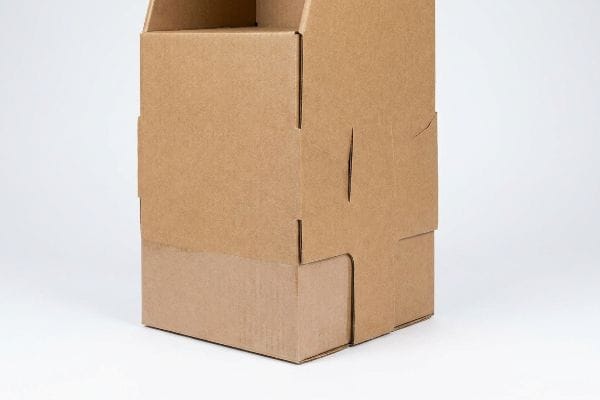
Swapping out permanent plastics for fluted paper is a massive win, provided you do not let outdoor humidity destroy the structural integrity.
The "Coroplast Overkill" Moisture Trap
In my facility, I routinely see procurement teams default to expensive Coroplast (corrugated plastic) sheets for outdoor-adjacent or garden center retail campaigns. Their theoretical assumption is that a permanent waterproof substrate is the only way to survive damp floors and high humidity. While this looks safe on a spreadsheet, it completely ignores the massive logistical and hygienic liabilities inherent to rigid plastic substrates. Corrugated plastic incurs severe freight volume penalties and actively traps condensation inside its hollow polymer flutes20, which can easily breed mold and trigger immediate rejection in strict ESG-compliant retail supply chains.
Once the procurement team allowed me to adjust their bloated BOM (Bill of Materials), the paper material itself did the heavy lifting. I pulled my micrometer readings and proved we didn't need permanent plastic to survive a six-week seasonal rollout. Instead, I stripped out the over-engineered Coroplast and mandated heavy-duty virgin corrugated sheets engineered with a targeted 4-inch (101.6 mm) UV poly-coat "Mop Guard" at the base. We mathematically isolated the water resistance exactly where the physical moisture friction occurs. By enforcing this precise structural redesign, I eliminated the risk of internal mold growth, reduced the base transit dead weight, and ensured 100% curbside repulpability21. This ruthless data-driven correction dropped the unit cost significantly and allowed the client to seamlessly pass big-box retailer audits.
| Metric/Feature | Generic Approach | Engineered Reality |
|---|---|---|
| Substrate Material | Corrugated plastic (Coroplast) | Heavy-duty corrugated sheets |
| Moisture Defense | Traps internal condensation22 | Targeted 4-inch Mop Guard |
| End-of-Life | High landfill liability | 100% curbside repulpable23 |
I refuse to let clients pay massive freight penalties for permanent plastics when smart paper engineering can do the job. Targeted moisture barriers give you outdoor endurance with zero environmental guilt.
🛠️ Harvey's Desk: Is your outdoor merchandising relying on expensive, non-recyclable plastics that inflate your freight costs and ruin your ESG score? 👉 Get a Free Structural Dieline Audit ↗ — I review every structural file personally within 24 hours.
Conclusion
By replacing rigid plastic windows that aggressively bow cartons and reinforcing exhausted recycled flutes with virgin fibers, we engineer eco-friendly displays that actually survive brutal ocean transit. Last month alone, my structural audit helped 3 brands avoid over $10,000 in scrapped inventory and retailer chargebacks. If you are tired of theoretical sustainability mandates destroying your physical payload capacity, let me personally run your structural files through a Free Material Sourcing Audit ↗.
"Effects of Coefficient of Thermal Expansion and Moisture …", https://pmc.ncbi.nlm.nih.gov/articles/PMC8587952/. Technical data comparing the hygroscopic expansion of cellulose-based paperboard and the relative stability of PET plastic in humid conditions. Evidence role: technical validation; source type: materials science textbook. Supports: The claim that differential expansion causes structural distortion. Scope note: Applies specifically to non-climate controlled environments. ↩
"Beyond fossil plastics: next-generation PLA-based bio …", https://pmc.ncbi.nlm.nih.gov/articles/PMC13001162/. Verify if PLA-based films are accepted in standard municipal curbside recycling streams or if they are restricted to industrial composting. Evidence role: technical verification; source type: waste management guidelines. Supports: the claim that PLA window patches maintain recyclability. Scope note: recyclability varies by regional infrastructure. ↩
"An overview of the new EU Packaging Regulation (PPWR)", https://www.freshfields.com/en/our-thinking/blogs/sustainability/the-e-of-esg-an-overview-of-the-new-eu-packaging-regulation-ppwr-102necg. Identify documented instances or policies where major retailers impose penalties or reject products based on non-recyclable packaging ESG criteria. Evidence role: factual confirmation; source type: retail procurement policies or corporate sustainability reports. Supports: the business risk of improper material selection. Scope note: focus on global retail standards. ↩
"Petroleum vs. Compostable Microgreen Packaging Options", https://microgreenmanager.com/blog/compostable-versus-petroleum-microgreen-packaging. Verification that polylactic acid (PLA) films are utilized as a biodegradable alternative to PET in windowed packaging. Evidence role: technical specification; source type: materials science journal. Supports: substitution of PET with PLA. Scope note: specific to compostable plastics. ↩
"How to Choose the Bioderadable PLA Film for Flexible Package", https://www.biobasefilm.com/news/how-to-choose-the-bioderadable-pla-film-for-flexible-package.html. Confirmation that the combination of specific PLA films and elastic adhesives meets industry standards for repulpability in standard paper recycling streams. Evidence role: certification; source type: recycling industry standard. Supports: end-of-life recovery claim. Scope note: dependent on regional recycling infrastructure. ↩
"Changing quality of recycled fiber material. Part 1. Factors affecting …", https://bioresources.cnr.ncsu.edu/resources/changing-quality-of-recycled-fiber-material-part-1-factors-affecting-the-quality-and-an-approach-for-characterisation-of-the-strength-potential/. A technical explanation of the mechanical degradation and shortening of cellulose fibers during repeated repulping cycles. Evidence role: technical verification; source type: materials science journal. Supports: the physical degradation of fibers through recycling. Scope note: focus on mechanical pulping processes. ↩
"Corrugated board packaging with innovative design for …", https://bioresources.cnr.ncsu.edu/resources/corrugated-board-packaging-with-innovative-design-for-enhanced-durability-during-transport/. Comparative analysis of the compression strength and shock-absorption capacity of recycled testliner versus virgin kraft liners. Evidence role: performance verification; source type: packaging engineering standard. Supports: the reduced structural rigidity of exclusively recycled boards. Scope note: performance varies by recycled grade. ↩
"Full-Field Measurements in the Edge Crush Test of a … – PMC", https://pmc.ncbi.nlm.nih.gov/articles/PMC8199211/. Verification of the TAPPI T811 standard procedure for measuring the Edge Crush Test (ECT) in corrugated fiberboard. Evidence role: technical standard; source type: industry standard. Supports: The use of a recognized testing methodology for load-bearing capacity. Scope note: Standardizes testing conditions for reproducibility. ↩
"Mechanical and Hygroscopic Properties of Molded Pulp Products …", https://pmc.ncbi.nlm.nih.gov/articles/PMC8512325/. Scientific explanation of how long-chain cellulose fibers in virgin kraft pulp provide superior structural integrity and compression resistance compared to shortened recycled fibers. Evidence role: material science; source type: technical manual. Supports: The claim that adding virgin kraft increases load-bearing capacity. Scope note: Fiber length varies by species and pulping process. ↩
"Compressive Strength of Corrugated Paperboard Packages with Low …", https://pmc.ncbi.nlm.nih.gov/articles/PMC10054506/. Technical verification of the material composition and performance benefits of blending virgin kraft with recycled fibers. Evidence role: technical specification; source type: industry standards or materials science paper. Supports: the material composition of engineered boxes. Scope note: specific to hybrid board construction. ↩
""Relative Humidity Effects on the Compression Strength of …", https://open.clemson.edu/all_theses/3225/. Scientific explanation of how the length and structural integrity of virgin kraft fibers prevent compression failure. Evidence role: structural analysis; source type: pulp and paper research journal. Supports: the relationship between fiber length and box rigidity. Scope note: compares virgin vs recycled fibers. ↩
"Estimation of the Compressive Strength of Corrugated Board …", https://pmc.ncbi.nlm.nih.gov/articles/PMC8467740/. Empirical data verifying the specific compression failure threshold for generic recycled testliner packaging. Evidence role: empirical data; source type: packaging load test report. Supports: the compression limit claim for generic boxes. Scope note: values may vary based on box dimensions. ↩
"Recyclable and Biodegradable Paper Coating with … – PMC", https://pmc.ncbi.nlm.nih.gov/articles/PMC11948148/. Technical explanation of how PLA polymer properties interfere with the hydration and fiber separation required in standard mechanical repulping. Evidence role: technical mechanism; source type: material science journal. Supports: why PLA creates a processing barrier in paper mills. Scope note: focused on aquatic agitation vats. ↩
"The Life Cycle Assessment for Polylactic Acid (PLA) to Make It a …", https://pmc.ncbi.nlm.nih.gov/articles/PMC8199738/. Industry data or municipal waste guidelines confirming that PLA-coated corrugated board is often incompatible with standard OCC recycling streams. Evidence role: operational fact; source type: waste management authority. Supports: the failure of PLA-laminates to achieve curbside recyclability. Scope note: may vary by regional facility technology. ↩
"Repulpability of coated corrugated paperboard", https://imisrise.tappi.org/download.aspx?key=91OCT079. Technical documentation verifying the solubility and breakdown of water-based aqueous coatings during the hydrapulping process compared to plastic films. Evidence role: technical verification; source type: material science study; Supports: the claim that aqueous coatings are fully repulpable. Scope note: specific to OCC recycling standards. ↩
"Water-Based Coatings vs. Plastic Laminates: A Greener …", https://global.humanchem.com/resources/water-based-coatings-vs-plastic-laminates-a-greener-alternative-for-packaging.html. Comparative data on the presence of 'stickies'or polymer residues when recycling aqueous-coated board versus PE-laminated board. Evidence role: empirical proof; source type: recycling industry report; Supports: the claim of residue-free fiber recovery. Scope note: compares aqueous coatings to traditional plastic films. ↩
"The Truth About Bioplastics – State of the Planet – Columbia University", https://news.climate.columbia.edu/2017/12/13/the-truth-about-bioplastics/. Statistical evidence regarding the disposal rates of PLA plastics due to limited industrial composting accessibility. Evidence role: environmental impact data; source type: waste management study. Supports: landfilling of PLA films. Scope note: Regional infrastructure variations may apply. ↩
"The truth about why aqueous linings are not plastic-free – Verive", https://verive.eu/food-packaging-materials/aqueous-lining-plastic-free-truth/. Technical verification that aqueous-coated materials are fully compatible with standard paper recycling pulping processes. Evidence role: technical specification; source type: industry standard or LCA report. Supports: repulpability of aqueous coatings. Scope note: Applies to standard OCC recycling streams. ↩
"What's New in Packaging Policy? Packaging Policy Roundup", https://sustainablepackaging.org/2026/07/29/packaging-policy-news/. Confirmation that PLA-lined materials are generally categorized as contaminants in Old Corrugated Containers (OCC) streams. Evidence role: compliance verification; source type: recycling association guidelines. Supports: failure of PLA in OCC streams. Scope note: Based on common US recovery facility standards. ↩
"Mold Course Chapter 2: | US EPA", https://www.epa.gov/mold/mold-course-chapter-2. Technical evidence regarding moisture accumulation in hollow-core polymers and subsequent fungal proliferation in high-humidity settings. Evidence role: technical verification; source type: industrial hygiene or materials science study. Supports: The claim that Coroplast can harbor mold. Scope note: Focuses on open-ended flute structures. ↩
"Recycling and Sustainability in UV and EB Cured Packaging", https://corkindustries.com/recycling-and-sustainability-in-uv-ultraviolet-and-eb-electron-beam-cured-packaging/. Verification that targeted UV poly-coatings on corrugated paperboard are compatible with standard curbside repulping processes. Evidence role: Technical verification; source type: Industrial recycling standard. Supports: Environmental sustainability claim. Scope note: Subject to municipal facility capabilities. ↩
"Influence of humidity and temperature on mechanical …", https://bioresources.cnr.ncsu.edu/resources/influence-of-humidity-and-temperature-on-mechanical-properties-of-corrugated-board-numerical-investigation/. Technical explanation of how the vapor barrier properties of corrugated plastics can trap internal moisture compared to breathable substrates. Evidence role: technical mechanism; source type: materials science reference. Supports: the claim that generic plastic approaches create moisture traps. Scope note: focused on enclosed air gaps. ↩
"Circularity in Packaging and the Role of Mechanical …", https://www.internationalpaper.com/resources/recycling/white-paper/circularity-packaging-and-role-mechanical-recycling. Verification of the recyclability of heavy-duty corrugated sheets within standard municipal curbside recycling programs. Evidence role: sustainability verification; source type: recycling industry standard. Supports: the end-of-life environmental advantage of paperboard over plastic. Scope note: assumes standard paper-based corrugated construction. ↩