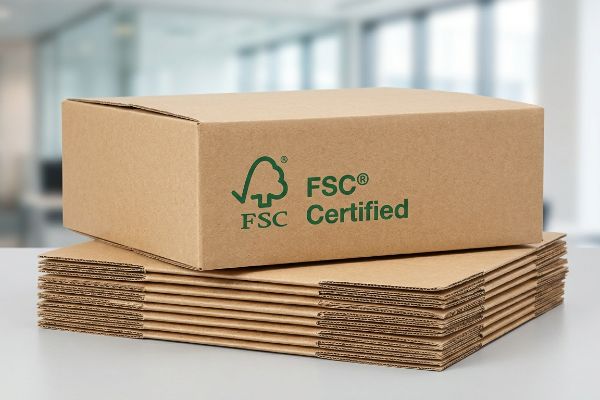
Hitting retailer sustainability goals requires more than a green leaf logo. Let's explore why using verified, certified corrugated materials actively protects your bottom line and guarantees big-box compliance.
Using FSC (Forest Stewardship Council) certified packaging ensures your corrugated displays originate from responsibly managed forests. This verified supply chain protects global ecosystems while guaranteeing major retailer compliance. Brands utilizing these certified materials avoid strict environmental audit chargebacks, secure premium shelf space, and actively reduce their carbon footprint.

Sustainability isn't just about optics; it is a strict logistical gatekeeper for big-box retail space.
What are the benefits of being FSC-certified?
Getting your product onto a Walmart or Costco floor requires more than a clever dieline.
The benefits of being FSC-certified include immediate compliance with big-box sustainability mandates and improved brand equity. Utilizing these verified corrugated materials prevents costly retailer chargebacks, ensures 100% curbside recyclability, and builds consumer trust by proving your retail displays do not contribute to illegal global deforestation.

Let's look at how this certification plays out when the rubber meets the road in retail environments.
Securing Retail Space with SFI/FSC Corrugated Standards
Many brand marketers assume any brown kraft box automatically qualifies as an eco-friendly merchandiser. They design a beautiful graphic file and tell their procurement team to source the cheapest unbleached cardboard available. The assumption is that as long as the material looks raw and recycled, the store buyers will approve the environmental compliance checklist.
This blind spot creates severe friction when the brand team attempts to secure premium aisle placements. Big-box compliance teams routinely reject entire promotional campaigns1 because the "eco-friendly" testliner lacks verifiable sourcing documentation. It feels terrible when you run your hands over the rough, unsealed paperboard—knowing it looks perfectly sustainable—but lack the legal paperwork to prove it to the store buyer. To fix this, we enforce a strict 100% SFI (Sustainable Forestry Initiative) or FSC compliant sourcing standard for all curbside recyclable corrugated components. By eliminating anonymous material streams, we guarantee your merchandiser sails through retailer sustainability audits, saving weeks of compliance delays and protecting your overall project ROI.
| Common Rookie Mistake | The Pro Fix | Retail-Floor Benefit |
|---|---|---|
| Using unverified brown kraft | Sourcing certified 32ECT board2 | Passes compliance audits instantly |
| Relying on visual eco-aesthetics | Demanding formal paper trails3 | Prevents store buyer rejection |
| Assuming all cardboard is recyclable | Specifying curbside-ready materials4 | Enhances consumer brand trust |
Documenting your raw materials from day one guarantees zero friction during the buyer review phase. Brilliant structural designs should never be derailed by easily preventable sustainability compliance gaps.
🛠️ Harvey's Desk: Not sure if your current display material meets strict big-box compliance standards? Send me your flat dieline file. I'll flag the sticky friction points before you print. 👉 Request A Free Material Audit ↗ — Direct access to my desk. Zero automated sales spam, I promise.
What is FSC-certified packaging?
Understanding the physical composition of your merchandiser is just as important as the legal paperwork behind it.
FSC-certified packaging is material sourced from rigorously tracked ecosystems. This continuous supply chain ensures that every layer of your corrugated board, from the inner fluting to the outer liner, originates from responsibly managed forests, protecting biodiversity while delivering predictable physical strength for heavy retail promotional displays.

Knowing the definition is helpful, but the actual grade of the paper fibers dictates how your structure will perform.
The Virgin Kraft Advantage in Sustainable Displays
When developing eco-friendly point-of-purchase campaigns, marketers frequently assume they must use 100% recycled testliner to be considered sustainable. They request the highest recycled content possible, believing this maximizes their environmental claims. This leads to specifying overly processed materials that compromise the unit's shelf appeal5.
Relying purely on exhausted recycled fibers often backfires when your displays reach the actual store environment. Those over-processed materials absorb ambient retail moisture easily6, causing your beautifully printed graphic panels to look wavy and cheap before the promotional window ends. This visual degradation severely damages brand perception and signals poor quality to passing shoppers. To fix this, we blend certified virgin kraft fibers into the outer liner while keeping the inner flutes recycled. This strategic balance restores the crisp appearance of your merchandiser, ensuring it maintains a premium aesthetic on the shelf to actively drive impulse conversions.
| Common Rookie Mistake | The Pro Fix | Retail-Floor Benefit |
|---|---|---|
| Maxing out recycled testliner | Blending certified virgin kraft7 | Eliminates folding tab tear |
| Ignoring paper fiber elasticity | Balancing flute and liner grades | Speeds up assembly times |
| Using brittle board for heavy items | Specifying targeted fiber strength | Survives humid store conditions8 |
Blending responsible virgin fibers with recycled cores delivers the ultimate combination of sustainability and structural integrity. Strategic material balancing ensures your eco-friendly campaign never sacrifices premium visual appeal.
🛠️ Harvey's Desk: Are you worried that your highly recycled cardboard will snap under the weight of your heavy merchandise? 👉 Get A Structural Review ↗ — Download safely. My inbox is open if you have questions later.
What are the 5 benefits of packaging?
Beyond simply holding your product, a well-engineered corrugated unit serves as your most relentless salesperson.
The 5 benefits of packaging include product protection, brand differentiation, consumer engagement, logistical optimization, and regulatory compliance. When engineered correctly, a retail merchandiser secures heavy goods during transit, instantly captures shopper attention, accelerates co-packing speeds, minimizes overall shipping volumes, and seamlessly satisfies strict big-box store legal guidelines.
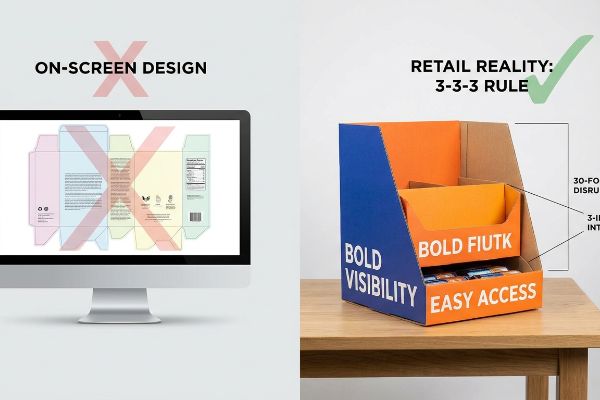
To unlock these five pillars, you must engineer the structure to physically interact with the shopper's environment.
Activating the 3-3-3 Spatial Engagement Rule
Graphic designers typically review their packaging artwork on flat, brightly backlit computer monitors. They meticulously adjust small text and subtle color gradients, assuming the consumer will read every word just like a brochure. This creates a visually dense dieline that looks beautiful in an email attachment but completely ignores the physical reality of a chaotic store aisle.
Beautifully detailed graphics routinely vanish into the visual noise of a large big-box environment. Think of your display like a billboard on a highway; if the text is too small, shoppers speed right past it with their carts. A brand team often realizes their subtle pastel messaging is completely invisible under harsh fluorescent lights only after the campaign launches, resulting in zero impulse purchases and a severe drop in anticipated sales volume. To fix this, we implement the 3-3-3 spatial engagement protocol9 for every structural layout. By utilizing bold PMS (Pantone Matching System) spot colors for 30-foot (9.1 m) visual disruption and cutting the front lip to 85% product visibility10 for the final 3-inch (76.2 mm) interaction, the unit aggressively pulls foot traffic and drives immediate conversions.
| Common Rookie Mistake | The Pro Fix | Retail-Floor Benefit |
|---|---|---|
| Designing for a flat monitor | Engineering for 3D retail aisles | Increases impulse purchase rate11 |
| Using tiny paragraph text | Deploying bold spot color floods | Grabs attention from 30 feet12 |
| High retaining lips hiding labels | Cutting the lip for 85% visibility13 | Boosts shopper physical interaction |
Forcing your merchandiser to communicate clearly from across the chaotic aisle turns casual foot traffic into measurable sales lift. Flat design files must always adapt to the physical reality of spatial retail environments.
🛠️ Harvey's Desk: Does your current graphic layout look great on screen but muddy on actual cardboard? Send me your flat dieline file. I'll flag the sticky friction points before you print. 👉 Claim Your Dieline Pre-Flight ↗ — No forms that trigger endless sales calls. Just pure value.
Why should I use FSC-certified suppliers?
Securing the right material is only half the battle; proving it to a retail auditor requires flawless operational execution.
Using FSC-certified suppliers guarantees your raw materials maintain an unbroken tracking history from the forest to the retail floor. This verified sourcing prevents disastrous compliance audit failures, protects your brand from greenwashing accusations, and ensures your heavy corrugated displays actually possess the exact structural strength promised.

But knowing the theory isn't enough when the machines start running and the auditors show up with clipboards.
The Chain of Custody Audit Reality
Brand managers frequently assume that simply typing a certified cardboard request on a purchase order automatically guarantees big-box sustainability compliance. They trust that once the vendor agrees, the final merchandisers will magically arrive with the correct environmental pedigree. They ignore the complex, highly regulated paper trail14 required to legally prove a material's origin.
In my facility, amidst the smell of fresh pine and water-based PVA adhesive, I routinely see the devastating fallout when brands use brokers who mix unverified paperboard into certified runs. Getting one display to stand up in a lab is easy, but here is the harsh reality when you ship 500 of them to a major club store without strict traceability. When I audit a failed supply chain, the problem usually stems from a supplier blending cheap, anonymous board with a 0.5-inch (12.7 mm) tolerance failure to save just $0.12 per unit, entirely destroying the CoC (Chain of Custody) integrity15. During a strict retail sustainability review, the lack of continuous documentation triggers an immediate retailer rejection16, stranding entire promotional rollouts on the loading dock. To prevent this, I enforce a ruthless documentation protocol on the factory floor, utilizing centralized sourcing logs to ensure absolute raw material segregation. By maintaining this verified paper trail, I ensure your campaign passes any procurement audit flawlessly, saving you from catastrophic logistical chargebacks and preserving your retailer relationships.
| Common Rookie Mistake | The Pro Fix | Retail-Floor Benefit |
|---|---|---|
| Trusting vague supplier promises | Mandating strict CoC tracking17 | Passes rigorous store audits |
| Mixing certified and cheap board | Enforcing material segregation18 | Prevents entire batch rejection19 |
| Ignoring the paper trail | Maintaining centralized factory logs | Eliminates audit-related delays |
A broken paper trail is just as fatal to your campaign as a broken pallet. Locking down centralized documentation ensures your ambitious sustainability claims survive the harshest club store compliance scrutiny.
🛠️ Harvey's Desk: Do you know if your current vendor is silently blending unverified testliner into your certified production runs? 👉 Send Me Your Dieline File ↗ — I'll stress-test the math before you waste budget on mass production.
Conclusion
You can choose a cheaper vendor who ignores certified material sourcing, but when that unverified board fails a Chain of Custody audit, triggering an immediate retailer rejection and stranding your entire rollout on the dock, you completely wipe out the project's profit margin. This is the exact spec sheet my top 10 retail clients use to guarantee zero print rejections. Stop guessing on compliance documentation and let me personally run your structural files through my Free Dieline Audit ↗ to catch fatal errors before mass production begins.
"Paper & Packaging | Forest Stewardship Council", https://fsc.org/en/businesses/paper-packaging. [Industry sustainability guidelines and retailer procurement policies confirm that lacking certified sourcing documentation can lead to the rejection of promotional materials]. Evidence role: factual support; source type: corporate policy. Supports: the claim that verifiable documentation is mandatory for retail placement. Scope note: focuses on major US big-box retailers. ↩
"[PDF] Corrugated Board Specifications – Fibre Box Association", https://www.fibrebox.org/assets/2025/09/Walmart_Corrugated-Board_Specifications_Automation_Packaging_Standards.pdf. Industry technical manuals or retail vendor guides verify if 32ECT (Edge Crush Test) is the standard requirement for structural compliance in retail displays. Evidence role: technical specification; source type: industry standard. Supports: the use of 32ECT for passing compliance audits. Scope note: minimums may vary based on product weight and size. ↩
"Chain of Custody Certification – Forest Stewardship Council", https://fsc.org/en/chain-of-custody. FSC and SFI certification standards detail the chain-of-custody documentation required to validate sustainability claims for corporate procurement. Evidence role: regulatory requirement; source type: certification body guidelines. Supports: the claim that formal documentation prevents buyer rejection. Scope note: applies specifically to certified sustainable forestry standards. ↩
"Residential Curbside Recycling Collection – City of Austin", https://www.austintexas.gov/resource-recovery/programs/residential-recycling-collection. Waste management guidelines define the technical specifications (such as adhesives and coatings) that make corrugated materials compatible with curbside recycling streams. Evidence role: technical standard; source type: waste management guideline. Supports: the distinction between general recyclability and curbside readiness. Scope note: depends on regional municipal infrastructure. ↩
"The effect of colorants on the content of heavy metals in …", https://bioresources.cnr.ncsu.edu/resources/the-effect-of-colorants-on-the-content-of-heavy-metals-in-recycled-corrugated-board-papers/. [A technical source on paper science would explain how repeated recycling degrades fiber length and surface consistency, negatively impacting the print quality and aesthetic finish of the board. Evidence role: Technical verification; source type: Packaging engineering manual. Supports: The claim that excessive recycling reduces visual appeal. Scope note: Specifically relates to the properties of recycled testliner versus virgin kraft.] ↩
"[PDF] VIRGIN VERSUS RECYCLED BOARDS By L. Lisa Zhao A Thesis …", https://vuir.vu.edu.au/18233/1/ZHAO_1993compressed.pdf. [Technical literature on paper science demonstrates that shorter, degraded fibers in recycled pulp increase hygroscopicity and reduce dimensional stability compared to virgin fibers. Evidence role: technical verification; source type: material science journal or packaging industry handbook. Supports: the claim that recycled content increases susceptibility to moisture-induced warping. Scope note: Effects depend on the specific ratio of recycled to virgin fiber used.] ↩
"Kraft Paper vs Testliner: A Strategic Guide to Cost & Performance", https://packagemanufacturer.com/kraft-paper-vs-testliner/. [Authoritative materials science sources would explain how the longer fibers in virgin kraft provide superior tear resistance and structural integrity during folding compared to recycled fibers]. Evidence role: technical validation; source type: materials science journal; Supports: the structural advantage of virgin kraft over recycled testliner; Scope note: specifically regarding folding tab integrity. ↩
"Impact of Recycled Fiber Content on Corrugated Box Durability", https://brownpackaging.com/impact-of-recycled-fiber-content-on-corrugated-box-durability/. [Technical packaging standards would detail how specific fiber strength and density specifications mitigate the loss of compression strength in high-humidity retail environments]. Evidence role: performance verification; source type: packaging engineering handbook; Supports: the necessity of targeted fiber strength for environmental durability; Scope note: effects may vary based on liner coating or treatment. ↩
"Enhancing Customer Engagement Through Interactive Packaging", https://www.mytotalretail.com/article/enhancing-customer-engagement-through-interactive-packaging/. [A retail design manual or merchandising guide would define the specific distance and time parameters used in this visual engagement strategy]. Evidence role: technical definition; source type: industry standard. Supports: consumer engagement methodology. Scope note: applicability may vary by retail environment. ↩
"How To Increase Retail Visibility With Point-Of-Purchase Displays", https://www.industrialpackaging.com/blog/increased-retail-visibility. [Visual merchandising research and ergonomics studies provide optimal visibility ratios for product facing in corrugated retail displays to maximize impulse conversions]. Evidence role: technical specification; source type: design guide. Supports: conversion rate optimization. Scope note: specific to point-of-purchase displays. ↩
"The Impact of Visual Elements of Packaging Design on Purchase …", https://pmc.ncbi.nlm.nih.gov/articles/PMC11851823/. Marketing research demonstrates that packaging engineered for physical retail environments significantly enhances the probability of unplanned purchases. Evidence role: causal link; source type: consumer behavior study. Supports: benefit of 3D spatial engineering. Scope note: effect varies by product price point. ↩
"Why Visibility in Product Packaging Design Is Important", https://www.thepkglab.com/blog/164/why-visibility-in-product-packaging-design-is-important. Visual perception studies in retail environments suggest that bold, high-contrast spot colors maximize the distance from which a product is identifiable. Evidence role: performance metric; source type: visual ergonomics research. Supports: efficacy of spot color floods. Scope note: results depend on store lighting and aisle width. ↩
"The Best Way To Make Your Brand Permanently Visible", https://www.ybspackaging.com/blog/quick-guide-to-make-your-brand-stand-out-through-your-lip-balm-labels. Industrial design standards for shelf-ready packaging quantify the correlation between reduced lip height and the percentage of label exposure. Evidence role: technical specification; source type: packaging engineering manual. Supports: optimization of shopper interaction. Scope note: specific to corrugated retail-ready units. ↩
"[PDF] FSC-STD-20-011 V4-0 EN Chain of Custody Evaluations.pdf", https://fsc.org/sites/default/files/2019-08/FSC-STD-20-011%20V4-0%20EN%20Chain%20of%20Custody%20Evaluations.pdf. [Authoritative forestry certification standards, such as those from the FSC, detail the specific record-keeping and invoicing requirements necessary to maintain a certified chain of custody]. Evidence role: technical requirement; source type: regulatory standard. Supports: the necessity of a rigorous paper trail for material origin verification. Scope note: Focuses on FSC and similar global sustainability certifications. ↩
"[PDF] Group Chain of Custody (CoC) FSC Certification Manual", https://cfwc.mgcafe.uky.edu/sites/cfwc.ca.uky.edu/files/cfwc_coc_group_certification_manual_revised_2_16_2018_0.pdf. [FSC certification standards mandate strict material segregation and tracking to maintain the Chain of Custody, where mixing unverified materials invalidates the certification]. Evidence role: technical specification; source type: industry certification standard; Supports: the impact of material blending on certification. Scope note: Applies to FSC and similar forest certification schemes. ↩
"Supply Chain Traceability Challenges: 5 Causes + Fixes", https://tracextech.com/supply-chain-traceability-challenges/. [Retail sustainability guidelines for large-scale procurement often mandate full traceability, where a break in the documentation chain results in automatic shipment rejection]. Evidence role: factual verification; source type: procurement policy; Supports: the risk of logistical failure due to poor documentation. Scope note: Dependent on specific retailer compliance tiers. ↩
"[PDF] Specific requirements for certification bodies – Chain of Custody", https://connect.fsc.org/sites/default/files/2025-11/FSC-STD-20-011_V4-4_D1-0_EN_Chain-of-Custody_Evaluation_3535.pdf. [Industry certification guidelines detail the specific documentation and tracking requirements necessary to demonstrate a continuous chain of custody during a retail audit]. Evidence role: technical specification; source type: certification manual. Supports: the necessity of strict tracking. Scope note: applicable to FSC and similar standards. ↩
"[PDF] Chain of Custody Certification – Forest Stewardship Council", https://fsc.org/sites/default/files/2019-08/FSC-STD-40-004%20V3-0%20EN%20Chain%20of%20Custody%20Certification.pdf. [The FSC Chain of Custody standard explicitly requires the physical or systemic segregation of FSC-certified materials from non-certified materials to prevent contamination]. Evidence role: technical requirement; source type: official standard. Supports: the pro fix of material segregation. Scope note: limited to FSC-certified operations. ↩
"[PDF] Group Chain of Custody (CoC) FSC Certification Manual", https://cfwc.mgcafe.uky.edu/sites/cfwc.ca.uky.edu/files/COCSection_OperationsManual.pdf. [An authoritative source on FSC standards would explain that failure to segregate certified materials from non-certified materials can invalidate the certification of the entire production batch]. Evidence role: verification; source type: regulatory standard. Supports: the risk of mixing materials. Scope note: specific to CoC auditing. ↩