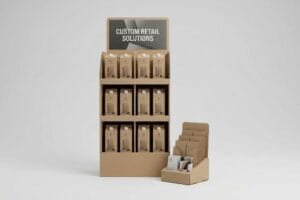
You want to move massive product volume fast, but dropping generic cardboard boxes on the retail floor damages your brand equity. Custom structures solve this, but where do you start?
Yes. Options for branded or promotional dump bins exist across multiple configurations. These displays utilize OCC (Old Corrugated Containers) tailored for high-volume retail. Customization includes vibrant spot color printing, structural belly bands to prevent material bulging, and fractional footprints designed to maximize aisle space and drive impulse purchases.

Knowing your customization options is just the first step; understanding the mechanics behind these massive bulk merchandisers ensures they actually survive the retail floor.
How do discount bins work?
Dropping heavy, loose merchandise into a deep cardboard well seems simple until gravity takes over. The mechanics rely entirely on lateral load distribution.
Discount bins work by consolidating disorganized, loose merchandise into a single high-visibility retail zone. Functionally, these bulk containers rely on reinforced corrugated walls and internal cross-dividers to distribute immense outward kinetic pressure, preventing the paperboard structure from tearing while enabling frictionless shopper access during rapid inventory clearance.

A bin might look like a simple bucket, but without the right engineering, it becomes a massive liability.
The Structural Mechanics of "The Bulge"
Most brand managers assume standard corrugated board is strong enough1 to hold hundreds of loose items like plush toys or clearance electronics. They design a massive, empty open-top box, drop the inventory inside, and expect the outer walls to maintain a perfectly rigid, straight profile on the floor.
I see this "empty bucket" trap routinely when clients launch deep-discount campaigns. The retail-floor headache starts immediately after the co-packing team dumps 150 lbs (68 kg) of irregular product into the core. Without internal stabilization, the outward lateral pressure forces the flat sidewalls to bow outwards, creating the infamous dump bin bulge. The stiff resistance of the virgin kraft board simply gives up under the disorganized weight. Once the walls bow out, you can hear the loud snap as the interlocking bottom tabs shift out of alignment and break. To fix this, I engineer an internal "H-Divider" or a double-layered belly band right at the horizontal centerline. This acts as an invisible skeletal anchor, holding the outer panels tight and ensuring the printed graphics never distort.
| Common Rookie Mistake | The Pro Fix | Retail-Floor Benefit |
|---|---|---|
| Empty open-top boxes | Internal H-Dividers | Prevents wall bowing |
| Ignoring lateral pressure | Double-layer belly bands | Secures interlocking tabs |
| Single-wall corrugated | Upgrading ECT (Edge Crush Test) | Increases load capacity |
I refuse to let a massive clearance event fail because of a bulging sidewall. By inserting a simple corrugated spine, I ensure your bulk merchandiser remains structurally intact, dramatically reducing the risk of a messy collapse in high-traffic aisles.
🛠️ Harvey's Desk: Not sure if your clearance bin can handle the outward pressure of heavy loose goods? 👉 Request a Structural Review ↗ — Direct access to my desk. Zero automated sales spam, I promise.
What is a dump bin display?
Beyond being a high-volume clearance tool, this fixture is an independent island on the retail floor. It must survive harsh foot traffic and nightly cleaning crews.
A dump bin display is a freestanding, open-top retail fixture engineered to hold massive volumes of loose promotional merchandise. Unlike neatly stacked shelves, these merchandisers invite shoppers to dig through disorganized inventory, driving impulse buys while requiring specialized structural reinforcement to withstand aggressive consumer interaction and floor-level hazards.

Because these fixtures sit directly on the ground in busy intersections, their lifespan is dictated by what happens at the base level.
Surviving the Nightly Maintenance Floor Hazards
Even experienced designers focus all their energy on the towering header card and the vibrant exterior graphics. They treat the bottom of the structure as a generic fold-and-lock base, assuming that if the B-flute cardboard is rated for heavy top-loads2, it will easily survive a standard two-week promotional cycle.
That theoretical confidence vanishes when you consider the daily reality of a retail supercenter. I constantly deal with buyers confused as to why their displays are collapsing at the bottom edges within three days. The culprit isn't weak cardboard; it's the nightly cleaning crew. When an industrial floor scrubber hits the base of your unit, the porous testliner acts like a sponge, soaking up dirty water3 and instantly losing its structural rigidity. You can actually hear the wet tearing sound as a shopping cart casually grazes the compromised corner. My fix is mandatory: I apply a clear poly-coat or varnish barrier strictly to the bottom 4 inches4 (101.6 mm) of the dieline. This "mop guard" repels the moisture, keeping the base perfectly dry.
| Common Rookie Mistake | The Pro Fix | Retail-Floor Benefit |
|---|---|---|
| Raw cardboard bases | Clear poly-coat varnish5 | Repels floor moisture |
| Ignoring cleaning crews | 4-inch (101.6 mm) barrier6 | Prevents edge softening |
| Flimsy bottom tabs | Reinforced crash-lock base7 | Survives cart impacts |
I always armor the bottom edge because a wet base equals a dead campaign. Adding a moisture barrier costs pennies in manufacturing but guarantees your structure stays upright, preventing angry store managers from throwing your soggy unit into the compactor.
🛠️ Harvey's Desk: Are your current floor merchandisers surviving the nightly cleaning crew's industrial scrubbers? 👉 Get Your Base Evaluated ↗ — Download safely. My inbox is open if you have questions later.
What are the three types of bins?
Categorizing these units isn't just about square, hexagonal, or round shapes. In professional logistics, categorization is dictated by strict spatial geometry on a wooden transport base.
The three types of bins are primarily defined by their footprint: full pallet, half pallet, and quarter pallet units. These specific dimensional categories allow logistics teams to mathematically subdivide standard wooden transport bases, ensuring perfect alignment within transport containers and optimal utilization of highly contested retail aisle space.
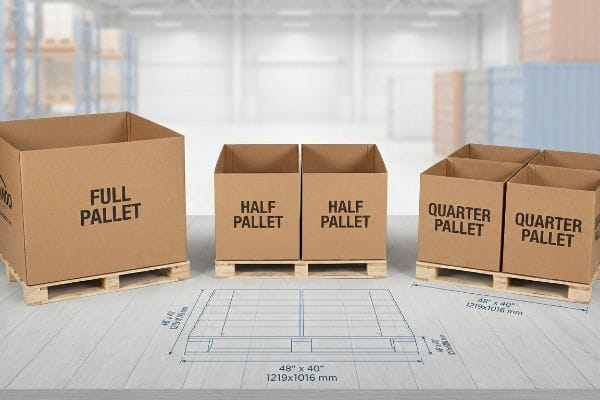
Designing an eye-catching shape is irrelevant if it doesn't mathematically conform to the strict dimensions of the retailer's physical supply chain.
The Math Behind Fractional Pallet Geometry
Emerging brands often pitch a massive 48×40 inch (1219×1016 mm)8 standalone floor unit to a major big-box buyer. They assume that if they are offering a deep discount, the store will gladly surrender an entire premium intersection to host their oversized, custom-shaped promotion.
Think of retail floor space like premium real estate; you cannot just build a sprawling mansion on a shared lot. I routinely see buyers get their entire campaign rejected simply because their massive footprint monopolizes too much aisle space. When you try to force an oversized unit onto the floor, the store clerks struggle to place it, and you end up with an awkward overhang that snags passing carts. To fix this, I strictly engineer bulk merchandisers into standard fractional dimensions: Half Pallets and Quarter Pallets. This mathematical subdivision allows two or four distinct campaigns to lock together smoothly like puzzle pieces on a single GMA (Grocery Manufacturers Association) wood base9.
| Common Rookie Mistake | The Pro Fix | Retail-Floor Benefit |
|---|---|---|
| Oversized custom footprints | Fractional pallet geometry10 | Guarantees buyer approval |
| Ignoring aisle limits | Quarter pallet sizing11 | Maximizes floor density |
| Wasting truck space | Standardized modular locking12 | Cuts shipping volume |
Strict mathematical subdivision guarantees retailer approval. Locking your footprint to standard fractional dimensions eliminates logistics friction, getting your merchandise off the truck and onto the sales floor without spatial objections.
🛠️ Harvey's Desk: Are your displays getting rejected because they demand too much premium aisle space? 👉 Claim Your Dieline Template ↗ — No forms that trigger endless sales calls. Just pure value.
What are the three types of display?
Moving beyond bulk bins, categorizing general retail fixtures requires understanding the strict spatial and legal constraints that govern different zones within a supercenter.
The three types of display commonly utilized in retail include freestanding POP (Point of Purchase) floor units, countertop POS (Point of Sale) merchandisers, and integrated shelf trays. Each category is engineered under distinct legal and logistical parameters to maximize consumer engagement without violating store safety guidelines or accessibility laws.
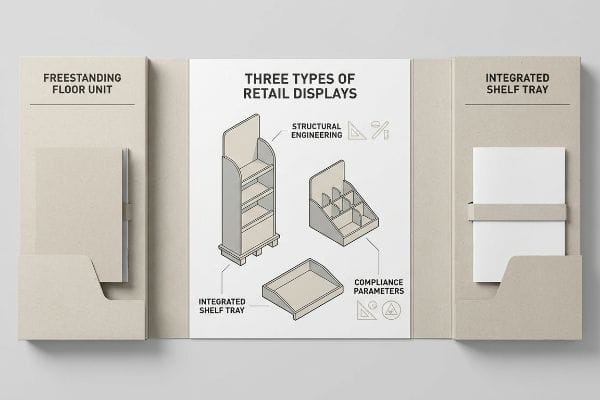
But knowing the theory isn't enough when the machines start running and your supposedly "universal" design triggers a compliance nightmare.
Why "Shrink-to-Fit" Fails on the Factory Floor
Many procurement teams request a scalable master design where a massive floor merchandiser can simply be reduced by 50% to serve as a secondary register unit. They assume shrinking the vector file proportionately across all three dimensions is a brilliant, cost-saving hack for omnichannel campaigns.
Getting one display to stand up in a lab is easy, but here is the harsh reality when you ship 500 of them into different retail zones. In my facility, I routinely see clients try to force this lazy proportional scaling. The disaster hits when the shrunk floor display reaches the checkout counter. The ADA (Americans with Disabilities Act) strictly mandates a 15-48 inch (381-1219 mm) forward reach compliance window13 for register-adjacent fixtures. When you blindly shrink a floor unit by 50%, the product opening drops out of the legal reach zone, and the base footprint completely destabilizes. I have seen store managers instantly toss these non-compliant POS units into the trash, causing massive friction and completely wiping out the project's profit margin. I fix this by physically separating the engineering pipelines. I anchor floor units strictly to standard logistics limits and engineer counter units independently to match exact legal reach ranges.
| Common Rookie Mistake | The Pro Fix | Retail-Floor Benefit |
|---|---|---|
| Scaling down floor units | Separating structural pipelines | Prevents retailer chargebacks |
| Ignoring legal heights | Engineering to ADA limits | Ensures shopper accessibility |
| Unstable scaled bases | Recalculating depth ratios | Eliminates register tipping |
I never let a client guess on compliance parameters. By isolating the engineering pipelines for different physical zones, I ensure you avoid devastating store-level rejections, keeping your checkout campaigns fully legal, stable, and highly profitable.
🛠️ Harvey's Desk: Do you know if your current countertop merchandiser actually complies with strict forward-reach regulations? 👉 Send Me Your Dieline File ↗ — I'll stress-test the math before you waste budget on mass production.
Conclusion
You can choose a cheaper vendor who blindly scales your artwork, but when that non-compliant register unit violates legal reach limits and triggers an immediate retailer rejection, you completely wipe out the project's profit margin. Over 500 brand managers use my prepress checklist to avoid these exact fatal early-stage mistakes. Stop guessing on retail tolerances and let me personally audit your geometry through my Free Structural File Review ↗ to catch compliance blind spots before you fund a doomed production run.
"Corrugated Bulk Bin Market Size, Trends and Segments (2026–2035)", https://www.towardspackaging.com/insights/corrugated-bulk-bin-market-sizing. [Technical data on the compressive strength and lateral load limits of corrugated paperboard would verify if it can support bulk loose inventory without deformation]. Evidence role: technical validation; source type: materials engineering specification. Supports: the claim that basic cardboard often fails as a bulk retail container. Scope note: applies to standard single-wall or double-wall corrugated materials. ↩
"Estimation of the Compressive Strength of Corrugated Board Boxes …", https://pmc.ncbi.nlm.nih.gov/articles/PMC8467740/. [An authoritative source on corrugated packaging materials would specify the vertical crush strength and load-bearing capacity of B-flute board compared to other flute sizes]. Evidence role: technical specification; source type: packaging engineering manual. Supports: material durability for retail fixtures. Scope note: actual strength varies by paper grade and board thickness. ↩
"[PDF] Investigating the mechanical properties of paperboard packaging …", https://repository.rit.edu/cgi/viewcontent.cgi?article=1066&context=japr. [A technical source on packaging materials would verify the hygroscopic properties of testliner cardboard and how water absorption degrades its compressive strength]. Evidence role: technical verification; source type: material science handbook. Supports: the cause of base collapse in cardboard displays. Scope note: applies specifically to non-coated recycled paperboard. ↩
"Polycoat Products", https://www.polycoatusa.com/products/. [Industry guides for retail fixture manufacturing would detail the use of protective coatings on cardboard bases to withstand floor cleaning chemicals and water]. Evidence role: industry standard; source type: packaging engineering manual. Supports: the efficacy of moisture barriers for retail durability. Scope note: effectiveness varies by coating thickness and material. ↩
"Tip On How to Make Cardboard Waterproof? – Custom Boxes Market", https://customboxesmarket.com/tip-on-how-to-make-cardboard-waterproof/?srsltid=AfmBOoor4JKoB9HqM07I-bxKE_CblUnBNdFqLZ-2TRc0Z-0rIVcnqeFo. Technical data on polymer coatings confirms their ability to create a hydrophobic barrier on porous cellulose substrates to prevent water absorption. Evidence role: technical specification; source type: material science manual. Supports: effectiveness of varnish for moisture repulsion. Scope note: efficiency varies by micron thickness of the coating. ↩
"[PDF] Washington State Retail Food Code", https://doh.wa.gov/sites/default/files/legacy/Documents/Pubs/332-033.pdf. Industry guidelines for retail point-of-purchase (POP) fixtures recommend specific base elevations to protect against wet-mopping runoff. Evidence role: industry best practice; source type: retail fixture design guide. Supports: prevention of edge softening. Scope note: specific to commercial floor maintenance standards. ↩
"Crash Lock Boxes vs Standard Cardboard Boxes: A Practical Guide …", https://fencorpackaging.co.uk/blog/crash-lock-boxes-vs-standard-cardboard-boxes/. Packaging engineering specifications demonstrate that crash-lock folding mechanisms provide significantly higher vertical compression strength and impact resistance than standard tab locks. Evidence role: structural analysis; source type: packaging engineering textbook. Supports: durability against cart impacts. Scope note: performance is dependent on the Edge Crush Test (ECT) rating of the cardboard. ↩
"48×40" GMA Pallets | Largest Pallet Manufacturer & Supplier", https://www.palletone.com/products/gma-pallets/. [An authoritative logistics or shipping industry source would confirm that 48×40 inches is the standard GMA pallet dimension used in North American big-box retail]. Evidence role: technical verification; source type: industry standard; Supports: the dimensional standard for full pallet units. Scope note: Applicable primarily to the North American market. ↩
"What Are the GMA Pallet Guidelines for Food Industry Pallets?", https://www.kampspallets.com/gma-pallet-guidelines/. [An industry standard guide on logistics defines the exact measurements of a GMA pallet to verify the spatial capacity for subdivision into fractional units]. Evidence role: Technical Specification; source type: Industry Standard. Supports: The physical basis for fractional palleting. Scope note: Applies specifically to North American retail logistics. ↩
"Why Pallet Dimensioning Matters for Compliance with Cross-Border …", https://vocal.media/journal/why-pallet-dimensioning-matters-for-compliance-with-cross-border-shipping. [An authoritative guide on logistics spatial geometry would explain how fractional pallet sizing optimizes transport base usage and reduces footprint waste]. Evidence role: Technical definition; source type: Logistics manual. Supports: The use of fractional geometry to resolve oversized footprint issues. Scope note: Specific to wooden transport bases. ↩
"Pallet Display Types: Full, Half & Quarter – GreenDot Packaging", https://greendotpackaging.com/understanding-pallet-display-types-full-half-and-quarter-pallet-displays/. [Industry standards for retail display units specify how quarter-pallet dimensions maximize available floor space and aisle accessibility]. Evidence role: Technical specification; source type: Retail operations guide. Supports: The claim that quarter pallet sizing maximizes floor density. Scope note: Applicable to retail floor layouts. ↩
"Intermodal container – Wikipedia", https://en.wikipedia.org/wiki/Intermodal_container. [Technical documentation on modular bin systems demonstrates how interlocking mechanisms reduce void space and optimize truck cube utilization]. Evidence role: Technical specification; source type: Engineering handbook. Supports: The claim that modular locking cuts shipping volume. Scope note: Focuses on transport efficiency. ↩
"Chapter 9: Built-In Elements – Access-Board.gov", https://www.access-board.gov/ada/chapter/ch09/. [An authoritative source such as the ADA Standards for Accessible Design would verify the specific height ranges required for reachability of service counters and fixtures]. Evidence role: technical specification; source type: legal standard. Supports: ADA height requirements for retail displays. Scope note: Focuses specifically on forward reach. ↩