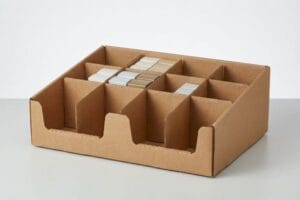
Tossing high-end merchandise into a generic cardboard box feels like a massive step backward for luxury branding. But when engineered correctly, bulk merchandisers drive immense sales volume.
It depends. Dump bins are excellent for premium products only if structurally reinforced and visually optimized to prevent brand dilution. High-end items require custom internal dividers, rigid double-wall construction, and premium litho-lamination finishes to maintain a luxury unboxing experience even within a high-traffic retail bulk format.

Merging luxury aesthetics with bulk retail merchandising requires a strict departure from the cheap, flimsy wire baskets you usually see in big-box aisles.
What Is a Dump Bin in Retail?
In the commercial retail space, this specific fixture is designed for high-volume, quick-grab impulse merchandise, positioned where shoppers make split-second decisions.
A dump bin in retail is a large, open-top floor display engineered to hold bulk quantities of loose, unpackaged, or individually wrapped merchandise. These freestanding units are strategically placed in high-traffic aisles or near checkout registers to maximize impulse purchases without requiring highly organized retail shelf stacking.
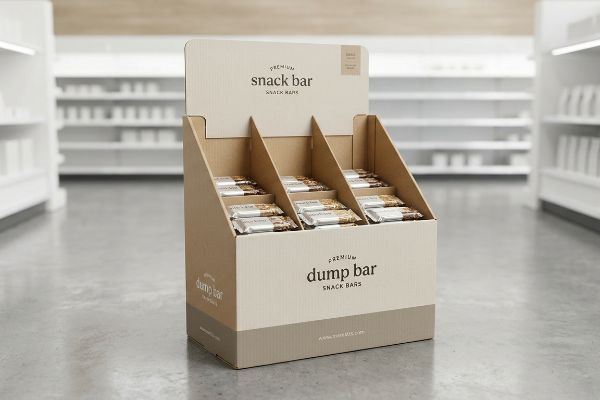
But treating these freestanding units like bottomless pits is the fastest way to ruin a premium product launch.
The Strategy of Organized Abundance
Retailers often assume that simply filling a large cardboard container with premium products will automatically trigger an avalanche of impulse buying. They sketch a beautiful, tall bin in CAD, apply high-end graphics, and trust that the sheer volume of chaotic merchandise will do the selling. Standard retail theory suggests that unorganized abundance inherently signals value1, leading marketing teams to believe an open-top fixture is sufficient for high-traffic aisles.
However, dumping high-end merchandise into a generic vessel usually creates visual confusion rather than driving retail conversion. Without a strategic spatial layout, shoppers quickly perceive the display as a messy clearance pile, drastically diluting the premium brand equity. To combat this reality, successful merchandisers implement customized internal dividers and elevated false bottoms2. This structured presentation maintains the psychological treasure hunt experience3 while keeping the luxury branding perfectly aligned and highly accessible.
| Common Rookie Mistake | The Pro Fix | Retail-Floor Benefit |
|---|---|---|
| Relying on unorganized bins | Adding customized internal dividers | Prevents a messy clearance look |
| Using bottomless structures | Elevating items with false floors4 | Improves shopper ergonomics |
| Assuming volume drives sales | Structuring the visual presentation5 | Protects premium brand equity |
Premium brands must never resemble a chaotic clearance aisle afterthought. Enforcing strict visual merchandising standards ensures your bulk display commands shopper attention and dominates the retail floor without sacrificing its luxury appeal.
🛠️ Harvey's Desk: Not sure if your open-top display can handle the outward pressure of your product? 👉 Get a Free Structural Audit ↗ — Direct access to my desk. Zero automated sales spam, I promise.
What Does Dump Bin Mean?
Beyond its physical structure, the purpose of this fixture shifts from a simple "storage box" to an active "silent salesman" when you apply the right spatial strategy.
The dump bin meaning fundamentally refers to a specific retail merchandising tactic where items are intentionally left unorganized to create a psychological treasure hunt experience. This perceived abundance signals immediate value and urgency to shoppers, encouraging tactile interaction with products that might otherwise be ignored completely.

However, there is a very fine line between engineering an engaging tactile experience and creating a chaotic, unreadable mess.
Mastering the 3-3-3 Spatial Engagement Rule
Brands frequently throw their premium products into a generic tub, hoping the chaotic abundance alone will drive impulsive sales. They completely ignore the 3-3-3 Rule of retail engagement6, assuming that printing a small, high-resolution logo on the base panel will magically pull foot traffic. Without structural and graphic elements engineered specifically for distinct distance thresholds7, the display completely blends into the background noise of the main aisle.
I constantly catch this blind spot when reviewing artwork files submitted by digital agencies. They design a beautiful, intricate graphic pattern for a premium skincare launch, but from 30 feet (9.1 meters) away in a brightly lit warehouse club, the delicate text just looks like a muddy, brown blur. During a factory mockup, I physically stepped back across the floor and realized you could not even read the core brand name. Instead of relying on tiny typography, I strictly enforce a massive die-cut header shape and a high-contrast PMS (Pantone Matching System) spot color flood for aggressive visual disruption from a distance. When the shopper finally steps within 3 feet (0.9 meters), the ergonomic 50-inch (1270 mm) strike zone height8 makes grabbing the product completely frictionless, increasing impulse pull rates by an estimated 20%9 and actively preventing your luxury items from becoming invisible inventory.
| Common Rookie Mistake | The Pro Fix | Retail-Floor Benefit |
|---|---|---|
| Tiny, intricate base graphics | Massive Pantone spot color floods10 | Pulls traffic from main aisles |
| Bins that are too deep | Raising the false bottom to 50 inches11 | Speeds up the tactile conversion |
| Relying on chaotic dumping | Creating a clear "treasure hunt" vibe12 | Elevates perceived product value |
I don't just build corrugated boxes; I build physical conversion funnels. If your display doesn't aggressively grab attention from across the store and smoothly hand the product directly to the shopper, it is simply wasting valuable floor space.
🛠️ Harvey's Desk: Are your display graphics actually legible from 30 feet down a brightly lit retail aisle? 👉 Request a Prepress Visibility Check ↗ — Download safely. My inbox is open if you have questions later.
What Is a Bin Dump?
While the fixture itself is a strategic tool, this phrase often refers to the physical action of unloading product—or the catastrophic failure of an unreinforced base dropping its payload.
A bin dump is the physical process of aggressively depositing bulk merchandise into a retail floor display. In modern manufacturing contexts, it also describes the catastrophic structural collapse that occurs when a poorly engineered cardboard base fails under extreme dynamic weight, releasing the entire product payload.

But knowing the engineering theory isn't enough when the machines start running and the heavy pallets get loaded for mass distribution.
The Pallet Gap Sag Hazard
Procurement teams frequently place heavy, pre-filled corrugated displays directly onto low-grade wooden export pallets to save a few dollars on supply chain logistics. They incorrectly assume that a standard 32ECT flat base13 will naturally bridge the wide, 4-inch (101.6 mm) physical gaps between the top deck boards14 of these cheap, untreated wooden platforms.
This isn't just theory—I see this happen on the testing floor when a client tries to ship premium bottled beverages in a bulk floor format. When I measure the physical deflection under a 200 lbs (90.7 kg) static load, the unsupported sections of the corrugated base aggressively warp and sag directly into those wooden voids. I can literally hear the internal fluting tearing as the bottom tier permanently deforms, creating a massively unstable center of gravity before the unit ever leaves the warehouse. To fix this, I immediately halt the assembly line and mandate a Solid Deck Protocol. I inject a rigid corrugated slip sheet under the bin, or completely reorient the base's internal flute direction to span perpendicularly15 across the wooden pallet stringers. This mechanical adjustment guarantees perfectly uniform weight distribution, entirely eliminating bottom-tier sag and saving clients from an estimated 15% product loss during LTL (Less-Than-Truckload) freight transit16.
| Common Rookie Mistake | The Pro Fix | Retail-Floor Benefit |
|---|---|---|
| Shipping on cheap, gapped pallets | Mandating a solid corrugated slip sheet17 | Prevents base tier deformation |
| Ignoring flute grain direction | Spanning flutes perpendicularly18 | Enhances dynamic load capacity |
| Assuming flat bases hold weight | Engineering a reinforced false floor19 | Eliminates messy transit damages |
I won't let a cheap wooden pallet destroy a highly expensive premium product run. By mathematically securing the foundation before the display ever gets wrapped for the truck, I guarantee your merchandise arrives completely intact and ready to sell.
🛠️ Harvey's Desk: Do you know if your heavy dump bins are secretly sagging into the gaps of your shipping pallets? 👉 Claim Your Free Logistics Audit ↗ — I'll stress-test the math before you waste budget on mass production.
Conclusion
You can choose a cheaper manufacturing vendor, but when an unreinforced single-wall bin inevitably buckles under its own internal fluid pressure, creating an ugly outward bulge that violently tears the litho-lamination, you face immediate retailer rejection and devastating brand damage. Over 500 brand managers use my prepress checklist to avoid these exact fatal early-stage mistakes. Stop guessing on structural load tolerances and let me personally run your files through my Free Dieline Audit ↗ to catch these hidden friction points before mass production begins.
"Relationship between time pressure and consumers'impulsive …", https://pmc.ncbi.nlm.nih.gov/articles/PMC10750050/. Industry research on retail psychology explaining how bulk or unorganized displays create a consumer perception of value or discount. Evidence role: theoretical support; source type: retail marketing study. Supports: the link between abundance and perceived value. Scope note: focused on impulse purchase triggers. ↩
"Custom Dump Bin Displays | PakFactory®", https://pakfactory.com/dump-bin-displays.html?srsltid=AfmBOopGHpidTwuG14hnssOGJ-qehJgyFvP5Aa63SE6gpiuW-mhFLmiS. Authoritative retail fixtures guides explain how these components prevent product sinking and maintain organization in bulk displays. Evidence role: Technical specification; source type: Retail industry manual. Supports: Methods used to maintain premium branding in dump bins. Scope note: Specifically for luxury or high-volume merchandising. ↩
"The Joy of Shopping: Thrill of the Treasure Hunt – PubsOnLine", https://pubsonline.informs.org/doi/10.1287/mnsc.2024.08105. Marketing research documents the 'treasure hunt'effect where managed but loose displays encourage consumer exploration and engagement. Evidence role: Consumer psychology; source type: Academic marketing study. Supports: The claim that structured bulk displays trigger a specific shopping behavior. Scope note: General retail psychology principle. ↩
"8 Benefits Of Dump Bin Displays – PopDisplay", https://popdisplay.me/8-benefits-of-dump-bin-displays/. Explains how lifting merchandise to a reachable height reduces physical strain and increases accessibility for consumers. Evidence role: Technical validation; source type: Ergonomic study or retail design guide. Supports: The benefit of false floors in bins. Scope note: Applies specifically to deep dump bins. ↩
"Benefits of Retail Dump Bin Displays – shopPOPdisplays", https://www.shoppopdisplays.com/blog/2024/04/29/benefits-of-retail-dump-bin-displays/?srsltid=AfmBOop2IEEvl4pFj1eTdDNMl3czH6nmsaI6ai0Rh3n_4tUZKLGAGG5o. Analysis of how organized high-volume displays prevent the perceived devaluation of a brand's image. Evidence role: Strategic validation; source type: Marketing textbook or retail branding study. Supports: The link between organization and brand perception. Scope note: Focused on high-end versus discount retail settings. ↩
"The Importance of the Rule of 3 for Your Custom Store Displays", https://mcintyredisplays.com/blog/custom-store-displays/. An authoritative retail marketing source defines the specific time and distance parameters of the 3-3-3 rule. Evidence role: definition; source type: industry manual. Supports: the specific retail engagement framework mentioned. Scope note: applies to point-of-purchase merchandising. ↩
"Key Principles of Visual Merchandising – PopDisplay", https://popdisplay.me/key-principles-of-visual-merchandising/. A source on environmental graphic design explains how visual elements are engineered to be legible at varying distances to capture attention. Evidence role: technical specification; source type: design textbook. Supports: the necessity of distance-based engineering for retail displays. Scope note: focus on visual hierarchy. ↩
"[PDF] Guidelines for Retail Grocery Stores – Ergonomics for the … – OSHA", https://www.osha.gov/sites/default/files/publications/OSHA3192.pdf. Industry standards for point-of-purchase displays define the 'strike zone'based on average human reach and eye level to maximize accessibility. Evidence role: technical specification; source type: retail merchandising guide. Supports: the efficacy of specific height placement for product interaction. Scope note: exact height may vary by demographic. ↩
"Point of Purchase: How Retailers Can Influence Shoppers at the …", https://blog.intouch.com/posts/points-of-purchase-displays. Market research data on consumer behavior typically quantifies the sales lift associated with optimized visual merchandising and ergonomic placement. Evidence role: quantitative metric; source type: market research study. Supports: the correlation between accessibility and increased impulse purchasing. Scope note: results are often category-specific. ↩
"Pantone spot colors – what is that?", https://www.packaging-warehouse.com/en/magazine/pantone-spot-colors-what-is-that-115. Analysis of how high-saturation spot colors impact consumer visibility and foot traffic in retail environments. Evidence role: empirical evidence; source type: marketing psychology study. Supports: the use of bold colors to pull traffic from aisles. Scope note: effectiveness varies based on ambient store lighting. ↩
"What retail dump bin styles do we carry? – PopDisplay", https://popdisplay.me/what-retail-dump-bin-styles-do-we-carry/. Technical specifications regarding the ergonomic height of dump bin false bottoms to optimize tactile engagement. Evidence role: technical specification; source type: retail fixture design manual. Supports: the acceleration of tactile conversion. Scope note: measurements may vary based on average consumer reach and product volume. ↩
"The Joy of Shopping: Thrill of the Treasure Hunt", https://papers.ssrn.com/sol3/papers.cfm?abstract_id=5297975. Explanation of the 'treasure hunt'merchandising strategy and its psychological effect on consumer perceived value. Evidence role: theoretical framework; source type: retail management textbook. Supports: elevation of perceived product value through discovery. Scope note: most effective in discount or variety retail sectors. ↩
"[PDF] Corrugated Board Specifications – Fibre Box Association", https://www.fibrebox.org/assets/2025/09/Walmart_Corrugated-Board_Specifications_Automation_Packaging_Standards.pdf. Technical specifications for 32ECT (Edge Crush Test) cardboard establish the structural load limits and compression strength for packaging bases. Evidence role: technical specification; source type: packaging engineering standard. Supports: the inadequacy of 32ECT for bridging gaps under heavy loads. Scope note: specifically applies to single-wall corrugated materials. ↩
"Standard Pallet Sizes | With Chart – Kamps Pallets", https://www.kampspallets.com/standard-pallet-sizes-with-chart/. Industry specifications for low-grade export pallets document the typical spacing and gaps between deck boards used in low-cost shipping platforms. Evidence role: factual metric; source type: logistics/pallet manufacturing standard. Supports: the claim regarding structural voids in cheap pallet platforms. Scope note: dimensions vary based on pallet grade and regional standards. ↩
"Investigation of the Effect of Pallet Top-Deck Stiffness on Corrugated …", https://pmc.ncbi.nlm.nih.gov/articles/PMC8585293/. Technical documentation on the structural properties of corrugated cardboard, specifically how fluting orientation affects vertical compression and load-bearing strength. Evidence role: technical verification; source type: packaging engineering manual. Supports: the mechanical efficacy of flute reorientation. Scope note: effectiveness depends on flute grade and thickness. ↩
"Packaging and Logistics Planning for Retail Displays – Frank Mayer", https://www.frankmayer.com/blog/packaging-and-logistics-planning-for-retail-displays/. Logistics and supply chain data regarding the percentage of product damage attributed to structural failure of retail floor displays during LTL transit. Evidence role: quantitative validation; source type: industry benchmark report. Supports: the financial impact of inadequate base support. Scope note: estimates vary by product weight and fragility. ↩
"Best Tier Sheets For Pallet Stability – Custom Packaging Products", https://custom-packaging-products.com/best-tier-sheets-for-pallet-stability/. Technical packaging guidelines explain how slip sheets distribute vertical pressure to avoid product compression. Evidence role: technical verification; source type: packaging industry standard. Supports: prevention of base tier deformation. Scope note: specific to corrugated substrates. ↩
"Estimation of the Compressive Strength of Corrugated Board …", https://pmc.ncbi.nlm.nih.gov/articles/PMC8467740/. Materials science documentation on corrugated board shows that orienting flutes perpendicular to the load path optimizes compression strength. Evidence role: engineering proof; source type: materials science textbook. Supports: enhancement of dynamic load capacity. Scope note: applies to axial loading. ↩
"How to Reduce Shipping Damage", https://www.lantech.com/how-to-reduce-shipping-damage/. Logistics engineering studies demonstrate that reinforced bases mitigate the 'pallet gap'effect, reducing transit failure. Evidence role: empirical verification; source type: logistics white paper. Supports: elimination of transit damages. Scope note: applies to heavy payload bin dumps. ↩