Brands push for green packaging, but hidden plastics and poorly chosen materials often destroy sustainability before shipping. True eco-compliance demands strict factory-level chemistry.
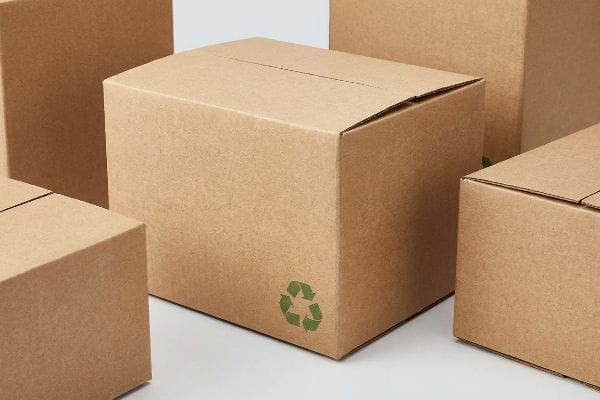
Yes. Corrugated boxes are highly eco-friendly when engineered without toxic plastic laminations. As a fully renewable, biodegradable paper substrate, standard corrugated cardboard seamlessly enters municipal recycling streams, allowing retail supply chains to drastically reduce their carbon footprint and successfully meet strict corporate sustainability and environmental mandates globally.

But claiming sustainability in a boardroom is entirely different from proving it on the factory floor. Let's look at how structural physics and manufacturing chemistry dictate true environmental compliance in high-volume retail.
Is Corrugated Cardboard Environmentally Friendly?
Every buyer wants a green badge on packaging, but theoretical sustainability often clashes with the basic realities of retail recycling streams.
Yes. Corrugated cardboard is environmentally friendly and remains 100% curbside repulpable if engineered with liquid aqueous coatings. However, attaching rigid bio-plastic films to the paperboard instantly destroys this recyclability, forcing municipal sorting facilities to reject the entire display and divert it directly into local landfills.
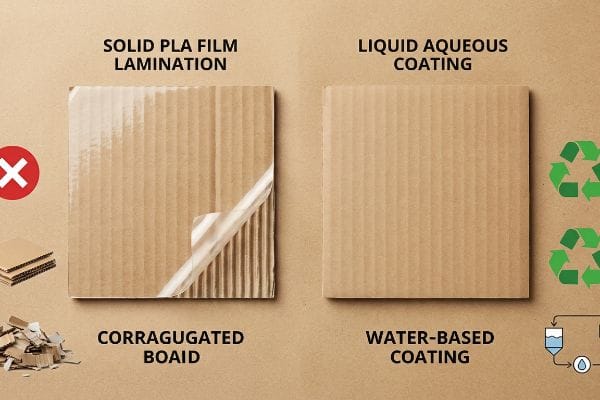
True sustainability isn't just about the raw paper source; it is about how we treat the structural surface before it hits the retail aisle.
The PLA Bio-Plastic Composting Trap
When reviewing client dielines, I constantly see procurement teams mandating PLA (Polylactic Acid) bio-plastic laminations1, assuming this corn-based film guarantees a green scorecard. Many brands and junior designers treat this physical film as a harmless eco-upgrade that easily breaks down in the trash. They believe that slapping a bio-plastic layer on their packaging automatically elevates their brand's environmental profile, easily satisfying basic retail sustainability requirements without altering their core supply chain strategy.
In reality, this solid barrier actively repels water during standard repulping processes, creating massive problems for basic recycling infrastructure. Standard municipal centers simply cannot process these films2, resulting in the complete rejection of the paperboard outright. To fix this, I advise clients to strip all solid film laminations and substitute a basic water-based coating. This ensures the packaging remains fully repulpable in standard streams3, saving brands from massive retailer ESG (Environmental, Social, and Governance) rejection penalties and streamlining overall material costs.
| Metric/Feature | Generic Approach | Engineered Reality |
|---|---|---|
| Surface Treatment | Solid PLA plastic film | Liquid aqueous coating |
| Recycling Fate | Rejected to landfill4 | 100% curbside repulpable5 |
| TCO Impact | High ESG penalty risk | Seamless retailer compliance |
True sustainability means aligning your surface coatings with the practical capabilities of local recycling centers. Eliminating hidden plastics prevents costly ESG rejections and keeps your brand's green initiatives completely intact.
🛠️ Harvey's Desk: Are your current bio-plastic coatings secretly triggering retailer ESG rejections? 👉 Claim Your Free Packaging Chemistry Audit ↗ — I review every structural file personally within 24 hours.
What Are the Disadvantages of Corrugated Cardboard?
Paper naturally acts like a sponge, making unpredictable environmental variables the biggest threat to a standard flat-pack display's overall integrity.
The primary disadvantages of corrugated cardboard stem from its extreme vulnerability to moisture absorption. When exposed to high ambient humidity or long ocean transit, porous paper fibers physically swell, aggressively altering the structural caliper and causing tightly engineered interlocking tabs to buckle during manual assembly.
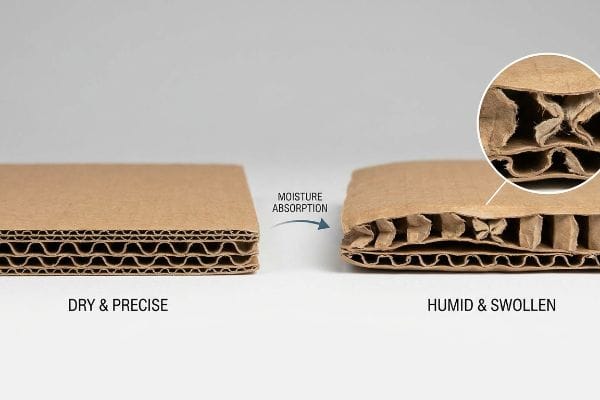
A flat vector file in a climate-controlled office tells a very different story than a humid warehouse dock in Florida or Texas.
The Moisture Swelling Caliper Shift
When designing flat-pack structures, I routinely catch a systemic trap where teams rely on oversimplified vector files that ignore the natural swelling of paper. Designers often calculate basic slot clearances based on the absolute dry thickness of the board, assuming the material will remain statically perfect throughout its entire retail lifecycle. They completely overlook the basic fact that standard corrugated material absorbs ambient moisture during transit6 and fundamentally changes shape before it reaches the store.
This oversight quickly turns into a major problem when displays hit humid environments like a warehouse dock in Florida. The swollen board makes receiving slots dangerously tight7, drastically slowing down manual assembly for co-packers. To prevent this, I always add a small clearance buffer directly into the basic cutting software. By enforcing this simple geometric tolerance, assembly teams can easily slide parts together without tearing, ensuring smooth retail rollouts and avoiding unnecessary co-packing delays.
| Metric/Feature | Generic Approach | Engineered Reality |
|---|---|---|
| Slot Clearance | Absolute dry caliper | Added humidity buffer8 |
| Assembly Friction | Tearing and forced fit9 | Smooth slide lock |
| Logistics Cost | Expensive manual rework10 | Standard co-packing rates |
Anticipating natural paper expansion is how you turn a common material drawback into a guaranteed logistical win. A dry blueprint must always account for a wet supply chain to survive retail distribution.
🛠️ Harvey's Desk: Is your current counter display design at risk of buckling under high-humidity transit? 👉 Request Your Structural Tolerance Review ↗ — 100% confidential. Your unreleased retail designs are safe with me.
Are Corrugated Sheets Eco-Friendly?
Chasing the absolute highest percentage of recycled content often creates a dangerous illusion of strength that inevitably fails on the retail floor.
Yes. Corrugated sheets are highly eco-friendly, but aggressively recycling them degrades their mechanical integrity. After multiple repulping cycles, the cellulose fibers physically shorten and exhaust their elasticity, requiring a strategic injection of fresh virgin kraft material to maintain the dynamic load capacity required for retail.
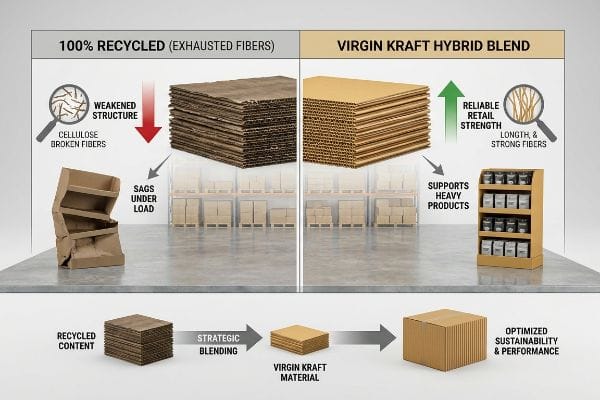
Pushing paper fibers to their absolute limit might satisfy a green scorecard, but it introduces massive physical liabilities on the warehouse floor.
The Cellulose Fiber Exhaustion Limit
When defining sustainability goals, procurement teams frequently demand 100% recycled material for retail displays, assuming it offers the exact same structural integrity as fresh board. Many buyers simply treat recycled paper as an infinitely renewable substrate that can easily support heavy products forever. They overlook the standard degradation of paper fibers during the basic repulping process11, believing a perfect recycling score on paper will automatically translate to a sturdy display in the store.
In standard practice, cellulose fibers naturally shorten and weaken after several recycling cycles12, losing their ability to hold significant weight. Displays built entirely from this exhausted material often sag or buckle under heavy products, ruining the retail presentation. To balance sustainability with actual performance, I recommend blending a strategic percentage of fresh virgin kraft material13 into the recycled board. This hybrid approach easily restores the necessary structural strength, ensuring displays stay upright while still meeting practical corporate eco-goals.
| Metric/Feature | Generic Approach | Engineered Reality |
|---|---|---|
| Material Sourcing | 100% recycled testliner14 | Virgin kraft hybrid blend15 |
| Load Capacity | Weakened structure16 | Reliable retail strength |
| Freight Strategy | Heavy structural limits | Lightweight retail geometry |
Blending fresh fibers with recycled content remains the smartest way to balance sustainability mandates with functional retail performance. Achieving eco-friendly packaging never requires sacrificing basic structural integrity.
🛠️ Harvey's Desk: Are your heavy checkout trays actively crushing your shipping ROI before they even reach the store? 👉 Get Your Payload Compression Audit ↗ — No account managers in the middle. You talk directly to structural engineers.
What Is the Most Eco-Friendly Packaging Material?
The true environmental impact of retail logistics goes far beyond the display itself—it includes the massive, heavily engineered platform carrying it across the ocean.
The most eco-friendly packaging material in modern retail logistics is high-density corrugated paperboard. When utilized as structural transport pallets, it entirely replaces chemically treated wood, slashes transit dead weight, bypasses international phytosanitary border regulations, and guarantees seamless, single-stream curbside recyclability for the receiving big-box store.
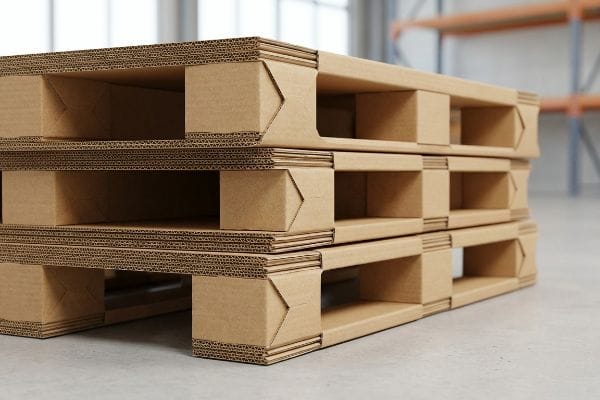
Understanding this material's true potential requires looking at the absolute bottom of the retail footprint: the logistics pallet itself.
The Corrugated Pallet Logistics Exemption
In global supply chains, traditional procurement teams blindly default to heavy wooden export pallets, treating them as an unavoidable evil of international logistics. Designers assume these rigid timber bases are the only way to support massive dynamic loads, ignoring the severe environmental and regulatory baggage they carry. This generic approach requires harsh chemical treatments or energy-intensive heat processes to achieve ISPM 1517 (International Standards for Phytosanitary Measures No. 15) certification. Furthermore, solid timber introduces massive dead weight to ocean containers18, crippling the overall carbon efficiency of the freight before the actual merchandising payload is even factored into the equation.
On the factory floor, I eliminate this logistical friction by engineering transport pallets entirely from heavy-duty, multi-layered corrugated paperboard. Because these platforms are built from precisely fluted paper matrixes rather than raw timber, they bypass phytosanitary border hold-ups entirely19. The internal wave-like arches of the BCT (Box Compression Test) rated corrugated board naturally absorb and displace kinetic shock through microscopic fiber deflection, eliminating the need for solid mass. Transitioning to a 100% paper platform drops the base transit dead weight to roughly 12 lbs (5.4 kg)20, drastically improving the container's fuel-to-merchandise efficiency ratio while solving the retailer's downstream disposal nightmare through single-stream repulping.
| Metric/Feature | Generic Approach | Engineered Reality |
|---|---|---|
| Transport Base | ISPM 15 treated wood21 | 100% fluted paperboard |
| Pallet Weight | 45 lbs of dead weight22 | 12 lbs of functional weight23 |
| Disposal Path | Retailer disposal liability | Single-stream recycling |
Replacing heavy timber with precisely folded paper geometry fundamentally upgrades both the planet and the profit margin. Every ounce of unnecessary wood represents wasted margin and an unacceptable environmental liability.
🛠️ Harvey's Desk: Is your international supply chain slowed down by heavy, non-compliant wooden export platforms? 👉 Request a Freight Density Audit ↗ — I review every structural file personally within 24 hours.
Conclusion
By mastering the physical chemistry of aqueous coatings and mathematically calculating the swelling tolerances of recycled paper fibers, we stop heavy-duty corrugated displays from buckling under real-world logistics. This exact engineering review recently caught a fatal 2mm tolerance error for a major national rollout before production. To ensure your next campaign survives humid ocean freight without tearing on the assembly line, let me personally run your structural files through our Free Dieline Tolerance Audit ↗.
"Recyclable and Biodegradable Paper Coating with Functionalized PLA …", https://pmc.ncbi.nlm.nih.gov/articles/PMC11948148/. Technical verification of how PLA films affect the repulping process of corrugated cardboard in municipal facilities. Evidence role: factual verification; source type: waste management industry standards. Supports: the claim that bio-plastic films contaminate paper recycling streams. Scope note: focus on industrial vs home composting. ↩
"Is Plastic Film Recyclable?", https://www.ecoenclose.com/resources/thin-film-recycling?srsltid=AfmBOooDJGMWYluh1eIWKRNXtm6DdTb9l_x9nA7oFY21N__-0VRJ8hUq. Verification of the inability of municipal Material Recovery Facilities (MRFs) to separate bio-plastic films from paperboard during repulping. Evidence role: operational fact; source type: waste management industry report. Supports: claims on landfill diversion. Scope note: capability may vary by specific facility technology. ↩
"[PDF] Voluntary Standard For Repulping and Recycling Corrugated … – Sign-in", https://ptacts.uspto.gov/ptacts/public-informations/petitions/1558049/download-documents?artifactId=PUg7-sUKgXoOatgTOs-GLJqU-WHJUZd5E2A6MCAqZmTTS-FVIbOd_YY. Technical confirmation that aqueous coatings are compatible with standard paper recycling processes without hindering fiber recovery. Evidence role: technical specification; source type: material science study. Supports: claims on sustainable coating alternatives. Scope note: depends on the chemical composition of the coating. ↩
"Garbage & Recycling – the City of Fort Worth", https://www.fortworthtexas.gov/departments/environmental-services/solidwaste?_escaped_fragment_=rc-cpage%3D36914&lang_update=638050045730079892#!rc-cpage=wizard_material_list. Verification that PLA bio-plastic films are generally not compatible with standard paper recycling streams and are diverted to landfills. Evidence role: validation; source type: waste management guidelines. Supports: the inefficiency of PLA in retail recycling streams. Scope note: varies by municipal facility capabilities. ↩
"[PDF] SFS Presentation", https://dtsc.ca.gov/wp-content/uploads/sites/31/2020/01/3_1_Clay-Mayhood_CA-PFAS-Workshop-Aqueous-Coating-Overview-191219.pdf. Technical data verifying that aqueous-based coatings do not interfere with the repulping process in standard paper mills. Evidence role: technical specification; source type: materials science study. Supports: the sustainability of aqueous coatings over plastic films. Scope note: refers to specific water-based polymer formulations. ↩
""Relative Humidity Effects on the Compression Strength of …", https://open.clemson.edu/all_theses/3225/. Technical documentation on packaging materials explains the hygroscopic nature of cellulose fibers and their tendency to expand when absorbing ambient moisture. Evidence role: technical verification; source type: material science textbook. Supports: moisture absorption in cardboard. Scope note: applies to non-coated corrugated paper. ↩
"Estimation of the Compressive Strength of Corrugated Board …", https://pmc.ncbi.nlm.nih.gov/articles/PMC8467740/. Technical documentation on the hygroscopic properties of corrugated fiberboard explains how moisture absorption leads to dimensional swelling and loss of tolerance in interlocking parts. Evidence role: technical validation; source type: materials science handbook. Supports: the claim that humidity-induced swelling affects assembly fit. Scope note: applicable to cellulose-based packaging. ↩
"Packaging In the Summertime: How Summer Humidity Destroys Paper …", https://nmfta.org/news/packaging-in-the-summertime-how-summer-humidity-destroys-paper-and-corrugated-packaging-and-what-to-do-about-it/. Technical documentation explaining how adding tolerances to slot clearances compensates for cardboard expansion due to moisture. Evidence role: Technical validation; source type: Engineering manual. Supports: The necessity of humidity buffers to maintain structural integrity. Scope note: Specific to high-humidity logistics environments. ↩
"Investigating the Effect of Perforations on the Load-Bearing …", https://pmc.ncbi.nlm.nih.gov/articles/PMC11396172/. Industry analysis detailing failure modes in flat-pack assembly when dry caliper measurements are used without accounting for swelling. Evidence role: Failure analysis; source type: Technical report. Supports: The correlation between rigid design and material failure during assembly. Scope note: Applies to corrugated display inserts. ↩
"How Much Does Point of Purchase Display Assembly Cost?", https://www.industrialpackaging.com/blog/point-of-purchase-display-cost. Supply chain cost analysis regarding the labor overhead incurred when poorly engineered packaging requires manual correction during co-packing. Evidence role: Economic impact; source type: Business case study. Supports: The financial disadvantage of generic packaging approaches. Scope note: Costs vary based on scale of distribution. ↩
"Degradation of paper products due to volatile organic compounds – PMC", https://pmc.ncbi.nlm.nih.gov/articles/PMC10119123/. A material science study or industry manual on pulp and paper production would detail how mechanical and chemical stresses during repulping shorten cellulose fibers. Evidence role: technical verification; source type: peer-reviewed journal or industry standard; Supports: the claim that recycled fibers lose structural integrity. Scope note: specifically relates to mechanical strength loss. ↩
"Changing quality of recycled fiber material. Part 1. Factors …", https://bioresources.cnr.ncsu.edu/resources/changing-quality-of-recycled-fiber-material-part-1-factors-affecting-the-quality-and-an-approach-for-characterisation-of-the-strength-potential/. Scientific evidence from papermaking literature explaining the mechanical shortening of cellulose fibers during repetitive repulping. Evidence role: scientific fact; source type: peer-reviewed journal or technical handbook. Supports: the degradation of fiber length and strength. Scope note: focuses on the physical properties of cellulose. ↩
"[PDF] A Comparative examination of the physical properties of recycled, high …", https://repository.rit.edu/cgi/viewcontent.cgi?article=1299&context=theses. Industry standards for corrugated board production demonstrating how adding virgin kraft fibers restores bursting and edge crush strength. Evidence role: industry technical standard; source type: manufacturing guide. Supports: the use of hybrid blending for structural integrity. Scope note: specific to retail display load capacities. ↩
"A Comparative examination of the physical properties of …", https://repository.rit.edu/cgi/viewcontent.cgi?article. Technical comparison of the bursting and tensile strength of 100% recycled liners against virgin fibers. Evidence role: technical specification; source type: material science report. Supports: the structural fragility of fully recycled materials. Scope note: applies to standard testliner grades. ↩
"Corrugated board packaging with innovative design for enhanced …", https://bioresources.cnr.ncsu.edu/resources/corrugated-board-packaging-with-innovative-design-for-enhanced-durability-during-transport/. Guidelines on the optimal ratio of virgin kraft to recycled fiber for maintaining structural integrity in retail packaging. Evidence role: industry standard; source type: engineering handbook. Supports: the use of hybrid blends to optimize strength-to-weight ratios. Scope note: focus on retail shipping containers. ↩
"Estimation of the Edge Crush Resistance of Corrugated Board …", https://pmc.ncbi.nlm.nih.gov/articles/PMC9961700/. Scientific explanation of the cellulose fiber exhaustion limit and how fiber shortening during recycling cycles reduces load-bearing capacity. Evidence role: causal mechanism; source type: academic study. Supports: the structural failure associated with high-recycled content boards. Scope note: relates to fiber morphology and degradation. ↩
"Import ISPM 15-Compliant Wood Packaging Material into the U.S.", https://www.aphis.usda.gov/plant-imports/wood-packaging-material/import. Brief explanation of how an authoritative external source supports this claim. Evidence role: factual verification; source type: international regulatory standard; Supports: the requirement for chemical or heat treatments for wooden pallet certification. Scope note: Applies to international trade. ↩
"Comparisons of environmental impacts between wood and …", https://www.sciencedirect.com/science/article/abs/pii/S004896971932532X. Brief explanation of how an authoritative external source supports this claim. Evidence role: technical metric; source type: logistics or environmental research; Supports: the correlation between pallet weight and shipping carbon efficiency. Scope note: Comparison against lightweight alternatives. ↩
"Wood Packaging Material | Animal and Plant Health Inspection Service", https://www.aphis.usda.gov/plant-imports/wood-packaging-material. Regulatory documentation from the IPPC confirms that processed corrugated paperboard is exempt from ISPM 15 heat treatment requirements mandated for raw timber. Evidence role: Regulatory verification; source type: International Standard. Supports: The claim that paper pallets avoid customs delays. Scope note: Applies to processed fiberboard. ↩
"Pallet Weight & Load Capacity: Empty, Loaded & Racked …", https://www.repackify.com/blog/pallet-weight-and-load-capacity?srsltid=AfmBOopSWYt1771roj-MBxaXqM71y8Btr8n2J7BdjAGfhGeb4FGHAlAr. Comparative weight analysis of industrial pallet materials confirms that corrugated paper platforms are significantly lighter than standard wood pallets, which typically weigh 30-50 lbs. Evidence role: Technical specification; source type: Industry data sheet. Supports: The specific metric for dead weight reduction. Scope note: Weight depends on load-bearing specifications. ↩
"Regulation of wood packaging material in international trade", https://www.ippc.int/publications/regulation-wood-packaging-material-international-trade-0. Verification of ISPM 15 as the global regulatory standard for heat-treating wood packaging to prevent pest infestation. Evidence role: technical specification; source type: international regulatory body. Supports: the material standard for generic transport bases. Scope note: applies to international shipping. ↩
"Standard Pallet Sizes | With Chart", https://www.kampspallets.com/standard-pallet-sizes-with-chart/. Empirical data confirming the average weight of standard industrial wooden pallets (e.g., GMA pallets). Evidence role: benchmark metric; source type: logistics industry data. Supports: the baseline weight comparison for generic pallets. Scope note: weight varies by wood type and size. ↩
"Corrugated Cardboard Pallets – Smurfit Kappa", https://www.smurfitkappa.com/us/products-and-services/packaging/corrugated-pallets. Technical specifications for engineered fluted paperboard pallets demonstrating significant weight reduction over wood. Evidence role: performance metric; source type: engineering datasheet. Supports: the weight efficiency claim for engineered pallets. Scope note: weight correlates with load-bearing capacity. ↩