Launching a CBD brand is tough, but choosing the wrong retail packaging can instantly trigger retailer rejections. You need to know if custom presentation actually drives sales or kills margins.
It depends. CBD gift boxes require strict structural engineering and regulatory compliance to succeed. While premium presentation boosts perceived brand value, integrating incorrect materials or failing to display mandatory legal text will inevitably result in catastrophic retail compliance failures and immediate supply chain rejections globally.

Making the leap from a standard shipper to a premium presentation unit sounds great in marketing meetings, but the factory floor tells a different story.
What Are the Latest Gift Box Trends?
Everyone wants a sustainable, high-end unboxing experience, but chasing the latest green packaging trends without understanding material chemistry will destroy your entire physical rollout.
The latest gift box trends emphasize sustainable mono-materials, interactive unboxing mechanics, and minimalist tactile finishes. Brands are rapidly shifting toward fully recyclable structures and liquid aqueous coatings, replacing traditional petroleum-based plastics to meet strict global environmental mandates without sacrificing premium visual aesthetics on the retail shelf.

It is easy to point to a mood board and demand eco-friendly finishes, but forcing those concepts through automated production lines exposes hidden mechanical traps.
Navigating Sustainable Packaging Chemistry
Most emerging brands immediately mandate PLA (Polylactic Acid) bio-plastic laminations1 for their new retail boxes. They assume this "corn-based" film guarantees total eco-compliance and a premium feel. It is a common trap that catches even experienced procurement teams who rely strictly on theoretical material data rather than downstream waste-stream realities.
I see this happen constantly when those PLA-coated boxes hit standard municipal recycling centers. Because PLA forms a solid physical film, it repels water during standard OCC (Old Corrugated Containers) repulping2. I can literally hear the loud, aggressive scraping as the plastic fails to dissolve in the mill vats, forcing the entire batch to be diverted directly to a landfill. Instead, I strictly enforce a liquid aqueous coating protocol3. This liquid polymer dissolves seamlessly, completely eliminating the recycling friction and saving you from severe retailer ESG chargebacks.
| Common Rookie Mistake | The Pro Fix | Retail-Floor Benefit |
|---|---|---|
| Specifying solid PLA films | Liquid aqueous coatings4 | Guarantees curbside recycling |
| Ignoring repulping friction | Mono-material structures5 | Passes strict retailer audits |
| Overcomplicating finishes | High-solid gloss formulas6 | Prevents surface scuffing |
I never let cosmetic trends compromise downstream compliance. By stripping out incompatible bio-plastics, I guarantee your packaging survives both the retail shelf and the strict environmental audit.
🛠️ Harvey's Desk: Not sure if your new eco-friendly finish will actually pass a big-box recycling audit? 👉 Get a Free Material Assessment ↗ — Direct access to my desk. Zero automated sales spam, I promise.
What Are Cbd Boxes?
Designing packaging for heavily regulated markets is not just about holding a glass tincture bottle; it is about surviving an unforgiving labyrinth of federal compliance checks.
CBD boxes are highly specialized retail enclosures engineered to protect fragile glass components while strictly displaying mandatory regulatory data. These structures combine shock-absorbing internal corrugated inserts with precisely die-cut outer panels, ensuring federal compliance labels remain fully visible to consumers and big-box receiving teams at all times.
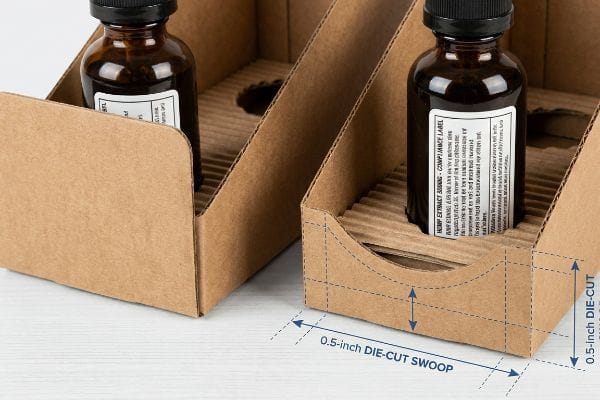
Nailing the structural integrity is only half the battle; if the box architecture accidentally hides your legal text, your product is dead on arrival.
The Regulatory Label Clearance Mapping
Junior designers often build beautiful RRP (Retail Ready Packaging) trays specifically to hold premium CBD tinctures on the counter. They calculate the exact internal dimensions to grip the glass, completely forgetting that these highly regulated products require unobstructed visibility of their milligrams and origin claims7.
I know you are staring at this cardboard structure feeling lost, because 80% of my clients let a generic front retaining lip physically cover the primary regulatory text. When I run these through initial factory assembly, I feel the stiff resistance of the thick B-flute board completely burying the bottle's warning label. To fix this, I mandate a strict label-clearance mapping protocol in CAD (Computer-Aided Design), engineering a custom die-cut swoop. This 0.5-inch (12.7 mm) adjustment guarantees 100% legal visibility8, completely eliminating the risk of catastrophic big-box compliance rejections.
| Common Rookie Mistake | The Pro Fix | Retail-Floor Benefit |
|---|---|---|
| High retaining lips | Custom die-cut swoops9 | Keeps legal text visible |
| Generic tray heights | 3D label clearance mapping10 | Prevents compliance rejections |
| Ignoring product shift | Internal locking inserts11 | Secures fragile glass |
I refuse to let a poorly measured piece of cardboard trigger a federal compliance hold. Matching the structural geometry directly to the legal label is non-negotiable.
🛠️ Harvey's Desk: Are your retaining lips accidentally hiding your mandatory milligram counts from the consumer? 👉 Claim Your Structural Audit ↗ — Download safely. My inbox is open if you have questions later.
Are Gift Boxes a Good Idea?
Throwing money at premium structures seems like a surefire way to increase perceived value, but an unbalanced procurement strategy will turn that investment into a total liability.
Yes. Gift boxes are a highly effective merchandising strategy when properly engineered. A structurally balanced gift box significantly elevates brand communication, ensures frictionless retail assembly, and provides dynamic transit protection, actively preventing costly supply chain damages while driving massive impulse conversions on the retail floor.

Everyone loves the concept of a high-end presentation, but when buyers obsess strictly over unit costs, the physical execution rapidly falls apart.
Avoiding the "4 C's" Packaging Imbalance
Procurement departments frequently isolate and obsess strictly over the primary cost metric, hollowing out structural board grades to save a few pennies per unit. They falsely assume a cheaper substrate will still deliver the premium unboxing experience12 the marketing team promised.
Think of it like building a luxury house on a foundation of cheap sand. When those downgraded boxes hit the logistics chain, I see the immediate fallout. I can smell the damp, dusty odor of crushed, low-grade paper fibers when the pallets arrive completely buckled under top-weight. By enforcing a unified assessment matrix, I mathematically link the structural material directly to downstream supply chain survival. Restoring a virgin 32ECT standard13 might cost slightly more upfront, but it actively prevents the crushed graphics that trigger massive retailer chargebacks14.
| Common Rookie Mistake | The Pro Fix | Retail-Floor Benefit |
|---|---|---|
| Downgrading board grades | Enforcing 32ECT standards15 | Stops transit crushing |
| Isolating unit cost | Unified ROI assessment | Prevents retailer chargebacks16 |
| Ignoring assembly time | Frictionless die-cutting17 | Speeds up restocking |
I always tell my clients that saving three cents on raw material is useless if the box arrives looking like an accordion. You have to engineer for total supply chain survival.
🛠️ Harvey's Desk: Are your current material specs secretly setting you up for a massive transit failure? 👉 Request a Material Verification ↗ — No forms that trigger endless sales calls. Just pure value.
What Is the Safest Form of Cbd?
Delivering a potent product requires flawless internal chemistry, but if your secondary packaging micro-fractures during transit, the resulting oxygen exposure destroys the product entirely.
The safest form of CBD relies on uncompromising flexible barrier packaging and structural laminations that prevent oxygen ingress. By utilizing highly elastic anti-crack films and mathematically calibrated fold tolerances, brands ensure their primary packaging remains perfectly sealed, maintaining strict chemical stability and consumer safety globally.

Getting a perfectly sealed sample to stand up in a climate-controlled lab is easy, but here is the harsh reality when you ship thousands of them across dry climates.
The Lethal "Litho-Cracking" Reality
Brand teams frequently assume that standard rigid litho-varnishes can simply be ported over to highly flexible packaging structures18 or extreme 180-degree folding headers. They trust standard prepress templates, ignoring the intense mechanical elasticity required when flat boards are folded19 by automated factory machinery.
In my facility, I routinely see this fail during initial pre-production testing. When a standard rigid varnish is applied to a heavily scored header and run through the folder-gluer, I hear the sharp, brittle snapping of the cured ink. The coating physically ruptures, creating micro-fractures along the seam20 and exposing the raw brown cardboard underneath. I pulled the micrometer readings and proved we needed an elastic anti-crack film lamination21 instead. This highly flexible polymer layer moves harmoniously with the substrate, cutting machine downtime and guaranteeing a perfectly sealed package that easily survives retail handling.
| Common Rookie Mistake | The Pro Fix | Retail-Floor Benefit |
|---|---|---|
| Using rigid varnishes | Elastic anti-crack film22 | Stops brittle ink snapping |
| Ignoring fold elasticity | Calibrated bend allowances23 | Prevents raw edge exposure |
| Standard machine speeds | Adjusted folder-gluer tension24 | Reduces machine downtime |
I never let a rigid coating compromise the safety of a heavily handled retail product. If the chemistry cannot stretch with the fold, it has no business being on my factory floor.
🛠️ Harvey's Desk: Does your current carton snap and expose raw edges when you fold the main header? 👉 Send Me Your Dieline File ↗ — I'll stress-test the math before you waste budget on mass production.
Conclusion
You can chase trendy box designs all day, but when a rigid litho-varnish micro-fractures during automated assembly, it exposes raw paperboard, slowing down the packaging line by an estimated 30% and instantly wiping out your profit margin. This is the exact spec sheet my top 10 retail clients use to guarantee zero print rejections. Stop guessing on fold elasticity and let me personally run your structural files through my Free Dieline Pre-Flight Audit ↗ to catch fatal cracking hazards before mass production begins.
"The Life Cycle Assessment for Polylactic Acid (PLA) to Make It a …", https://pmc.ncbi.nlm.nih.gov/articles/PMC8199738/. Authoritative waste management guidelines describe how PLA laminations contaminate traditional paper recycling streams, contradicting perceived eco-compliance. Evidence role: technical verification; source type: environmental report. Supports: the claim that PLA laminations present downstream waste-stream challenges. Scope note: focus on industrial compostability vs curbside recyclability. ↩
"Surface treatment of laboratory-made papers: Impact on water …", https://bioresources.cnr.ncsu.edu/resources/surface-treatment-of-laboratory-made-papers-impact-on-water-absorption-and-structural-characteristics/. Technical data explaining how polylactic acid (PLA) creates a hydrophobic barrier that prevents effective fiber separation during standard paper recycling. Evidence role: technical verification; source type: waste management research paper. Supports: the incompatibility of PLA coatings with municipal paper recycling streams. Scope note: specifically concerns OCC recycling processes. ↩
"California PFAS Workshop Aqueous Coatings as an …", https://dtsc.ca.gov/wp-content/uploads/sites/31/2020/01/3_1_Clay-Mayhood_CA-PFAS-Workshop-Aqueous-Coating-Overview-191219.pdf. Technical standards confirming that aqueous-based coatings are designed to dissolve or disperse during the repulping process. Evidence role: technical validation; source type: packaging engineering specification. Supports: the claim that aqueous coatings eliminate recycling friction compared to plastic films. Scope note: depends on the specific aqueous polymer formulation used. ↩
"Recyclable and Biodegradable Paper Coating with … – PMC", https://pmc.ncbi.nlm.nih.gov/articles/PMC11948148/. Technical verification that aqueous-based coatings allow paper packaging to be processed in standard curbside recycling facilities unlike solid PLA films. Evidence role: technical validation; source type: recycling industry guideline. Supports: the claim that aqueous coatings enable curbside recycling. Scope note: efficacy depends on regional municipal facility capabilities. ↩
"The Ultimate Guide to Environmentally Friendly Packaging", https://intrecore.com/blog/environmentally-friendly-packaging/. Documentation verifying that mono-material constructions minimize repulping friction and meet the strict sustainability audit requirements of major retailers. Evidence role: industry standard verification; source type: packaging engineering report. Supports: the link between mono-materials and passing retailer audits. Scope note: audit criteria vary by retailer. ↩
"What coatings work best for folding carton packaging?", https://popdisplay.me/what-coatings-work-best-for-folding-carton-packaging/. Material science data proving that high-solid content in gloss formulas increases the hardness and abrasion resistance of the finish. Evidence role: material property verification; source type: chemical data sheet. Supports: the claim that these formulas prevent surface scuffing. Scope note: pertains specifically to surface abrasion during transit. ↩
"Part 128: Packaging & Labeling Guidance", https://cannabis.ny.gov/part-128-guidance. Governmental regulatory guidelines (such as FDA or state-specific hemp laws) mandate the clear disclosure of potency and sourcing on CBD packaging. Evidence role: verification; source type: regulatory documentation. Supports: the necessity for packaging design to maintain label visibility. Scope note: labeling requirements vary by country and state. ↩
"Requirements for Cannabis Product Labeling by U.S. State – PMC", https://pmc.ncbi.nlm.nih.gov/articles/PMC9070747/. Authoritative packaging guidelines would specify minimum clearance distances for mandatory regulatory text to ensure it is not obscured by structural elements. Evidence role: technical validation; source type: regulatory guideline. Supports: the efficacy of a specific clearance measurement for legal compliance. Scope note: requirements may vary by jurisdiction. ↩
"Online Proofing for Packaging: Dielines, Barcodes & Text", https://www.dalim.com/dalimfusion_main_blog/online-proofing-packaging-dielines-barcodes-regulatory-text. Explanation of how custom die-cutting removes structural material to ensure mandatory legal warnings remain visible on the retail shelf. Evidence role: design specification; source type: packaging guide. Supports: the benefit of die-cut swoops for legal text visibility. Scope note: applicable to small-form factor CBD packaging. ↩
"Top 7 Packaging Label Compliance Errors to Avoid", https://www.esko.com/en/blog/top-7-packaging-label-compliance-mistakes-and-how-to-avoid-them. Verification of how digital 3D mapping prevents packaging label obstructions in regulated industries to avoid regulatory penalties. Evidence role: technical validation; source type: industry whitepaper. Supports: use of 3D mapping to prevent compliance rejections. Scope note: specific to highly regulated consumer goods packaging. ↩
"1 oz Boston Round Glass Bottle Shipping Insert", https://flushpackaging.com/products/1-oz-boston-round-glass-bottle-shipping-insert?srsltid=AfmBOop9vpsnkPLX_kHrcsE07dX23fOpMKPDzc6KW8E0dgr4ud3JZEPT. Technical standard for using internal structural inserts to prevent product shift and breakage of glass containers during shipping. Evidence role: structural specification; source type: engineering manual. Supports: effectiveness of locking inserts in securing fragile glass. Scope note: focuses on physical security and transit protection. ↩
"The Impact of Visual Elements of Packaging Design on Purchase …", https://pmc.ncbi.nlm.nih.gov/articles/PMC11851823/. Research in sensory marketing and packaging engineering demonstrates that material tactility and structural integrity directly correlate with perceived brand luxury. Evidence role: corroboration; source type: academic journal/industry study. Supports: the claim that lower-grade substrates degrade the premium perception of an unboxing experience. Scope note: varies by product category. ↩
"Understanding Shipping Box Strength", https://www.ecoenclose.com/blog/understanding-shipping-box-strength/?srsltid=AfmBOoog5LgtjqNUqyKElukH-Rf8MdFgKAohIvwlmUl2VoEZ4dBifl4X. Explanation of 32 ECT (Edge Crush Test) ratings in corrugated packaging and how this strength threshold prevents structural collapse during palletization. Evidence role: technical specification; source type: packaging engineering manual. Supports: the use of a specific material standard to ensure supply chain survival. Scope note: specific to corrugated fiberboard measurements. ↩
"Retail Chargebacks Explained: The 7 Common Mistakes …", https://legacyscs.com/common-retail-chargebacks-mistakes-explained/. Documentation of financial penalties and chargebacks imposed by retailers for damaged primary packaging and compromised brand presentation. Evidence role: industry practice; source type: logistics and retail compliance guide. Supports: the link between material failure and financial liability. Scope note: dependent on individual retailer vendor agreements. ↩
"ECT Ratings Explained: What They Mean for Your …", https://epackagesupply.com/blogs/packaging-guide/ect-ratings-explained-what-they-mean-for-your-corrugated-packaging?srsltid=AfmBOorKggmRsz8E3jYL-ws-9wOVl3YVLtZU-A2mS9rrkmQiFVZ4ZwVf. Technical specifications regarding Edge Crush Test (ECT) ratings and their role in preventing structural failure during shipping. Evidence role: technical specification; source type: industry standard; Supports: the efficacy of 32ECT in stopping transit crushing. Scope note: specific to corrugated cardboard materials. ↩
"What Contract Packaging Mistakes Trigger Retailer Chargebacks?", https://www.industrialpackaging.com/blog/copacker-mistakes-retailer-chargebacks. Industry documentation on retail logistics penalties and the cost of shipping non-compliant packaging to distributors. Evidence role: business impact; source type: supply chain report; Supports: the link between procurement standards and the avoidance of chargebacks. Scope note: applicable to big-box retail distribution. ↩
"What is Die Cutting in Packaging? A Guide to Die Cut Boxes – Gentlever", https://gentlever.com/die-cutting-in-packaging/. Manufacturing benchmarks comparing assembly times for precision die-cut boxes versus standard cuts. Evidence role: operational metric; source type: manufacturing guide; Supports: the correlation between die-cutting quality and reduced restocking time. Scope note: focus on labor efficiency in retail environments. ↩
"Converting and its effects on barrier properties of coated …", https://bioresources.cnr.ncsu.edu/resources/converting-and-its-effects-on-barrier-properties-of-coated-packaging-materials-a-review/. Technical documentation on coating failure and delamination when applying rigid lithographic varnishes to flexible substrates. Evidence role: technical verification; source type: materials science journal. Supports: risk of varnish failure on flexible packaging. Scope note: specific to lithographic coating compatibility. ↩
"Automating Box Folding: Sequence Extraction and …", https://arxiv.org/html/2505.04257v2. Engineering specifications regarding tensile stress and elongation requirements for substrates during automated high-speed folding. Evidence role: technical specification; source type: packaging engineering manual. Supports: the necessity of elasticity to prevent structural cracking. Scope note: focused on automated machinery tolerances. ↩
"Package printing with Solids and UV Coating having cracking issues", https://printplanet.com/threads/package-printing-with-solids-and-uv-coating-having-cracking-issues.278760/. Technical packaging standards explain how brittle coatings fail under stress at fold lines, leading to structural ruptures. Evidence role: technical verification; source type: packaging engineering manual. Supports: the failure of rigid varnishes on scored substrates. Scope note: specific to high-stress fold points. ↩
"Flexible Packaging Film – Premade Bags – Laminated Film – Pouch", https://www.prepac.org/packaging-film/. Materials science documentation describes how flexible polymer laminations prevent structural rupture and preserve barrier seals during folding. Evidence role: efficacy proof; source type: industry technical specification. Supports: the use of flexible polymers to ensure chemical stability. Scope note: focuses on barrier integrity. ↩
"How to prevent film snapping on your wrapping lines? – Lindum Packaging", https://www.lindumpackaging.com/resources/how-to-fix-issues-with-film-snapping-on-your-wrapping-lines/. Technical specifications from printing material manufacturers explain how elastic coatings prevent ink failure during folding. Evidence role: technical specification; source type: industry manual. Supports: efficacy of anti-crack films in preventing brittle ink snapping. Scope note: specific to lithographic printing processes. ↩
"How to Calculate Bend Allowance and Bend Deduction", https://www.youtube.com/watch?v=21Ky5ayg_q8. Structural packaging engineering guides describe how precise bend allowances minimize material stress and prevent the exposure of raw edges. Evidence role: engineering standard; source type: packaging design guide. Supports: use of calibrated allowances to maintain package integrity. Scope note: applies to heavy cardstock and folding cartons. ↩
"Prevent Excessive Belt Wear on Your Folder Gluer", https://www.aim-inc.net/2025/05/14/prevent-folder-gluer-belt-wear/. Industrial machinery operation manuals detail how optimizing tension in folder-gluer machines reduces jams and operational errors. Evidence role: operational metric; source type: equipment manual. Supports: claim that tension adjustments reduce machine downtime. Scope note: applicable to automated high-speed packaging lines. ↩