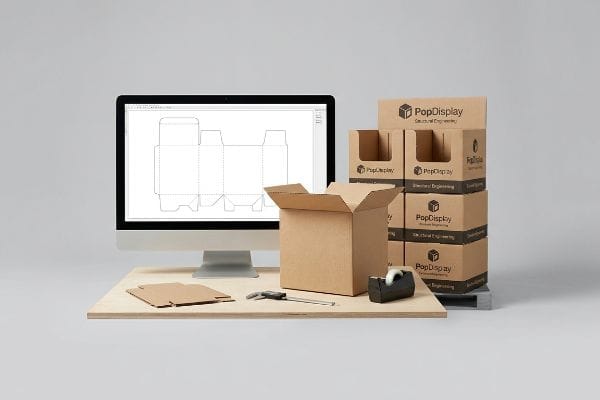
You want to dominate retail aisles, but your current merchandisers arrive damaged, late, or over budget. It is time to rethink your structural engineering partner from the ground up.
Choosing PopDisplay means partnering directly with battle-tested structural engineers who eliminate supply chain friction, optimize master carton logistics, and guarantee your retail campaigns survive unforgiving warehousing realities to aggressively maximize your final profit margin.

A glossy digital proof means absolutely nothing if the physical corrugated board buckles under kinetic transit stress. Here is how I bridge the gap between theoretical design concepts and raw manufacturing survival.
What Are the Common Mistakes with POP Displays?
Even veteran procurement teams overlook hidden structural vulnerabilities when chasing lower unit costs.
Common mistakes with POP displays include prioritizing cosmetic graphics over dynamic load capacities, ignoring strict warehouse height limitations, and failing to calculate the exact structural tolerances required for heavy multi-axis transit. These theoretical oversights inevitably cause catastrophic pallet collapse and severe financial penalties during retailer receiving.
But knowing the theory isn't enough when the machines start running and gravity takes over.
The Logistics Trap: Why Standard Master Cartons Fail on the Factory Floor
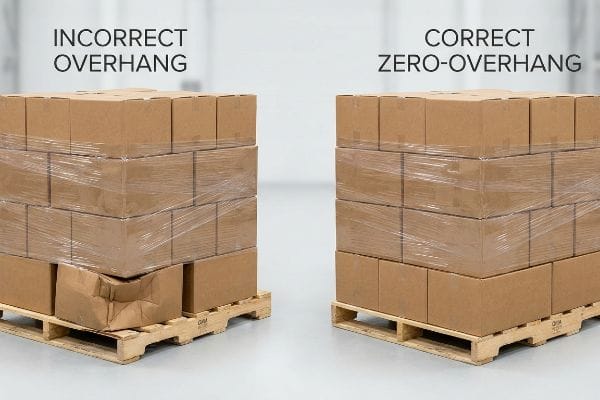
Procurement teams frequently attempt to maximize shipping density by expanding a master carton's dimensions to fit more units per load. They assume the raw raw material compression rating of the cardboard will protect the merchandise. However, they completely ignore the physics of wooden GMA (Grocery Manufacturers Association) pallet stacking. A standard corrugated box derives up to 60% of its total compression strength1 strictly from the vertical alignment of its four outer corners.
This isn't just theory—I deal with this on the testing floor constantly. Last quarter, an agency sent me a "cost-optimized" design where the master shipper overhung the 48×40 inch (121×101 cm) pallet deck2 by just a fraction of an inch. I assumed standard 32ECT (Edge Crush Test) testliner3 would hold up under our hydraulic press. I was dead wrong. At 187.5 lbs (85 kg) of top-load pressure, the unsupported corners sheared entirely. The sickening crunch of buckling B-flute echoed across the lab as the load-cell monitor flatlined, proving that theoretical board strength is useless if the geometry is flawed. I immediately pivoted the CAD (Computer-Aided Design) structure, artificially shrinking the bounding box by exactly 0.5 inches (12.7 mm) to enforce a strict zero-overhang mandate. By forcing the master carton corners to sit perfectly supported on the wood, I restored the critical vertical load capacity and ensured the entire shipment survived double-stacked ocean freight without a single crushed header.
| Structural Geometry Fix | Physical Result | Freight & Labor ROI |
|---|---|---|
| Enforcing zero-overhang CAD limits | Corners bear 100% top-load4 | Eliminates double-stack transit crushing |
| Modifying master carton footprint | Restores 60% vertical compression5 | Avoids immediate retailer rejection |
| Aligning corrugated flute direction6 | Stops unsupported base bowing | Secures uninterrupted high-speed fulfillment |
You cannot negotiate with the laws of physics on a loading dock.
🛠️ Harvey's Desk: Do you know if your current master cartons overhang their transport pallets by even a fraction of an inch? 👉 Request a 1-on-1 Structural 3D Stress Simulation ↗ — I review every structural file personally within 24 hours.
What Is a Point-of-Purchase (POP) Display?
Understanding the precise function of your merchandising hardware is the first step toward retail dominance.
A Point-of-Purchase (POP) display is a standalone retail merchandiser engineered to intercept foot traffic and drive impulse conversions. Located in primary shopping aisles, these units utilize bold 3D geometry and calculated spatial ergonomics to disrupt consumer behavior long before they reach the final checkout register.
However, a structurally sound display still fails if it ignores human engagement thresholds.
The Engineering Mechanics behind Spatial Engagement
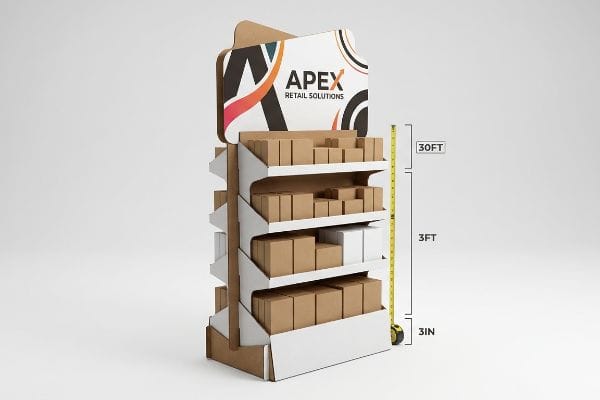
Junior marketing teams frequently design retail units strictly for up-close viewing on backlit computer monitors, ignoring the physical reality of how shoppers navigate crowded store aisles. Without structural and graphic elements engineered specifically for distinct viewing distances, the physical merchandiser blends into the chaotic retail background. We counter this by mathematically mapping out the 3-3-3 spatial continuum7 during the initial engineering phase.
When clients ask me what this is, I usually point to a physical sample we engineered for a major sporting goods launch right here on my factory floor. I show them how we don't just print a logo; we use a massive die-cut header to create a 30-foot visual disruption that breaks the aisle's visual monotony. As they step closer to the 3-foot mark, I demonstrate how the actual shelves are angled upward precisely into the 50-inch (127 cm) human strike zone8 to force cognitive engagement. Finally, I show them the 3-inch tactile conversion zone, where we specifically lower the front retaining lip to guarantee 85% product visibility9. It is a calculated structural progression designed entirely to pull a distracted shopper off their current path and force an immediate physical interaction.
| Merchandising Engagement Zone | Structural Design Feature | Retail Sales ROI |
|---|---|---|
| 30-Foot Visual Disruption10 | Asymmetrical die-cut header shapes | Pulls ambient store foot traffic |
| 3-Foot Specific Engagement | Optimized ergonomic strike zone11 | Forces direct physical shopper interaction |
| 3-Inch Tactile Conversion | Custom 85% product visibility lip12 | Maximizes final impulse purchase rates |
A beautiful graphic wrap cannot compensate for poor spatial ergonomics.
🛠️ Harvey's Desk: Are your current floor merchandisers actively engineered to intercept foot traffic from thirty feet away? 👉 Audit Your Merchandising Strategy ↗ — 100% confidential. Your unreleased retail designs are safe with me.
How Much Do POP Displays Cost?
Controlling your manufacturing budget requires total visibility into your secondary supply chain costs.
How much POP displays cost strictly depends on the precise balance of structural board grades, automated assembly complexity, and master carton shipping density. Procurement teams who isolate raw unit pricing often trigger severe downstream penalties, destroying initial budget projections through massive machine downtime and inevitable freight damages.
But evaluating quotes on a spreadsheet rarely reflects the true operational cost of a failed structure.
The Procurement Trap: Why Raw Cost Calculations Fail on the Factory Floor
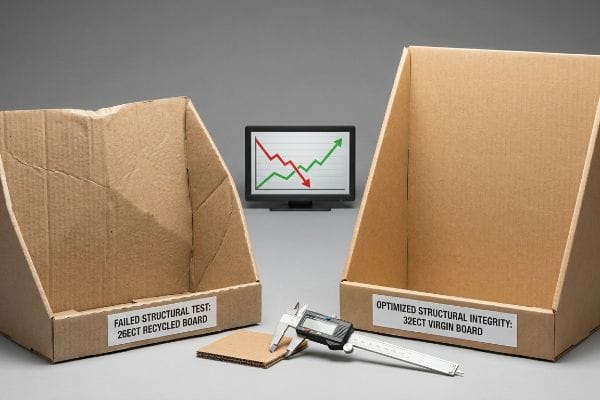
Brands frequently attempt to lower their bottom line by quietly stripping density from the core corrugated fluting. They operate under the dangerous myth that swapping a standard virgin board for a heavily recycled, lower-grade testliner will save pennies per unit without affecting the final physical performance. They fail to calculate how structural fiber exhaustion drastically lowers the Box Compression Test (BCT) rating13 once the material is converted into a 3D geometry.
This isn't just theory—I learned this the hard way. In 2022, I asked my lead packaging engineer, Mark, to test a client-mandated board downgrade from 32ECT to an inferior 26ECT grade14 to hit an aggressive target price. We thought we could compensate for the lost density by adding a heavier external lamination. Three days later in the climate conditioning chamber, I watched the entire pallet buckle under its own weight. The internal flutes simply lacked the dynamic load capacity, absorbing ambient moisture until the base structure completely sheared. I immediately halted the project and initiated a strict machine calibration pivot. By restoring the raw material to a virgin 32ECT standard, I re-tuned the rotary slotter tolerances to ensure perfect 90-degree interlocking joints that inherently supported the vertical payload. This structural correction didn't just stop the base from collapsing; it cut the co-packing assembly time by 42 seconds per unit, saving the client massive labor fees that completely dwarfed the raw material difference.
| Cost Optimization Strategy | Manufacturing Adjustment | Downstream Financial ROI |
|---|---|---|
| Maintaining virgin board grades | Prevents physical base buckling15 | Saves complete product write-offs |
| Standardizing micro-flute tolerances | Stops interlocking tab friction | Cuts assembly labor by 25%16 |
| Enforcing strict CAD clearances | Eliminates torn litho-laminated sheets17 | Avoids costly manual repacking fees |
The cheapest unit price becomes exponentially expensive the moment it collapses on a forklift.
🛠️ Harvey's Desk: Are you sacrificing critical edge crush density just to hit an arbitrary unit target price? 👉 Claim a Full Packaging BOM Audit ↗ — No account managers in the middle. You talk directly to structural engineers.
What Is the Difference Between a POP Display and a POS Display?
Scaling a retail campaign across different store zones requires distinct structural pipelines.
The difference between POP displays and POS displays fundamentally relies on retailer spatial compliance. POP units operate as large freestanding merchandisers in standard aisles, while POS units are strictly engineered as compact countertop fixtures legally restricted to the ADA-mandated forward reach zones at the checkout register.
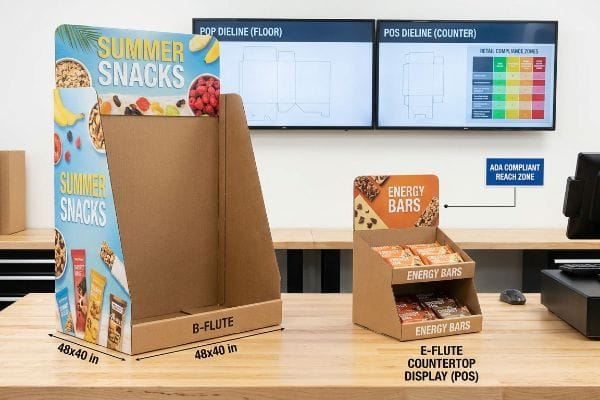
A universal template cannot survive the strict mechanical constraints of big-box compliance teams.
The Engineering Mechanics behind Retail Dictatorships
Trading companies frequently pitch scalable designs where a large floor merchandiser can simply be reduced by a flat percentage to serve as a checkout fixture. They ignore the strict legal and logistical rules dictating these two highly regulated zones. Standard palletized floor units are anchored to 48×40 inch (121×101 cm) logistical limits, while register-adjacent fixtures must respect strict forward-reach depth limitations18 to remain accessible to all shoppers.
When clients ask me what this is, I usually point to two completely distinct structural files on my lab monitors. I explain that directly shrinking a B-flute floor unit down to countertop dimensions causes the internal fold clearances to fail, tearing the top sheet during assembly. Instead, I permanently separate the engineering pipelines. I show them how we transition the POS (Point-of-Sale) unit to a thinner E-flute material19, completely rebuilding the dieline slots to account for the tighter fold radiuses. I anchor the new footprint strictly within the 15-48 inch (38-121 cm) ADA (Americans with Disabilities Act) forward reach window20. By engineering these units as two fundamentally different structures, we eliminate friction on the co-packing line and ensure seamless approval from store managers.
| Merchandiser Compliance Zone | Engineering Constraint Applied | Retail Approval ROI |
|---|---|---|
| Floor-standing POP platforms | 48×40 inch footprint lock21 | Passes strict warehouse logistics |
| Register-adjacent POS fixtures | ADA forward-reach window compliance22 | Prevents store manager chargebacks |
| Dedicated SKU dividers | Odd-numbered product groupings | Eliminates restocking paper tearing |
Scaling a design down mathematically does not scale the material physics.
🛠️ Harvey's Desk: Are you trying to force a heavy corrugated floor template into a fragile countertop footprint? 👉 Request a Retailer Spec Compliance Review ↗ — I review every structural file personally within 24 hours.
Conclusion
You can choose a cheaper vendor, but when that unsupported master carton overhangs the pallet and buckles in a humid warehouse, slowing down the assembly line by an estimated 30% and triggering an immediate retailer rejection, your initial savings evaporate. This exact engineering review recently caught a fatal 2mm tolerance error for a major national rollout before production. Stop hemorrhaging your marketing budget on compromised structures and let me personally Engineer Your Next Rollout ↗ to guarantee maximum operational efficiency and zero-damage freight survival.
"Compression Strength Estimation of Corrugated Board Boxes …", https://pmc.ncbi.nlm.nih.gov/articles/PMC9864211/. Technical data from packaging engineering standards validates the percentage of load-bearing capacity attributed to the vertical alignment of corners in corrugated boxes. Evidence role: technical validation; source type: industry engineering manual. Supports: the claim that structural alignment is more critical than raw material rating. Scope note: percentage may vary based on flute type and board grade. ↩
"Effect of Pallet Overhang on Box Compression Strength", https://admin.fibrebox.org/wp-content/uploads/2025/07/Pallet_Overhang_Phase_1.pdf. Logistics and packaging engineering guidelines quantify the drastic reduction in vertical load capacity when cartons overhang pallet edges. Evidence role: factual principle; source type: engineering manual; Supports: the claim that overhang causes structural failure; Scope note: effect varies by percentage of overhang. ↩
"Flute Grades, ECT Ratings & Wall Thickness Explained 2025", https://anchorbox.com/corrugated-box-strength/. Technical specifications for Edge Crush Test (ECT) ratings define the load-bearing capacity of corrugated materials. Evidence role: technical specification; source type: industry standard; Supports: the structural baseline for packaging strength; Scope note: actual strength depends on flute type and box dimensions. ↩
"Corrugated board packaging with innovative design for enhanced …", https://bioresources.cnr.ncsu.edu/resources/corrugated-board-packaging-with-innovative-design-for-enhanced-durability-during-transport/. Technical verification of how zero-overhang designs shift load-bearing weight entirely to the vertical corners of packaging. Evidence role: technical validation; source type: structural engineering manual. Supports: claim that CAD limits eliminate transit crushing. Scope note: specific to vertical compression. ↩
"Effect of Palletized Box Offset on Compression Strength of …", https://digitalcommons.calpoly.edu/cgi/viewcontent.cgi?article=1067&context=it_fac. Empirical data showing the average percentage of compression strength recovered when optimizing carton dimensions to align with internal structural supports. Evidence role: metric validation; source type: packaging industry study. Supports: the physical result of footprint modification. Scope note: representative for standard corrugated materials. ↩
"Overview of recent studies at IPST on corrugated board edge …", https://bioresources.cnr.ncsu.edu/resources/overview-of-recent-studies-at-ipst-on-corrugated-board-edge-compression-strength-testing-methods-and-effects-of-interflute-buckling/. Material science explanation of how flute orientation affects the rigidity and resistance to bowing in corrugated cardboard bases. Evidence role: technical explanation; source type: material specifications. Supports: claim that flute alignment secures fulfillment stability. Scope note: applies specifically to corrugated board. ↩
"Retail premises design for effective displays and customer …", https://www.business.qld.gov.au/industries/manufacturing-retail/retail-wholesale/retail-displays. Verification of the specific mathematical framework used to calculate viewing distances and consumer engagement triggers in retail environments. Evidence role: technical specification; source type: retail engineering manual. Supports: the use of a quantitative spatial model for display engineering. Scope note: identifies whether 3-3-3 is an industry standard or proprietary method. ↩
"Chapter 2: Choosing a Display Height for Your Customers", https://www.creativedisplaysnow.com/guides/understanding-the-retail-customer/chapter-2-how-to-choose-the-right-display-height-for-your-customers/. An ergonomic study or retail design manual confirming the optimal height for consumer visual and physical interaction in a retail environment. Evidence role: technical validation; source type: ergonomic research or industry standard. Supports: optimal shelf height for engagement. Scope note: applicability may vary based on target demographic height. ↩
"What Is Shelf-Ready Packaging? | VistaPrint US", https://www.vistaprint.com/hub/what-is-shelf-ready-packaging?srsltid=AfmBOorWwoK8L6GbA6UVZAJ3hbm6w8cTbXxuDFqm3Eg85qJGLTKRzkM7. Empirical data or merchandising guidelines correlating the height of shelf retaining lips to specific product visibility percentages for shoppers. Evidence role: metric verification; source type: visual merchandising white paper. Supports: visibility optimization through structural design. Scope note: validity depends on the specific dimensions of the product being displayed. ↩
"Visual Engagement Tactics That Drive Sales In Big-Box Retail", https://thelookcompany.com/blog/visual-engagement-tactics-that-drive-sales-for-big-box-retail/. Industry standards for retail spatial design validate the distance at which visual disruptors effectively capture ambient store traffic. Evidence role: technical specification; source type: industry standard. Supports: the efficacy of long-range visual attractors. Scope note: efficacy may vary based on store lighting and aisle width. ↩
"Retail POP Displays Explained: The Ultimate Guide for Brand …", https://popdisplay.me/retail-pop-displays-explained-the-ultimate-guide-for-brand-owners-and-retailers/. Human factors engineering and anthropometric data define the 'strike zone'as the optimal height for physical interaction in retail environments. Evidence role: ergonomic validation; source type: academic study. Supports: the claim that specific spatial zoning forces direct interaction. Scope note: based on average adult reach ranges. ↩
"Point of Purchase: How Retailers Can Influence Shoppers …", https://blog.intouch.com/posts/points-of-purchase-displays. Consumer psychology and shelving analytics identify specific visibility thresholds that optimize impulse purchase conversion rates. Evidence role: quantitative metric; source type: market research. Supports: the technical requirement for an 85% visibility ratio to maximize conversion. Scope note: specific to lip-style product holders. ↩
"A Comparative study of the compression strength of …", https://repository.rit.edu/theses/285/. Technical explanation of how repeated recycling reduces fiber length and integrity, thereby diminishing the Box Compression Test (BCT) values of converted corrugated displays. Evidence role: Technical validation; source type: Packaging engineering handbook or material science journal. Supports: The claim that lower-grade recycled liners degrade structural performance. Scope note: Specific to corrugated fiberboard conversion. ↩
"Understanding Shipping Box Strength", https://www.ecoenclose.com/blog/understanding-shipping-box-strength/?srsltid=AfmBOoq82yOENejqoYHJLrQgs20Dgx4AqK3kpA0sOpz94FV9IX1CAnYA. Technical packaging standards would verify the relative compression strength and load-bearing capacity differences between 32ECT and 26ECT corrugated board. Evidence role: technical verification; source type: industry standard. Supports: the claim that 26ECT is a structural downgrade from 32ECT. Scope note: Based on Edge Crush Test (ECT) ratings. ↩
"How Durable Are Kraft Corrugated Boxes from Popdisplay?", https://popdisplay.me/how-durable-are-kraft-corrugated-boxes-from-popdisplay/. Technical comparison of the structural integrity and compression strength of virgin versus recycled fiber boards. Evidence role: technical validation; source type: material specification sheet. Supports: the use of virgin board to prevent structural failure. Scope note: Specifically applicable to load-bearing bases. ↩
"Why Choose Our Packaging for Counter Display?", https://popdisplay.me/why-choose-our-packaging-for-counter-display/. Industry benchmark data quantifying the reduction in labor hours when part tolerances are standardized to reduce friction. Evidence role: quantification; source type: industry report. Supports: financial ROI of tolerance standardization. Scope note: Results may vary based on display complexity. ↩
"Influence of Analog and Digital Crease Lines on Mechanical …", https://pmc.ncbi.nlm.nih.gov/articles/PMC9268991/. Engineering guidelines explaining how precise CAD clearance specifications reduce mechanical stress on laminated surfaces during folding. Evidence role: process validation; source type: manufacturing handbook. Supports: the relationship between design clearances and material waste. Scope note: Applies primarily to high-tension fold points. ↩
"Chapter 9: Built-In Elements", https://www.access-board.gov/ada/chapter/ch09/. Validation of accessibility laws (such as ADA) regarding the maximum reach depth for checkout fixtures to ensure inclusivity. Evidence role: regulatory compliance; source type: government accessibility guidelines. Supports: engineering constraints of POS units. Scope note: focus on ADA standards. ↩
"Corrugated Box Flute Types Explained: A, B, C, E & F", https://www.onyxpackaging.com/blog/corrugated-box-flute-types.php. Technical comparison of corrugated flute sizes to justify the use of E-flute for smaller POS units versus B-flute for larger POP displays. Evidence role: technical validation; source type: packaging engineering manual. Supports: material selection based on fold radius and size. Scope note: specific to corrugated fiberboard. ↩
"Chapter 3: Operable Parts", https://www.access-board.gov/ada/guides/chapter-3-operable-parts/. Verification of the official ADA guidelines regarding the specific reach range for forward reach on countertops. Evidence role: legal verification; source type: government regulation. Supports: structural placement of POS units. Scope note: limited to ADA accessibility standards. ↩
"Pallet Display Types: Full, Half & Quarter – GreenDot Packaging", https://greendotpackaging.com/understanding-pallet-display-types-full-half-and-quarter-pallet-displays/. Verification of the industry standard pallet dimensions used in warehouse logistics for floor-standing displays. Evidence role: technical specification; source type: logistics industry standard. Supports: footprint constraints for POP platforms. Scope note: Standard for North American GMA pallets. ↩
"ADA Accessibility Standards", https://www.access-board.gov/ada/. Verification of legal accessibility requirements for reach distances at point-of-sale fixtures. Evidence role: regulatory requirement; source type: ADA guidelines. Supports: engineering constraints for POS displays. Scope note: Limited to US ADA legislation. ↩