
You spend massive budgets designing a retail campaign, but execution often fails at the receiving dock. Knowing who manages floor installation dictates whether your product actually sells or simply sits.
Store displays are set up by visual merchandisers, third-party field agencies, or direct retail store employees depending on the retail channel. These teams physically assemble corrugated components, stock the products, ensure ADA (Americans with Disabilities Act) compliance, and position point-of-purchase promotional materials on the active retail floor.

But delegating this task to overwhelmed store teams without providing foolproof structural engineering is a recipe for damaged goods. Let's look at the mechanics behind retail execution.
What Is It Called When You Set up Displays in Stores?
Brands often mistake simple box-stacking for effective consumer engagement. The process goes far beyond unpacking; it is a calculated psychological strategy designed to interrupt fast-moving foot traffic.
Setting up store displays is formally called visual merchandising or point-of-purchase installation. This professional practice combines spatial planning, structural design, and inventory management to maximize product visibility, guide foot traffic patterns, and strategically trigger impulse purchases within high-volume commercial retail environments like big-box stores.
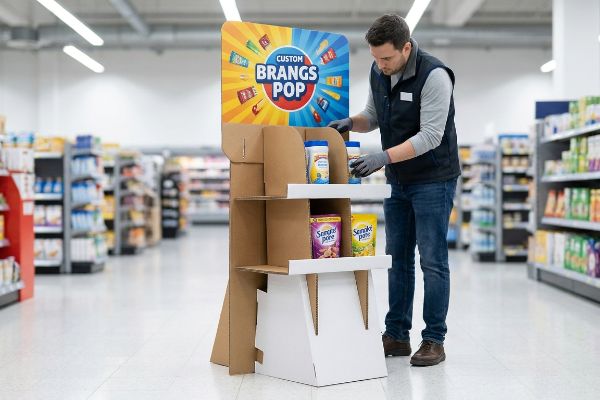
However, a beautiful rendering on a computer monitor means nothing if it ignores how human beings actually navigate physical aisles.
The 3-3-3 Spatial Engagement Rule in Visual Merchandising
Junior marketing teams frequently design retail merchandisers strictly for up-close viewing on backlit screens. They assume detailed text and intricate graphics will naturally draw consumers in. This completely ignores the physical reality of a chaotic big-box store environment where visual competition is fierce1.
Even veteran designers often overlook the 3-3-3 rule2, packing the unit with tiny fonts that cause cognitive overload. I see store clerks squinting and tearing the raw paperboard lip while trying to decipher microscopic assembly instructions printed directly on the artwork. What is it called when you set up displays in stores without spatial awareness? It is called invisible inventory3, because shoppers will glide right past a flat, text-heavy box without stopping.
| Common Rookie Mistake | The Pro Fix | Retail-Floor Benefit |
|---|---|---|
| Printing tiny text blocks | 30-foot high-contrast color flood4 | Grabs distant visual attention |
| Flat symmetrical headers | Aggressive 3D die-cut shapes | Interrupts aisle foot traffic |
| Deep retaining lips | 85% product visibility cut5 | Speeds up tactile conversion |
I strictly mandate the 3-3-3 spatial continuum for every retail layout. By engineering visual disruption at thirty feet and unobstructed access at three inches, I ensure your campaign converts passing glances into physical sales.
🛠️ Harvey's Desk: Not sure if your header graphic is visible from the main aisle? 👉 Request a Spatial Rendering ↗ — Direct access to my desk. Zero automated sales spam, I promise.
Who Can Create Displays in Your Store?
Deciding who handles your physical buildout heavily impacts your unit cost. Relying on fragmented vendors creates severe operational liabilities during high-speed automated assembly.
Creating displays in your store is executed by turnkey contract packagers, dedicated visual merchandising agencies, or internal supply chain teams. These specialized groups manage the physical engineering, material sourcing, and final co-packing assembly required to safely deliver pre-filled promotional units directly to the retail floor.

But assuming any standard packing warehouse can handle complex corrugated structures is a dangerous operational blind spot.
Why Fragmented Co-Packing Teams Fail Store Guidelines
Brand owners frequently try to artificially minimize unit costs by sourcing printed components from disparate vendors and merely paying a local co-packer for hourly assembly labor. They assume the final facility will magically make mismatched materials fit together perfectly. This tolling model fragments the structural liability6 across multiple companies who do not communicate.
When trying to figure out who can create displays in your store profitably, remember that mismatched tolerances cause automated machinery to stall7. I have listened to the loud, grinding hiss of a glue line jamming because an outsourced top-sheet was cut just 0.12 inches (3.04 mm) too wide for the base. The tolling warehouse simply halts production and bills you for the downtime, entirely wiping out your projected savings.
| Common Rookie Mistake | The Pro Fix | Retail-Floor Benefit |
|---|---|---|
| Sourcing parts from multiple vendors | Turnkey centralized manufacturing | Eliminates machine downtime8 |
| Assuming flat parts fit perfectly | Pre-production tolerance testing9 | Guarantees frictionless assembly |
| Paying hourly co-pack rates | Fixed per-unit turnkey pricing10 | Protects baseline profit margins |
I consolidate material sourcing, structural engineering, and co-packing under a single roof. By shifting the compatibility liability away from your brand, I guarantee fixed costs and zero missed rollout dates.
🛠️ Harvey's Desk: Are fragmented vendor delays eating into your promotional budget? 👉 Get a Turnkey Quote ↗ — Download safely. My inbox is open if you have questions later.
How Much Is the Salary of a Visual Merchandiser?
Paying top-tier talent to organize your retail layout is a smart investment, but it becomes entirely useless if the physical materials fight against them during setup.
The salary of a visual merchandiser typically ranges from $40,000 to $70,000 annually in the US market, depending on regional experience and retail sector. These professionals maximize their hourly value by relying on modular, pre-glued merchandising structures that completely eliminate slow, complicated manual assembly on the floor.
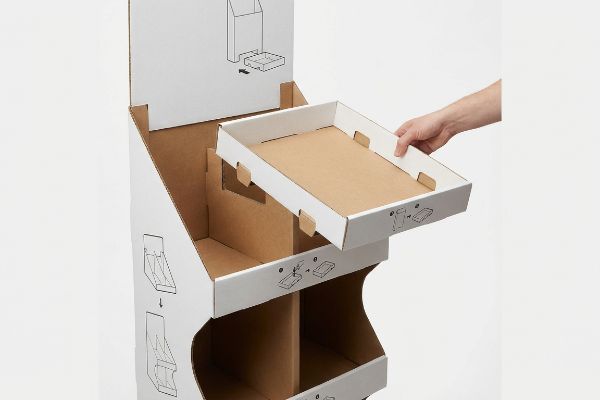
The true cost of retail execution isn't just their base paycheck; it is the expensive hourly wage wasted on bad structural engineering.
How Structural Engineering Protects Merchandising Budgets
Many procurement teams approve cheap, flat-packed corrugated shippers to save upfront material costs. They assume field representatives will happily spend thirty minutes per store decoding complex origami folds11. This drastically reduces the number of store visits a representative can complete in a single day.
Think of it like buying premium tires for a car with a broken engine. If you are researching how much is the salary of a visual merchandiser, you should also calculate the labor bleed caused by confusing dielines. I have watched frustrated clerks sweat through a 15-minute setup, finally resorting to wrapping sticky, messy clear packing tape around failing interlocking tabs.
| Common Rookie Mistake | The Pro Fix | Retail-Floor Benefit |
|---|---|---|
| Shipping complex flat origami | Pre-glued modular trays | Saves 20 minutes per store12 |
| Using invisible locking slots | High-contrast visual guides | Eliminates assembly confusion |
| Relying on raw friction holds | Interlocking stacking tabs13 | Prevents shelf collapse |
I engineer every retail unit using a zero-frustration assembly standard. By utilizing pre-glued modular components, I cut field execution time by an estimated 40%, letting your paid teams focus on selling rather than building.
🛠️ Harvey's Desk: Are complex folding instructions destroying your field team's efficiency? 👉 Claim a Zero-Frustration Audit ↗ — No forms that trigger endless sales calls. Just pure value.
Which Department Is Responsible for Visual Merchandising?
Internal misalignment between corporate departments often destroys the physical rollout. When cross-functional teams fail to communicate, the resulting unit usually fails to survive basic logistics.
The marketing department is primarily responsible for visual merchandising strategy, conceptualizing brand graphics and seasonal campaigns. However, successful retail execution requires deep collaboration with procurement to fund structural materials, and logistics teams to ensure the physical dimensions align seamlessly with freight and retail warehouse compliance standards.
But knowing the theory isn't enough when the machines start running and corporate budgets collide.
When Procurement Budgets Ruin Marketing's Vision
Brand teams frequently establish a cohesive concept, but procurement departments often isolate and obsess strictly over the primary cost metric. They secretly downgrade structural board grades to save upfront pennies14 on raw materials. This creates a severe imbalance that completely destroys the original strategic pillars of convenience and physical communication.
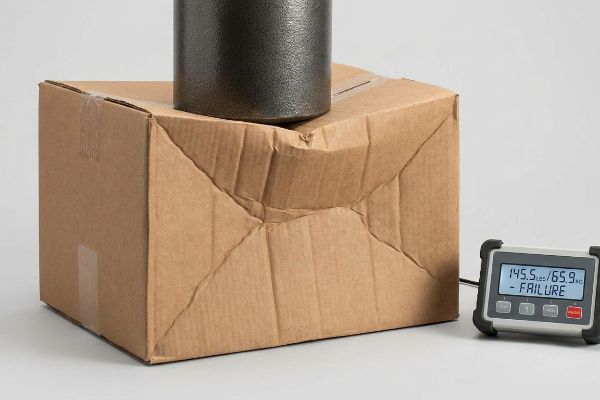
In my facility, I routinely see this disconnect when evaluating which department is responsible for visual merchandising approvals. A buyer will mandate a drop from 32 ECT (Edge Crush Test) to a cheaper 26 ECT board to offset the cost of heavy cosmetic foil. When I measure the dynamic load capacity on the testing press, the squishy collapse of the thinned fluting is immediate under a mere 145.5 lbs (65.9 kg)15 of top pressure. By restoring a rigid 3.2 mm (0.32 cm) flute tolerance16 and substituting high-solid aqueous coatings for foil, I ensure the co-packing assembly time drops by 35 seconds per unit, saving clients significant labor fees while guaranteeing the brand vision survives freight transit.
| Common Rookie Mistake | The Pro Fix | Retail-Floor Benefit |
|---|---|---|
| Downgrading ECT for cost | Enforcing strict 32 ECT minimums17 | Survives palletized ocean transit |
| Prioritizing expensive foil films | High-solid aqueous coatings18 | Lowers cost while keeping shine |
| Isolating procurement metrics | Unified cross-department assessment | Prevents costly retailer chargebacks |
I strictly forbid downgrading core structural integrity just to fund cosmetic bloat. By mechanically linking your unit cost directly to supply chain endurance, I ensure your finalized packaging system actually generates a positive return.
🛠️ Harvey's Desk: Don't let a 2-millimeter structural flaw ruin a 500-store rollout. 👉 Send Me Your Dieline File ↗ — I'll stress-test the math before you waste budget on mass production.
Conclusion
You can choose a cheaper vendor, but when that secret 26 ECT board downgrade collapses in a humid warehouse, it slows down automated co-packing lines by an estimated 30% and triggers immediate, catastrophic retailer chargebacks. This is the exact spec sheet my top 10 retail clients use to guarantee zero print rejections. Stop guessing on structural tolerances and let me personally run your artwork through my Free Dieline Audit ↗ to catch fatal friction points before mass production begins.
"Big Box USA: The Environmental Impact of America's Biggest Retail …", https://history.osu.edu/publications/big-box-usa. Analysis of how high-density product placement and signage in large-scale retail create sensory overload and visual noise for consumers. Evidence role: conceptual validation; source type: retail psychology study. Supports: the claim that environmental clutter necessitates simplified visual communication. Scope note: applies specifically to high-traffic commercial retail settings. ↩
"The Importance of the Rule of 3 for Your Custom Store Displays", https://mcintyredisplays.com/blog/custom-store-displays/. Brief explanation of how professional visual merchandising standards define the 3-3-3 rule regarding consumer distance and perception. Evidence role: technical definition; source type: industry handbook. Supports: The spatial engagement guidelines for retail displays. Scope note: Focuses on viewing distances and timing. ↩
"Overcoming Invisible Inventory – eBook", https://www.aptos.com/resource/overcoming-invisible-inventory. Brief explanation of how retail psychology identifies products that are physically present but unnoticed due to poor placement. Evidence role: terminology verification; source type: retail management literature. Supports: The concept of display failure leading to consumer ignorance of stock. Scope note: May be used as a descriptive industry term. ↩
"[PDF] Shops that shine – Guide to visual merchandising | Brisbane City …", https://www.brisbane.qld.gov.au/content/dam/brisbanecitycouncil/corpwebsite/business/documents/shops-that-shine-guide-to-visual-merchandising.pdf. Brief explanation of how high-contrast color applications attract visual attention from a specific distance in retail environments. Evidence role: technical specification; source type: retail design guideline. Supports: effectiveness of color floods for distant engagement. Scope note: effectiveness depends on lighting and ambient noise. ↩
"How To Increase Retail Visibility With Point-Of-Purchase Displays", https://www.industrialpackaging.com/blog/increased-retail-visibility. Brief explanation of how deep retaining lips on product displays statistically reduce the percentage of visible product. Evidence role: quantitative metric; source type: merchandising industry study. Supports: correlation between shelf depth and tactile conversion rates. Scope note: specific to point-of-purchase display architecture. ↩
"1.6 Tolling and manufacturing services arrangements", https://viewpoint.pwc.com/dt/us/en/pwc/accounting_guides/inventory/Inventory-Guide/Chapter-1-Inventory-costing/tolling_and_manu.html. Brief explanation of how an authoritative external source on supply chain risk management supports the claim that tolling arrangements divide legal and quality liability among multiple parties. Evidence role: validation of operational risk; source type: industrial engineering or supply chain management journal. Supports: the link between fragmented sourcing and divided liability. Scope note: limited to the context of co-packing and assembly. ↩
"Packaging Machine Jam – Wayne Automation", https://wayneautomation.com/news/packaging-machine-jam/. Industry standards for automated packaging detail how dimensional deviations lead to mechanical jams and system downtime. Evidence role: technical validation; source type: industrial engineering guidelines. Supports: the claim that imprecise tolerances disrupt automated assembly. Scope note: Specific to high-speed automated machinery. ↩
"Common Challenges When Transitioning to U.S. Manufacturing for …", https://popdisplay.me/common-challenges-when-transitioning-to-u-s-manufacturing-for-packaging-and-pop-displays/. An authoritative source on manufacturing logistics would demonstrate how consolidating vendors reduces lead-time variability and component mismatches that cause line stoppages. Evidence role: technical verification; source type: operational whitepaper. Supports: the benefit of centralized manufacturing over fragmented sourcing. Scope note: Applicable to high-speed automated assembly. ↩
"How to Request and Review a Pre-Production Sample PPS", https://www.samtop.com/pre-production-sample-review-guide/. Engineering standards for physical displays would validate that testing tolerances before full-scale production prevents assembly friction and fitment failures. Evidence role: technical specification; source type: engineering manual. Supports: the link between tolerance testing and frictionless assembly. Scope note: Focuses on physical manufacturing tolerances. ↩
"Chapter 4: Calculating Costs & Setting a Price – Mass.gov", https://www.mass.gov/info-details/chapter-4-calculating-costs-setting-a-price. Financial benchmarks in co-packing would compare the cost predictability of per-unit pricing against the volatility of hourly labor rates. Evidence role: economic validation; source type: industry financial report. Supports: the claim that fixed pricing protects baseline profit margins. Scope note: Analysis focuses on cost variance and risk mitigation. ↩
"Why Flat-Pack Displays Save More Than Just Shipping Fees", https://www.samtop.com/flat-pack-retail-displays-cost-benefits/. Industry benchmarks or labor studies on retail merchandising setup times provide empirical data on the time spent assembling complex corrugated displays. Evidence role: factual verification of labor time; source type: operational industry report. Supports: the claim that manual assembly slows field representatives. Scope note: Assembly time varies by kit complexity. ↩
"How Packaging Shapes Retail Display Program Success", https://www.frankmayer.com/blog/how-packaging-shapes-retail-display-program-success/. Industrial engineering or retail operations data documenting time reduction in store setup when using pre-assembled modular components. Evidence role: quantitative verification; source type: operational study. Supports: time efficiency of modular trays. Scope note: based on average retail store footprints. ↩
"[PDF] Investigation of Pallet Stacking Pattern on Unit Load Bridging", https://vtechworks.lib.vt.edu/bitstream/handle/10919/78616/Molina%20Montoya_Eduardo_T_2017.pdf?. Structural engineering specifications for point-of-purchase displays explaining how mechanical interlocking prevents load-bearing failure. Evidence role: technical verification; source type: engineering manual. Supports: prevention of shelf collapse. Scope note: specifically for lightweight retail materials. ↩
"How to Reduce POP Display Costs Without Downgrading Quality", https://brownpackaging.com/how-to-reduce-pop-display-costs-without-downgrading-quality/. Verification of procurement practices where material specifications are lowered to reduce unit cost in retail displays. Evidence role: factual verification; source type: retail supply chain analysis. Supports: the practice of downgrading materials for cost savings. Scope note: specific to structural materials used in VM. ↩
"Estimation of the Compressive Strength of Corrugated Board Boxes …", https://pmc.ncbi.nlm.nih.gov/articles/PMC8467740/. Technical data from packaging engineering manuals supports the load-bearing capacity limits of 26 ECT corrugated board. Evidence role: technical specification; source type: industry standard. Supports: the claim that specific weights cause structural failure in 26 ECT board. Scope note: Actual failure depends on box dimensions. ↩
"Specifications for Corrugated Paperboard", https://www.archives.gov/files/preservation/storage/pdf/corrugated-board.pdf. Corrugated board standards (e.g., TAPPI) define specific tolerances for flute height and geometry to ensure structural stability. Evidence role: technical specification; source type: industry standard. Supports: the validity of using 3.2 mm as a metric for flute tolerance. Scope note: Tolerance varies by specific flute type (A, B, C, or E). ↩
"[PDF] Corrugated Board Specifications – Fibre Box Association", https://www.fibrebox.org/assets/2025/09/Walmart_Corrugated-Board_Specifications_Automation_Packaging_Standards.pdf. Authoritative source confirming that 32 ECT (Edge Crush Test) is a standard threshold for ensuring corrugated packaging survives the compression of palletized ocean transit. Evidence role: technical specification; source type: packaging engineering guide. Supports: minimum material strength requirements. Scope note: Specific to corrugated cardboard. ↩
"What is Aqueous Coating? Benefits, Applications, and Why It Matters …", https://millionpack.com/aqueous-coating/. Technical comparison verifying that high-solid aqueous coatings provide a cost-effective alternative to foil films while maintaining high-gloss visual properties. Evidence role: material specification; source type: commercial printing industry manual. Supports: cost reduction for visual merchandising. Scope note: Applies to retail display finishing. ↩