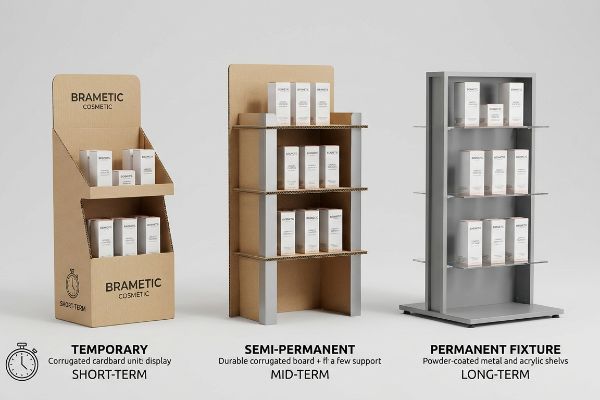
Brands lose money when displays collapse under heavy merchandise. Choosing between temporary corrugated, semi-permanent, or permanent fixtures dictates whether products sell out or get rejected by store managers.
The best retail display type depends on campaign length and supply chain logistics. Temporary corrugated structures dominate short-term promotions, while permanent metal fixtures secure long-term placement. Factoring freight density usually makes engineered corrugated the superior total-cost option.
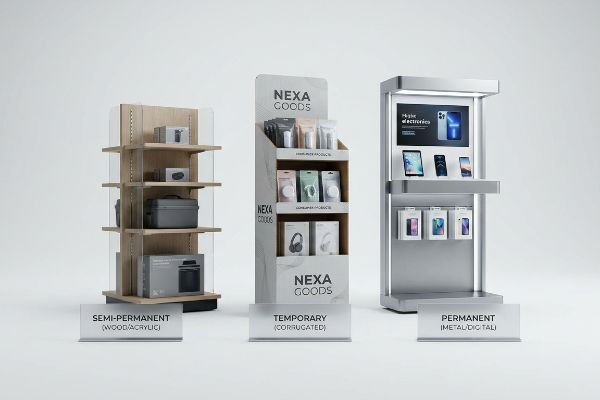
Selecting the right material isn't just about store aesthetics; it's a calculation of freight density and strict retailer compliance. Let's break down the realities that dictate success on the shop floor.
What Are the Different Types of Retail Displays?
Categorizing retail merchandisers goes far beyond just calling them floor stands or counter units; it's about navigating strict retail zoning.
Different retail display types include floor-standing units, countertop merchandisers, pallet bulk displays, shelf-ready trays, and hanging clip strips. Each format targets a specific physical store zone and must strictly adhere to differing spatial and strategic layout rules dictated by big-box retail management teams.
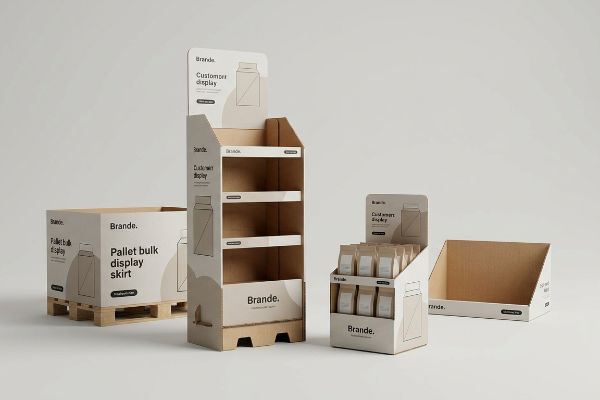
Beginners often assume they can simply shrink a large floor display design to fit securely on a countertop, believing a single unified aesthetic structure will scale perfectly across the entire store environment. This common misconception ignores how different zones dictate distinct shopping behaviors. They think merchandising is a simple copy-paste exercise, failing to realize that oversized counter units instantly block vital walkways and trigger immediate rejection from store managers who prioritize clear sightlines.
In reality, each store area demands a meticulously tailored merchandising approach based on practical spatial availability. Floor units must effectively anchor wide aisles to catch impulse buyers, whereas counter displays need to be strictly compact to avoid cluttering the highly sensitive checkout zone. Structuring a marketing campaign around these clear spatial rules ensures your products integrate seamlessly into the retail environment, ultimately boosting product visibility and simplifying the shopping experience for everyday consumers.
| Metric/Feature | Generic "Shrink-to-Fit" | Zoned Retail Strategy |
|---|---|---|
| Floor Focus | Ignored footprint limits | Anchors wide aisles |
| Counter Space | Cluttered checkout zones | Compact and clean |
| Shopper Flow | High navigational friction | Seamless interaction |
Stop copying and pasting identical designs across different store zones. Tailoring structures to specific spatial rules guarantees better visibility, protects crucial walkways, and fundamentally prevents costly layout rejections from big-box management teams.
🛠️ Harvey's Desk: Are your multi-format campaigns triggering compliance rejections because of unchecked spatial dimensions? 👉 Get a Free Spatial Compliance Audit ↗ — I review every structural file personally within 24 hours.
What Are the Five Types of Displays?
Nailing down the core categories of merchandisers is completely useless if the underlying substrate caves under basic logistical pressure.
The five main display types are temporary corrugated floor stands, semi-permanent metal wire racks, permanent acrylic countertop units, interactive end-caps, and heavy-duty club store pallet merchandisers. Each format demands distinct strategic alignment to survive specific supply chain cycles and diverse retail shopping environments.
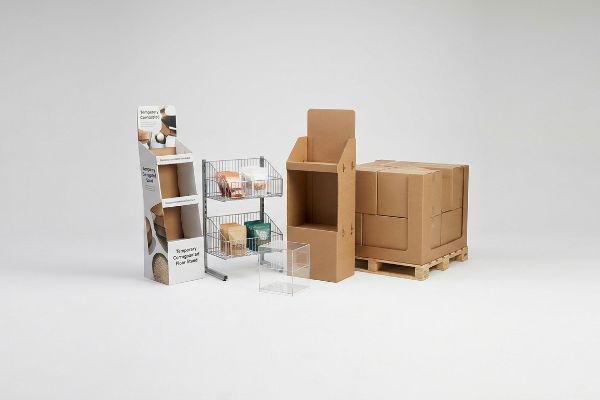
Brands frequently assume that all display categories can be used interchangeably for absolutely any product launch. They enthusiastically try to force heavy bulk items into lightweight temporary bins, or they invest heavily in expensive permanent acrylic units for incredibly short seasonal holiday pushes. This misguided approach entirely overlooks the specific strategic strengths each format brings, leading marketing teams to burn through their entire annual budget on over-engineered fixtures for campaigns that only last three weeks.
Successful retail campaigns rely completely on matching the right display format to the product's actual sales velocity and the store's natural foot traffic patterns. Heavy-duty pallet merchandisers excel at moving exceptionally high volumes quickly in large club stores, while interactive end-caps effectively draw shoppers into specific aisles to educate them on new product features. Selecting the correct structure based strictly on your strategic goals perfectly aligns with how modern consumers physically navigate the aisles.
| Metric/Feature | Mismatched Formats | Strategic Alignment |
|---|---|---|
| Heavy Items | Flimsy temporary bins | Robust pallet bulk |
| Seasonal Push | Expensive permanent units | Cost-effective corrugated |
| Visibility Strategy | Hidden inside aisles | High-traffic end-caps |
Do not waste your budget by misaligning campaign timelines with incorrect formats. Choosing strategically aligned materials actively amplifies your merchandising message and maximizes the impact of your marketing spend.
🛠️ Harvey's Desk: Is your heavy-duty floor campaign secretly relying on over-recycled paper fibers that will snap under the pressure of ocean freight? 👉 Request a Material Fiber Analysis ↗ — 100% confidential. Your unreleased retail designs are safe with me.
How Much Do Retail Displays Cost?
Pricing out a merchandising campaign is never just about looking at the raw unit cost printed on a factory invoice.
Retail displays cost a fraction of traditional marketing when utilizing temporary corrugated flat-packs, whereas permanent acrylics require significantly larger capital investments. The final price tag depends heavily on basic board material, printing methods, and the shipping multiplier that makes pre-assembled fixtures far less economical.
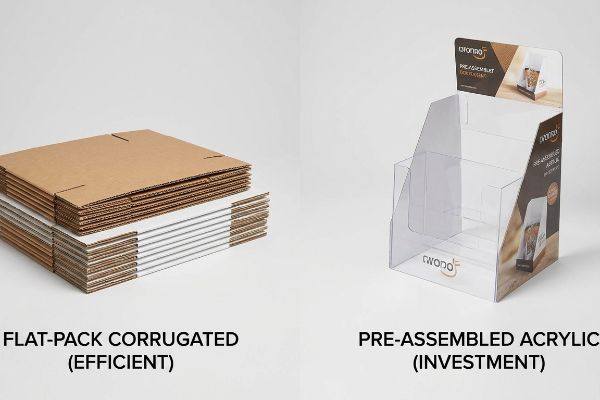
Marketing teams frequently view display costs purely through the lens of expensive visual upgrades and premium aesthetic finishes. They incorrectly assume that wrapping a basic retail structure in glossy foils or custom laminations is the only guaranteed way to attract casual shoppers. This single-minded mindset often leads them to completely overlook the fundamental costs associated with physically shipping and assembling bulky promotional units across a widespread nationwide distribution network.
In practical merchandising, the true operational expense of a display program is heavily dictated by its flat-pack shipping efficiency. Investing smartly in crisp, high-quality printing on standard corrugated board allows for stunning visuals without the massive budget drain of specialty custom finishes. By prioritizing highly efficient structural footprints over superficial cosmetic wrappers, retail brands can dramatically stretch their marketing dollars further and successfully deploy striking units across a much larger physical store network.
| Budget Area | Cosmetic Focus | Balanced Strategy |
|---|---|---|
| Visual Finish | Expensive specialty foils | High-quality standard print |
| Shipping Format | Pre-assembled bulk units | Efficient flat-pack design |
| Store Reach | Limited nationwide deployment | Widespread retail rollout |
Clean graphics printed on a well-designed structural footprint will always outshine a poorly planned aesthetic. Prioritize shipping efficiency over costly cosmetic wrappers to truly maximize your retail presence nationwide.
🛠️ Harvey's Desk: Are your premium visual finishes silently eroding your structural board grade and threatening your freight survival? 👉 Claim a Hidden Cost Audit ↗ — No account managers in the middle. You talk directly to structural engineers.
How to Display Items in a Boutique?
High-end environments require an entirely different approach to product density, visual tension, and daily physical upkeep.
Displaying items in a boutique requires prioritizing asymmetrical visual tension over maximizing shelf density. Utilizing modular dividers to cluster products in odd numbers naturally directs the shopper's eye, prevents cognitive overload, and drastically reduces physical friction when customers interact with high-value merchandise on premium countertop trays.

When designers construct client dielines for boutique setups, they constantly attempt to flat-pack a dense, perfectly symmetrical grid of high-end products onto a single display shelf. They assume maximum product density inherently yields higher sales per square foot, entirely ignoring the severe physical friction introduced by tight, unyielding corrugated retaining lips. Procurement teams frequently submit RFQs that blindly downgrade the ECT rating on boutique trays to save $0.05 per unit, simultaneously requesting heavy plastic dividers to aggressively separate the goods in a completely rigid grid.
On the testing floor, these value-engineered hybrid trays instantly fail. When clerks forcefully restock items into rigid plastic grids mounted on weakened board, the raw corrugated retaining lip shears under the physical pressure. Measuring the tear force reveals it fails at a mere 2.1 lbs (0.95 kg) of lateral pressure. Adjusting the Excel BOM proves you do not need expensive plastic clips; you just need a 0.25-inch (6.35 mm) wider fold tolerance and integrated corrugated modular dividers spaced in odd clusters. Engineering out the plastic waste and restoring board integrity drops restocking friction to zero.
| Metric/Feature | Symmetrical Plastic Grid | 3-5-7 Asymmetric Corrugated |
|---|---|---|
| Divider Setup | Expensive plastic clips | Integrated mono-material folds |
| Restocking Space | High-friction zero tolerance | 0.25-inch (6.3 mm) buffer zone |
| Merchandising | Monotonous grid overload | High-tension premium layout |
Eliminate rigid plastic hardware entirely and strictly control your internal fold tolerances. Engineering asymmetrical boutique trays out of mono-materials effectively resists the sheer physical chaos of daily retail restocking.
🛠️ Harvey's Desk: Are clumsy plastic dividers and tight tolerances causing your boutique displays to tear during routine store restocking? 👉 Get a Free Structural Dieline Audit ↗ — I review every structural file personally within 24 hours.
Conclusion
Relying on unchecked theoretical dimensions or downgrading internal flute structures inevitably causes heavy checkout trays and bulk displays to buckle under the brutal physics of real-world retail logistics. Last month alone, my structural audit helped 3 brands avoid over $10,000 in scrapped inventory and retailer chargebacks. If you are ready to secure your freight ROI, let me personally run your structural files through our Free Freight Density & Tolerance Audit ↗ to expose the blind spots before they hit the mass production floor.