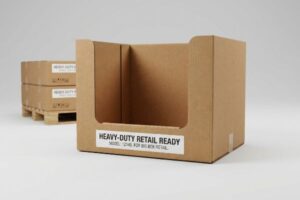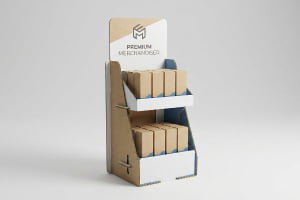
When launching a product at the world's largest retailer, assuming your standard corrugated box will survive the aisles is a fast track to rejection.
Retail displays offered to brands at Walmart include floor units, countertop merchandisers, end-caps, sidekicks, and pallet displays. Brands must independently source these fixtures to meet strict corporate guidelines. Securing aisle space requires engineering physical merchandisers that survive heavy foot traffic while adhering to precise store dimension rules.
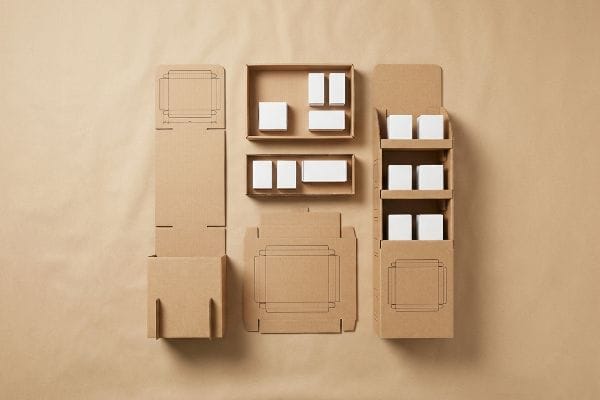
Making the cut means understanding not just what formats exist, but the physical physics required to keep them standing.
What Are the Different Types of Store Displays?
Designing for big-box retail isn't just about picking a random shape from a catalog.
Different types of store displays include POP (Point of Purchase) floor units, POS (Point of Sale) countertop units, sidekicks, and pallet skirts. Categorizing these formats correctly is essential because each structural classification dictates distinct spatial limitations, load capacities, and shopper interaction distances within the harsh retail environment.
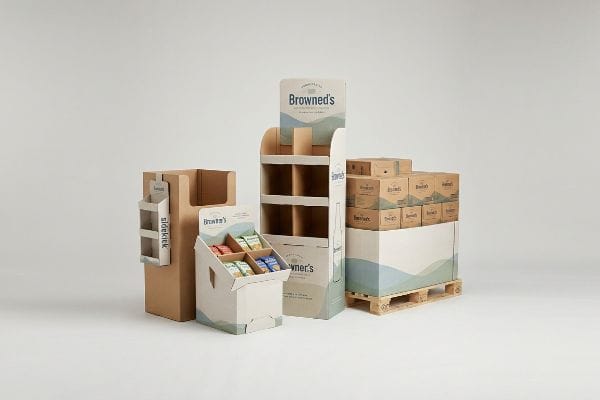
But simply knowing the names of these units won't stop your campaign from collapsing in the aisles.
Why POP and POS Physical Limits Matter
Even veteran designers often overlook the blind spot of treating retail space as a one-size-fits-all canvas. They design a massive freestanding floor unit and assume they can just scale the exact same dieline down by 50%1 to sit near the cash registers.
In my facility, I routinely intercept these "scalable" structural files before they hit the CNC (Computer Numerical Control) cutting tables. I watch buyers realize too late that reducing a POP floor unit ignores the strict legal and logistical rules dictating these two separate retail zones. You cannot shrink a master carton designed for a 48×40 inches (121.9×101.6 cm) GMA (Grocery Manufacturers Association) wood platform2 and shove it onto a checkout counter. The sharp friction of dragging an oversized base across a glass register counter usually results in torn raw paperboard and angry store managers. I permanently separate the engineering pipelines: floor files anchor to pallet limits, while counter files anchor strictly to the ADA (Americans with Disabilities Act) 15-48 inches3 (38.1-121.9 cm) forward reach compliance window, keeping you out of trouble.
| Common Rookie Mistake | The Pro Fix | Retail-Floor Benefit |
|---|---|---|
| Scaling floor files to counter size | Separate ADA and GMA CAD pipelines | Prevents register area chargebacks4 |
| Ignoring ADA reach limits | Anchor POS units to a 15-inch minimum5 | Ensures compliant shopper access |
| Dragging oversized bases | Enforce strict perimeter tolerances6 | Eliminates torn paperboard edges |
I refuse to let brands cross-contaminate their floor and counter engineering. Forcing compliance from the very first sketch guarantees your merchandiser is actually allowed on the floor, saving you from catastrophic rejection and costly physical rework.
🛠️ Harvey's Desk: Are you blindly scaling your floor dielines to fit the checkout counter? 👉 Send Me Your Flat Dieline File ↗ — Direct access to my desk. Zero automated sales spam, I promise.
Does Walmart Sell Their Displays?
Procurement teams frequently assume big-box giants provide off-the-shelf cardboard stands for their upcoming campaigns.
No. Walmart does not sell retail displays directly to brands. Instead, vendors must independently engineer, manufacture, and ship their own corrugated merchandisers. While the retailer dictates strict structural guidelines, brand teams frequently utilize Co-Op Marketing Funds or MDF programs to finance their custom point-of-purchase manufacturing operations.
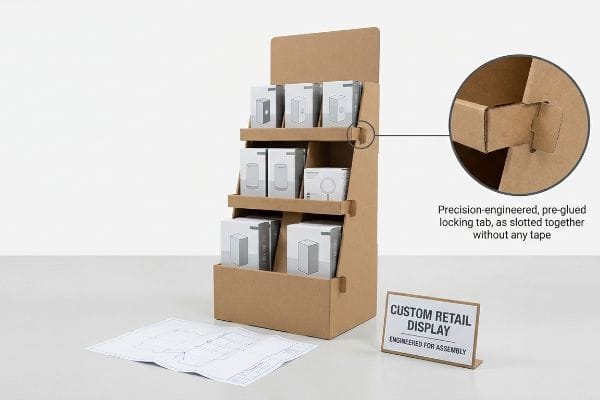
Sourcing your own fixtures means you carry the entire liability for how they assemble and perform on the shop floor.
The Trap of Outsourcing Retailer Compliance
Many emerging CPG (Consumer Packaged Goods) brands believe that simply handing a generic dieline to a commercial printer will satisfy massive retail mandates7. They assume standard commercial packaging rules apply to heavy-duty retail merchandisers, leaving the actual structural math8 entirely up to chance.
This is a trap that catches even experienced procurement teams when they try to save upfront budget. I see it when a brand ships unassembled units to a third-party warehouse, and the Co-Packing team struggles to decipher a generic folding sequence. The messy stickiness of cheap packing tape applied in a panic to hold a failing header card completely ruins the premium aesthetic you paid for. Because the retailer does not supply the fixture, they also will not supply the assembly labor9 if your design is flawed. I always advise brands to tap into their MDF (Market Development Funds) not just for flashy graphics, but to engineer pre-glued, frictionless locking tabs that snap together in seconds, saving an estimated 30% in manual labor costs10.
| Common Rookie Mistake | The Pro Fix | Retail-Floor Benefit |
|---|---|---|
| Assuming the store provides fixtures | Sourcing custom-engineered units | Total control over brand visibility |
| Using standard tape for assembly | Pre-glued modular locking tabs11 | Saves 30% on labor costs12 |
| Ignoring retailer style guides | Auditing CAD files against store specs | Prevents incoming shipment rejection |
I constantly remind brands that paying for their own display is actually an operational advantage. It forces you to control the exact structural integrity and assembly speed, ultimately maximizing the ROI on your marketing funds.
🛠️ Harvey's Desk: Are your unassembled merchandisers causing massive friction at the co-packing facility? 👉 Request A Structural Audit ↗ — Download safely. My inbox is open if you have questions later.
What Is the 10 Foot Rule at Walmart?
Translating customer service principles into physical merchandising architecture is the secret to moving volume.
The 10 foot rule originally dictates greeting shoppers within ten feet, but visually, it translates to immediate product engagement. A successful retail display must capture attention from thirty feet, clarify the offer at three feet, and drive the tactile impulse purchase at exactly three physical inches away.
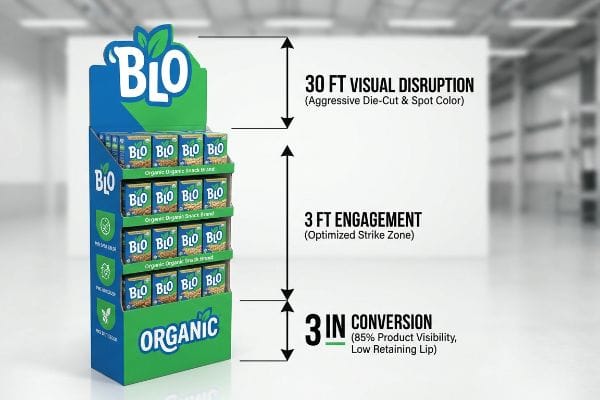
If your artwork only looks good on a backlit monitor, it will completely vanish under harsh fluorescent store lights.
Engineering the 3-3-3 Spatial Engagement Continuum
Junior marketing teams frequently design retail displays strictly for up-close viewing on computer screens13, assuming the shopper will naturally stop and read every bullet point. They fail to understand the physical reality of how rushed consumers navigate massive warehouse aisles14 with overflowing shopping carts.
Think of your merchandiser like a highway billboard; if it requires a magnifying glass to read, the driver has already passed it. I see brands print tiny, intricate fonts on raw 32ECT testliner, only to watch the ink bleed into the porous fibers, resulting in a muddy blur that smells faintly of wet paper. Rushing shoppers simply ignore the cognitive overload. To fix this, I utilize the 3-3-3 spatial rule. I mandate aggressive die-cut shapes and PMS (Pantone Matching System) spot color floods for the 30-foot visual disruption, optimize the shelf height to the 50-70 inches (127-177.8 cm) strike zone15 for 3-foot engagement, and cut the front retaining lip to guarantee 85% product visibility16 for that final tactile conversion.
| Common Rookie Mistake | The Pro Fix | Retail-Floor Benefit |
|---|---|---|
| Printing tiny text on testliner | Use PMS spot color floods | Grabs attention from 30 feet17 |
| Hiding products behind high lips | Cut retaining lips to 85% visibility18 | Increases tactile impulse conversions |
| Placing key items too low | Optimize the 50-inch strike zone19 | Reduces shopper bending friction |
I engineer visual disruption directly into the physical structure because hoping a shopper will casually stroll over is a losing strategy. You have exactly three seconds to halt their cart, and the geometry must do the heavy lifting.
🛠️ Harvey's Desk: Is your front retaining lip accidentally hiding your core product branding from shoppers? 👉 Claim Your Visibility Check ↗ — No forms that trigger endless sales calls. Just pure value.
What Are the 5 Types of Displays with Examples?
Naming the formats is easy, but keeping them upright under dynamic retail pressure is where most campaigns fail.
Five types of displays include pallet merchandisers, end-caps, sidekicks, free-standing floor units, and countertop PDQ (Product Display Quarter) trays. For example, a quarter-pallet floor unit holds bulk FMCG (Fast-Moving Consumer Goods) items, while a sidekick efficiently hangs from an existing metal shelf bracket to capture quick secondary impulse sales.
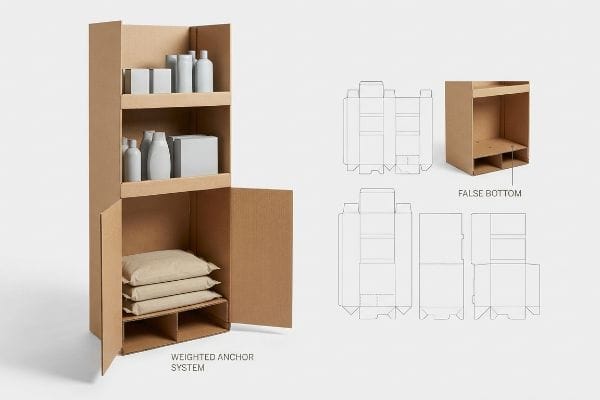
But knowing the theory isn't enough when the machines start running and gravity takes over in the aisle.
Why Tall Fractional Pallets Fail on the Factory Floor
Brands frequently attempt to secure high-traffic aisle placement by scaling down standard full-size floor displays into smaller footprints, like a quarter-pallet. They assume that maintaining the original 50 inches (127 cm) overall height20 on a reduced base is a simple matter of shrinking the dieline.
In my facility, I routinely test these towering, narrow structures, and this is where theoretical desk-work causes physical reality to break. When you place a 50-inch tall unit on a tight 24×20 inches (60.9×50.8 cm) footprint, you shift the center of gravity drastically upward21. It acts exactly like a pencil standing on its eraser. During ISTA (International Safe Transit Association) tilt evaluation22, I watch these top-heavy units violently tip over under the slightest rotational shear force. The loud crash of the base tearing apart proves it's a massive liability. I fix this by engineering a strict center of gravity anchor protocol. I mathematically lower the mass by building hidden false bottoms designed to house physical 15 lbs (6.8 kg) sandbag weights. By anchoring the base, I guarantee the unit remains completely stable during minor shopping cart collisions, preventing retailer chargebacks and costly liability claims.
| Common Rookie Mistake | The Pro Fix | Retail-Floor Benefit |
|---|---|---|
| Shrinking base but keeping height | Engineer a false bottom anchor | Eliminates dangerous tip-over hazards23 |
| Ignoring center of gravity shifts | Add targeted sandbag weights | Survives shopping cart collisions |
| Assuming standard tilt stability | Run physical rotational shear tests24 | Prevents strict retailer chargebacks25 |
I refuse to release a top-heavy quarter-pallet design without mathematically validating its physical anchor points. Ensuring your fractional footprint survives kinetic impacts is exactly how I protect your campaign from disastrous mid-aisle collapses.
🛠️ Harvey's Desk: Do you know the exact center of gravity threshold for your tall quarter-pallet merchandiser? 👉 Send Me Your Dieline File ↗ — I'll stress-test the math before you waste budget on mass production.
Conclusion
You can choose a cheaper vendor for your quarter-pallet, but when that top-heavy structure tips over from a shopping cart collision, the resulting liability and immediate retailer rejection will wipe out your profit margin. Over 500 brand managers use my prepress checklist to avoid these exact fatal early-stage mistakes. Stop guessing on center of gravity mathematics and let me personally run your files through my Free Dieline Pre-Flight Audit ↗ to catch dangerous friction points before production.
"DISPLAY STRUCTURAL DESIGN FOR INTERACTIVE RETAIL …", https://www.bcipkg.com/display-structural-design-for-interactive-retail-displays/. Explains the structural and ergonomic differences between Floor Standing Display Units (FSDUs) and Point of Sale (POS) units, validating why proportional scaling of dielines is technically flawed for load-bearing and spatial requirements. Evidence role: technical validation; source type: structural design guidelines. Supports: the claim that scaling dielines is a design oversight. Scope note: specific to physical POP materials like corrugated cardboard. ↩
"48×40" GMA Pallets | Largest Pallet Manufacturer & Supplier", https://www.palletone.com/products/gma-pallets/. Verification of the standard industry dimensions for GMA wood pallets. Evidence role: technical specification; source type: industry standard. Supports: the physical constraints of floor units. Scope note: applies to North American standards. ↩
"Chapter 3: Operable Parts – Access-Board.gov", https://www.access-board.gov/ada/guides/chapter-3-operable-parts/. Confirmation of ADA accessibility standards regarding forward reach ranges for retail counters. Evidence role: regulatory compliance; source type: government regulation. Supports: the spatial limits of POS counter displays. Scope note: US federal law. ↩
"Vendor Compliance: How to Minimize Chargebacks in Retail Logistics", https://mfals.com/blog/how-to-minimize-chargebacks-retail-logistics. Evidence of industry standard financial penalties (chargebacks) imposed by big-box retailers on vendors for displays that violate store layout or safety specifications. Evidence role: industry practice; source type: retail vendor manual. Supports: the financial benefit of using separate CAD pipelines. Scope note: Chargeback structures vary by retailer. ↩
"Sales and Service Counters – Access-Board.gov", https://www.access-board.gov/ada/guides/animations/sales-and-service-counters.html. Verification of specific ADA reach range requirements and minimum clearances for Point of Sale (POS) displays to ensure accessibility compliance. Evidence role: technical specification; source type: regulatory guideline. Supports: compliant shopper access. Scope note: Specific to US ADA Standards for Accessible Design. ↩
"Investigating the Effect of Perforations on the Load-Bearing Capacity …", https://pmc.ncbi.nlm.nih.gov/articles/PMC11396172/. Technical guidance on structural tolerances in paperboard and corrugated manufacturing to prevent edge damage during transport and retail installation. Evidence role: manufacturing standard; source type: engineering guide. Supports: elimination of torn paperboard edges. Scope note: Specific to corrugated packaging materials. ↩
"Custom Retail Displays for Consumer Brands & CPG", https://www.colonydisplay.com/market/consumer-brands-cpg/. Authoritative retail compliance manuals demonstrate the rigorous specifications and mandates brands must meet for in-store displays. Evidence role: verification; source type: retailer compliance manual. Supports: the existence of strict retail mandates for display vendors. Scope note: applies to major big-box retailers. ↩
"Structural Design in Temporary Corrugated Retail Displays – UD Direct", https://www.ud-direct.com/blog/the-importance-of-structural-design-in-temporary-corrugated-retail-displays. Packaging engineering standards detail the mathematical calculations required for load-bearing stability and weight distribution in corrugated merchandisers. Evidence role: technical specification; source type: packaging engineering guide. Supports: the necessity of structural engineering for heavy-duty displays. Scope note: specific to corrugated board materials. ↩
"Supplier Agreements and Allowances Basics at Walmart", https://www.spscommerce.com/community/articles/supplier-agreements-and-allowances-basics-at-walmart. Retailer vendor manuals specify that the manufacturer is responsible for all costs and efforts associated with the setup and assembly of point-of-purchase displays. Evidence role: policy verification; source type: retailer compliance guide. Supports: the claim that retailers do not provide assembly labor. Scope note: Applies to standard vendor agreements. ↩
"How Packaging Shapes Retail Display Program Success", https://www.frankmayer.com/blog/how-packaging-shapes-retail-display-program-success/. Industry benchmarks or case studies on retail display manufacturing verify the percentage of labor cost reduction achieved through pre-glued components versus manual assembly. Evidence role: quantitative validation; source type: industry whitepaper. Supports: the financial benefit of engineered locking tabs. Scope note: Savings depend on display scale and complexity. ↩
"What Are Product Packaging Inserts? – PopDisplay", https://popdisplay.me/what-are-product-packaging-inserts%EF%BC%9F/. Technical documentation regarding the engineering of self-locking cardboard fixtures to eliminate the need for on-site adhesive. Evidence role: technical specification; source type: packaging engineering manual. Supports: the existence and function of modular locking tabs. Scope note: Applies primarily to corrugated cardboard displays. ↩
"The Benefits of Modular Retail Displays – Frank Mayer", https://www.frankmayer.com/blog/the-benefits-of-modular-retail-displays/. Industry benchmarks on the time and cost efficiency of modular locking mechanisms versus manual tape assembly for POP displays. Evidence role: metric verification; source type: logistics or packaging industry report. Supports: the specific percentage of labor savings. Scope note: Savings may vary based on display complexity. ↩
"Digital vs. Traditional Retail Signage: What Your Retail Shop Should …", https://www.phase3mc.com/thinking/digital-vs.-traditional-retail-signage-what-your-retail-shop-should-know. Industry analysis of retail merchandising often highlights the 'screen-to-shelf'gap where digital-first design fails to account for physical distance and shopper sightlines. Evidence role: technical critique; source type: industry white paper. Supports: The claim regarding improper design focus. Scope note: Pertains to the transition from UI/UX to physical merchandising. ↩
"[PDF] Indoor Navigation in Retail Environments without Surveys and Maps", https://users.ece.cmu.edu/~zhengs/MySite/attachments/Purohit2013-SugarTrail__Indoor_Navigation_in_Retail_Environments_without_Surveys_and_Maps.pdf. Empirical research in retail anthropology and consumer behavior confirms that shoppers in large-format stores exhibit high-velocity movement and are significantly impacted by spatial obstacles. Evidence role: behavioral evidence; source type: academic study. Supports: The physical reality of shopper navigation habits. Scope note: Specific to big-box warehouse settings. ↩
"What Is the Average Retail Shelf Height? – PopDisplay", https://popdisplay.me/what-is-the-average-retail-shelf-height/. Verification of the 50-70 inch range as the industry standard 'strike zone'for eye-level product engagement. Evidence role: technical specification; source type: retail merchandising guideline. Supports: optimal height for 3-foot engagement. Scope note: Applicability may vary based on average consumer height statistics. ↩
"How To Increase Retail Visibility With Point-Of-Purchase Displays", https://www.industrialpackaging.com/blog/increased-retail-visibility. Evidence validating the 85% visibility threshold for product conversion in retail point-of-purchase displays. Evidence role: performance metric; source type: retail design standard. Supports: tactile conversion through product visibility. Scope note: Specific to open-bin or tray displays. ↩
"Retail premises design for effective displays and customer flow", https://www.business.qld.gov.au/industries/manufacturing-retail/retail-wholesale/retail-displays. External research on visual merchandising and color psychology supports the distance at which high-contrast spot colors attract customer attention. Evidence role: factual verification; source type: retail design manual. Supports: visibility efficacy of PMS colors. Scope note: specific to high-contrast retail environments. ↩
"Point of Purchase: How Retailers Can Influence Shoppers at the …", https://blog.intouch.com/posts/points-of-purchase-displays. Industry standards for Point of Purchase (POP) displays provide data on the correlation between product visibility percentages and impulse purchase rates. Evidence role: technical specification; source type: merchandising guide. Supports: tactile impulse conversions. Scope note: applicable to shelf-edge design. ↩
"[PDF] Guidelines for Retail Grocery Stores – Ergonomics for the … – OSHA", https://www.osha.gov/sites/default/files/publications/OSHA3192.pdf. Ergonomic studies on shopper behavior identify the optimal reach height, or 'strike zone,'to minimize physical friction and maximize product interaction. Evidence role: technical specification; source type: ergonomic study. Supports: reduction of shopper bending friction. Scope note: based on average adult height. ↩
"Walmart Displays: RRP & PDQ Guideline FAQ – TPH Global Solutions", https://www.tphinc.com/custom-point-of-purchase-pop-pos-retail-store-displays/retailer-type/walmart/guidelines-faq/. Verification of industry-standard height benchmarks for full-size retail floor displays to establish the baseline for fractional pallet stability analysis. Evidence role: technical specification; source type: retail display standards. Supports: standard height dimensions. Scope note: dimensions may vary slightly by manufacturer. ↩
"Video: Stability & Center of Gravity – Study.com", https://study.com/academy/lesson/video/stability-center-of-gravity.html. Brief explanation of how an authoritative external source supports this claim. Evidence role: verification of mechanical principles; source type: engineering reference. Supports: how increasing the height of an object relative to a narrow base raises the center of gravity and decreases stability. Scope note: General principles of static equilibrium. ↩
"Test Procedures – International Safe Transit Association", https://ista.org/test_procedures.php. Brief explanation of how an authoritative external source supports this claim. Evidence role: verification of industry testing standards; source type: technical certification body. Supports: the existence and application of ISTA tilt tests to ensure structural stability. Scope note: Specifically relates to transit and retail packaging standards. ↩
"[PDF] Tipover-Prevention-Project-Anchors-without-Tools.pdf – CPSC", https://www.cpsc.gov/s3fs-public/pdfs/Tipover-Prevention-Project-Anchors-without-Tools.pdf. Technical documentation on structural engineering for point-of-purchase displays showing how weighted bases or anchors reduce tipping risks. Evidence role: safety verification; source type: engineering manual. Supports: the efficacy of false bottom anchors in preventing tipping. Scope note: applies specifically to high-center-of-gravity displays. ↩
"Rotational Shear Testing | Mecmesin", https://www.mecmesin.com/test-type/rotational-shear. Technical specifications for testing the rotational force and shear resistance of pallet displays to ensure stability during transit and placement. Evidence role: technical methodology; source type: material science or packaging standard. Supports: the use of shear tests to verify tilt stability. Scope note: standard tests may differ between cardboard and plastic displays. ↩
"What Contract Packaging Mistakes Trigger Retailer Chargebacks?", https://www.industrialpackaging.com/blog/copacker-mistakes-retailer-chargebacks. Retail vendor compliance manuals detailing financial penalties for unstable displays and the requirement for stability certification. Evidence role: industry standard validation; source type: retail compliance guide. Supports: the link between structural testing and avoiding financial penalties. Scope note: chargeback policies vary by retailer. ↩