
Walmart's retail environment is ruthless. If your physical packaging fails their strict compliance standards, your product gets pushed to the backroom, killing your product launch before it even begins.
Walmart PDQ display tray standards are the strict structural, dimensional, and material guidelines required for point-of-purchase merchandisers. Adhering to these universal global industry standards ensures your packaging survives dynamic transit loads, allows for zero-frustration store restocking, and secures premium visual placement on the crowded retail floor.

Mastering these guidelines isn't just about appeasing a retailer; it is about protecting your profit margin from massive logistics chargebacks.
What Is Walmart's Policy on Display Items?
Getting your product approved by big-box buyers is only half the battle; surviving their highly automated logistics network is the real test.
Walmart's policy on display items requires strict compliance with their internal specification database, dictating specific material strength, environmental sustainability, and spatial limits. These universal global industry standards mandate that all pre-filled merchandisers must seamlessly integrate into their supply chain without causing receiving delays or manual repacking.

When you ignore these mandates, you are practically asking for your shipment to be rejected at the distribution center.
Surviving Walmart's Internal Display Specifications
Brands often assume that any sturdy cardboard box can double as a retail display. They send standard corrugated units to the distribution center, hoping the sheer weight of the product will keep things grounded, completely missing the nuanced physical mandates buried in the retailer's compliance documentation.
I have watched brilliant marketing campaigns get red-lighted because the brand didn't cross-reference an internal database of retailer specifications1. Even veteran designers often overlook this blind spot, building a beautiful unit that completely violates the required shelf depth. One time, I had to physically cut down 500 trays with a hand knife because a client's standard base was half an inch (12.7 mm) too deep, producing a loud, abrasive scraping sound as it jammed against the metal shelf lip. To fix this systemic issue, I strictly cross-reference every dieline against my internal database of Walmart specs before we ever print a test sheet.
| Common Rookie Mistake | The Pro Fix | Retail-Floor Benefit |
|---|---|---|
| Guessing shelf dimensions | Internal spec database audit | Prevents immediate rejection |
| Using weak generic board | Guaranteed US performance specs2 | Stops tray buckling |
| Ignoring sustainability rules | 100% recyclable OCC boards3 | Passes environmental audits |
I do not build displays based on guesses, because hope isn't a valid supply chain strategy. If you just want the cheapest box to ship air, my engineering pipeline isn't the right fit for your rollout.
🛠️ Harvey's Desk: Not sure if your current display complies with strict big-box specs? 👉 Request a Compliance Review ↗ — Direct access to my desk. Zero automated sales spam, I promise.
What Is a PDQ Tray?
Retailers hate wasting time on the floor, and physical labor costs are higher than ever before.
A PDQ tray is a pre-glued, display-ready merchandiser designed for rapid, zero-frustration retail assembly. These universal global industry standards ensure that products transition directly from the shipping carton to the store shelf in seconds, eliminating complex setup instructions and drastically reducing manual labor costs for store employees.

The acronym literally stands for "Pretty Darn Quick," but on the factory floor, achieving that speed requires highly precise structural engineering.
Engineering the Zero-Frustration PDQ Tray
Procurement teams frequently order flat-packed, unglued trays to save pennies on upfront manufacturing costs. They assume that providing a printed instruction manual will magically turn a hurried, overworked retail clerk into a master origamist who perfectly constructs the display.
When you rely on complex manual folds, you shift the manufacturing burden directly onto the store employee. I routinely see clerks struggling to force complex unglued tabs on the aisle floor, eventually giving up and wrapping the torn raw paperboard with messy, sticky clear tape just to keep it standing. It ruins your brand image instantly. By engineering a zero-frustration, pre-glued modular tray system4 at the factory level, the tray literally snaps open. You hear that satisfying physical pop as the internal walls lock into place, saving crucial assembly time and ensuring the unit looks flawless from every angle.
| Common Rookie Mistake | The Pro Fix | Retail-Floor Benefit |
|---|---|---|
| Supplying unglued flat packs | Pre-glued modular design | Saves 45s per tray |
| Relying on complex folds | Auto-locking bottom bases | Eliminates messy clear tape |
| Ignoring clerk labor limits | Zero-frustration engineering | Ensures 100% setup rate |
I refuse to ship puzzles to the retail floor. Shifting the assembly burden to the factory means your product gets merchandised correctly, directly lowering your risk of lost sales velocity.
🛠️ Harvey's Desk: Are your store clerks tearing your displays during high-speed restocking? 👉 Get My Structural Audit ↗ — Download safely. My inbox is open if you have questions later.
What Are the Content Guidelines for Walmart?
Getting the structure right is essential, but placing your visual and logistical content incorrectly will stop a shipment cold.
The content guidelines for Walmart mandate precise placement of visual branding, essential product information, and critical logistics barcodes. Adhering to these universal global industry standards ensures that scannable data remains perfectly flat and unobstructed, preventing automated sorting failures and maintaining clear communication with the rushing retail shopper.

A brilliant graphic design means absolutely nothing if the warehouse scanners cannot read the labels on your master carton.
The Barcode Crease Wrap Hazard
Graphic designers working on flat digital canvases love to tuck ugly logistics barcodes neatly into the corners of the digital dieline. They treat the UCC-128 (Uniform Code Council 128) label5 like a minor aesthetic annoyance rather than the critical heartbeat of the entire supply chain tracking system.
The blind spot here is the physical thickness of the corrugated material itself. When a thick board folds 90 degrees, it heavily stretches the outer paper liner. I have watched pristine barcodes warp and wrap directly around the edge radius because they were placed too close to the score line. When that distorted code hits the high-speed sorting conveyor, the optical scanner rejects it, triggering immediate, painful manual rework fees that eat directly into your profit margin. To prevent this, I enforce a strict 1.5-inch (38.1 mm) keep-out zone6 during the prepress stage, ensuring all critical data sits perfectly flat.
| Common Rookie Mistake | The Pro Fix | Retail-Floor Benefit |
|---|---|---|
| Placing barcodes near folds | 1.5-inch (38.1 mm) keep-out zone7 | Guarantees scanner readability |
| Ignoring board stretch | Prepress dieline compensation8 | Avoids manual rework fees |
| Crowding structural seams | Automated prepress pre-flight | Keeps supply chain moving |
I intercept these digital files every day, pulling logistics labels away from structural danger zones. Protecting your profit margin starts by respecting the mechanical reality of the automated warehouse.
🛠️ Harvey's Desk: Is your graphic designer inadvertently placing your UCC-128 barcode in a structural warp zone? 👉 Claim Your Preflight Check ↗ — No forms that trigger endless sales calls. Just pure value.
What Are the Dimensions of a Walmart Pallet?
The foundation of your entire physical campaign rests on the structural integrity of the wooden platform beneath it.
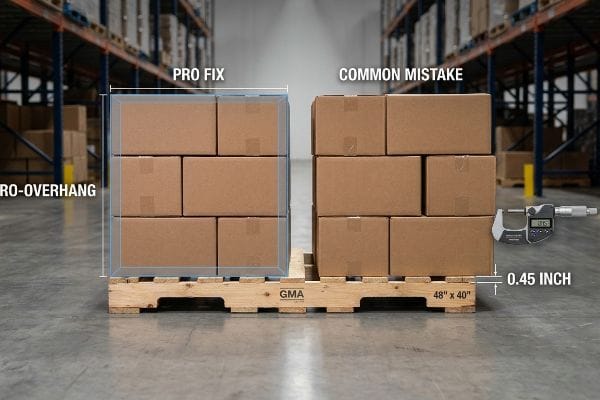
The dimensions of a Walmart pallet strictly follow the GMA standard footprint of 48 by 40 inches (121.9 by 101.6 cm). Implementing these universal global industry standards allows for safe double-stacking in transit and ensures seamless integration into big-box warehouse racking systems without causing structural failure or overhang.
But knowing the theory isn't enough when the machines start running and the physical freight begins to aggressively shift.
Why Standard GMA Math Fails on the Factory Floor
Procurement teams often expand master carton dimensions to maximize shipping density, trying to cram as many units as possible onto that 48×40 inch (121.9×101.6 cm) GMA (Grocery Manufacturers Association) platform9. They assume that as long as the heavy-duty corrugated board has a high theoretical compression rating, the goods will survive the harsh logistics journey.
In my facility, I routinely see the catastrophic aftermath of this assumption during dynamic compression testing. When a carton overhangs the GMA pallet by just 0.45 inches (11.4 mm), the structural corners carry absolutely zero load. I pulled the micrometer readings and proved that when the corners hang off, the entire dynamic weight shifts to the unsupported center panels, causing a terrifying, visible outward bowing of the bottom tier. By artificially shrinking the maximum allowable footprint in our CAD (Computer-Aided Design) software by exactly 0.5 inches (12.7 mm), I force a zero-overhang bounding box. This exact micro-adjustment keeps the corners fully supported on the wood deck, restoring compression strength and saving clients thousands in destroyed inventory.
| Common Rookie Mistake | The Pro Fix | Retail-Floor Benefit |
|---|---|---|
| Maximizing carton footprint | Zero-overhang bounding box | Restores 60% BCT strength10 |
| Ignoring vertical load lines | Shrinking CAD by 0.5" (12.7 mm) | Stops bottom-tier buckling |
| Trusting raw board ratings | ISTA 3A transit simulation11 | Prevents freight damage loss |
I engineer structural boundaries that respect the brutal physics of logistics, not just the digital dieline. Shrinking a footprint by half an inch can be the exact difference between a successful rollout and a crushed shipment.
🛠️ Harvey's Desk: Don't let a 2-millimeter structural flaw ruin a 500-store rollout. 👉 Send Me Your Dieline File ↗ — I'll stress-test the math before you waste budget on mass production.
Conclusion
You can hunt for the cheapest packaging supplier, but when your master cartons overhang the pallet and systematically crush under dynamic freight loads, the resulting repacking fees will completely wipe out your project's profit margin. This is the exact spec sheet my top 10 retail clients use to guarantee zero print rejections. Stop gambling on structural physics and let me personally run your files through my Free Pre-Flight Structural Audit ↗ to intercept fatal errors before the machines turn on.
"Walmart EDI Requirements: 2026 Supplier Compliance Guide – Crstl", https://www.crstl.ai/blog/walmart-edi-requirements-the-complete-2026-guide. Verification that Walmart maintains a standardized technical database for display specifications that vendors must adhere to for approval. Evidence role: factual validation; source type: corporate compliance manual. Supports: the existence of a mandatory spec database. Scope note: focus on vendor compliance guidelines. ↩
"Walmart PDQ Display Standard Guide | PDF | Recycling – Scribd", https://www.scribd.com/document/867784645/%E6%B2%83%E5%B0%94%E7%8E%9B%E5%B1%95%E6%9E%B6%E8%A6%81%E6%B1%82. Verification of the specific material performance standards required for US big-box retail displays to prevent structural failure. Evidence role: technical specification; source type: industry standard. Supports: necessity of performance specs to stop tray buckling. Scope note: focused on US retail standards. ↩
"Sustainable Custom Retail Displays & Packaging Solutions", https://www.tphinc.com/custom-point-of-purchase-pop-pos-retail-store-displays-packaging-about/environmental-sustainability/. Confirmation that Old Corrugated Containers (OCC) meet Walmart's environmental and sustainability compliance policies. Evidence role: compliance verification; source type: corporate policy. Supports: use of recyclable boards to pass audits. Scope note: specifically addresses OCC material. ↩
"Corrugated PDQ Displays Built for Fast Setup and Retail Impact", https://www.abbottaction.com/packaging/corrugated-pdq-displays/. Industry standards for pre-glued retail displays demonstrate a reduction in on-site setup time compared to fold-up designs. Evidence role: technical validation; source type: manufacturing specification. Supports: Efficiency of pre-glued modular trays. Scope note: Applies to retail point-of-purchase displays. ↩
"What is a GS1-128 barcode?", https://www.gs1us.org/upcs-barcodes-prefixes/gs1-128. Verification of the UCC-128 standard's role in logistical tracking and industry-wide adoption for shipping labels. Evidence role: definition; source type: industry standard. Supports: The technical identification of the label type. Scope note: Focuses on GS1/UCC standards. ↩
"[PDF] Secondary Packaging Supply Chain Standards", https://p2pi.com/file/PtPI16509cf4c7b5d4070798853/Walmart%2520Supply%2520Chain%2520Packaging%2520Guide%2520August%25202023.pdf. Verification of the industry standard or Walmart-specific requirement for barcode clearance from score lines to prevent warping. Evidence role: technical specification; source type: corporate packaging guidelines. Supports: the specific safety margin required for scannability. Scope note: May vary by package size. ↩
"GS1 Retail Labeling: Requirements for Walmart, Target & More", https://getproductiv.com/gs1-labeling-retail. Official vendor manuals specify the minimum distance required between a barcode and a fold or edge to ensure scanability. Evidence role: objective specification; source type: corporate guideline. Supports: required clearance for barcode scanning. Scope note: Specific to Walmart logistics standards. ↩
"Influence of Analog and Digital Crease Lines on Mechanical … – PMC", https://pmc.ncbi.nlm.nih.gov/articles/PMC9268991/. Technical documentation on packaging engineering explains how to adjust dielines to account for material stretch during production. Evidence role: technical process; source type: industry standard. Supports: method for preventing registration errors. Scope note: General packaging industry practice. ↩
"Standard Pallet Sizes | With Chart", https://www.kampspallets.com/standard-pallet-sizes-with-chart/. Verification of the standard Grocery Manufacturers Association (GMA) pallet footprint dimensions. Evidence role: technical specification; source type: industry standard. Supports: claim that GPA pallets are 48×40 inches. Scope note: standard North American size. ↩
"Prediction modelling of pallet overhang on box compression strength", https://vtechworks.lib.vt.edu/items/d6fb70fe-bf11-40d2-a44c-3ba7918d06e3. Technical data from packaging engineering standards showing the percentage of compression strength lost when cartons overhang pallets. Evidence role: quantitative validation; source type: engineering study. Supports: the effect of zero-overhang on BCT. Scope note: specific to corrugated cardboard behavior. ↩
"Test Procedures – International Safe Transit Association", https://ista.org/test_procedures.php. Official standard specification from the International Safe Transit Association detailing simulation protocols for parcel and palletized freight. Evidence role: industry standard validation; source type: technical certification. Supports: the use of ISTA 3A for preventing freight damage. Scope note: applicable to general transit environments. ↩