Walking into a massive retailer, you instantly notice certain products demanding your attention. This isn't random; it's the result of highly engineered retail marketing structures.
Examples of point of sale displays include floor stands, countertop units, pallet merchandisers, and sidekick clip strips. These engineered corrugated structures physically organize products in retail environments, increasing brand visibility, driving impulse purchases, and ensuring strict compliance with global warehouse logistics and structural safety standards.

Before you start designing a flashy structure, you have to understand the specific engineering requirements behind these common units.
What Are the Examples of Point of Sale Display?
Exploring retail layouts reveals distinct structures engineered for specific zones. Big-box stores strictly enforce spatial requirements to maximize their valuable floor space and maintain aisle flow.
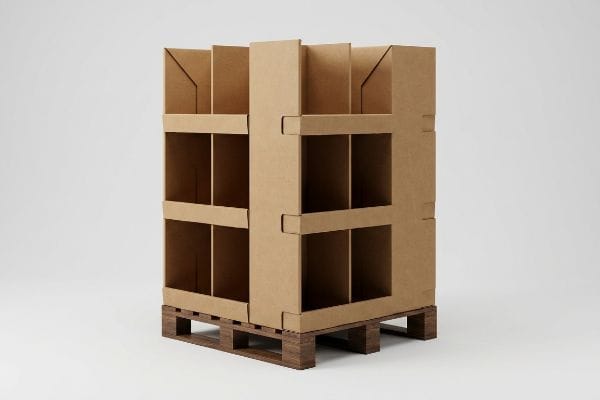
The examples of point of sale display units include fractional pallets, end-caps, power wings, and dump bins. Brands deploy these varied formats to seamlessly adapt to diverse store environments, securing premium placements while mathematically dividing standard logistics footprints to accommodate multiple product promotional campaigns simultaneously.
Understanding these formats is just the beginning; the real challenge is making them fit the retailer's rigid spatial math.
Engineering the Fractional Pallet Display
Marketing teams often assume they must pitch massive, full-size 48×40 inch (121.9×101.6 cm) floor units1 to big-box buyers. This "all-or-nothing" approach frequently leads to immediate rejection because valuable main-aisle space is heavily rationed. Standard layouts require scalable solutions.
I regularly see brands lose retail placements because they ignore the spatial strategy of fractional pallets. By mathematically subdividing a standard GMA (Grocery Manufacturers Association) pallet into quarter pallets measuring exactly 24×20 inches2 (60.9×50.8 cm), you bypass massive spatial friction. The stiff physical resistance of virgin kraft board locking into a perfectly subdivided grid creates a stable, high-density merchandiser. This specific geometry guarantees retail buyers can confidently approve your scaled-down footprint, dropping your campaign seamlessly into high-traffic store intersections without blocking shopping carts.
| Common Rookie Mistake | The Pro Fix | Retail-Floor Benefit |
|---|---|---|
| Pitching oversized floor units | Engineering quarter pallet sizes | Avoids buyer floor space rejections |
| Ignoring standard wood bases | Locking to GMA footprints3 | Eliminates warehouse pallet transfer times |
| Wasting aisle clearance zones | Designing modular 24×20 inch grids4 | Maximizes traffic flow in tight aisles |
I always enforce fractional pallet math before approving any floor unit CAD (Computer-Aided Design) file. It completely eliminates spatial rejections from store managers and ensures multiple brands can securely share a single logistics footprint.
🛠️ Harvey's Desk: Are your current floor displays mathematically compliant with big-box aisle rationing limits? 👉 Request a Spatial Audit ↗ — Direct access to my desk. Zero automated sales spam, I promise.
What Are the Four Basic Types of Display?
Breaking down the retail environment reveals four distinct merchandising categories. Each type serves a unique physical purpose and requires completely different material specifications to survive.
The four basic types of display are floor standing units, countertop trays, sidekick power wings, and pallet merchandisers. These structural variations allow marketers to position fast-moving consumer goods dynamically across the entire store landscape, targeting distinct shopper behaviors from main aisle browsing to checkout register impulse purchases.

Knowing the four main categories is helpful, but attempting to blindly convert one type into another causes immediate structural failure.
The Countertop Shrink-to-Fit Failure
Brands frequently attempt to save money by taking a successful heavy-duty floor unit dieline and mathematically shrinking it by 50% to create a countertop unit. They assume a universal vector file works perfectly across all physical dimensions without material adjustments.
I constantly have to step in when designers blindly scale down a floor unit because they forget about the physical density of thick B-flute corrugated boards5. When you shrink fold radiuses and interlocking tabs to micro-proportions, the dense flutes cannot bend cleanly. You will hear the sharp, distinct tearing sound of the printed top sheet snapping open under tension, forcing clerks to use messy clear tape to hold the tray together. I completely re-engineer these transitions by mandating a step-down to a thin E-flute substrate6, recalculating the clearances to ensure a smooth, zero-tear assembly for the co-packing team.
| Common Rookie Mistake | The Pro Fix | Retail-Floor Benefit |
|---|---|---|
| Scaling down floor dielines | Re-engineering friction lock math | Prevents snapped locking tabs |
| Using thick B-flute on counters | Pivoting to thin E-flute material7 | Delivers crisp micro-folding radiuses8 |
| Forcing tabs with clear tape | Setting proper geometric offsets | Eliminates messy tape aesthetics |
I permanently ban the direct mathematical scaling of floor templates into register formats in my facility. Switching materials and re-calibrating the slot widths guarantees a frictionless setup and protects your expensive brand graphics from cracking.
🛠️ Harvey's Desk: Are your countertop tabs buckling because you used scaled-down floor engineering math? 👉 Download My Flute Selection Guide ↗ — Download safely. My inbox is open if you have questions later.
What Are the Latest Trends in POS?
Modern retail environments are rapidly evolving to capture distracted shopper attention. Physical packaging is increasingly merging with digital technology to create highly engaging brand activations.
The latest trends in POS involve integrating interactive digital screens, utilizing mono-material sustainable structures, and engineering smart packaging elements. These innovations allow brands to broadcast dynamic video content directly in the aisle while strictly maintaining environmentally friendly curbside recycling compliance for global retail supply chains.

Adding flashing screens to your merchandising strategy sounds great, until you realize how big-box stores handle disposal.
Surviving the E-Waste Disposal Trap
Marketing teams love integrating LCD (Liquid Crystal Display) video players into corrugated stands to drive engagement. A common approach is securing this expensive hardware directly to the paperboard using permanent industrial adhesives9 to prevent theft.
I see brands face massive retailer chargebacks because they treat digital components like static printed panels. Think of it like super-gluing a smartphone to a pizza box; when the campaign ends, rushed store clerks will violently smash the glued housing to extract the screen, risking hazardous battery punctures and severe e-waste fines10. I completely eliminate permanent glues, opting instead to engineer precise die-cut friction-lock cavities. The smooth sliding friction of the board safely releases the electronic component in under three seconds without tools, maintaining a pristine paper recycling stream.
| Common Rookie Mistake | The Pro Fix | Retail-Floor Benefit |
|---|---|---|
| Gluing screens to paperboard | Engineering friction-lock cavities | Prevents dangerous battery punctures |
| Mixing e-waste with recycling | Decoupling electronics structurally | Passes strict environmental disposal audits |
| Requiring tools for removal | Using push-out die-cut voids | Cuts teardown time to three seconds |
I strictly enforce a zero-adhesive policy for all embedded electronics. Isolating the hardware inside a custom folded housing guarantees effortless extraction at the store level, protecting your brand from downstream environmental liabilities.
🛠️ Harvey's Desk: Are your interactive merchandising units secretly violating store-level e-waste disposal protocols? 👉 Get a Hardware Cavity Assessment ↗ — No forms that trigger endless sales calls. Just pure value.
What Is an Example of a Point of Sale?
One of the most engaging physical structures in the retail aisle is the kinetic merchandiser. These units encourage tactile interaction, inviting the shopper to manually browse multiple product facings.
An example of a point of sale is a 360-degree rotating corrugated floor merchandiser. This dynamic structural unit utilizes internal ball-bearing hardware to allow consumers to physically spin heavy product trays, effectively maximizing high-density inventory visibility within a highly constrained and heavily trafficked retail aisle footprint.

Getting one of these kinetic units to stand up in a lab is easy, but here is the harsh reality when you ship 500 of them to a live store.
Why Standard Rotating Bases Fail on the Factory Floor
Procurement teams frequently request spinning "Lazy Susan" displays for heavy cosmetics or hardware items. They typically assume that a standard folded corrugated flat-pack base can simply support a flat metal bearing plate11, treating the kinetic unit exactly like a static floor stand.
In my facility, I routinely see these standard bases suffer immediate shear failure on the testing floor when subjected to dynamic lateral force. When a shopper actively spins a unit holding a 187.5 lbs (85.0 kg) payload, the centrifugal torque transfers directly into the 32ECT base structure12 as intense kinetic friction. I measure the exact deflection, and without independent anchoring, this rotational stress violently tears the corner seams of the testliner within hours. I fix this by engineering an internal double-wall corrugated spine strictly isolated beneath a locked false bottom. This 3.2 mm (0.32 cm) micro-adjustment anchors the hardware and absorbs the shear force entirely, preventing structural collapse and saving brands from thousands in retailer chargebacks13.
| Common Rookie Mistake | The Pro Fix | Retail-Floor Benefit |
|---|---|---|
| Mounting hardware to flat bases | Engineering an isolated torque hub | Stops the unit from tipping over |
| Ignoring rotational shear force | Adding a double-wall inner spine | Eliminates corner seam tearing |
| Testing strictly static payloads | Simulating lateral centrifugal spin | Ensures frictionless long-term rotation |
I refuse to release kinetic units that rely on single-wall aesthetic panels for torque support. Shifting the mechanical burden to an internal, unseen spine guarantees a perfectly plumb rotational axis that handles aggressive shopper interaction effortlessly.
🛠️ Harvey's Desk: Are your rotating base structures engineered to absorb lateral centrifugal shear force, or just static weight? 👉 Send Me Your Dieline File ↗ — I'll stress-test the math before you waste budget on mass production.
Conclusion
You might choose an unreinforced base to save pennies, but when centrifugal torque violently shears open your 32ECT corners on the store floor, the resulting structural collapse triggers an immediate retailer rejection that wipes out your profit margin. Over 500 brand managers use my prepress checklist to avoid these exact fatal early-stage mistakes. Stop guessing on dynamic loads and let me personally run your files through my Free Dieline Audit ↗ to catch kinetic vulnerabilities before mass production begins.
"GMA American Pallet. Dimensions, types and much more.", https://acrosslogistics.com/blog/en/american-pallet-gma. Verification of industry-standard pallet dimensions (GMA) used in big-box retail logistics and display layouts. Evidence role: technical specification; source type: industrial standard. Supports: the standard size of retail floor units. Scope note: Applies primarily to North American retail standards. ↩
"[PDF] by 40-inch GMA-style wood pallets – Southern Research Station", https://www.srs.fs.usda.gov/pubs/VT_Publications/05t10.pdf. Verification that 24×20 inches is the industry standard dimension for a quarter-pallet subdivision of a GMA pallet. Evidence role: technical specification; source type: logistics/industry standard. Supports: exact measurements for fractional pallets. Scope note: pertains specifically to North American GMA standards. ↩
"Pallet Display Types: Full, Half & Quarter – GreenDot Packaging", https://greendotpackaging.com/understanding-pallet-display-types-full-half-and-quarter-pallet-displays/. An authoritative industry guide on Grocery Manufacturers Association (GMA) standards confirms the universal pallet dimensions required for retail logistics. Evidence role: technical specification; source type: industry standard. Supports: The necessity of using GMA footprints to eliminate transfer times. Scope note: Applies primarily to North American retail logistics. ↩
"Grocery Store Aisle Dimensions: How Wide Should Your Aisles Be?", https://wzrack.com/grocery-store-aisle-dimensions-how-wide-should-your-aisles-be/. Retail design manuals or ADA compliance guides verify the standard spacing and grid dimensions required to maintain aisle traffic flow. Evidence role: spatial metric; source type: design guideline. Supports: The use of 24×20 inch grids to maximize traffic flow. Scope note: May vary by specific retail sector. ↩
"Analytical Determination of the Bending Stiffness of a Five-Layer …", https://pmc.ncbi.nlm.nih.gov/articles/PMC8777652/. Technical data on the physical properties and structural limitations of B-flute corrugated cardboard. Evidence role: technical specification; source type: material science handbook. Supports: the claim that thick flutes resist bending at small scales. Scope note: focuses on corrugated packaging standards. ↩
"[PDF] Specifications for Corrugated Paperboard – National Archives", https://www.archives.gov/files/preservation/storage/pdf/corrugated-board.pdf. Comparison of flute sizes (B vs E) regarding foldability and assembly in retail displays. Evidence role: engineering standard; source type: packaging industry guideline. Supports: the efficacy of using thinner substrates for smaller display units. Scope note: specific to corrugated board grades. ↩
"Corrugated Board Specifications", https://www.fibrebox.org/assets/2025/09/Walmart_Corrugated-Board_Specifications_Automation_Packaging_Standards.pdf. Technical documentation on corrugated flute sizes verifies the specific thickness and suitability of E-flute for small-scale retail displays. Evidence role: technical specification; source type: manufacturing standard. Supports: material choice for counter displays. Scope note: Focuses on material thickness versus durability. ↩
"[PDF] CREASING AND FOLDING – BioResources", https://bioresources.cnr.ncsu.edu/wp-content/uploads/2019/01/2017.1.69.pdf. Engineering data explains how smaller flute sizes (like E-flute) allow for smaller, cleaner bend radii compared to larger flutes. Evidence role: physical property verification; source type: industrial engineering guide. Supports: benefit of thin materials in display design. Scope note: Specific to corrugated fiberboard geometry. ↩
"Display adhesives for reliable electronic assembly – TESA", https://www.tesa.com/en-us/industry/markets/electronics/display. Technical verification of industry standards for bonding electronic hardware to paperboard for retail security. Evidence role: technical specification; source type: manufacturing guide. Supports: common methods for securing hardware in POS. Scope note: refers specifically to permanent bonding methods. ↩
"Regulations, Resources, and Guidance on Recycling Electronic …", https://www.tceq.texas.gov/assistance/industry/e-recycling/e-recycling-regs.html. Regulatory guidelines on electronic waste disposal and safety protocols for lithium battery punctures in retail environments. Evidence role: factual verification; source type: environmental regulation/safety manual. Supports: the risk of fines and hazards from improper digital POS removal. Scope note: Focuses on global e-waste compliance standards. ↩
"Load Bearing Design Principles for Corrugated POP Displays", https://brownpackaging.com/load-bearing-design-principles-for-corrugated-pop-displays/. Technical engineering data on the load-bearing capacity of corrugated cardboard bases when supporting rotating metal hardware. Evidence role: technical validation; source type: structural engineering manual or packaging standard. Supports: the fact that standard flat-packs may be insufficient for kinetic loads. Scope note: focus on weight distribution in retail displays. ↩
"Estimation of the Compressive Strength of Corrugated Board Boxes …", https://pmc.ncbi.nlm.nih.gov/articles/PMC8467740/. Technical specification of Edge Crush Test (ECT) ratings to verify if 32ECT is susceptible to shear failure under high-payload rotational stress. Evidence role: technical validation; source type: materials engineering standard. Supports: structural vulnerability of the base. Scope note: Specific to corrugated board grades. ↩
"[PDF] How You Can Avoid The Ten Costliest Chargebacks", https://www.princegeorgescountymd.gov/sites/default/files/media-document/dcv4467_merchant-services-costliest-charge-backs-pdf.pdf. Industry data regarding common retailer penalties and chargeback costs associated with failed structural merchandising units. Evidence role: economic justification; source type: retail industry report. Supports: financial impact of structural collapse. Scope note: General retail logistics. ↩