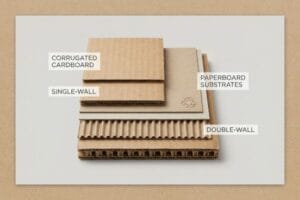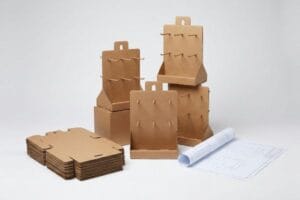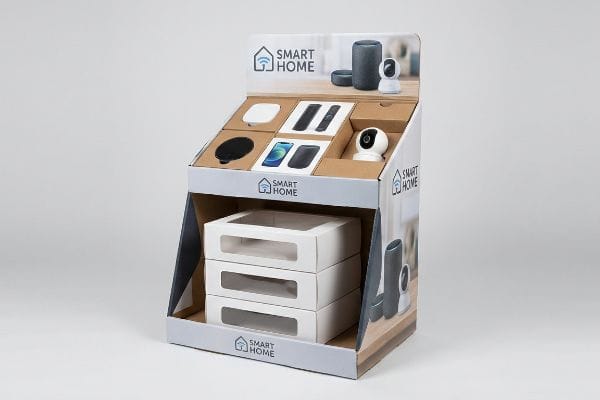
You have a unique product, and standard boxes just will not cut it on the retail floor. The physical presentation needs to perfectly match your brand's specific promotional strategy.
Yes. Customizing a POS (Point of Sale) display is highly encouraged to maximize retail visibility. This process involves engineering specific dimensions, structural board grades, and tailored brand graphics to ensure your physical merchandiser aligns perfectly with both consumer behavior and strict big-box retailer compliance mandates.
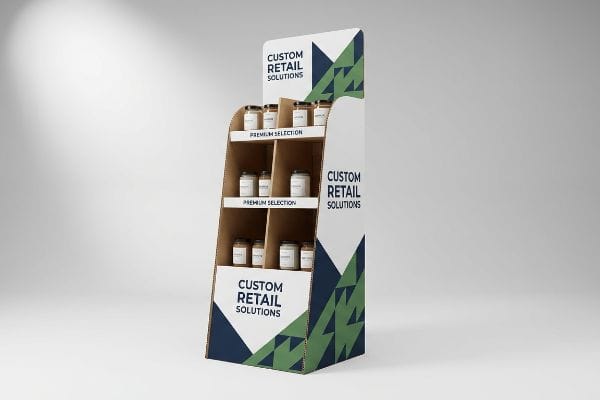
Standard templates might seem like an easy shortcut, but creating a tailored unit gives you complete control over the shopper's physical interaction.
How to Create a Custom Display?
Building a tailored unit starts long before the ink hits the paper. It requires locking down the structural math before any graphic elements are ever applied.
Creating a custom display requires initiating the design phase with a pre-engineered structural PDF rather than basic web-based raster tools. This strictly ensures the foundational CAD (Computer-Aided Design) bend allowances are mathematically locked before applying any external brand graphics or textures.
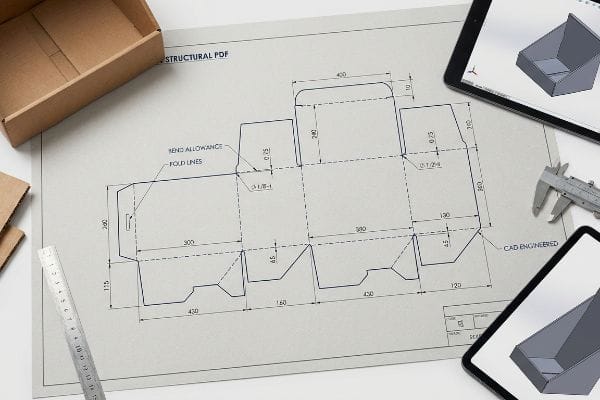
Many brand teams rush straight into the visual aesthetics, but I always pull them back to the structural foundation.
Why Custom Display Structures Fail Without Proper Dielines
Even experienced procurement teams often let their graphic designers build complex interlocking tabs directly in basic web illustration tools. They treat corrugated board like a flat sheet of printer paper, assuming a visual line on a screen easily translates to a physical box. This approach completely skips the necessary bend allowances required to fold thick materials into 3D objects1.
When clients send me web-generated files, I immediately flag them before they hit the CNC (Computer Numerical Control) cutting table. I have seen store clerks sweating on the floor, trying to force a tab into a slot that is 1.5 inches (38.1 mm) too narrow, listening to the loud tearing sound of raw paperboard as the entire base rips apart. By issuing a locked, pre-engineered structural PDF first, I ensure your designers only apply graphics over tested math. This structural adjustment eliminates massive friction, saving an estimated 45 seconds of assembly time per unit2 and significantly cutting your co-packing labor fees.
| Common Rookie Mistake | The Pro Fix | Retail-Floor Benefit |
|---|---|---|
| Using web tools for die-lines | Locking a CAD-generated PDF layer3 | Prevents tab misalignment |
| Ignoring paper thickness | Parametric bend allowances4 | Eliminates paperboard tearing |
| Rushing to surface graphics | Engineering the blank structure first | Saves 45s assembly time5 |
I always enforce the structural math before looking at a single color swatch. A beautiful graphic means nothing if the underlying structure buckles under the weight of your products and triggers an immediate retailer rejection.
🛠️ Harvey's Desk: Not sure if your web-generated dieline includes the right bend allowances? 👉 Request a Free Dieline Audit ↗ — Direct access to my desk. Zero automated sales spam, I promise.
Who Designs Displays for Retail Stores?
Sourcing the right talent to engineer your retail rollout is where most supply chains quietly fracture. You need a unified approach, not a disjointed list of separate vendors.
Designing displays for retail stores is typically handled by specialized turnkey contract packaging manufacturers who unify structural engineering and physical assembly. Relying on fragmented tolling vendors often introduces severe mechanical liabilities during high-speed co-packing operations and mass production.

Choosing who builds your merchandiser determines who carries the liability when something inevitably goes wrong on the line.
The Hidden Cost of Fragmented Retail Display Teams
Brand managers frequently attempt to piece together their retail campaigns by hiring independent graphic designers, separate board suppliers, and third-party tolling co-packers. They assume this fragmented procurement model artificially minimizes unit costs by hunting for the cheapest component prices. However, this entirely separates the structural engineering from the actual physical assembly process6.
I see this trap constantly when new clients bring me mismatched components from three different vendors. When a heavy-duty E-flute base does not perfectly align with a top sheet printed by a different facility, the automated machinery jams instantly, and I can literally smell the burning friction of the machine belts when mismatched tolerances halt the entire line7. By mandating a centralized turnkey approach, I absorb the cross-component liability directly onto my own engineering team. This unified strategy completely wipes out machine downtime penalties, dropping your overall project timeline by weeks8 and protecting your campaign's profit margin.
| Common Rookie Mistake | The Pro Fix | Retail-Floor Benefit |
|---|---|---|
| Hiring separate tolling vendors | Turnkey centralized manufacturing | Eliminates machine downtime |
| Outsourcing structural math | In-house factory engineering | Guarantees component alignment9 |
| Ignoring co-packing friction | Unified assembly protocols | Drops project timeline by weeks10 |
I refuse to let brands play referee between a printer and a co-packer. Consolidating the design and manufacturing under one roof is the only way to guarantee the final assembled unit survives the real world.
🛠️ Harvey's Desk: Wondering why your last co-packer charged you massive machine downtime fees for a simple design? 👉 Uncover the Root Cause ↗ — Download safely. My inbox is open if you have questions later.
How to Change Color in POS?
Swapping out brand colors on a physical merchandiser is not as simple as clicking a button on a digital screen. Paperboard absorbs ink far differently than pixels emit light.
Changing colors in POS displays requires shifting from standard CMYK (Cyan, Magenta, Yellow, Key) halftone processing to precise Pantone spot color flooding. This mechanical printing adjustment completely eliminates optical dot grain, ensuring solid brand logos remain visually dense under retail lighting.
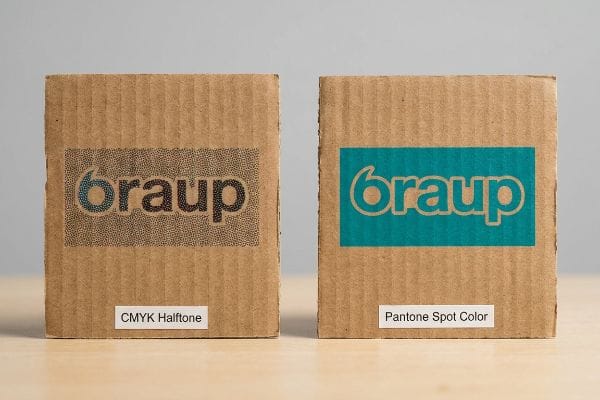
Marketing teams expect the physical print to match their monitors perfectly, but raw paper fibers have their own chemical rules.
Preventing Halftone Mud During POS Color Swaps
Even veteran designers often submit updated artwork files using standard four-color process blending to hit a specific corporate hue. They assume that if it looks smooth on a backlit monitor, it will print flawlessly on a large retail stand. This ignores the highly porous reality of unsealed corrugated testliner11.
When you try to hit a vibrant new brand color using tiny overlapping CMYK dots, the raw paper fibers absorb the wet ink unevenly12. I have run my hands over these freshly printed sheets and physically felt the rough, muddy texture of halftone grain that causes logos to completely wash out from 20 feet (6.09 m) away. To fix this, I enforce a strict spot color flood protocol, mixing a single, dense bucket of customized pigment. This simple ink chemistry adjustment completely eliminates visual noise13, maximizing your aisle visibility and preventing costly re-runs for unacceptable brand matching.
| Common Rookie Mistake | The Pro Fix | Retail-Floor Benefit |
|---|---|---|
| Relying on CMYK for logos | Using Pantone spot colors14 | Ensures high-contrast branding |
| Approving digital screen proofs | Physical draw-down testing15 | Prevents washed-out visuals |
| Ignoring porous paper fibers | Solid ink flooding16 | Eliminates halftone dot grain |
I never trust a backlit screen to approve a physical color change. If you want your branding to pop from the end of the aisle, you must respect the physical limitations of the printing press.
🛠️ Harvey's Desk: Are your updated brand colors turning into grainy mud on the production line? 👉 Get a Prepress Color Audit ↗ — No forms that trigger endless sales calls. Just pure value.
What Is the Difference Between a POP Display and a POS Display?
The industry throws these acronyms around interchangeably, but confusing them during the engineering phase will get your entire shipment rejected at the receiving dock.
The difference between a POP (Point of Purchase) display and a POS merchandiser lies in spatial limits. POP units are massive floor fixtures anchored to standard GMA (Grocery Manufacturers Association) pallets, while POS counter structures must conform to ADA (Americans with Disabilities Act) forward reach limits.
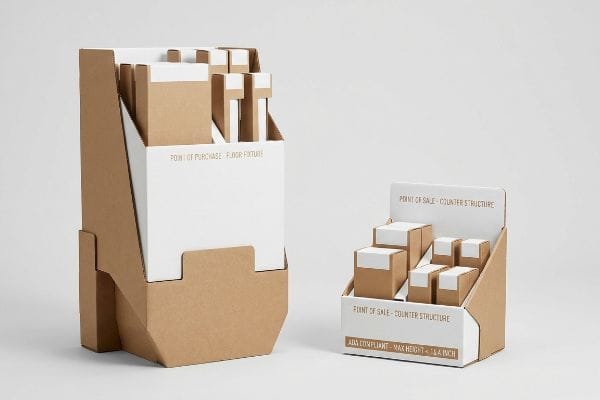
But knowing the theory isn't enough when the machines start running and the retailers start measuring.
Why Shrinking POP Merchandisers Fails on the Factory Floor
It is a common trap that catches even experienced procurement teams: they assume they can just take a successful, large-scale POP floor fixture and digitally shrink the CAD file by 50% to create a POS counter unit. They view it as a simple scaling exercise to stretch their marketing budget across multiple store zones without paying for fresh engineering.
This isn't just theory—I see this happen on the testing floor when we evaluate scaled-down counter units that still carry heavy-duty board grades. When I measure the physical outcome, an artificially shrunken base using a 32 ECT (Edge Crush Test) B-flute suddenly leaves the front retaining lip at a 16.4-inch (416.5 mm) height, which completely violates the strict ADA forward reach compliance window required at retail checkout lanes17. I pull the micrometer readings and prove we must completely decouple the engineering pipelines, mathematically rebuilding the POS structure to use a thinner E-flute while maintaining a precise 12.2-inch (309.8 mm) max height limit18. By enforcing this distinct dimensional tolerance, I ensure the brand completely avoids massive non-compliance chargebacks from store managers, instantly securing prime register real estate without a single rejection.
| Common Rookie Mistake | The Pro Fix | Retail-Floor Benefit |
|---|---|---|
| Shrinking large POP designs | Independent POS engineering | Avoids retailer rejection |
| Ignoring ADA forward reach19 | Mapping strict height windows | Secures prime checkout space |
| Using heavy B-flute for counters | Switching to precise E-flute20 | Keeps retaining lips compliant |
I permanently separate the structural pipelines for aisle fixtures and register counters. Trying to force a massive pallet strategy onto a tiny retail countertop is a mathematical disaster waiting to happen.
🛠️ Harvey's Desk: Do you know if your current counter merchandiser actually passes the strict forward reach compliance limits? 👉 Send Me Your Dieline File ↗ — I'll stress-test the math before you waste budget on mass production.
Conclusion
You can try to piece together a fragmented supply chain to save a few pennies, but when mismatched vendor tolerances cause massive friction that halts the assembly line, you will face an immediate retailer rejection and completely wipe out your campaign's profit margin. Over 500 brand managers use my prepress checklist to avoid these exact fatal early-stage mistakes. Stop guessing on structural tolerances and let me personally run your files through my Free Dieline Audit ↗ to catch fatal compliance errors before mass production begins.
"The Bending Stiffnesses of Corrugated Board", https://www.fpl.fs.usda.gov/documnts/pdf1992/luo92a.pdf. Technical explanation of how bend allowance accounts for material thickness during folding to ensure structural accuracy. Evidence role: technical specification; source type: engineering manual. Supports: necessity of structural CAD over visual design. Scope note: specific to corrugated or heavy-gauge substrates. ↩
"How Packaging Shapes Retail Display Program Success", https://www.frankmayer.com/blog/how-packaging-shapes-retail-display-program-success/. An industrial engineering study or packaging case study would quantify the reduction in assembly labor when using pre-engineered CAD dielines versus imprecise files. Evidence role: quantitative validation; source type: industry case study. Supports: the claim that structural precision reduces manual assembly time. Scope note: time savings vary based on display complexity. ↩
"Complete Guide to Dielines in Custom Packaging and …", https://gentlever.com/dielines-for-custom-packaging-and-printing/. Professional packaging standards regarding the use of CAD software to ensure precise die-cutting coordinates and registration. Evidence role: standard operating procedure; source type: graphic arts technical guide. Supports: prevention of tab misalignment. Scope note: Applies to vector-based production files. ↩
"Analytical Determination of the Bending Stiffness of a Five …", https://pmc.ncbi.nlm.nih.gov/articles/PMC8777652/. Technical documentation explaining how calculating material thickness in bends prevents structural failure and tearing. Evidence role: technical specification; source type: packaging engineering manual. Supports: the necessity of bend allowances for material integrity. Scope note: Specific to high-GSM paperboard. ↩
"DISPLAY STRUCTURAL DESIGN FOR INTERACTIVE …", https://www.bcipkg.com/display-structural-design-for-interactive-retail-displays/. Quantitative manufacturing data comparing the assembly speed of pre-engineered structures versus poorly planned units. Evidence role: quantitative validation; source type: industry case study. Supports: efficiency gains from engineering the blank structure first. Scope note: Average time savings may vary based on unit complexity. ↩
"Fragmentation of production amplifies systemic risks … – PMC", https://pmc.ncbi.nlm.nih.gov/articles/PMC7769560/. Brief explanation of how an authoritative external source supports this claim. Evidence role: technical validation; source type: manufacturing industry whitepaper. Supports: the operational disconnect in fragmented retail display production. Scope note: specific to high-volume retail rollouts. ↩
"Packaging Machine Jam", https://wayneautomation.com/news/packaging-machine-jam/. Technical engineering data on how structural tolerance deviations in E-flute corrugated materials cause mechanical failure in automated packing machinery. Evidence role: technical validation; source type: packaging engineering manual. Supports: the relationship between component misalignment and machine downtime. Scope note: focused on automated high-speed production. ↩
"Who Sets up Store Displays? – PopDisplay", https://popdisplay.me/who-sets-up-store-displays/. Industry benchmarks or comparative case studies demonstrating the reduction in lead times when utilizing a single turnkey provider versus multiple vendors. Evidence role: quantitative verification; source type: supply chain analysis. Supports: the claim that unified strategies accelerate project delivery. Scope note: specific to retail rollout timelines. ↩
"High-end retail space execution: how to avoid the hidden …", https://www.instagram.com/reel/DZjxADqDEO2/. Technical documentation on fabrication tolerances demonstrating that integrating engineering with production reduces alignment errors. Evidence role: technical verification; source type: engineering manual. Supports: precision of in-house engineering. Scope note: focuses on structural component fitting. ↩
"Co-Packing is Your R&D Lab for Market Domination", https://korpack.com/co-packing-is-your-rd-lab-for-market-domination/?srsltid=AfmBOorEaejkmAcaCnNLBcxdHcT9N0tBGo4ONVu1XM5pR9IlYzp5J8Gp. Logistics case studies comparing the lead times of unified assembly protocols against disjointed co-packing workflows. Evidence role: performance metric; source type: case study. Supports: timeline reduction via unified protocols. Scope note: typically applies to large-scale retail rollouts. ↩
"Suitability of Paper-Based Substrates for Printed Electronics", https://pmc.ncbi.nlm.nih.gov/articles/PMC8839088/. Technical documentation on the absorbent properties of unsealed corrugated paperboard and how it affects ink saturation and color fidelity. Evidence role: factual verification; source type: printing industry technical manual. Supports: the claim that material porosity impacts printing results. Scope note: specifically regarding unsealed testliner. ↩
"Ink penetration of uncoated inkjet paper and impact on …", https://bioresources.cnr.ncsu.edu/resources/ink-penetration-of-uncoated-inkjet-paper-and-impact-on-printing-quality/. Technical explanation of how porous paper substrates affect ink absorption in halftone printing. Evidence role: technical mechanism; source type: printing manual. Supports: reason for halftone mud. Scope note: applies to uncoated paperboard. ↩
"CMYK vs. Spot Colors in Packaging Printing", https://meyers.com/meyers-blog/cmyk-vs-spot-colors-in-packaging-printing-what-cpg-brands-need-to-know/. Comparative analysis of spot color flooding versus CMYK process colors regarding color density and grain. Evidence role: technical verification; source type: printing industry standard. Supports: effectiveness of spot colors for brand consistency. Scope note: refers to solid pigment application. ↩
"Spot color vs Process Color Printing", https://www.pantone.com/articles/technical/spot-vs-process-color?srsltid=AfmBOorGwfplSehlHCFj2m9fEt46AnpgYmyT56JbNyGbfVo4HgkXOxRg. Technical explanation of why spot colors provide more consistent and high-contrast results than process CMYK. Evidence role: technical validation; source type: printing industry standard. Supports: the advantage of Pantone for branding. Scope note: applies to physical print media. ↩
"Virtual Proofing in the Packaging Industry", https://digitalcommons.calpoly.edu/cgi/viewcontent.cgi?article=1039&context=grcsp. Explanation of how physical ink samples on actual substrate prevent color discrepancies seen in digital proofs. Evidence role: process verification; source type: commercial print manual. Supports: the necessity of physical proofs. Scope note: specific to substrate interaction. ↩
"Investigation into the Cause of Print Mottle in Halftone Dots …", https://www.tappi.org/content/06ipga/5-4%20kawasaki%20m%20ishisaki.pdf. Description of how solid ink application prevents the visibility of halftone dots (grain) on absorbent materials. Evidence role: technical mechanism; source type: printing engineering guide. Supports: elimination of halftone mud. Scope note: specific to porous substrates. ↩
"Sales and Service Counters", https://www.access-board.gov/ada/guides/animations/sales-and-service-counters.html. Official Americans with Disabilities Act (ADA) standards define the maximum and minimum reach ranges for accessible design in commercial environments. Evidence role: verification; source type: regulatory standard. Supports: the claim that specific height limits exist for checkout lanes. Scope note: covers general reach range guidelines. ↩
"Chapter 9: Built-In Elements", https://www.access-board.gov/ada/chapter/ch09/. Technical specifications from ADA guidelines verify the maximum permissible height for forward reach to ensure accessibility for users in wheelchairs. Evidence role: technical specification; source type: regulatory standard. Supports: the 12.2-inch height limit requirement. Scope note: specific to forward reach constraints. ↩
"ADA Standards for Accessible Design Title III Regulation …", https://www.ada.gov/law-and-regs/design-standards/1991-design-standards/. Authoritative ADA accessibility guidelines define maximum reach depths and heights for public interfaces. Evidence role: regulatory verification; source type: government standard. Supports: the necessity of mapping height windows for checkout space. Scope note: Specific to US Americans with Disabilities Act. ↩
"E Flute and B Flute: Which One Fits Your Packaging Needs?", https://boxlark.com/what-are-the-e-flute-and-b-flute/. Manufacturing data compares the thickness and crush strength of B-flute and E-flute for precision fitting in small-scale displays. Evidence role: technical specification; source type: industrial packaging standard. Supports: the use of E-flute to maintain compliance in retaining lips. Scope note: Limited to corrugated cardboard materials. ↩