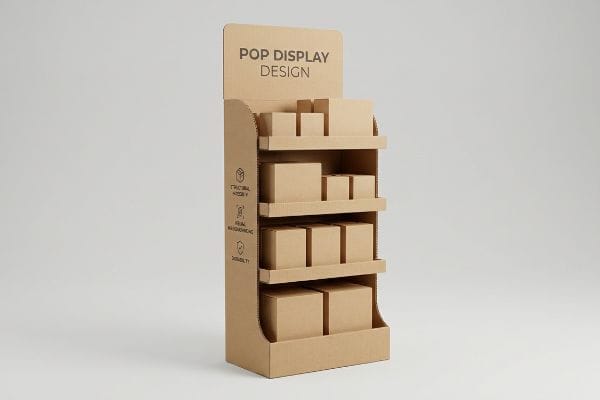
Investing thousands into a retail campaign is pointless if the physical display fails in the aisle. We will fix the structural blind spots destroying your sales.
The key elements of POP design include structural integrity, visual merchandising, spatial optimization, retailer compliance, material durability, clear messaging, ease of assembly, sustainable sourcing, and strategic product placement. Mastering these foundational pillars ensures your campaign physically survives the global supply chain and actively drives impulse conversions.

Understanding these theoretical elements is just the starting point. When you move from a digital rendering to a crowded big-box aisle, the physics of physical manufacturing take over.
What Is a Main Purpose of the Point of Purchase Display?
The ultimate goal isn't just to hold inventory; it is to actively disrupt shopper behavior. A display must physically pull foot traffic before it can convert a sale.
The main purpose of a POP (Point-Of-Purchase) display is to immediately capture shopper attention, disrupt routine store navigation, and drive spontaneous impulse purchases. By strategically isolating specific merchandise away from crowded primary shelves, these structural units physically force consumer engagement and drastically increase brand visibility.
But achieving that disruption requires precise spatial engineering, not just slapping a logo on a cardboard box.
The 3-3-3 Spatial Engagement Rule in Retail
Many marketing teams design their merchandisers strictly for up-close viewing on backlit computer monitors. They assume that if the graphics look crisp on a PDF (Portable Document Format), shoppers will naturally gravitate toward the unit in the store. This approach completely ignores the physical reality of how humans navigate crowded retail environments at walking speed1.
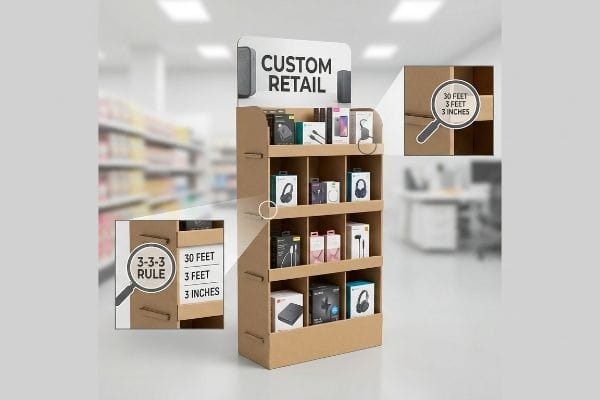
Even veteran designers often overlook the 3-3-3 rule2, assuming a single graphic strategy works for all distances. You have to engineer the unit to grab attention at 30 feet (9 meters), engage interest at 3 feet (0.9 meters), and drive the physical conversion at 3 inches (7.62 cm). I frequently see rookie brands rely on text-heavy headers that become an unreadable blur from across the store. When a store clerk builds one of these generic units, the flat, dull finish simply blends into the harsh fluorescent retail lights, causing rushing shoppers to completely ignore the aisle. To fix this, I mandate aggressive die-cut structural shapes for long-range visual disruption, ensuring your core offer punches through the visual clutter before the consumer even reaches the shelf.
| Common Rookie Mistake | The Pro Fix | Retail-Floor Benefit |
|---|---|---|
| Text-heavy headers for long-range viewing | Massive die-cut structural shapes | Grabs attention from 30 feet (9m)3 |
| Flat sides blending into shelves | Contrasting PMS spot color floods4 | Disrupts standard store navigation |
| High retaining lips hiding products | 85% product visibility cutouts5 | Drives instant impulse conversions |
I refuse to engineer flat billboards for retail floors because they act as visual camouflage. By forcing dynamic structural shapes into the dieline, I guarantee your merchandiser pulls foot traffic away from the primary aisle.
🛠️ Harvey's Desk: Not sure if your current display shape is too flat to grab attention from across the aisle? 👉 Get A Structural Audit ↗ — Direct access to my desk. Zero automated sales spam, I promise.
What Are the 6 Elements of Visual Merchandising?
Visual merchandising isn't just about making things look pretty. It is a calculated science of color, lighting, structure, space, information, and tactile sensory engagement.
The 6 elements of visual merchandising encompass color palettes, strategic lighting, structural space planning, tactile sensory details, precise product information, and dynamic presentation. Together, these core universal retail components create an immersive physical environment that intuitively guides shopper behavior and maximizes point-of-sale product interactions.
However, translating those visual elements from a bright digital screen onto raw paperboard introduces severe chemical challenges.
Why CMYK Halftone Mud Ruins Visual Elements
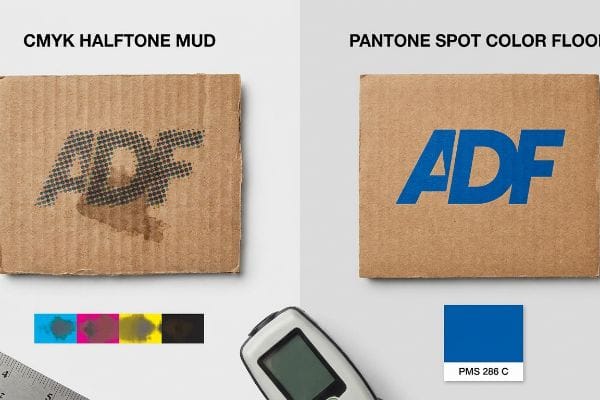
Procurement teams often finalize their visual merchandising elements by converting solid corporate logos into standard CMYK (Cyan, Magenta, Yellow, Key) digital formats. They assume that standard process printing will seamlessly match their pristine brand guidelines on the physical box. This theoretical approach works fine for glossy commercial magazines, but it fails mechanically when applied to structural packaging6.
The biggest trap I see is expecting four-color process dots to blend optically on raw packaging materials. When standard CMYK inks are printed directly onto porous corrugated testliner7, you can actually feel the rough paper fibers absorbing the liquid pigment unevenly like a dry sponge. This causes a muddy, washed-out logo that looks terrible under store lighting, completely destroying the visual engagement element. I solve this by mandating a spot color flood protocol for all primary brand elements. Instead of relying on overlapping dots, I use a single, precisely mixed Pantone [spot color ink]8(https://popdisplay.me/blog/) to create a dense, perfectly smooth flood of pigment that guarantees high-contrast visibility.
| Common Rookie Mistake | The Pro Fix | Retail-Floor Benefit |
|---|---|---|
| CMYK process printing for solid logos | Pantone spot color floods9 | Prevents muddy, washed-out branding |
| Printing directly on porous testliner | Sealing board with aqueous primers10 | Keeps ink pigments vibrant and sharp |
| Relying on backlit digital proofs | Physical spectrophotometer scanning11 | Ensures color matches under store lights |
I never trust optical dot blending for crucial brand elements on raw substrates. Mandating a dedicated spot color station on the printing press removes the variable of fiber absorption, keeping your visual merchandising perfectly crisp.
🛠️ Harvey's Desk: Are you worried your brand colors will look muddy on a raw cardboard base? 👉 Request A Spot Color Flood Sample ↗ — Download safely. My inbox is open if you have questions later.
What Are the Key Features of a Good Display?
A high-performing display balances aesthetic appeal with strict mechanical function. It must look effortless to the consumer while being rugged enough for the store clerk.
The key features of a good display include intuitive visual flow, structural stability, precise product visibility, asymmetrical layout grouping, and frictionless restocking clearances. These standard characteristics ensure the merchandiser effectively pulls consumer attention while surviving the harsh physical handling of busy retail environments.
But the most overlooked feature isn't the outer graphics; it is the internal geometry of the shelving.
The 3-5-7 Asymmetry Rule for SKU Grouping
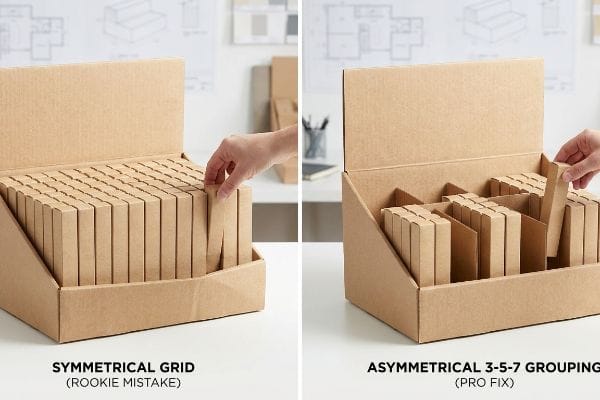
Junior design teams frequently attempt to flat-pack a dense, perfectly symmetrical grid of products onto a single display shelf. They naturally assume that maximizing spatial density yields a higher return on investment per unit. While this looks mathematically efficient on a CAD (Computer-Aided Design) blueprint, perfectly even product blocks fail to create visual tension12.
It is a common trap that catches even experienced procurement teams, much like packing a suitcase so tightly you cannot pull a single shirt out. When products are crammed symmetrically without gaps, store clerks struggle to restock the unit, often emitting the sharp, distinct tearing sound of raw paperboard as they force tight items past the front retaining lip. To prevent this, I engineer dedicated modular dividers that separate merchandise into asymmetrical, odd-numbered clusters of three, five, or seven items13. This built-in structural spacing creates psychological visual tension that draws the human eye, while providing the exact physical 0.25-inch (6.35 mm) clearance required to eliminate paperboard tearing14 during daily restocking.
| Common Rookie Mistake | The Pro Fix | Retail-Floor Benefit |
|---|---|---|
| Perfectly symmetrical SKU grids | 3-5-7 asymmetrical grouping15 | Creates visual tension to draw eyes |
| Zero-clearance product packing | Engineering 0.25-inch (6.35 mm) gaps16 | Prevents raw paperboard tearing |
| High front retaining lips | Custom die-cut product windows17 | Allows frictionless daily restocking |
I strip out symmetrical grid layouts because they create cognitive overload for the shopper and mechanical friction for the clerk. Grouping SKUs (Stock Keeping Units) asymmetrically mathematically guarantees both visual engagement and physical durability on the shelf.
🛠️ Harvey's Desk: Are your products packed so tightly that clerks might tear the cardboard trying to restock them? 👉 Claim Your Free Divider Layout ↗ — No forms that trigger endless sales calls. Just pure value.
What Are the 7 Principles of Retail?
Retail success relies on mastering product, price, place, promotion, people, presentation, and process. Without strict alignment across these foundational areas, supply chains inevitably break down.
The 7 principles of retail commonly feature the right product, right quantity, right price, right time, right place, compelling presentation, and seamless operational processes. Aligning these universal commercial frameworks ensures that retail campaigns integrate perfectly into distinct store environments and maximize long-term consumer purchasing behavior.
But knowing the theory isn't enough when the machines start running and structural limits clash with retailer mandates.
Why Theoretical Principles Fail on the Factory Floor
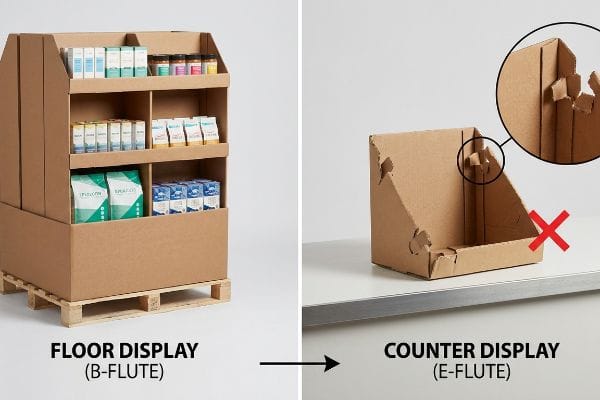
New brands frequently attempt to scale a single floor display design to fulfill multiple retail placement principles simultaneously. They assume a large floor unit can simply be reduced by 50% on a computer to serve as a checkout counter display, checking off the "place" and "presentation" principles in one move. This completely ignores the strict legal and logistical rules dictating these two separate physical zones18 in North American retail.
This isn't just theory—I see this happen on the testing floor when a client submits a unified "shrink-to-fit" dieline. The fatal blind spot is ignoring that floor displays are anchored to the heavy-duty 48×40 inch (121×101 cm) GMA (Grocery Manufacturers Association) pallet limit19 for warehouse operations, while counter displays are strictly anchored to the ADA (Americans with Disabilities Act) 15-48 inch (38-121 cm) forward reach20 compliance window. When I measure the scaled-down tabs, the thick B-flute board suddenly has a 0.11 inch (2.79 mm) clearance deficit, causing the dense micro-proportions to snap during assembly. I pull the CAD parameters and permanently separate the engineering pipelines, applying a ruthless step-down to a thin E-flute substrate for the counter units. By enforcing this absolute dimensional separation, I ensure the structural geometry perfectly fits the specific retail zone, completely eliminating the risk of store managers rejecting non-compliant register units and wiping out the project's profit margin.
| Common Rookie Mistake | The Pro Fix | Retail-Floor Benefit |
|---|---|---|
| Shrinking floor units by 50% | Separating POP and POS pipelines21 | Prevents non-compliant display rejections |
| Using B-flute for micro-tabs | Pivoting to thin E-flute substrates22 | Enables frictionless small-scale assembly |
| Ignoring forward reach limits | Strict ADA height window mapping23 | Guarantees checkout counter compliance |
I refuse to rely on lazy shrink-to-fit digital scaling. By mathematically anchoring every single file to its specific logistical and legal retail zone, I protect your campaign from devastating downstream chargebacks.
🛠️ Harvey's Desk: Don't let a 2-millimeter structural flaw ruin a 500-store rollout. 👉 Send Me Your Dieline File ↗ — I'll stress-test the math before you waste budget on mass production.
Conclusion
You can choose a cheaper structural vendor, but when that shrink-to-fit display violates ADA forward reach limits, it triggers an immediate retailer rejection that completely wipes out your project's profit margin. Over 500 brand managers use my prepress checklist to avoid these exact fatal early-stage mistakes. Stop guessing on retail compliance parameters and let me personally run your structural files through my Free Dieline Audit ↗ to catch these hidden physical failures before mass production begins.
"Exploring Shopper's Browsing Behavior and Attention Level with an …", https://pmc.ncbi.nlm.nih.gov/articles/PMC6895988/. An authoritative source on environmental psychology or retail design would detail how visual processing and movement patterns affect shopper engagement. Evidence role: theoretical framework; source type: academic journal or retail research study. Supports: The claim that high-detail graphics are ineffective for capturing attention at a distance. Scope note: Focused on high-traffic physical retail spaces. ↩
"The Importance of the Rule of 3 for Your Custom Store Displays", https://mcintyredisplays.com/blog/custom-store-displays/. Technical validation of the 3-3-3 rule for distance-based visual communication and engagement thresholds in retail environments. Evidence role: technical validation; source type: visual merchandising guide. Supports: the distance-based spatial engagement framework. Scope note: specific distance metrics may vary by retail store layout. ↩
"10 Tips for Creating a Better Point of Purchase Display", https://packagingtech.net/blog/10-tips-for-creating-a-better-point-of-purchase-display. Verification of the effective visual attraction range for oversized structural retail displays to capture foot traffic. Evidence role: quantitative validation; source type: retail design guidelines. Supports: the use of die-cut shapes for long-range visibility. Scope note: distance effectiveness may vary based on store lighting and aisle density. ↩
"POINT-OF-PURCHASE INSIGHTS: THE IMPACT OF RETAIL POP …", https://www.bcipkg.com/point-of-purchase-insights-the-impact-of-retail-pop-displays-on-consumer-behavior/. Analysis of how saturated, contrasting spot colors disrupt habitual shopper paths and create visual 'stoppers'. Evidence role: theoretical support; source type: visual merchandising research. Supports: the use of specific color floods to disrupt standard store navigation. Scope note: efficacy is dependent on the surrounding store color palette. ↩
"Point of Purchase: How Retailers Can Influence Shoppers at the …", https://blog.intouch.com/posts/points-of-purchase-displays. Confirmation of industry standards for visibility ratios in POP displays to minimize purchase friction. Evidence role: technical specification; source type: merchandising study. Supports: the link between visibility percentages and impulse conversion rates. Scope note: specific to consumer packaged goods (CPG) displays. ↩
"UV-curable coating process on CMYK-printed duplex paperboard …", https://bioresources.cnr.ncsu.edu/resources/uv-curable-coating-process-on-cmyk-printed-duplex-paperboard-part-1-mechanical-and-optical-properties/. Technical explanation of how substrate porosity and ink absorption on structural packaging cause dot gain and color shifts compared to glossy coated paper. Evidence role: technical validation; source type: printing industry standard or packaging engineering guide. Supports: the claim that process printing fails on structural packaging. Scope note: focuses on the physical interaction between CMYK inks and non-coated substrates. ↩
"Mathematical modelling and compensation strategies for printing dot …", https://pmc.ncbi.nlm.nih.gov/articles/PMC12574880/. Technical explanation of how porous substrates cause uneven pigment absorption and dot gain in four-color process printing. Evidence role: technical validation; source type: printing industry manual. Supports: the claim that CMYK blending fails on raw packaging. Scope note: focuses on uncoated corrugated materials. ↩
"What's the Difference Between Spot Colors (PMS) vs. CMYK for …", https://blog.fantastapack.com/difference-between-spot-colors-vs.-cmyk-packaging. Verification of spot color's ability to provide higher opacity and color density compared to halftone CMYK dots on porous surfaces. Evidence role: technical specification; source type: graphic arts standard. Supports: the use of spot color flood protocols for brand visibility. Scope note: applies to high-contrast brand elements. ↩
"CMYK vs. Spot Colors in Packaging Printing – Meyers Printing", https://meyers.com/meyers-blog/cmyk-vs-spot-colors-in-packaging-printing-what-cpg-brands-need-to-know/. Technical explanation of why spot colors provide superior saturation and consistency for brand colors compared to CMYK process printing. Evidence role: technical specification; source type: printing industry standard. Supports: the use of Pantone to prevent muddy branding. Scope note: applies to large format retail printing. ↩
"CAB-O-SPERSE® 4012K-F Silica Dispersion for Aqueous Inkjet …", https://www.cabotcorp.com/solutions/applications/coatings/ink-receptive-coatings/technical-article. Technical explanation of how aqueous primers prevent ink absorption in porous substrates to maintain pigment vibrancy. Evidence role: material science; source type: technical guide. Supports: the method for improving print quality on porous testliner. Scope note: specific to cardboard and testliner substrates. ↩
"The Secret to Perfect Color Matching in Print Shops – YouTube", https://www.youtube.com/watch?v=xZuEQk-Ukrg. Evidence that spectrophotometers provide objective color measurements that account for lighting variables, unlike backlit digital screens. Evidence role: measurement standard; source type: technical manual. Supports: accuracy of color matching under store lights. Scope note: focuses on colorimetry and metamerism. ↩
"Four Visual Merchandising Techniques For Retail Success", https://visualmerchandisingcourses.co.uk/four-visual-merchandising-techniques-for-retail-success/. Brief explanation of how principles of visual merchandising and consumer psychology support the claim that asymmetrical layouts create visual interest and tension to attract attention. Evidence role: theoretical support; source type: design textbook or retail psychology study. Supports: the inefficiency of symmetrical grids for consumer attraction. Scope note: specific to retail visual merchandising. ↩
"Rule of Odds Interior Design: Why Threes, Fives & Sevens Work", https://www.tidbitsandtwine.com/rule-of-odds-interior-design/. Brief explanation of how an authoritative external source supports the psychological appeal of odd-numbered groupings in retail displays. Evidence role: theoretical validation; source type: visual merchandising guide. Supports: the use of 3, 5, or 7 item clusters. Scope note: focused on consumer eye-tracking and visual tension. ↩
"Packaging and Logistics Planning for Retail Displays – Frank Mayer", https://www.frankmayer.com/blog/packaging-and-logistics-planning-for-retail-displays/. Brief explanation of how industry engineering standards for corrugated paperboard determine the minimum clearance to prevent material stress and tearing. Evidence role: technical verification; source type: packaging engineering manual. Supports: the specific 0.25-inch clearance metric. Scope note: applies to retail point-of-purchase displays. ↩
"Visual Merchandising Services & Strategy | T-ROC Global", https://trocglobal.com/visual-merchandising/. Authoritative guide on visual merchandising principles confirming how odd-numbered groupings create visual interest and focal points. Evidence role: technical validation; source type: retail design manual. Supports: the efficacy of the 3-5-7 rule. Scope note: applicable to physical retail displays. ↩
"What Are Tear Away Display Boxes and How Do They Increase …", https://thepioneerpackaging.com/what-are-tear-away-display-boxes-and-how-do-they-increase-retail-sales/. Engineering specifications for point-of-purchase (POP) displays detailing required clearances to prevent material stress and tearing. Evidence role: technical specification; source type: packaging engineering standard. Supports: the specific 0.25-inch gap requirement. Scope note: specific to paperboard materials. ↩
"How Die Cut Packaging is a Better Option? | Journal – Vocal Media", https://vocal.media/journal/how-die-cut-packaging-is-a-better-option. Design analysis of retail display ergonomics showing how die-cut windows reduce restocking friction. Evidence role: functional validation; source type: industrial design study. Supports: the benefit of custom windows for restocking. Scope note: focused on operational efficiency. ↩
"Chapter 2 – Use Regulations – Zoning Resolution – NYC.gov", https://zr.planning.nyc.gov/article-iii/chapter-2. Industry regulatory guides or retail safety standards would outline the specific legal and logistical constraints governing the placement of displays in different retail zones. Evidence role: verification; source type: regulatory manual. Supports: the claim that distinct rules exist for floor vs counter placement. Scope note: regulations may vary by jurisdiction. ↩
"48×40" GMA Pallets | Largest Pallet Manufacturer & Supplier", https://www.palletone.com/products/gma-pallets/. Verification of the Grocery Manufacturers Association (GMA) standard dimensions for warehouse pallets. Evidence role: factual verification; source type: industry standard. Supports: standardization of floor display footprints. Scope note: Primary North American standard. ↩
"Chapter 3: Operable Parts – Access-Board.gov", https://www.access-board.gov/ada/guides/chapter-3-operable-parts/. Verification of the Americans with Disabilities Act (ADA) requirements for forward reach range in retail environments. Evidence role: regulatory compliance; source type: government legislation. Supports: placement constraints for counter displays. Scope note: accessibility standards. ↩
"Custom Retail Store POP & POS Displays, Packaging Supply Chain", https://www.tphinc.com/point-of-purchase-retail-displays-packaging-capabilities/project-management-supply-chain/. Logistics best practices distinguish between Point of Purchase (POP) and Point of Sale (POS) distribution to ensure specialized handling and compliance. Evidence role: operational validation; source type: industry best practice. Supports: prevention of display rejections. Scope note: focused on supply chain management. ↩
"E Flute vs B Flute: Which One Is Right for Your Custom Boxes?", https://custompackaginghouse.com/e-flute-vs-b-flute-which-one-is-right-for-your-custom-boxes/?srsltid=AfmBOorCbJjkYYHX47Jd7IWWdaNhaXmlgJ8A7YuTnTIZng6OzRkKJx6z. Technical specifications of corrugated flute sizes demonstrate that E-flute is more suitable for micro-tabs and small-scale precision assembly than B-flute. Evidence role: technical validation; source type: manufacturing standard. Supports: substrate choice for frictionless assembly. Scope note: specific to corrugated packaging. ↩
"Chapter 9: Built-In Elements – Access-Board.gov", https://www.access-board.gov/ada/chapter/ch09/. ADA accessibility guidelines define specific maximum forward reach heights and clearances for accessible retail counters. Evidence role: regulatory verification; source type: legal standard. Supports: checkout counter compliance. Scope note: applicable to US ADA standards. ↩