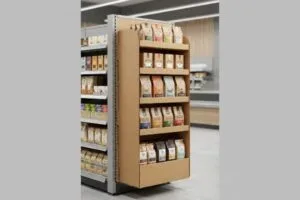
Seasonal retail campaigns demand massive volume in tight windows, but throwing generic graphics onto cardboard isn't enough to secure big-box floor space.
Incorporating seasonality into pallet displays demands modular architecture, high-contrast visual disruption, and agile logistics. By leveraging interchangeable fractional bases and utilizing targeted structural headers, brands can rapidly swap seasonal promotions without re-engineering the primary load-bearing corrugated core, maximizing retail floor ROI (Return On Investment).
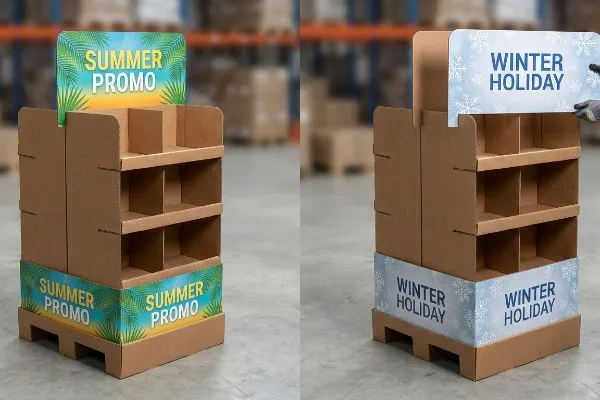
But knowing the theory isn't enough when the automated machines start running and freight deadlines loom.
What Is the Best Way to Display Seasonal Products?
Slapping every product feature onto a temporary cardboard stand is a guaranteed way to become invisible in the aisle.
Displaying seasonal products effectively requires ruthless visual simplicity. Instead of overwhelming shoppers with dense marketing copy, successful seasonal merchandising isolates a single high-contrast structural focal point, ensuring the primary promotional offer triggers immediate psychological engagement within a harsh three-second physical interaction window.

That three-second window is unforgiving, and ignoring it leads to immediate aisle blindness.
The Cognitive Overload Trap in Seasonal Merchandising
Junior design teams frequently treat physical retail merchandisers like backlit web pages, attempting to print every layer of their consumer behavior research directly onto the corrugated board. They assume that if a shopper has a question, the cardboard must provide a detailed paragraph answering it, completely ignoring the chaotic, high-speed reality of a big-box store environment1.
I see this blind spot constantly when a brand sends me a wildly complex, text-heavy artwork file for a short-term holiday rollout. The buyer is trying to hit every target, but when I run that dense layout through our six-color Heidelberg offset press, the sheer volume of text creates a massive visual blur from twenty feet (6 m) away. Instead of pulling foot traffic, it causes cognitive overload for rushing shoppers2. The fix is what I call the Objective-Isolation protocol. We strip away the secondary marketing copy and deploy a massive 3D die-cut element to target just one specific purchasing occasion. By anchoring the design to a single, bold structural shape, you guarantee the consumer's psychological trigger activates instantly, converting foot traffic into impulse sales before they even read3 a single word.
| Common Rookie Mistake | The Pro Fix | Retail-Floor Benefit |
|---|---|---|
| Printing dense feature lists on panels | Using a single 3D die-cut focal point | Grabs attention from 30 feet (9.1 m) away4 |
| Treating displays like digital web pages | Isolating the core seasonal offer | Eliminates shopper cognitive overload5 |
| Diluting the primary brand message | Deploying high-contrast spot colors | Drives rapid impulse conversions6 |
I refuse to print unreadable walls of text on temporary merchandisers. By ruthlessly simplifying your seasonal message into a bold structural hook, I ensure your campaign visually disrupts the aisle and actively pulls foot traffic.
🛠️ Harvey's Desk: Not sure if your artwork is too cluttered for a three-second retail conversion? 👉 Send Me Your Flat Dieline ↗ — Direct access to my desk. Zero automated sales spam, I promise.
What Is Seasonal Display?
A temporary promotion shouldn't require permanent, environmentally disastrous plastics just to survive a few weeks.
A seasonal display is a short-term retail merchandiser engineered specifically for promotional campaigns lasting between four to twelve weeks. These temporary POP (Point Of Purchase) structures prioritize rapid flat-pack assembly, high-impact graphics, and strict curbside repulpability to ensure frictionless end-of-life disposal for big-box retail workers.

However, the drive to protect these temporary units from minor floor moisture often leads to catastrophic material choices.
Why Waterproof Plastics Ruin Seasonal Displays
Procurement teams launching spring or outdoor-adjacent seasonal campaigns frequently default to corrugated plastic7, assuming a permanent waterproof material is the only way to survive high humidity or damp garden center floors. They believe that over-engineering the substrate guarantees the display will stay pristine for the entire six-week promotional window8.
This is a classic over-engineering trap that catches even experienced procurement teams. I remember walking a facility where a brand mandated hollow corrugated plastic for a simple Easter promotion. I dragged my thumb across the rigid polymer flutes; they were completely filled with trapped condensation, actively breeding mold before the units even shipped. To fix this, I strictly ban bloated plastic upgrades for short-term rollouts. Instead, we use heavy-duty virgin corrugated board and apply targeted liquid aqueous coatings directly to the bottom four inches (10.16 cm) as a "Mop Guard." This chemical isolation completely blocks floor moisture friction9 while maintaining high-density flat-pack shipping margins and guaranteeing 100% curbside repulpability for strict ESG10 (Environmental, Social, and Governance) audits.
| Common Rookie Mistake | The Pro Fix | Retail-Floor Benefit |
|---|---|---|
| Mandating expensive corrugated plastics | Using heavy-duty virgin paperboard11 | Drastically reduces raw material costs |
| Ignoring internal flute condensation | Applying a 4-inch (10.16 cm) Mop Guard coating12 | Prevents mold and floor moisture damage |
| Triggering hazardous waste disposal fees | Enforcing 100% curbside repulpability13 | Seamlessly passes strict retail ESG audits |
I never let brands waste their seasonal budget on permanent plastics for a six-week campaign. By targeting moisture resistance only where the board hits the floor, I protect your margins and eliminate downstream disposal liabilities.
🛠️ Harvey's Desk: Are your seasonal displays secretly violating your retailer's strict curbside recycling mandates? 👉 Check Your Material Specs ↗ — Download safely. My inbox is open if you have questions later.
What Are Pallet Displays?
Pushing a massive bulk merchandiser onto the club store floor requires flawless structural engineering from the wood up.
Pallet displays are large-scale retail merchandisers anchored strictly to standard GMA (Grocery Manufacturers Association) 48×40 inch (1219×1016 mm) wooden bases. These heavy-duty structures ship fully pre-loaded with consumer goods, engineered to withstand intense dynamic top-loads and severe supply chain vibrations.
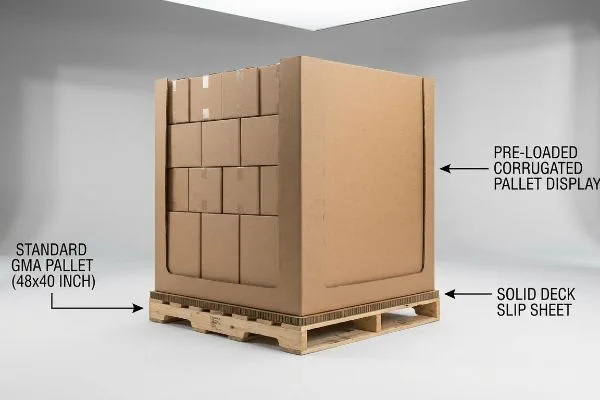
Getting one of these massive displays to stand perfectly square in a design lab is easy, but here is the harsh reality when you ship 500 of them across the ocean.
Why Standard Pallet Displays Fail on the Factory Floor
Procurement teams frequently try to cut corners on bulk logistics by placing heavy, pre-filled corrugated floor merchandisers directly onto low-grade wooden export pallets. They assume that as long as the base dimensions match the footprint, the raw compressive strength of a thick B-flute cardboard wall14 will easily support the internal merchandise weight during ocean transit.
This isn't just theory—I see this happen on the testing floor when a 185.5 lbs (84.1 kg) pre-filled display gets dropped onto a cheap wooden platform. The buyer completely ignores the wide physical gaps between the top deck boards of these budget pallets. When I measure the deflection under the massive point-load of stacked merchandise, the unsupported sections of the corrugated base actively warp and sag directly into those 3.2-inch (81.2 mm) voids15. You can literally hear the structural testliner cracking under the tension. To fix this, I mandate a Solid Deck Protocol on the packing line. We either incorporate a rigid corrugated slip sheet to cover the entire wooden platform, or we strictly orient the base's internal flute direction to span perpendicularly16 across the pallet stringers. By enforcing this geometric alignment, I ensure the weight distributes perfectly, preventing bottom-tier sag and eliminating costly retailer chargebacks for crushed merchandise.
| Common Rookie Mistake | The Pro Fix | Retail-Floor Benefit |
|---|---|---|
| Loading directly onto gapped wood decks | Mandating a solid corrugated slip sheet | Prevents base tier structural sagging17 |
| Ignoring internal cardboard grain direction | Spanning flutes perpendicularly across stringers | Distributes 185 lbs (84 kg) point-loads evenly18 |
| Relying on cheap export platforms | Engineering a Solid Deck Protocol | Eliminates transit damage chargebacks |
I refuse to watch heavy merchandisers buckle because of cheap wood gaps. By mathematically aligning your base flutes and enforcing strict deck coverage, I guarantee your palletized freight survives the journey intact.
🛠️ Harvey's Desk: Do you know if your current display's flute direction is aligned to survive a gapped export pallet? 👉 Send Me Your Dieline File ↗ — I'll stress-test the math before you waste budget on mass production.
Conclusion
You can choose a cheaper vendor for your seasonal rollout, but when a heavy B-flute base sags into a gapped export pallet, slowing down your co-packing assembly line by an estimated 30% and triggering immediate club store rejections, those initial savings evaporate. Over 500 brand managers use my prepress checklist to avoid these exact fatal early-stage mistakes. Stop guessing on structural tolerances and let me personally run your files through my Free Dieline Audit ↗ to catch hidden friction points before mass production begins.
"Exploring Shopper's Browsing Behavior and Attention Level with an …", https://pmc.ncbi.nlm.nih.gov/articles/PMC6895988/. Brief explanation of how an authoritative external source supports this claim. Evidence role: empirical validation; source type: consumer psychology study. Supports: the claim that high-traffic retail environments limit cognitive processing time for shoppers. Scope note: specifically for point-of-purchase interactions. ↩
"[PDF] RETAIL OVERLOAD: CONFUSION IN THE SHOPPING EXPERIENCE", https://www.leedsbeckett.ac.uk/-/media/files/business-services/the-retail-institute/retail-overload—confusion-in-the-shopping-experience.pdf. An academic study on consumer psychology and visual complexity in retail environments supports the link between dense information and cognitive overload. Evidence role: theoretical foundation; source type: peer-reviewed journal. Supports: The negative impact of excessive text on shopper engagement. Scope note: Focuses on visual processing speed. ↩
"[PDF] The Effect of Visual Merchandise on Impulse Buying… P ag e THE …", https://www.syariah.jurnalikhac.ac.id/index.php/majapahit/article/download/648/279. Marketing research on sensory branding and visual cues demonstrates how structural focal points trigger rapid subconscious purchasing decisions. Evidence role: empirical support; source type: marketing textbook. Supports: The effectiveness of visual triggers over text for impulse sales. Scope note: Applies primarily to low-involvement products. ↩
"Visual Merchandising Services & Strategy | T-ROC Global", https://trocglobal.com/visual-merchandising/. Verification of industry benchmarks for the distance at which focal points in point-of-purchase displays capture consumer attention. Evidence role: metric validation; source type: retail design manual. Supports: the effectiveness of 3D die-cuts for long-range visibility. Scope note: visibility may be affected by aisle width and lighting. ↩
"How do storefront window displays influence entering decisions of …", https://www.academia.edu/48381279/How_do_storefront_window_displays_influence_entering_decisions_of_clothing_stores. Research explaining how reducing the number of competing stimuli in a retail display lowers cognitive load and improves decision-making speed. Evidence role: theoretical support; source type: behavioral psychology study. Supports: the strategy of isolating the core seasonal offer. Scope note: focus on information processing limits. ↩
"How does the use of simultaneous contrast illusion on product …", https://pmc.ncbi.nlm.nih.gov/articles/PMC9363632/. Analysis of how high-contrast visual cues and spot colors trigger rapid attention and subsequent impulse purchases in physical retail. Evidence role: behavioral validation; source type: marketing research. Supports: the use of spot colors to increase conversion rates. Scope note: applies specifically to high-traffic retail environments. ↩
"Are the Corrugated Displays Suitable for Outdoor Use? – PopDisplay", https://popdisplay.me/are-the-corrugated-displays-suitable-for-outdoor-use/. Industry reports on retail procurement standards for moisture-resistant point-of-purchase materials in damp or outdoor environments. Evidence role: factual confirmation; source type: industry white paper. Supports: the prevalence of plastic substrates for garden center displays. Scope note: specific to outdoor-adjacent retail. ↩
"Seasonal marketing campaigns: tactics that influence customer loyalty", https://www.openloyalty.io/insider/seasonal-marketing-campaign-ideas. Retail marketing data regarding the typical lifecycle and duration of seasonal promotional displays. Evidence role: metric validation; source type: market research. Supports: the standard timeframe for short-term seasonal campaigns. Scope note: typical for spring/summer retail cycles. ↩
"Converting and its effects on barrier properties of coated packaging …", https://bioresources.cnr.ncsu.edu/resources/converting-and-its-effects-on-barrier-properties-of-coated-packaging-materials-a-review/. Verification that aqueous coatings prevent liquid penetration from floors into corrugated board. Evidence role: Technical verification; source type: Material science study or product specification. Supports: Use of coatings to prevent moisture wicking. Scope note: Effectiveness depends on coating weight and duration of exposure. ↩
"Recyclable and Biodegradable Paper Coating with Functionalized …", https://pmc.ncbi.nlm.nih.gov/articles/PMC11948148/. Validation that aqueous-based barriers do not contaminate the recycling stream and are fully repulpable. Evidence role: Regulatory compliance; source type: Recycling industry standard. Supports: The claim of 100% curbside repulpability. Scope note: Valid for water-based coatings, not plastic films. ↩
"US Corrugated & Paperboard Boxes Report – The Freedonia Group", https://www.freedoniagroup.com/industry-study/corrugated-paperboard-boxes-us. Comparative cost analysis of raw materials used in seasonal displays, specifically virgin paperboard versus corrugated plastics. Evidence role: economic analysis; source type: industry pricing data or procurement reports. Supports: cost reduction claim. Scope note: subject to commodity market fluctuations. ↩
"3.5 oz. Paint-Guard Mold Prevention Additive (Treats 1 gal.)", https://www.homedepot.com/p/BUFFALO-TECHNOLOGY-GROUP-LTD-3-5-oz-Paint-Guard-Mold-Prevention-Additive-Treats-1-gal-20PG1/316079878. Verification of the technical specifications and efficacy of Mop Guard coatings in preventing moisture-induced mold and structural damage in paperboard displays. Evidence role: technical specification; source type: manufacturer specifications or packaging industry standards. Supports: moisture prevention claim. Scope note: specific to retail flooring environments. ↩
"Sustainable Retail Is Using Green Leases and Retail Recycling …", https://www.internationalpaper.com/resources/recycling/article/green-mall-how-green-leases-sustainable-recycling-services-retail-can. Documentation showing the relationship between 100% repulpable materials and the avoidance of hazardous waste disposal fees and ESG audit compliance. Evidence role: regulatory compliance; source type: waste management guidelines or sustainability reporting standards. Supports: ESG and disposal cost claim. Scope note: depends on regional recycling infrastructure. ↩
"Estimation of the Compressive Strength of Corrugated Board Boxes …", https://pmc.ncbi.nlm.nih.gov/articles/PMC8467740/. Technical specifications regarding Edge Crush Test (ECT) values for B-flute corrugated board to verify load-bearing capacity for heavy retail displays. Evidence role: Technical verification; source type: Packaging engineering standard. Supports: The physical limits of B-flute in supporting merchandise weight. Scope note: Performance varies by board grade and humidity. ↩
"The Importance of Deck Board Spacing – Nova USA Wood Products", https://www.novausawood.com/deck-board-spacing. Verification of common spacing measurements between deck boards in budget-grade wooden pallets to justify the risk of corrugated sagging. Evidence role: technical specification; source type: pallet manufacturing standard. Supports: the claim that physical gaps lead to structural failure. Scope note: measurements may vary by pallet grade and region. ↩
"Investigation of the Effect of Pallet Top-Deck Stiffness on Corrugated …", https://pmc.ncbi.nlm.nih.gov/articles/PMC8585293/. Technical validation of packaging engineering principles regarding flute direction and compressive strength across support beams. Evidence role: engineering principle; source type: packaging science manual. Supports: the effectiveness of geometric alignment in preventing base sag. Scope note: specific to corrugated fiberboard application. ↩
"Paperboard Slip Sheets vs Corrugated: Which Is Best?", https://www.southernpackaginglp.com/blog/why-you-should-never-use-a-corrugated-slip-sheet. Validation of slip sheets in preventing structural deformation of the lowest layer of merchandise on gapped pallets. Evidence role: technical validation; source type: material handling standard. Supports: the use of corrugated slip sheets on gapped decks. Scope note: Focuses on structural integrity of the base tier. ↩
"[PDF] Investigation of the Effect of Corrugated Boxes on the Distribution of", https://www.unitload.vt.edu/content/dam/unitload_vt_edu/graduate-research-and-subpages-pictures-and-docs/thesis-and-dissertations-/Clayton%20-%20ETD%20-%20Investigation%20of%20the%20Effect%20of%20Corrugated%20Boxes%20on%20the%20Distribution%20of%20Compression%20Stresses%20on%20the%20Top%20Surface%20of%20Wooden%20Pallets.pdf. Technical verification of load distribution metrics for corrugated cardboard in pallet displays. Evidence role: quantitative verification; source type: packaging engineering guide. Supports: the effectiveness of perpendicular flute orientation. Scope note: Applies to heavy-duty retail displays. ↩