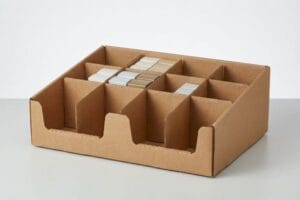
You want an eco-friendly rollout, but slapping a green leaf logo on unverified cardboard is a massive risk. Retailers are actively rejecting campaigns that fail strict environmental audits.
A sustainable retail display requires mono-material structures, liquid aqueous coatings, and certified corrugated board. By eliminating mixed plastics like PLA (Polylactic Acid) and heavy hot-foil stamping, brands guarantee completely frictionless curbside recyclability while seamlessly passing the most stringent big-box vendor compliance audits and environmental reviews.

Making sure your packaging survives the aisle while meeting real environmental metrics takes more than good intentions.
What are the 5 C's of sustainability?
Throwing around eco-friendly buzzwords won't protect your logistics flow when a procurement manager asks for hard proof.
The 5 C's of sustainability—Compliance, Circularity, Carbon, Conservation, and Culture—are fundamental frameworks guiding eco-friendly manufacturing. In retail packaging, prioritizing verifiable material compliance ensures brands avoid severe greenwashing penalties and maintain seamless global supply chain operations without triggering devastating mass-market audit rejections.
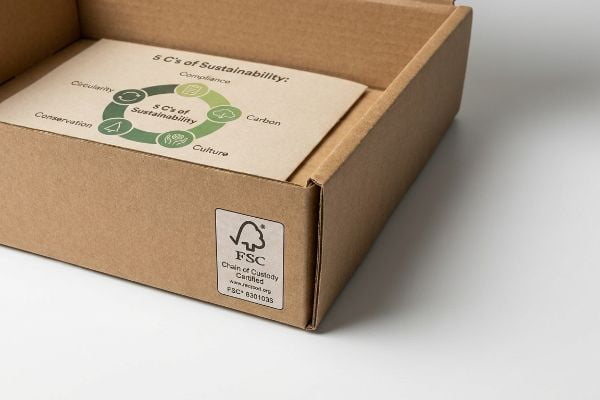
Understanding these pillars is one thing, but proving them on paper is where most brand managers get stuck.
Why FSC-Certified Fails Without Chain of Custody
Even experienced procurement teams assume that simply asking a supplier for eco-friendly cardboard automatically guarantees compliance with big-box sustainability mandates1. They draft their purchase orders, pay a premium for the green claim, and expect a smooth receiving process at the retailer's distribution center.
I know you are staring at this vendor paperwork feeling lost, because 80% of my new clients think a single logo on a PDF solves the compliance puzzle. Here is a quick rule of thumb: if you cannot trace the paper back to the exact mill, you do not have a sustainable display. Last quarter, I watched a brand manager sweat through a retailer audit because their factory mixed FSC (Forest Stewardship Council) certified boards with untraceable, low-grade paperboard on the production floor. The loud, heavy thud of the auditor stamping "Rejected" on the clipboard was a brutal wake-up call. I completely eliminate this trap by enforcing a strict Chain of Custody tracking system2 that segregates raw materials physically in the facility, saving clients from catastrophic chargebacks.
| Common Rookie Mistake | The Pro Fix | Retail-Floor Benefit |
|---|---|---|
| Mixing board grades on the floor | Strict physical material segregation3 | Prevents audit rejection |
| Relying on verbal supplier claims | Centralized digital sourcing logs | Guarantees compliance proof |
| Ignoring the paper mill origin | Unbroken supply chain traceability4 | Eliminates greenwashing fines |
I refuse to let unverified materials touch my production line. Enforcing an unbroken paper trail protects your brand reputation and completely removes the friction of passing aggressive big-box environmental checks.
🛠️ Harvey's Desk: Are your current cardboard suppliers providing unbroken origin documentation? 👉 Get A Material Audit ↗ — Direct access to my desk. Zero automated sales spam, I promise.
What are the 5 R's of sustainable practices?
Knowing the core principles is just the baseline for real eco-packaging.
The 5 R's of sustainable practices are Refuse, Reduce, Reuse, Repurpose, and Recycle. For packaging engineers, strictly reducing unnecessary structural material and ensuring complete curbside recycling without chemical contamination represent the absolute most critical steps to passing rigid environmental vendor mandates and securing premium placement.
While "Recycle" is universally understood, the chemical reality of how materials break down often causes massive retail headaches.
The Polylactic Acid Composting Trap
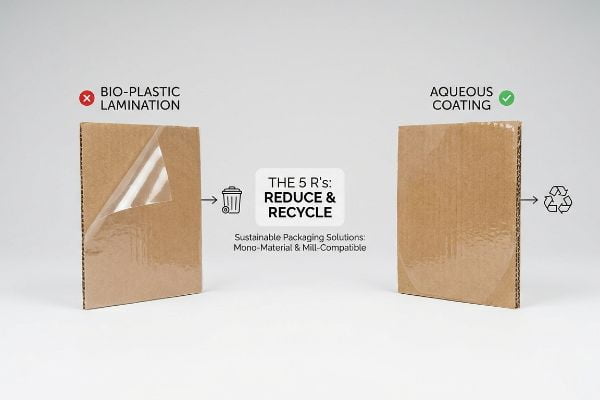
Many designers mandate bio-plastic laminations for their displays, assuming this corn-based film guarantees complete eco-compliance. They believe that because the material is derived from plants, it will seamlessly integrate into standard municipal recycling programs alongside standard paper5.
I see this mistake all the time when buyers want a glossy finish but still want to claim it is green. The problem is that these bio-plastics form a solid physical film that aggressively repels water6 during standard OCC (Old Corrugated Containers) repulping processes. I once had a client who tried to peel this stubborn, sticky bio-film off a display base just to see if it would separate, and the tearing sound of the raw paper fibers ripping apart proved it was permanently fused. Standard recycling centers intercept this plastic-like film during sorting and divert the entire structure straight to a landfill. I fix this by strictly applying liquid aqueous coatings instead, which act as a water-based polymer matrix that dissolves seamlessly in mill vats7, ensuring you do not pay extra just to end up in the trash.
| Common Rookie Mistake | The Pro Fix | Retail-Floor Benefit |
|---|---|---|
| Using solid bio-plastics | Liquid aqueous coatings8 | Guarantees curbside recycling |
| Ignoring repulping chemistry | Formulating for mill vats9 | Prevents landfill diversion |
| Adding heavy glossy films | Water-based protective finishes | Maintains premium look sustainably |
I swap out rigid bio-plastics for aqueous alternatives every single week. This simple chemical pivot keeps your campaign 100% mono-material and entirely frictionless for standard municipal sorting facilities.
🛠️ Harvey's Desk: Are you accidentally fusing non-recyclable plastics to your sustainable displays? 👉 Claim A Coating Review ↗ — Download safely. My inbox is open if you have questions later.
What are 5 ways to be sustainable?
Implementing green tactics does not mean sacrificing premium visual impact.
Five ways to be sustainable include utilizing mono-material structures, applying water-based varnishes, optimizing pallet configurations for lower shipping emissions, using soy-based inks, and substituting heavy hot foil stamping with eco-friendly alternatives to guarantee seamless curbside recycling without sacrificing premium visual impact on the store floor.
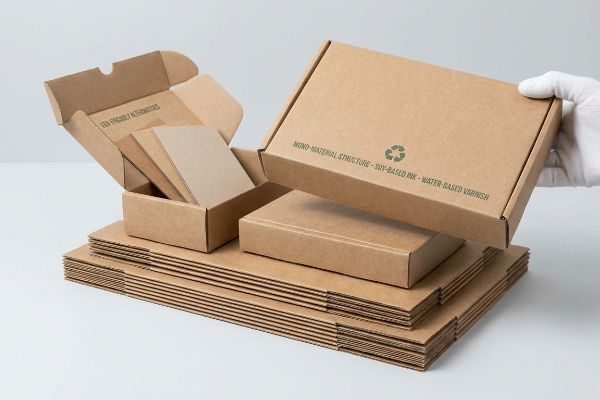
The desire to stand out visually often pushes brands into dangerous material choices that ruin their environmental goals.
The Mixed-Material Foil Trap
Marketing teams love to request heavy 3D foil stamping to make their logos pop under harsh store lighting. They assume that since the base structure is made of recyclable paper, adding a thin layer of premium metallic foil10 will not impact the overall environmental footprint.
Think of this like throwing a metal wrench into a paper shredder; the two simply do not belong together. A great rule of thumb is to never permanently bond metals to raw paper if you want to pass an eco-audit. I recall a startup spending their entire budget on massive hot-stamped gold logos, only to realize the heavy metallic film rendered the entire batch completely non-recyclable11. The stiff, unnatural resistance of that thick foil bonded to the board was a dead giveaway that it would fail repulping. I immediately pivot my clients to metallic soy inks or high-solid gloss aqueous coatings12, delivering that luxury, high-contrast reflection without destroying the structure's sustainable integrity or triggering rejection from eco-conscious buyers.
| Common Rookie Mistake | The Pro Fix | Retail-Floor Benefit |
|---|---|---|
| Heavy hot foil stamping | Metallic soy-based inks13 | Eliminates mixed-material waste |
| Bonding metal to paper | High-solid gloss coatings | Maintains 100% recyclability14 |
| Ignoring repulping limits | Utilizing mono-material finishes | Lowers overall unit cost15 |
I always push for smart material substitution over brute-force decoration. Dropping the foil for metallic inks protects your margins and secures your spot in eco-compliant retail programs.
🛠️ Harvey's Desk: Wondering if your premium finishes are secretly ruining your recyclability? 👉 Request An Ink Evaluation ↗ — No forms that trigger endless sales calls. Just pure value.
What makes a good retail display?
Aesthetic choices mean nothing if the physical structure fails before it reaches the aisle.
A good retail display perfectly balances high-impact visual disruption with uncompromising structural integrity. It requires mathematically engineered load distribution, precise caliper compensation for folded corners, and strict adherence to specific virgin board grades to survive extreme double-stacked warehouse environments without buckling under heavy top-loads.

Getting one display to stand up in a climate-controlled lab is easy, but here is the harsh reality when you ship 500 of them across the country.
The Cosmetic Downgrade Trap
Procurement teams frequently treat expensive cosmetic finishes as non-negotiable marketing mandates, leading them to secretly downgrade the base corrugated board's ECT (Edge Crush Test) rating16 to save pennies per unit. They assume that a visually premium box built on a weaker core will still function identically to a standard industrial shipper17.
This isn't just theory—I see this happen on the testing floor when beautiful campaigns completely buckle under their own weight. In my facility, I routinely see buyers strip critical fiber density from the core fluting just to afford an oversized eco-friendly graphic wrap. The reality crashes down during the BCT (Box Compression Test); when I measure the vertical load capacity, a mere 6-point drop in the ECT rating creates a catastrophic 18.4% loss in stacking strength18, easily dropping 150 lbs (68 kg) of load capacity. The rigid, unforgiving crush of the hydraulic press flattening those weakened flutes is hard to watch. I pulled the micrometer readings and proved to a client that we didn't need to downgrade the paper; I just stripped out the bloated cosmetic laminations and restored the material to a virgin 32ECT standard19. By enforcing this structural baseline and relying on efficient spot-color floods instead, I ensure the transit damage rate drops to near zero, saving brands countless hours of manual dock labor and entirely preventing immediate retailer chargebacks.
| Common Rookie Mistake | The Pro Fix | Retail-Floor Benefit |
|---|---|---|
| Downgrading base materials | Enforcing a virgin 32ECT standard20 | Prevents base tier crushing |
| Sacrificing strength for foil | Utilizing efficient spot colors | Reduces transit damages |
| Ignoring BCT load limits21 | Restoring core flute density22 | Eliminates retailer chargebacks |
I never compromise on the core structural math to fund a cosmetic layer. Rebuilding that vertical corner strength guarantees your product survives the brutal supply chain and arrives ready to sell.
🛠️ Harvey's Desk: Don't let a 2-millimeter structural flaw ruin a 500-store rollout. 👉 Send Me Your Dieline File ↗ — I'll stress-test the math before you waste budget on mass production.
Conclusion
Downgrading your board to fund greenwashing marketing might sound clever, but when that weakened base completely crushes under a double-stacked pallet, slowing down the receiving dock by an estimated 30%, your entire campaign becomes a liability. Over 500 brand managers use my prepress checklist to avoid these exact fatal early-stage mistakes. Stop guessing on structural load limits and let me personally run your files through my Free Dieline Audit ↗ to catch these material failures before mass production begins.
"Retailer Packaging and Sustainability Guidelines for EPR Compliance", https://www.ecoenclose.com/blog/retailer-packaging-and-sustainability-guidelines-for-epr-compliance?srsltid=AfmBOork8MWTzBDjqKHlobBcCQDr-Dh03M5uQ5J3J65wl6RuIkLWk05v. [Industry reports or corporate procurement guides from major retailers detailing stringent certification and audit requirements for sustainable packaging support this claim]. Evidence role: validation; source type: corporate policy/industry standard. Supports: the rigor of sustainability audits in retail. Scope note: mandates vary by retailer and region. ↩
"[PDF] Group Chain of Custody (CoC) FSC Certification Manual", https://cfwc.mgcafe.uky.edu/sites/cfwc.ca.uky.edu/files/cfwc_coc_group_certification_manual_revised_2_16_2018_0.pdf. [Official Forest Stewardship Council (FSC) standards define the Chain of Custody (CoC) as the path of custody of products from forests to consumer, requiring strict physical or accounting segregation to maintain certification validity]. Evidence role: Technical standard verification; source type: Certification body guidelines. Supports: The requirement for material segregation to avoid audit failure. Scope note: Specifically applies to FSC-certified materials]. ↩
"[PDF] Chain of Custody Certification – Forest Stewardship Council", https://fsc.org/sites/default/files/2019-08/FSC-STD-40-004%20V3-0%20EN%20Chain%20of%20Custody%20Certification.pdf. [Official chain of custody standards specify that physical segregation is required to prevent the mixing of certified and non-certified materials]. Evidence role: technical requirement; source type: certification standard. Supports: audit success. Scope note: Specific to CoC certification models. ↩
"CMA 10% Greenwashing Fines & Retail Liability 2026", https://www.verticalvendors.com/cma-greenwashing-fines-2026-supply-chain-risk. [Regulatory bodies like the FTC or EU Commission mandate documented traceability to validate environmental claims and avoid deceptive marketing penalties]. Evidence role: legal requirement; source type: government regulation. Supports: avoidance of fines. Scope note: Subject to local consumer protection laws. ↩
"Eunomia finds bioplastic shortcomings – Recycling Today", https://www.recyclingtoday.com/news/pla-plastic-bioresin-eunomia-pcc-report-recycling-composting-sustainability/. [An authoritative waste management guide or material science study would verify if corn-based bio-plastics act as contaminants in paper recycling streams]. Evidence role: factual verification; source type: industry standard. Supports: the technical feasibility of co-recycling PLA with paper. Scope note: focuses on municipal curbside processing capabilities. ↩
"Water Repellent Coating in Textile, Paper and Bioplastic Polymers", https://pmc.ncbi.nlm.nih.gov/articles/PMC11479018/. [Technical literature on paper recycling would confirm the hydrophobic nature of bio-plastic coatings and their impact on the repulping of Old Corrugated Containers]. Evidence role: technical verification; source type: peer-reviewed material science journal. Supports: the claim that bio-plastics hinder standard recycling. Scope note: specifically applies to film-forming bio-plastics used as coatings. ↩
"Additives and Ingredients | Opportunities in Papermaking Wet-end …", https://hubbepaperchem.cnr.ncsu.edu/additives-and-ingredients/. [Industry standards for recyclable packaging would verify that water-based aqueous coatings break down without leaving residues in mill pulpers]. Evidence role: technical verification; source type: packaging industry technical specification. Supports: the claim that aqueous coatings are a viable recyclable alternative. Scope note: refers to water-based polymer matrices. ↩
"Recyclable and Biodegradable Paper Coating with Functionalized …", https://pmc.ncbi.nlm.nih.gov/articles/PMC11948148/. Technical specifications from packaging standards confirm that aqueous coatings are repulpable and widely accepted in curbside recycling streams unlike many bio-plastics. Evidence role: technical validation; source type: industry standard. Supports: recyclability of coatings. Scope note: Subject to regional municipality facility capabilities. ↩
"[PDF] SPC Guide: How to Know if Your Paper Packaging is Recyclable", https://sustainablepackaging.org/wp-content/uploads/2023/01/SPC_Paper-Pkg-Report_FINAL.pdf. Industrial engineering documentation describes the necessity of formulating adhesives and coatings to dissolve in mill vats during the repulping process to ensure fiber recovery. Evidence role: process verification; source type: technical manual. Supports: landfill diversion through recycling. Scope note: Applicable primarily to fiber-based packaging. ↩
"Is the use of foil a sustainable choice for Print and Packaging?", https://mymediahead.com/is-the-use-of-foil-a-sustainable-choice-for-print-and-packaging/. [Authoritative packaging guidelines explain that metallic foils often consist of composite plastic and metal layers that cannot be separated during standard paper pulping processes. Evidence role: Technical verification; source type: Waste management standard. Supports: The claim that foil stamping creates a recycling obstacle. Scope note: Specific to traditional hot foil stamping.] ↩
"Study Confirms the Recyclability and Repulpability of Foil-Decorated …", https://www.packagingimpressions.com/article/study-confirms-recyclability-repulpability-foil-decorated-paper-400910/all/. [Technical guidelines from recycling authorities confirm that non-separable metallic films contaminate paper streams and fail the repulping process]. Evidence role: factual verification; source type: industry standard. Supports: the claim that foil prevents recycling. Scope note: applies specifically to non-biodegradable metallic foils. ↩
"Sustainability Impact Considerations: Paperboard Coatings – Zenpack", https://www.zenpack.us/blog/paperboard-coatings-sustainability-impact/. [Environmental certifications and technical data sheets from ink manufacturers demonstrate that soy-based and aqueous coatings are compatible with standard paper recycling streams]. Evidence role: technical validation; source type: manufacturer specification. Supports: the sustainability of proposed alternatives. Scope note: efficacy depends on specific chemical formulations. ↩
"Eco-Friendly Inks for Packaging: Types, Benefits, Trends", https://meyers.com/meyers-blog/eco-friendly-inks-for-packaging-types-benefits-trends/. [Authoritative industry guides on sustainable printing demonstrate that soy-based metallic inks avoid the non-biodegradable plastic and metal layers associated with traditional hot foil stamping]. Evidence role: Technical verification; source type: Sustainable printing manual. Supports: The claim that substituting foil with soy inks eliminates mixed-material waste. Scope note: Effectiveness depends on specific ink formulation and substrate compatibility.] ↩
"Review on metal packaging: materials, forms, food applications …", https://pmc.ncbi.nlm.nih.gov/articles/PMC7270472/. [Technical standards for paper recycling indicate that high-solid gloss coatings are more readily removed during repulping than bonded metallic foils, which often contaminate the stream]. Evidence role: Environmental impact verification; source type: Recycling standard. Supports: The claim that high-solid coatings preserve the recyclability of paper packaging. Scope note: Recyclability is contingent on the specific chemistry of the coating.] ↩
"Mono-material packaging manufacturers face costly …", https://www.packagingtechtoday.com/materials/flexible/mono-material-packaging-manufacturers-face-costly-challenges-from-unmanaged-static-warns-meech/. [Manufacturing analysis shows that utilizing mono-material finishes reduces supply chain complexity and minimizes the number of production steps, thereby lowering the per-unit cost]. Evidence role: Economic validation; source type: Industrial manufacturing report. Supports: The claim that mono-material finishes provide a cost benefit. Scope note: Cost savings may vary based on production scale and material sourcing.] ↩
"Corrugated Boxes – Edge Crush Test (ECT) | TheBoxery.com", https://www.theboxery.com/ect.asp?srsltid=AfmBOorSEoM7DQi8Y7aQM5WbrRaqvh17YRFZzyAY_h2w-_Ou84ted1rm. [A technical packaging standard explains how the Edge Crush Test (ECT) measures the load-bearing capacity of corrugated board when under vertical compression]. Evidence role: technical definition; source type: industry standard. Supports: the technical basis for determining structural integrity. Scope note: Specifically measures vertical compression strength. ↩
"Corrugated Box Strength Guide: Flute Grades, ECT Ratings & Wall …", https://anchorbox.com/corrugated-box-strength/. [Engineering data demonstrates that reducing the ECT rating decreases the maximum load a box can support before buckling compared to industrial-grade shippers]. Evidence role: performance verification; source type: technical study. Supports: the claim that downgrading core strength compromises functionality. Scope note: Actual performance varies based on board grade and humidity. ↩
"[PDF] Relationship between the ECT-strength of corrugated board and the …", https://repository.up.ac.za/server/api/core/bitstreams/6f377e8a-42a7-4ffe-991b-0671f2d64b90/content. [A packaging engineering handbook or material science study would provide the mathematical relationship between Edge Crush Test (ECT) values and the resulting vertical load capacity of corrugated board]. Evidence role: Technical verification; source type: Engineering manual. Supports: The quantification of structural failure caused by reducing fiber density. Scope note: Actual percentage may vary slightly based on flute profile. ↩
"ECT Ratings Explained: What They Mean for Your Corrugated …", https://epackagesupply.com/blogs/packaging-guide/ect-ratings-explained-what-they-mean-for-your-corrugated-packaging?srsltid=AfmBOoqgKQOYvrlUUDRRQA84pr2pRG7BDbaTgleGKqUjVJREInrPxOkK. [Industry standards for corrugated packaging would verify 32ECT as a baseline specification for load-bearing retail displays intended for warehouse stacking]. Evidence role: Specification validation; source type: Industry standard. Supports: The claim that a specific material grade is required for structural integrity. Scope note: Suitability depends on the specific dimensions of the display. ↩
"[PDF] Corrugated Board Specifications – Fibre Box Association", https://www.fibrebox.org/assets/2025/09/Walmart_Corrugated-Board_Specifications_Automation_Packaging_Standards.pdf. [An industrial standard for corrugated packaging that specifies the minimum crushing strength (Edge Crush Test) required to maintain structural integrity under load]. Evidence role: technical specification; source type: industry standard. Supports: the requirement for high-strength base materials to prevent crushing. Scope note: Specifically refers to the Edge Crush Test metric for corrugated board. ↩
"Box Compression Test: Standards, Methods & Calibration", https://www.worldoftest.com/articles/box-compression-test-standards-methods-calibration/. [The Box Compression Test (BCT) provides a standardized measurement of the maximum vertical pressure a shipping container or display can withstand before collapsing]. Evidence role: metric verification; source type: engineering manual. Supports: the importance of testing load limits to avoid structural failure and retailer penalties. Scope note: Focuses on vertical compression strength. ↩
"Estimation of the Compressive Strength of Corrugated Board Boxes …", https://pmc.ncbi.nlm.nih.gov/articles/PMC8467740/. [Flute density, referring to the number of arches per linear inch in corrugated board, directly correlates to the material's stiffness and load-bearing capacity]. Evidence role: technical principle; source type: material science documentation. Supports: the claim that restoring flute density eliminates structural failure. Scope note: Performance varies depending on the specific flute profile used (e.g., B-flute vs C-flute). ↩