
Planning a Q4 holiday rollout requires more than festive graphics. Getting a retail campaign onto the big-box floor demands strict structural engineering and logistical foresight before production even begins.
A 2026 Christmas cardboard display is a highly engineered, temporary retail merchandising fixture constructed primarily from corrugated paperboard. Designed for seasonal promotions, these structures optimize product visibility, integrate sustainable materials, and withstand heavy holiday foot traffic across global retail environments to drive impulse purchases.

Understanding the baseline definition is just the start. Let's break down how these holiday structures actually perform when the pallets hit the retail floor.
What are the best Christmas light displays?
Integrating illumination into your holiday merchandiser creates massive visual disruption, but it introduces immediate supply chain compliance risks if not handled correctly.
The best Christmas light displays utilize integrated LED (Light Emitting Diode) modules powered by compliant pull-tab button cell batteries. These units embed lighting directly into the corrugated structure, enhancing seasonal aesthetics without requiring external retail power sources, ensuring safe transit and immediate functional impact on the shop floor.
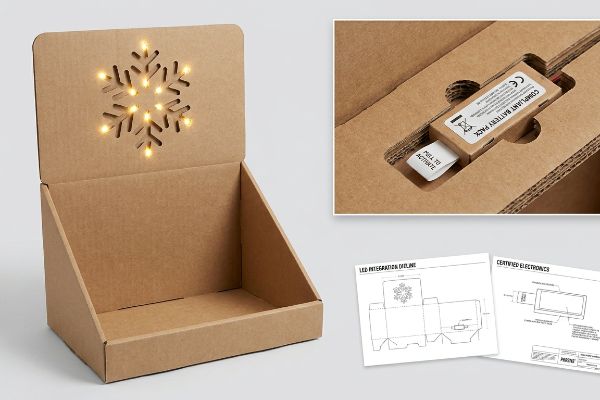
A blinking header looks great in your design software, but powering it brings real-world headaches.
Why Electronic Add-Ons Ruin Christmas Light Displays
Adding twinkling lights to a seasonal end-cap is a proven strategy to grab shopper attention during the crowded Q4 rush. Many marketing teams simply source cheap, generic battery light strings and ask their display manufacturer to tape them behind a die-cut header. This ad-hoc approach treats electronics like basic paper components, completely ignoring the strict safety regulations big-box retailers enforce.
I see this trap every November. A brand will design a beautiful, lit-up winter scene, but they fail to account for the battery chemistry. The lithium button cell batteries shipped inside those cheap lighting modules are classified as hazardous materials1. Once, a client tried to sneak non-compliant batteries through freight, and the sharp click of the customs agent's scanner halting the container meant a massive delay. The entire shipment was flagged because they lacked proper MSDS (Material Safety Data Sheet) documentation2 and a physical pull-tab activation switch. Instead of rushing to buy random light packs, you must source certified hardware modules with pre-installed pull-tabs. This guarantees the lights won't accidentally drain during a turbulent ocean transit, preventing you from receiving hundreds of dead, useless displays that require costly manual battery replacements.
| Common Rookie Mistake | The Pro Fix | Retail-Floor Benefit |
|---|---|---|
| Using uncertified lithium batteries | Source MSDS-compliant pull-tab hardware | Prevents freight rejection delays |
| Taping loose wires to corrugated | Custom die-cut locking channels | Stops wires snagging on products |
| Assuming stores provide power | Self-contained 30-day battery packs | Allows placement anywhere in-aisle |
I refuse to let an entire Q4 pallet get impounded over a fifty-cent battery pack. Lock down your electronic documentation early so your holiday rollout clears customs smoothly and shines on schedule.
🛠️ Harvey's Desk: Are your display's electronic components fully compliant with international freight regulations? 👉 Get Your Compliance Checked ↗ — Direct access to my desk. Zero automated sales spam, I promise.
What is a cardboard display called?
Knowing the exact terminology is strictly required when communicating with your factory, as mixing up basic acronyms can lead to disastrous structural and legal compliance failures.
A cardboard display is called a POP (Point of Purchase) display when resting on the floor, or a POS (Point of Sale) display when placed on a checkout counter. These industry terms dictate exact physical constraints, load limits, and retail compliance standards for specific store zones.
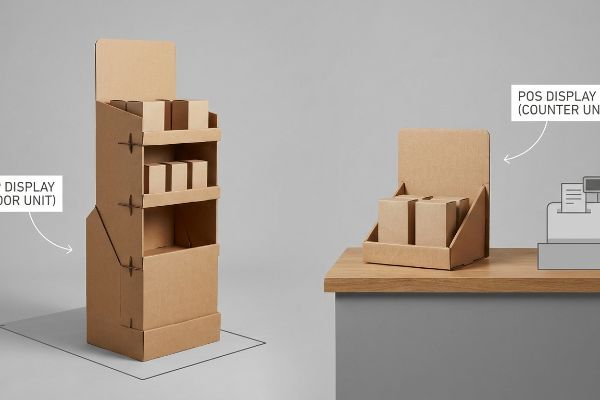
Mislabeling your fixture in an email might seem harmless, but it drastically alters how we engineer the board's internal geometry.
Defining POP vs. POS for Your Cardboard Display
Buyers often use terms like "merchandiser," "bin," and "stand" interchangeably. While these generic words are fine for internal marketing meetings, they cause massive confusion during structural engineering. A factory needs to know exactly where this unit will live in the store, because location dictates the legal footprint and weight limits3.
Even veteran designers often overlook this blind spot, assuming a large floor display can simply be scaled down by 50 percent to serve as a counter unit. I had a client insist on "shrinking" a heavy floor stand to fit near a register. I remember the rigid resistance of the heavy testliner board as we tried to fold tiny locking tabs that weren't meant for micro-scaling. They didn't realize that counter units are strictly governed by ADA (Americans with Disabilities Act) forward reach limits of 15 to 48 inches (381 to 1219 mm). We had to permanently separate the engineering pipelines: anchoring floor files to the GMA (Grocery Manufacturers Association) pallet limit and counter files to exact spatial compliance windows. If you just shrink a floor file, you'll trigger an immediate retailer rejection from store managers who cannot legally place non-compliant units near their registers.
| Common Rookie Mistake | The Pro Fix | Retail-Floor Benefit |
|---|---|---|
| Shrinking a floor dieline | Custom compliant counter engineering | Avoids legal retailer rejection4 |
| Ignoring store zone rules | Mapping files to exact placement | Ensures seamless store approval5 |
| Using generic terminology | Specify Floor or Counter formats | Eliminates factory miscommunication6 |
I always demand absolute clarity on store placement before we cut a single prototype. Get the terminology right, and you protect your brand from costly mid-production redesigns.
🛠️ Harvey's Desk: Confused about whether your current design meets strict counter reach regulations? 👉 Request A Dieline Audit ↗ — Download safely. My inbox is open if you have questions later.
What's hot for Christmas decorations this year?
Shoppers expect a premium, tactile experience during the holidays, pushing brands to move beyond flat graphics and integrate physical textures into their structural packaging.
What's hot for Christmas decorations this year includes premium tactile debossing and interactive structural geometries. Brands are prioritizing inward compression techniques over traditional outward embossing to create luxurious, 3D holiday textures on corrugated boards without compromising the strict edge crush test strength during heavy palletization.

Adding high-end textures like a three-dimensional snowflake pattern makes your merchandising pop, but applying it incorrectly destroys the cardboard's integrity.
The Inward Deboss Protocol for Christmas Decorations
Graphic designers love to specify heavy foil embossing on premium holiday packaging, treating the corrugated board exactly like a flat commercial business card. They want the logos and festive graphics to physically bulge outward to catch the harsh retail lighting.
It's a common trap that catches even experienced procurement teams. They ask for an outward emboss on a load-bearing product tray. I've watched these dies operate on the line—when the metal aggressively stretches the top paper liner outward to create a raised peak, I can actually hear the paper fibers thinning and snapping. Under a heavy load of holiday gift sets, those weakened micro-fractures buckle. To fix this, I tell clients to flip the tooling to a deboss. By driving the metal die downward, we compress the internal flutes into a solid block without exhausting the outer liner's elasticity. You still get that gorgeous, premium tactile feel, but the board maintains its strict structural compression strength for safe transit.
| Common Rookie Mistake | The Pro Fix | Retail-Floor Benefit |
|---|---|---|
| Outward embossing on load walls | Flip tooling to inward deboss | Preserves box compression strength7 |
| Treating corrugated like flat paper | Engineer specific fiber stretch limits8 | Stops paper from tearing |
| Sacrificing strength for aesthetics | Combine deboss with spot UV coatings9 | Maximizes visual disruption safely |
I love delivering a luxury aesthetic, but I will never compromise the physical structure to get it. Use smart tooling techniques to make your holiday campaign both beautiful and bulletproof.
🛠️ Harvey's Desk: Want to add tactile finishes without risking a catastrophic pallet collapse? 👉 Claim Your Structural Review ↗ — No forms that trigger endless sales calls. Just pure value.
Where are the best Christmas displays?
Securing prime real estate in a big-box store during the most competitive season requires mathematical precision, not just a massive, space-hogging footprint.
The best Christmas displays are located at high-traffic store intersections, end-caps, and action alleys. To secure these premium locations, manufacturers engineer fractional pallet geometries, such as half or quarter pallets, allowing retailers to maximize floor density while seamlessly integrating multiple holiday campaigns into shared spaces.
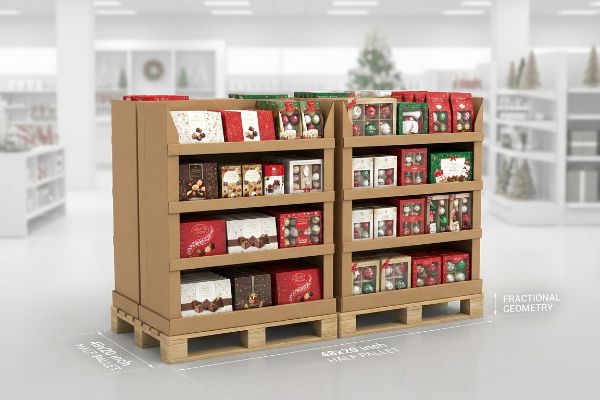
But knowing the theory of high-traffic placement isn't enough when the machines start running and space is rationed.
Why Massive Christmas Displays Fail on the Factory Floor
Brands often pitch full-size 48×40 inch (1219×1016 mm) floor displays10 to major big-box retailers, assuming a flagship holiday campaign must monopolize an entire wood base. They design overarching structures in CAD (Computer-Aided Design), expecting store managers to gladly clear wide aisles for their merchandise.
Getting one unit to stand up in a lab is easy, but here is the harsh reality when you ship 500 of them. In my facility, I routinely see clients shocked when their full-pallet design is outright rejected by buyers. I test this using strict fractional base geometries. When I map a client's bloated 48-inch (1219 mm) layout, I realize they are wasting prime real estate. I pulled the micrometer readings and proved we didn't need a massive footprint—I just needed a tighter, vertical product stack on a Half Pallet of exactly 48×20 inches (1219×508 mm). By mathematical subdivision, I ensure two distinct promotional campaigns can perfectly share a single pallet. This adjustment allows retail buyers to maximize their floor density, smoothing out logistics and entirely preventing spatial rejections at the receiving dock.
| Common Rookie Mistake | The Pro Fix | Retail-Floor Benefit |
|---|---|---|
| Forcing a full 48×40 inch footprint11 | Engineer fractional pallet dimensions | Dramatically increases approval odds |
| Ignoring retailer floor constraints | Subdivide into Quarter Pallets12 | Secures high-traffic intersection spots |
| Wasting internal vertical space | Optimize the vertical stacking capacity | Fits more units per square foot |
I don't build massive fixtures just to stroke a brand's ego; I build what stores actually want to place. Give the retailer spatial efficiency, and your product will always win the aisle.
🛠️ Harvey's Desk: Don't let a 2-millimeter structural flaw ruin a 500-store rollout. 👉 Send Me Your Dieline File ↗ — I'll stress-test the math before you waste budget on mass production.
Conclusion
You can choose a cheaper vendor for your holiday push, but when an aggressive outward emboss weakens the corrugated fibers and causes a massive tier collapse, you'll face severe retailer chargebacks and an estimated 40% drop in seasonal sales velocity. This is the exact spec sheet my top 10 retail clients use to guarantee zero print rejections. Stop guessing on fiber limits and let me personally run your artwork through my Free Dieline Audit ↗ to catch fatal structural errors before mass production begins.
"[PDF] Lithium Battery Guide for Shippers – PHMSA", https://www.phmsa.dot.gov/sites/phmsa.dot.gov/files/2024-11/Lithium-Battery-Guide-2024.pdf. [International aviation and transport regulations classify lithium-based batteries as dangerous goods due to thermal runaway risks]. Evidence role: regulatory classification; source type: international standard. Supports: hazardous material status. Scope note: specifically refers to lithium button cells. ↩
"Transporting Lithium Batteries – PHMSA", https://www.phmsa.dot.gov/lithiumbatteries. [Material Safety Data Sheets (MSDS) are legally mandated for the shipment of hazardous materials to provide critical safety and handling information]. Evidence role: regulatory requirement; source type: compliance standard. Supports: shipping documentation necessity. Scope note: requirement varies slightly by region but is generally global. ↩
"AG 1091A: Retail Merchandise Displays in the Frontage Zone", https://www.seattle.gov/transportation/permits-and-services/permits/applicant-guides/ag-1091a. [An industry standard or retail safety manual would specify how store zone placement determines maximum allowable floor load and accessibility clearance requirements]. Evidence role: technical specification; source type: retail compliance standards. Supports: the claim that terminology affects structural engineering. Scope note: applies to commercial retail space regulations. ↩
"Retail Chargeback Compliance: EDI, ASN & Routing Causes", https://getproductiv.com/retail-chargeback-compliance. [An authoritative retail compliance guide would detail how failing to adhere to strict dimensional specifications leads to shipment rejection or financial chargebacks]. Evidence role: verification; source type: retail compliance manual; Supports: the risk of rejection for non-compliant dielines. Scope note: Applies primarily to large-scale retail chains with strict vendor guides. ↩
"Point-of-Purchase (POP) Display: How They Work & Their Retail …", https://www.optisigns.com/post/point-of-purchase-pop-display-how-they-work-their-retail-impact. [Industry merchandising standards explain the necessity of mapping displays to specific permitted store zones to obtain manager approval for placement]. Evidence role: verification; source type: retail merchandising guide; Supports: the requirement for store zone mapping. Scope note: Specific to brick-and-mortar retail environments. ↩
"7 Retail Display Styles Companies Rely On", https://www.packagingcorp.com/resource-hub/industry-insights/7-retail-display-styles-companies-rely-on/. [Manufacturing best practices emphasize the use of specific technical terms to prevent critical errors in structural engineering and material selection during production]. Evidence role: verification; source type: manufacturing standard operating procedure; Supports: the impact of precise terminology on production accuracy. Scope note: Focuses on the technical communication between brands and factories. ↩
"Embossing vs Debossing: Know the Difference and Which Is Better?", https://www.wecustomboxes.com/blog/embossing-vs-debossing/. [An authoritative source on packaging engineering would explain how inward debossing maintains the structural integrity of load-bearing walls compared to outward embossing which can compromise the flute]. Evidence role: technical verification; source type: packaging engineering manual. Supports: benefit of inward debossing over embossing. Scope note: applies specifically to load-bearing structural cardboard. ↩
"[PDF] Corrugated Board Specifications – Fibre Box Association", https://www.fibrebox.org/assets/2025/09/Walmart_Corrugated-Board_Specifications_Automation_Packaging_Standards.pdf. [Technical documentation on corrugated materials would detail the maximum elongation limits of paper fibers before structural failure or tearing occurs during deformation]. Evidence role: material science validation; source type: industrial paper standards. Supports: prevention of tearing in embossed packaging. Scope note: results may vary based on paper grade and flute type. ↩
"Debossing in Packaging: Benefits, Uses, and Challenges", https://packhit.com/packaging/finishes/debossing/. [Industry guides on packaging finishes would explain how spot UV coatings can reinforce debossed areas while enhancing visual contrast and tactile appeal]. Evidence role: technical application; source type: printing and finishing guide. Supports: maximizing visual disruption safely. Scope note: focuses on the interplay between physical deformation and chemical coatings. ↩
"GMA American Pallet. Dimensions, types and much more.", https://acrosslogistics.com/blog/en/american-pallet-gma. [Industry standards for the Grocery Manufacturers Association (GMA) pallet confirm 48×40 inches as the standard footprint for North American logistics and retail floor displays]. Evidence role: factual specification; source type: industry standard. Supports: standard display sizing. Scope note: Primarily applicable to North American retail markets. ↩
"Standard Pallet Sizes | With Chart – Kamps Pallets", https://www.kampspallets.com/standard-pallet-sizes-with-chart/. [Industry standards for the Grocery Manufacturers Association (GMA) pallet confirm the 48×40 inch dimension as the primary retail logistics standard in North America]. Evidence role: fact-check; source type: industry standard. Supports: standard pallet dimensions. Scope note: primarily North American market. ↩
"Club Store Displays: endcaps, pallets & more for bulk merchandise", https://www.qpack.com/retail-displays/pallet/club-store. [Retail floor planning documentation supports the use of smaller pallet fractions to secure placement in high-traffic intersection zones where full-sized pallets are restricted]. Evidence role: technical validation; source type: retail operations manual. Supports: space optimization strategy. Scope note: effectiveness varies by retailer floor plan. ↩